
Course
Introduction to Python for Developers
3 hr
177.7K
Dependency injection is a design pattern where objects or services (we mean dependencies here) are provided to a class from the outside, instead of the class creating them internally. This decouples components.
Using dependency injection in Python has many benefits, such as:
In this tutorial, I will demonstrate how to use dependency injection in Python through simple, practical examples.
Dependency injection is a design pattern where a class receives its dependencies from outside instead of creating them itself. It makes your code more modular.
You can inject dependencies through the constructor, a setter method, or directly into a method, and Python supports this manually or through frameworks like dependency-injector, injector, and punq.
Popular web frameworks handle it differently: FastAPI has built-in support via Depends(). Flask and Django need a library like dependency-injector.
To understand how to implement dependency injection, it's essential that you grasp the key principles that govern it.
Dependency injection is based on something called the principle of Inversion of Control (IoC), which means that instead of a class creating and managing its dependencies, it receives them from an external source. This helps to focus on a single task and makes your code clean.
Injecting dependencies in Python includes these common way,s although there are others:
As a developer, understanding and implementing dependency injection can make a lot of difference in your code design. Let’s look at some benefits of dependency injection.
Dependency injection enables you to break down your code into smaller, more focused components, allowing for greater flexibility and modularity.
Each part or component handles a specific task and relies on external dependencies, making it easier to reuse in different parts of your or someone else’s application
For example, if you have a class that sends messages. Instead of building an email or SMS logic directly into your service, you can inject an email or sms sender class.
Now, your class that sends messages does not care how the message is sent, but just uses the sender provided to it. This implies that you can use your messaging sender with different email or sms senders.
When using dependency injection, you can easily replace real dependencies with mock data during testing. This makes it simpler to write unit tests without relying on APIs or databases.
Suppose, as a thinking exercise, that you have a class that saves data to a database. For testing purposes, you can inject a mock database instead of a real one to avoid coupling your test to the production database.
Dependency injection enables you to modify specific parts of your code without breaking the entire system. This is particularly handy in situations where you need to switch payment providers in an application, such as from Stripe to PayPal, without modifying the rest of your code.
The idea of of inversion of control is this: dependency injection will shift the responsibility of creating and managing dependencies to an external source.
This implies that you can easily swap one implementation for another; for example, if you have a ReportGenerator class that formats and exports reports.
Instead of the class deciding on the format to export, you could inject an exporter class, such as PDFExporter, ExcelExporter, or CSVExporter, into it.
The ReportGenerator class does not care how the export happens, so to change a format, you just swap the exporter you inject, without modifying the ReportGenerator at all.
Now that you have a clear glimpse of what dependency injection is and why it’s useful, let’s look at how you can implement it in Python. Let’s start with the simplest method: manual dependency injection.
In manual dependency injection, you create dependencies yourself and pass them into the class or function that needs them.
This method works well for small applications, but as your application scales, you need to use a dependency injection framework to avoid errors.
Here is an example of code without dependency injection
class EmailService:
    def send_email(self, message):
        print(f"Sending email: {message}")


class UserNotifier:
    def __init__(self):
        self.email_service = EmailService()  # Creates its own dependency

    def notify(self, message):
        self.email_service.send_email(message)


notifier = UserNotifier()
notifier.notify("Welcome!")
In the above example, UserNotifier is tightly coupled to EmailService. You can’t easily swap or mock EmailService for testing.
Here is another version, but with manual dependency injection.
class EmailService:
    def send_email(self, message):
        print(f"Sending email: {message}")


class UserNotifier:
    def __init__(self, email_service):
        self.email_service = email_service  # Dependency is injected

    def notify(self, message):
        self.email_service.send_email(message)


email_service = EmailService()
notifier = UserNotifier(email_service)
notifier.notify("Welcome!")
The version above is flexible and allows you to inject various messaging services; you can also replace EmailService with a mock in tests.
As your application grows, it becomes complex and messy to manage dependencies.
The dependency-injector framework provides a structured approach.
The dependency-injector framework works based on a container-provider architecture.
from dependency_injector import containers, providers


# Services
class EmailService:
    def send_email(self, message):
        print(f"Sending email: {message}")


class UserNotifier:
    def __init__(self, email_service):
        self.email_service = email_service

    def notify(self, message):
        self.email_service.send_email(message)


# Container
class Container(containers.DeclarativeContainer):
    email_service = providers.Singleton(EmailService)
    user_notifier = providers.Factory(UserNotifier, email_service=email_service)


# Usage
container = Container()
notifier = container.user_notifier()
notifier.notify("Hello!")
In the example above:
Container defines how instances are created
Singleton ensures only one instance of EmailService exists
Factory creates a new UserNotifier with the EmailService injected automatically.
You can use decorators like @inject to reduce the need for manual dependency passing.
Here is another version of the previous example:
from dependency_injector import containers, providers


# Define services
class EmailService:
    def send_email(self, message):
        print(f"Sending email: {message}")


class UserNotifier:

    def __init__(self, email_service: EmailService):
        self.email_service = email_service

    def notify(self, message):
        self.email_service.send_email(message)


# Create container
class Container(containers.DeclarativeContainer):
    email_service = providers.Singleton(EmailService)
    user_notifier = providers.Factory(UserNotifier, email_service=email_service)


from dependency_injector.wiring import inject, Provide


@inject
def main(notifier: UserNotifier = Provide[Container.user_notifier]):
    notifier.notify("Hello!")


if __name__ == "__main__":
    container = Container()
    container.wire(modules=[__name__])  # This wires the current module
    main()
In the current version;
Without manually adding the dependency, the @inject decorator automatically injects the function or class dependency.
The Provide class tells the dependency-injector which dependency to inject.
This approach eliminates the need for manual wiring dependencies from the container.
It’s helpful in larger applications where services may depend on multiple components (hence this need to initialize them automatically).
Most modern Python frameworks make it easy to work with dependency injection, allowing you to write cleaner and more testable code.
In this section, you will learn how dependency injection is applied in Flask, Django, and FastAPI.
Flask does not have built-in support for dependency injection, but you can implement it using the dependency-injector library through these following steps.
class GreetingService:
    def get_greeting(self, name):
return f"Hello, {name}!"from dependency_injector import containers, providers
class Container(containers.DeclarativeContainer):
greeting_service = providers.Factory(GreetingService)from flask import Flask, request
from dependency_injector.wiring import inject, Provide
container = Container()
app = Flask(__name__)
@app.route("/greet")
@inject
def greet(greeting_service: GreetingService = Provide[Container.greeting_service]):
name = request.args.get("name", "World")
return greeting_service.get_greeting(name)
container.wire(modules=[__name__])
if __name__ == "__main__":
app.run(debug=True)From the code above:
The function, name = request.args.get(“name”, “World”) extracts the name from the query string, and defaults to ”World” if not provided.
return greeting_service.get_greeting(name) calls the method on the injected service and returns a greeting message.
container.wire(modules=[__name__]) tells the dependency injector to scan this module for @inject decorators and Provide[...] markers to connect them to the actual providers.
Run the application on your terminal using the command python <name_of_file>.py, and visit the URL http://localhost:5000/greet?name=Jacob.
You should see the following.

Just like Flask, Django does not offer built-in dependency injection. But, you can use its class-based views, middleware, and app structure to integrate Dependency injection manually or using the dependency-injector library.
Here is a step-by-step procedure for implementing dependency injection in Django.
Create a simple service containing your business logic in a new file services.py under your app folder.
# myapp/services.py
class GreetingService:
    def get_greeting(self, name):
return f"Hello, {name}!"Inside your application directory, create a container using the dependency-injector library inside a new file containers.py.
# myapp/containers.py
from dependency_injector import containers, providers
from .services import GreetingService

class Container(containers.DeclarativeContainer):
greeting_service = providers.Factory(GreetingService)Use the @inject decorator in your view to receive dependencies in views.py.
# myapp/views.py
from django.http import HttpResponse
from dependency_injector.wiring import inject, Provide
from .containers import Container
from .services import GreetingService

@inject
def greet_view(
    request, greeting_service: GreetingService = Provide[Container.greeting_service]
):
    name = request.GET.get("name", "World")
    message = greeting_service.get_greeting(name)
return HttpResponse(message)Under your project folder, go to the urls.py file and hook your dependency injector into Django’s URL routing system.
from django.contrib import admin
from django.urls import path
from myapp.views import greet_view

urlpatterns = [
    path("admin/", admin.site.urls),
    path("greet/", greet_view),
]Go to apps.py and wire the container to the application.
 # myapp/apps.py
from django.apps import AppConfig
from .containers import Container

class MyAppConfig(AppConfig):
    default_auto_field = "django.db.models.BigAutoField"
    name = "myapp"

    def ready(self):
        container = Container()
        container.wire(modules=["myapp.views"])
Then go to your app config in INSTALLED_APPS and add your application.
# settings.py
INSTALLED_APPS = [
    'myapp.apps.MyAppConfig',
    ...
]Start your Django server and access the view through the URL http://localhost:8000/greet/?name=Django.
You should see the following.

FastAPI has built-in support for dependency injection through the special marker Depends() that injects whatever a function returns.
Here is a step-by-step guide on how to go about FastAPI dependency injection.
class GreetingService:
    def get_greeting(self, name: str) -> str:
return f"Hello, {name}!"def get_greeting_service():
return GreetingService()app = FastAPI()
@app.get("/greet")
def greet(
name: str = "World", service: GreetingService = Depends(get_greeting_service)
):
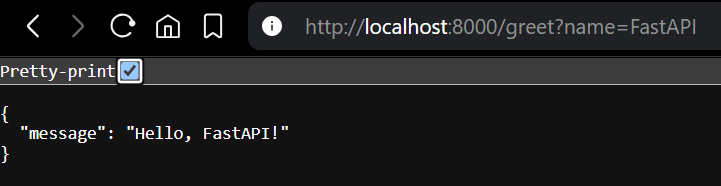
return {"message": service.get_greeting(name)}Start your server using the command uvicorn main:app –reload and visit the URL http://localhost:8000/greet?name=FastAPI. You should see the following response.
There are various Python Dependency frameworks, each with its own strengths, syntax, and use cases. Choosing the proper framework depends on the size and structure of your project.
Here is a comparison of some common Python dependency injection frameworks.
As your application code base becomes large, dependency injection becomes challenging to maintain.
You can use advanced dependency injection to handle tasks such as request-scoped resources, cleanup, and separation of concerns.
Scoped dependencies enable you to control how long a dependency persists, for example, when you want a new object per request, a shared object across the app's lifetime, or automatic cleanup of resources such as database connections.
Most dependency injector frameworks support scopes like:
The following is an example of scoped dependencies with nested containers using dependency-injector.
from dependency_injector import containers, providers, resources

# A simple resource that needs setup and cleanup
class MyResource:
    def __enter__(self):
        print("Setting up the resource")
        return self

    def __exit__(self, exc_type, exc_val, exc_tb):
        print("Cleaning up the resource")

# Create a container to manage the resource
class MyContainer(containers.DeclarativeContainer):
    resource = providers.Resource(MyResource)

# Using the resource with a context manager
container = MyContainer()

with container.resource() as r:
    print("Using the resource")
In the example above, MyResource mimics a class that requires setup and teardown, such as opening/closing a file or database.
The container provides the resource using providers.Resource, and when you use with container.resource(), it enters and exits the context correctly.
This pattern ensures that resources, such as file handles, database connections, or network sessions, are managed cleanly.
Imagine an API endpoint that needs a database session for the current request or a logger with request-specific context.
With scoped dependencies, the framework creates a request-scoped container when the request begins resolving all dependencies from that scope.
When the request ends, any necessary cleanup, such as closing database sessions, occurs automatically. This ensures that states are not shared across requests and avoids resource leaks.
To handle I/O bound tasks efficiently, you need asynchronous execution. Dependency injection systems in frameworks like FastAPI and dependency-injector, offer asynchronous injection using async/await.
Asynchronous injection refers to injecting dependencies that are async def functions or managing async resources like async database connections, external APIs, or background tasks.
Rather than resolving them synchronously, the dependency injection system waits for them to be resolved before injecting.
The following is an example of an async dependency in FastAPI:
from fastapi import FastAPI, Depends

app = FastAPI()

# Async dependency
async def get_user():
    # Simulate async I/O
    await some_async_db_query()
    return {"name": "Philip Jones"}

@app.get("/profile")
async def read_profile(user: dict = Depends(get_user)):
    return {"user": user}
FastAPI automatically handles the async resolution of get_user and injects the result.
dependency-injector also supports async lifecycle management using AsyncResource providers.
from dependency_injector import containers, providers, resources

class AsyncDB:
    async def connect(self):
        print("Connected")
        return self

    async def disconnect(self):
        print("Disconnected")

class AsyncDBResource(resources.AsyncResource):
    async def init(self) -> AsyncDB:
        db = AsyncDB()
        return await db.connect()

    async def shutdown(self, db: AsyncDB):
        await db.disconnect()

class Container(containers.DeclarativeContainer):
    db = providers.Resource(AsyncDBResource)

# Usage
async def main():
    container = Container()
    await container.init_resources()

    db = await container.db()  # Get the AsyncDB instance

    # Use db here...

    await container.shutdown_resources()
In the code above:
resources.AsyncResource is used for async setup/teardown logic.
await container.init_resources() initializes all resources and calls init.
await container.shutdown_resources() cleans up all resources.
await container.db() gets the actual resources instance, which is AsyncDB.
Using async dependency injection helps keep your application performant by avoiding synchronous I/O in asynchronous routes, and eliminates the need to manually await dependencies in your logic.
While dependency injection improves modularity and testability, it can introduce potential security risks if not managed carefully.
One significant risk is dependency confusion, where malicious packages mimic legitimate ones. For example, attackers have uploaded packages to PyPI with names used in internal enterprise systems to trick apps into using the malicious version.
To stay secure, ensure that you never inject untrusted or user-controlled components and validate configuration sources, such as environment variables, before they are injected.
Use requirements.txt or poetry.lock files to lock exact versions, and automate security scanning on dependency changes. Additionally, ensure that you regularly audit your dependencies for vulnerabilities.
Centralizing control of your dependencies is also essential, as it ensures consistency across your applications and facilitates the application of security patches or version updates more easily. It helps avoid "shadow dependencies" injected in different ways across the codebase.
Several tools can detect risks and improve your security posture:
Dependency injection is not just a theoretical pattern; it is used in various production systems to manage complexity, improve flexibility, and streamline testing.
In modern web applications, dependency injection plays a crucial role in managing standard services, such as authentication, logging, and database access.
Frameworks like FastAPI play an essential role in resolving routes and dependencies.
The example below illustrates a centralized authentication implementation in FastAPI.
from fastapi import Depends, HTTPException

def get_current_user(token: str = Depends(oauth2_scheme)):
    user = verify_token(token)
    if not user:
        raise HTTPException(status_code=401)
    return user

@app.get("/protected")
def protected_route(user: dict = Depends(get_current_user)):
    return {"message": f"Hello {user['name']}"}
In the code above, get_current_user() is injected as a route dependency, but the logic for checking the token is centralized and reusable.
You can also do the same for database access, such that database sessions are automatically managed and cleaned.
Here is an example of how you can use dependency injection to centralize database access.
from sqlalchemy.ext.asyncio import AsyncSession

async def get_db_session() -> AsyncSession:
    async with async_session() as session:
        yield session

@app.get("/items")
async def read_items(db: AsyncSession = Depends(get_db_session)):
    return await db.execute("SELECT * FROM items")
In the code above, the get_db_session is a dependency provider. When the read_items route is called, FastAPI automatically injects the db parameter, allowing the route to access the database without manually managing session setup or teardown.
Dependency injection makes it easy for you to change the dependencies components receive, which is important when testing.
You can replace real services with mocks during testing, making your code more modular and easier to test.
FastAPI and dependency-injector support overriding dependencies at test time.
Here is an example in FastAPI.
from fastapi.testclient import TestClient
from main import app, get_db_session

def override_db():
    return TestDBSession()

app.dependency_overrides[get_db_session] = override_db

client = TestClient(app)
response = client.get("/items")
assert response.status_code == 200
In the code example above, get_db_session is overridden with a mock database during tests; hence, there is no need to patch or alter the production code.
Same also in depedency-injector, you can override your real database with a mock database for testing purposes, like in the example below.
from containers import Container

def test_service_behavior():
    container = Container()
    container.db.override(providers.Factory(TestDB))

    service = container.service()
    assert service.get_data() == "mocked"
The override() method replaces the real dependency with a mock, which is clean, controlled, and reversible.
Here are some strategies you should use for dependency overrides:
FastAPI.dependency_overrides in FastAPI or dependency_injector.override() in dependency-injector.pytest to create reusable mocks and inject them via fixtures.Although dependency injection is intended to make code modular and easy to test, it can lead to bugs or create complexity in the code.
Here are some best practices you should adhere to when creating dependencies:
Here are some common pitfalls you should avoid when using dependency injection.
Dependency injection makes it easy to inject mock objects into your components, thereby simplifying unit tests. This allows you to separate fundamental components from test-specific ones.
With dependency injection, tests are deterministic, have no side effects, and result in faster test execution.
Here is an example showing how you can use dependency Injection to inject mock, stub, or fake versions of those dependencies in your tests.
class EmailService:
    def send_email(self, to: str, message: str): ...

class Notifier:
    def __init__(self, email_service: EmailService):
        self.email_service = email_service

    def alert(self, user_email):
        self.email_service.send_email(user_email, "Alert!")
In tests, replace EmailService with a mock:
class TestEmailService:
    def send_email(self, to, message):
        self.sent_to = to

def test_notifier_sends_email():
    test_email = TestEmailService()
    notifier = Notifier(test_email)

    notifier.alert("test@example.com")
    assert test_email.sent_to == "test@example.com"
Ensure to use dependency injection often and avoid monkey patching for maintainability and avoid breaking changes when internal name changes.
Although you might not need dependency injection initially for small projects, as the project grows and scales, you can benefit from the structure and modularity offered by dependency injection.
Looking ahead, the future of dependency injection in Python is promising, and we can expect it to continue with an improved type system and enhanced async lifecycle management.
Mastering dependency injection is essential for becoming a fluent Python developer. But it doesn’t stop there; many other advanced concepts can elevate your Python skills.
To help you accelerate your learning journey, here are some of our resources you should look at.
Courses:
Blog Posts:
Learn Python with DataCamp
Course
Course
Course
blog
Javier Canales Luna
13 min
Tutorial
Bexruz (Bex) Tuychiev
11 min
Tutorial
Nishant Kumar
8 min
Tutorial
Javier Canales Luna
11 min
Tutorial
Aditya Sharma
14 min
Tutorial
Abid Ali Awan
10 min