
Khóa học
Nhập môn các mô hình Claude
3 giờ
14.9K
GPT-6 Astra là mẫu chủ lực tuyến đầu của OpenAI, kế nhiệm GPT-5.6 Sol, được xây dựng xoay quanh thực thi tác vụ kiểu tác tử hơn là chat. OpenAI định vị nó cho thao tác máy tính, công việc chuyên nghiệp và kỹ nghệ phần mềm, và đây là mô hình OpenAI đầu tiên vượt ngưỡng an ninh mạng “Critical” trong Preparedness Framework của công ty. Nó chạy với cửa sổ ngữ cảnh 1.050.000 token, tối đa đầu ra 128K và mốc kiến thức đến ngày 30 tháng 4 năm 2026.
Hai điểm nổi bật trong thông báo. Trong Codex, Astra lưu ghi chú xuyên suốt các cửa sổ ngữ cảnh thay vì nén thành tóm tắt, nên các cửa sổ trước vẫn có thể tìm kiếm, và nó tự quyết định khi nào cần hỏi làm rõ thay vì luôn đoán hoặc luôn hỏi.
Để xem đầy đủ tính năng, bảng benchmark và cách truy cập, xem hướng dẫn GPT-6 Astra. Cũng đáng đọc kèm phần chúng tôi viết về đời trước của nó trong GPT-5.6 Sol, Terra, và Luna.
Claude Fable 5.1 là mô hình tuyến đầu sẵn sàng chung của Anthropic cho các tác vụ suy luận đòi hỏi cao và công việc tác tử đường dài. Nó có cửa sổ ngữ cảnh 1 triệu token với đầu ra tối đa 128K, tư duy thích ứng luôn bật, và mốc kiến thức đến tháng 6 năm 2026. Tài liệu của Anthropic đánh giá độ trễ của nó chậm hơn Claude Opus 5 và Claude Sonnet 5, cả hai đều có giá thấp hơn.
Claude Mythos 5.1 là cùng mô hình nhưng với cơ chế bảo vệ khác, cung cấp theo thư mời qua Project Glasswing. Thay đổi lớn cho số đông là giá đọc cache, giảm 75% xuống $0,25 mỗi triệu token, trong khi giá niêm yết giữ nguyên.
Hướng dẫn Claude Fable 5.1 của chúng tôi có đầy đủ phân tích benchmark, và hướng dẫn API Claude Fable 5.1 xây dựng một tác tử lập trình nhận biết kho mã, kèm phân rã chi phí thực cho các mức nỗ lực.
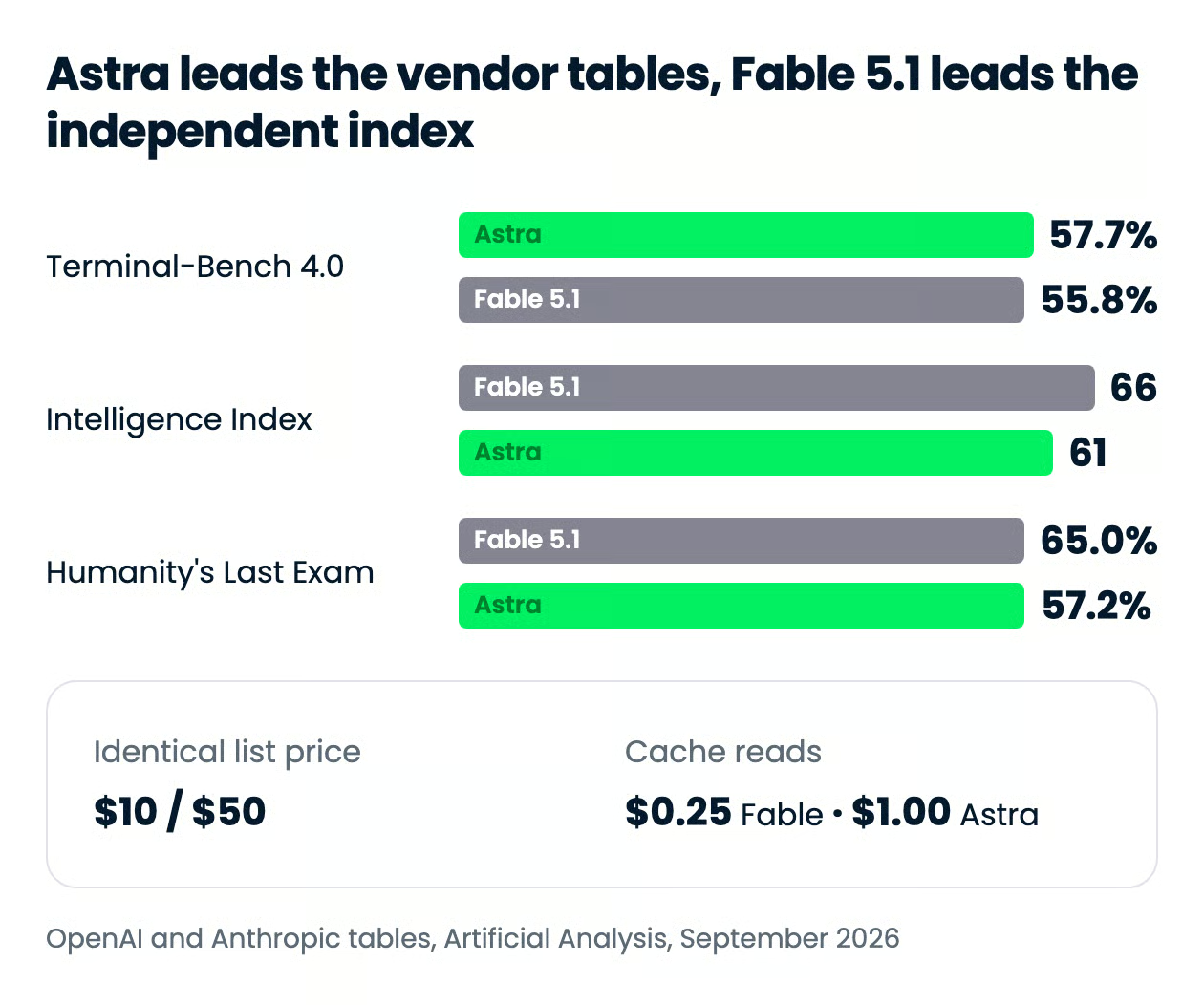
Tóm tắt ngắn: Bảng so sánh của OpenAI cho thấy Astra dẫn Fable 5.1 ở gần như mọi hàng đã công bố, còn Artificial Analysis lại cho kết quả ngược trên cả hai chỉ số của họ. Bạn tin bên nào tùy vào mức độ bạn đặt nặng việc nhà cung cấp tự chấm điểm đối thủ.
| Tính năng | GPT-6 Astra | Claude Fable 5.1 |
|---|---|---|
| Ngày phát hành | 3 tháng 9, 2026 | 1 tháng 9, 2026 |
| ID mô hình API | gpt-6-astra |
claude-fable-5-1 |
| Cửa sổ ngữ cảnh | 1,05 triệu token | 1 triệu token |
| Tối đa đầu ra | 128K token | 128K token |
| Mốc kiến thức | 30 tháng 4, 2026 | Tháng 6, 2026 |
| Giá niêm yết mỗi 1M token | $10 vào / $50 ra | $10 vào / $50 ra |
| Đọc đầu vào đã cache mỗi 1M | $1,00 ($2,00 trên 272K) | $0,25 |
| Giá trên 272K token đầu vào | Gấp đôi đầu vào và cache, 1,5x đầu ra | Không phụ phí |
| FrontierMath Tier 4 (v2) | 97,6% | 87,8% |
| Humanity's Last Exam, có công cụ | 57,2% | 65,0% |
| ScreenSpot-Pro (không công cụ) | 92,7% | 87,3% (Fable 5, từ Mythos) |
| AutomationBench | 41,4% | 31,4% |
| ExploitBench | 100% | 70% |
| AA Intelligence Index (nỗ lực tối đa) | 61 | 66 |
| AA chi phí mỗi tác vụ Intelligence Index (tối đa) | $1,67 | $3,76 |
| Thế mạnh | Thao tác máy tính, toán học, an ninh mạng, chi phí mỗi tác vụ | Chiều sâu suy luận, vòng lặp tác tử thiên về cache |
Astra dẫn trên các benchmark lập trình mà OpenAI công bố, nhưng khoảng cách nhỏ và chỉ số độc lập thì không đồng tình. Trên Terminal-Bench 4.0, kiểm tra kỹ nghệ phần mềm, cấu hình hệ thống và phân tích dữ liệu trong terminal, OpenAI báo 57,7% cho Astra so với 55,8% cho Fable 5.1. Anthropic cũng công bố con số 55,8% đó, nên hàng này ít nhất là không tranh cãi.
Khoảng cách nới rộng ở DeepSWE v1.1, nơi Astra đạt 74,1% so với 67,4%, và gần như khép lại ở FrontierCode 1.1 Main, nơi 53,3% so với 50,9% nằm trong khoảng mà Claude Fable 5 (53,5%) và Claude Opus 5 (53,4%) đã đạt.
| Benchmark | GPT-6 Astra | Claude Fable 5.1 | Ghi chú |
|---|---|---|---|
| Terminal-Bench 4.0 | 57,7% | 55,8% | Bảng của OpenAI ghi 57,7% trong khi chú thích biểu đồ ghi 57,9% |
| DeepSWE v1.1 | 74,1% | 67,4% | OpenAI báo cáo |
| FrontierCode 1.1 Main | 53,3% | 50,9% | Gần như hòa với Fable 5 ở 53,5% và Opus 5 ở 53,4% |
| Di trú cơ sở dữ liệu nội bộ | 63,9% | 57,8% | Đánh giá nội bộ của OpenAI, không có bản lặp bên ngoài |
| CursorBench 3.2.0 | Không công bố | 73,4% | Anthropic báo cáo; SpaceXAI xác nhận 73,4% ở nỗ lực tối đa |
| AA Coding Agent Index | 67 trong Codex | 70 trong Claude Code | Độc lập, nhưng bộ khung khác nhau |
Hàng cuối là điều tôi cứ quay lại. Artificial Analysis chấm Fable 5.1 trong Claude Code đạt 70, cao nhất trên Coding Agent Index của họ, còn Astra trong Codex đạt 67, xấp xỉ Claude Opus 5 và Claude Fable 5. Có hai lưu ý cần thận trọng:
Astra thắng sát nút ở các hàng lập trình đã công bố và thắng rõ rệt về hiệu suất, trong khi Fable 5.1 giữ điểm độc lập cao nhất cho tác tử lập trình, vượt cả hai.
Đây là sự phân hóa rõ nhất, và theo cả hai hướng. Astra thắng các hàng toán và khoa học: 97,6% so với 87,8% trên FrontierMath Tier 4 v2, 96,0% so với 93,7% trên GPQA Diamond, và 64,6% so với 52,6% trên Terminal-Bench Science 0.1, benchmark nghiên cứu tác tử mà Anthropic dựa vào cho buổi ra mắt của họ.
Fable 5.1 thắng Humanity's Last Exam có công cụ, 65,0% so với 57,2%, cách biệt đáng kể. Artificial Analysis cũng ủng hộ chiều đó một cách độc lập, chấm Fable 5.1 ở 66 trên Intelligence Index so với 61 cho Astra, là điểm cao nhất họ từng đo.
Một lưu ý về con số 66. Artificial Analysis chạy Fable 5.1 với fallback phía máy chủ mặc định của Anthropic, định tuyến các yêu cầu bị gắn cờ an toàn sang Claude Opus 4.8 hoặc Claude Opus 5, và fallback chiếm khoảng 4% token đầu ra trên chỉ số. Điểm là của Fable 5.1 theo cách hầu hết người dùng thực sự gọi nó, không phải mô hình thô tách biệt.
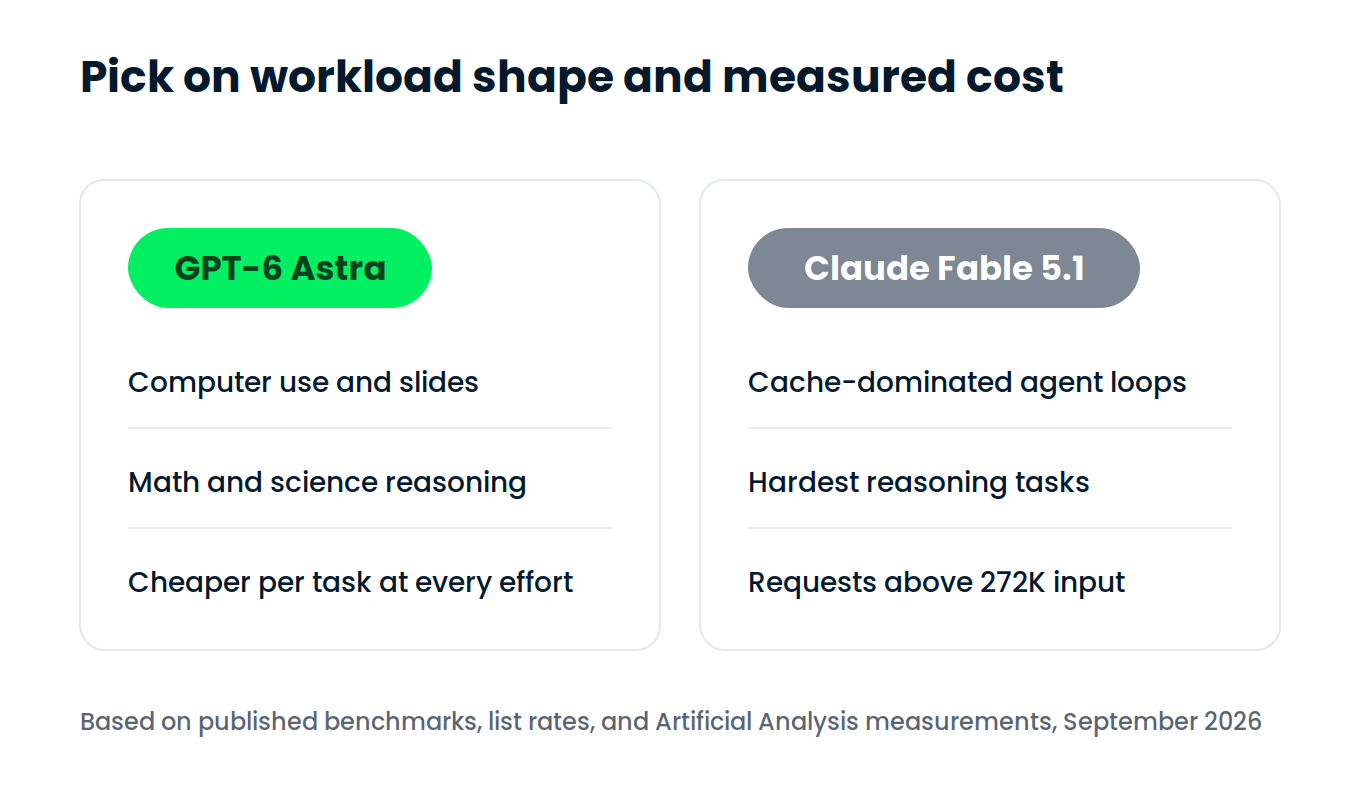
Nếu công việc của bạn là toán hoặc khoa học ở bậc cao học, chọn Astra. Nếu là dạng suy luận rộng và khó như Humanity's Last Exam đo, chọn Fable 5.1.
Astra nắm phần này, chủ yếu vì Anthropic chưa công bố số liệu so sánh tương ứng. OpenAI báo 72,6% cho Astra trên bộ offline của OSWorld 2.0 so với 70,2% của Claude Opus 5, và 92,7% trên ScreenSpot-Pro so với 87,3% của Claude Fable 5. Các con số của chính Anthropic cho Fable 5.1, 77,9% “partial” và 41,7% “strict”, đến từ bản phát hành tác vụ và cách chấm khác.
Các con số về tạo artifact ít mơ hồ hơn: 95,9% trên BenchCAD so với 84,3%, và 41,4% so với 31,4% trên AutomationBench.
Với các tác tử nhấp qua phần mềm thực và tạo slide hoặc đầu ra CAD, Astra là lựa chọn mạnh hơn.
Các con số về căn chỉnh của Astra là phần ít được bàn nhất trong lần ra mắt. Trên benchmark an toàn thao tác máy tính nội bộ của OpenAI, nơi thấp hơn là tốt hơn, nó đạt 2,4% so với 9,5% của Fable 5.1.
Về an ninh mạng, nó ở đẳng cấp khác: 100% trên ExploitBench, và giải được 86 trong 226 thử thách FrontierCyber so với 34 của GPT-5.6 Sol theo kiểm thử độc lập của Irregular. Anthropic nới Fable 5.1 đủ để tìm lỗ hổng nhưng không khai thác chúng.
Hai lưu ý, đều đáng thận trọng:
Astra vừa là tác tử an toàn hơn, vừa là kẻ tấn công mạnh hơn, vì thế mới có cơ chế kiểm soát truy cập.
Giá niêm yết là giống nhau, nên trên bảng giá, khác biệt duy nhất giữa hai mô hình đến từ cache và ngữ cảnh dài. Khung đó chỉ đúng nếu cả hai dùng cùng số token cho cùng tác vụ, mà thực tế không, vì vậy các số liệu chi phí mỗi tác vụ đo được ở phần dưới quan trọng hơn bảng giá.
| Mức giá | GPT-6 Astra | Claude Fable 5.1 |
|---|---|---|
| Đầu vào, mỗi 1M token | $10,00 | $10,00 |
| Đầu ra, mỗi 1M token | $50,00 | $50,00 |
| Đọc đầu vào đã cache, mỗi 1M token | $1,00 | $0,25 |
| Ghi cache (5 phút), mỗi 1M token | $12,50 | $12,50 |
| Giảm giá theo lô | 50% | 50% |
| Giá trên 272K token đầu vào | $20,00 vào / $2,00 đọc cache / $75,00 ra | Không phụ phí |
Đầu vào, đầu ra, ghi cache và giảm giá theo lô đều trùng khớp đến từng xu. Dòng đọc cache là ngoại lệ, và là khoảng cách 4x: Anthropic giảm đọc cache của Fable 5.1 xuống $0,25, còn OpenAI định giá của Astra là $1,00, tương đương giảm 90% so với giá đầu vào.
Trên 272K token đầu vào, khoảng cách nới rộng thành 8x, vì phụ phí của OpenAI nhân đôi đọc cache lên $2,00 cùng với đầu vào, trong khi tài liệu giá của Anthropic áp dụng mức chuẩn cho toàn bộ cửa sổ 1 triệu token. Lưu ý ngưỡng đó thấp thế nào so với quảng bá của Astra: 272K xấp xỉ một phần tư cửa sổ 1,05 triệu của chính nó, nên bất kỳ yêu cầu nào dùng hơn một phần tư ngữ cảnh đi kèm sẽ bị tính ở bậc giá cao hơn.
Đọc cache là mức giá tích lũy theo vòng lặp dài, vì một tác tử gửi lại cùng system prompt, định nghĩa công cụ, và ngữ cảnh kho mã ở mỗi lượt. Hướng dẫn về prompt caching của chúng tôi trình bày cơ chế phân biệt ghi cache - đọc cache, nếu bạn chưa quen.
Mọi thứ trong bảng này là phép tính theo giá niêm yết trên một hình dạng token cố định, không phải kết quả đo. Nó trả lời câu hỏi “nếu cả hai mô hình dùng token y hệt, bảng giá sẽ tính bao nhiêu?” Phần tiếp theo trả lời câu hỏi họ thực sự dùng bao nhiêu.
| Khối lượng công việc | GPT-6 Astra | Claude Fable 5.1 | Chênh lệch |
|---|---|---|---|
| Trợ lý cân bằng: 1M vào / 250K ra | $22,50 | $22,50 | $0, 0% |
| Truy xuất, dưới ngưỡng: 10M vào / 1M ra | $150 | $150 | $0, 0% |
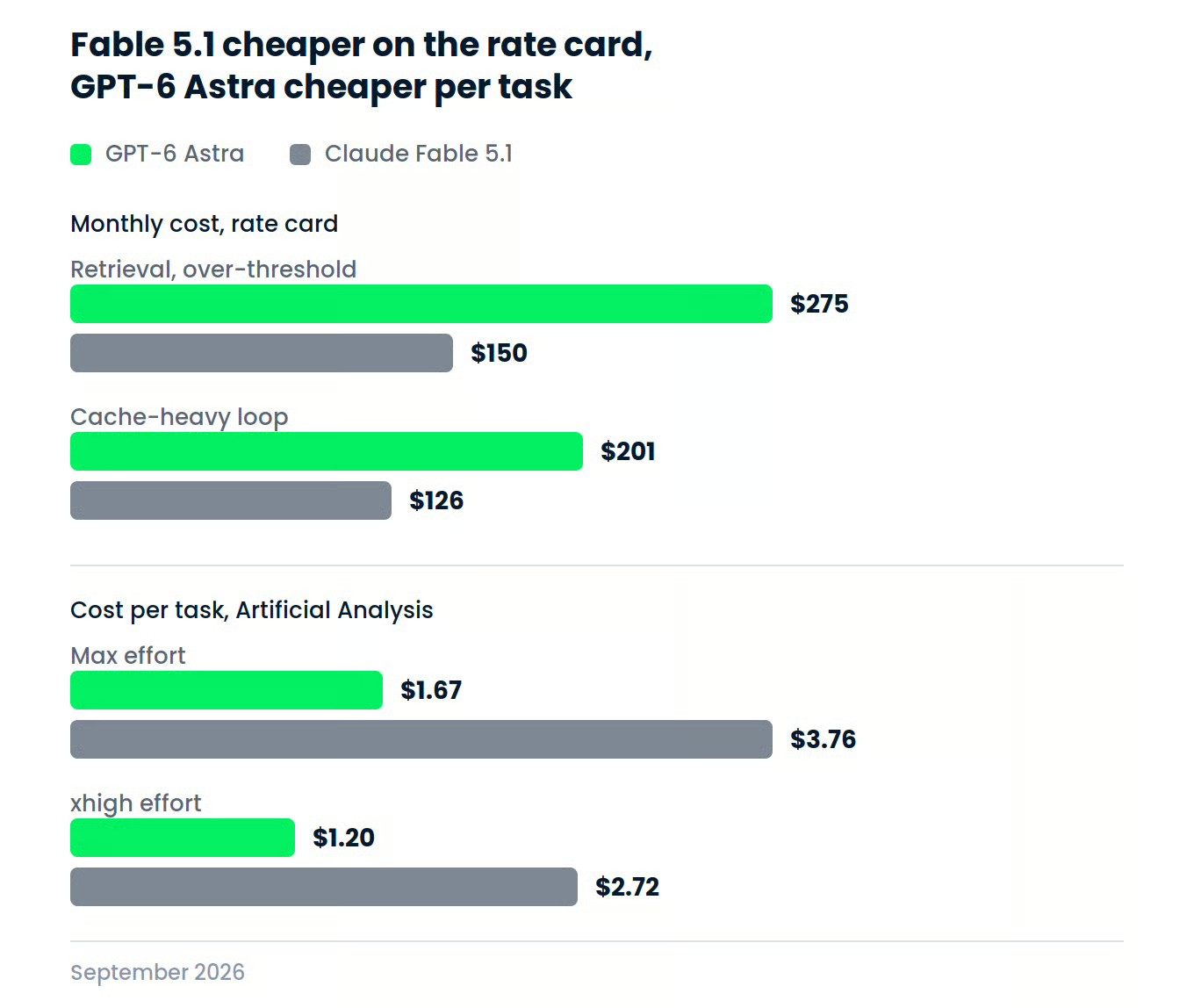
| Truy xuất, vượt ngưỡng: 10M vào / 1M ra | $275 | $150 | $125, Astra đắt hơn 83% |
| Vòng lặp nặng cache: tiền tố 100K, 1.000 lần đọc | $201 | $126 | $75, Astra đắt hơn 59% |
Công thức giống nhau cho mọi hàng: (khối lượng ÷ 1M) × mức giá, cộng dồn đầu vào mới, đọc cache, ghi cache và đầu ra. Hàng “nặng cache” giả định tiền tố 100K được ghi một lần và đọc lại 1.000 lần, cộng 5K đầu vào mới và 1K đầu ra cho mỗi yêu cầu.
Hàng truy xuất vượt ngưỡng là tiêu đề chính. Giữ mỗi yêu cầu dưới 272K token đầu vào, cả hai mô hình đều tốn $150. Đẩy cùng 10M token qua theo các yêu cầu mà mỗi yêu cầu vượt 272K, Astra nhảy lên $275 còn Fable 5.1 vẫn $150, vì Anthropic tính giá chuẩn cho toàn bộ cửa sổ 1 triệu token.
Vòng lặp nặng cache là thứ nhiều độc giả sẽ gặp. Với 1.000 lần đọc cache của tiền tố 100K, khoảng cách $0,75 cho mỗi triệu token cache biến thành chênh $75 trên một khối lượng công việc còn lại giống hệt. Lưu ý hình dạng khối lượng đó: cố tình ít đầu ra, 1K token đầu ra mỗi yêu cầu so với 100K đọc cache. Đó là hình dạng duy nhất nơi lợi thế cache của Fable 5.1 quyết định hóa đơn.
Khi bạn đo mức tiêu thụ token thực thay vì giả định, bức tranh đảo chiều. Artificial Analysis tính giá mỗi mô hình theo mỗi tác vụ Intelligence Index, và phương pháp của họ đã gồm token đầu vào, trúng cache, ghi cache, tư duy và trả lời, nên giá cache rẻ hơn của Fable 5.1 đã được tính vào.
| Mức nỗ lực | GPT-6 Astra: điểm/chi phí mỗi tác vụ | Claude Fable 5.1: điểm/chi phí mỗi tác vụ |
|---|---|---|
| max | 61 / $1,67 | 66 / $3,76 |
| xhigh | 61 / $1,20 | 65 / $2,72 |
Ở mức nỗ lực tối đa, Fable 5.1 tốn gấp 2,25 lần Astra cho cùng bộ tác vụ tại cùng giá niêm yết. Artificial Analysis đi tới kết luận tương tự trên chỉ số lập trình của họ, nơi Astra sánh ngang Fable 5 “với chưa tới một nửa chi phí, nhờ các cải thiện đáng kể về hiệu quả token”. Dải của Astra xuống tới $0,46 mỗi tác vụ ở mức nỗ lực thấp.
Fable 5.1 không bị “phạt” bởi bảng giá ở đây, mà bởi khối lượng đầu ra. Artificial Analysis đo nó dùng khoảng 1,7x token đầu ra so với Fable 5 ở mức nỗ lực tối đa, đó là lý do nó tốn hơn 20% mỗi tác vụ so với đàn anh dù giá đọc cache đã giảm. Nếu bỏ khoản giảm đó, con số sẽ khoảng $5,16, nghĩa là mức giảm thực sự có tác dụng, chỉ là chưa đủ.
Bạn đang trả khoản chênh đó để lấy một thứ gì đó. Fable 5.1 cao hơn 5 điểm trên cùng chỉ số, và cao hơn 4 điểm ở mức xhigh. 5 điểm có đáng 2,25x hay không là quyết định của bạn chứ không phải của tôi, nhưng phiên bản so sánh coi giá niêm yết giống nhau sẽ ra hóa đơn giống nhau là không trụ vững trước số đo thực tế.
Chú thích của chính OpenAI cũng chỉ theo hướng đó, với mức độ tin cậy của số liệu tự báo. Họ ước tính chi phí API mỗi tác vụ của Astra thấp hơn khoảng 31% so với Fable 5.1 trên Terminal-Bench Science 0.1, thấp hơn khoảng 63% trên Terminal-Bench 4.0, và thấp hơn khoảng 86% trên BenchCAD, đo ở mức nỗ lực mà OpenAI chọn cho từng mô hình.
Astra nhỉnh hơn một chút trong bài test của chúng tôi, dù cả hai mô hình đều xuất xưởng một mô phỏng hoạt động ngay ở lần thử đầu.
Tôi chạy một tác vụ khó cho cả hai mô hình trong điều kiện giống hệt, thay vì vài tác vụ nông. Bài test là một mô phỏng vật lý xây mới hoàn toàn thành một file HTML đơn, được chọn vì nó chạm đúng điều cả hai bên tuyên bố đã cải thiện: tính đúng đắn bền bỉ xuyên suốt quá trình xây dài, không dựa vào thư viện.
Phiên bản này là bản làm mới của test đó. Bản đã công bố dùng một buồng hình vuông quay, nên lần này thay bằng lục giác quay với vật cản trung tâm quay ngược và khối lượng tỷ lệ kích thước, tăng độ khó nhưng vẫn giữ việc giam chứa là đỗ hay trượt rõ ràng. Đây là prompt, dán nguyên văn vào một phiên chat mới cho mỗi mô hình:
Build a single-file HTML page (inline CSS and JS, canvas, no build step, no external libraries, no network) that simulates a few dozen balls of varying sizes bouncing under gravity inside a **slowly rotating hexagonal container**, with a **smaller counter-rotating obstacle at the centre** that the balls also collide with.
Ball mass should scale with size, so larger balls shove smaller ones around.
The balls should collide with each other, with the hexagon's walls, and with the central obstacle, and lose a little energy on each collision so the system settles rather than gaining energy over time.
Both the hexagon and the inner obstacle keep rotating throughout, so the balls should slosh and re-pile as they turn.

Ship it as one working file named `index.html` that starts animating on load.
Do not install packages.
Do not open, screenshot, or headless-render the page (no Playwright, Puppeteer, or Chrome).
Do not ask me clarifying questions — make reasonable assumptions and note them briefly in a comment at the top of the file.
Cả hai mô hình chạy ở mức nỗ lực suy luận cao, một lần thử mỗi mô hình, không thử lại, trong cùng một tác tử lập trình với cùng bộ công cụ. Chấm điểm gồm kiểm tra chạy được/không trước, rồi thang 1–5 cho đúng đắn vật lý, độ ổn định trong 30 giây, và chất lượng hình ảnh.
Astra vượt qua kiểm tra chạy được và đạt 5/5 trên cả ba trục chấm điểm. Nó hoàn thành trong 6 lượt và 9 lần gọi công cụ, và tổ hợp công cụ là phần thú vị: nó viết file, đọc lại 5 lần, grep 2 lần và vá 2 lần trước khi tuyên bố xong.
Mô phỏng là đúng. 44 quả bóng, khối lượng tỷ lệ diện tích, giam chứa giữ vững suốt 30 giây trong khi lục giác quay. Astra đặt vật cản trong tương đối lớn so với buồng, khiến bóng liên tục va vào nó thay vì dừng ở nơi nó không chạm tới.
Nó cũng dựng cả một trang biên tập quanh mô phỏng, với tiêu đề serif, nhãn monospace giãn chữ, và bảng đo lường hiển thị tốc độ quay trực tiếp. Không ai yêu cầu, nhưng theo tôi trông khá đẹp. Nó còn thêm nút tạm dừng và khởi động lại, prompt cũng không đòi, nhưng giúp dễ kiểm tra artifact hơn.
Astra quay buồng ở 0,09 rad/s và vật cản ở -0,16 rad/s, chậm hơn Fable khoảng 3 lần ở tường ngoài và 5 lần ở vật cản. Dễ theo dõi hơn, và là phép thử dịu hơn cho biên xoay so với tốc độ nhanh. Vì prompt yêu cầu quay chậm, điều này ổn.
| Chỉ số | GPT-6 Astra | Claude Fable 5.1 |
|---|---|---|
| Lượt | 6 | 2 |
| Lần gọi công cụ | 9 | 1 |
| Chạy được | Đạt | Đạt |
| Đúng đắn vật lý | 5 | 4 |
| Ổn định theo thời gian | 5 | 5 |
| Chất lượng hình ảnh | 5 | 4 |
| Điểm rubric | 5,0 | 4,3 |
Astra thắng về chất lượng, và khoảng cách rộng hơn ở phần trình bày so với vật lý. Khác biệt nằm ở cách mỗi mô hình hiểu công việc. Astra đọc prompt như một bản giao việc để diễn giải, thêm điều khiển, bố cục biên tập đầy đủ, và tốc độ quay chậm dễ xem. Fable đọc nó như bản đặc tả để thỏa mãn, viết xong trong một lần, và dành phần công sức còn lại cho HUD chẩn đoán.
Đây là một lần chạy mỗi mô hình, nên hãy coi như một điểm dữ liệu chứ không phải benchmark. Nó báo cáo số lượt chứ không phải token hay chi phí, và chỉ kiểm tra mã mô phỏng viết từ đầu, không đo các khía cạnh thao tác máy tính hay suy luận đã bàn ở trên.
Vì giá niêm yết trùng nhau, quyết định phụ thuộc vào hình dạng khối lượng công việc, mức tiêu thụ token đo được, và tác tử lập trình bạn đang chạy. Ba con số nên ảnh hưởng đến bạn là khoảng cách đọc cache 4x, ngưỡng phụ phí 272K, và hệ số 2,25x chi phí mỗi tác vụ đo được.
| Nền tảng | GPT-6 Astra | Claude Fable 5.1 |
|---|---|---|
| Ứng dụng người dùng | ChatGPT Plus, Pro, Business, Enterprise | Claude web, di động, desktop (Pro, Max, Team, Enterprise) |
| API chính chủ | OpenAI API | Claude API |
| Nền tảng đám mây | Amazon Bedrock, Microsoft Azure/Foundry | Amazon Bedrock, Google Cloud, Microsoft Azure/Foundry |
| Tác tử lập trình | Codex | Claude Code, Cursor |
| Bộ định tuyến bên thứ ba | OpenRouter, Vercel AI Gateway | OpenRouter, Vercel AI Gateway |
| ID mô hình API | gpt-6-astra |
claude-fable-5-1 |
Hai chi tiết truy cập có thể chặn bạn trước cuộc gọi đầu tiên. Astra mặc định tắt cho workspace doanh nghiệp cho đến khi quản trị viên bật, và Fable 5.1 yêu cầu lưu trữ dữ liệu 30 ngày và không hỗ trợ Priority Tier. Khả năng tiếp cận đám mây gần như ngang nhau, với Google Cloud hiện là nền tảng chỉ Fable 5.1 có mà GPT-6 Astra chưa có.
Mỗi mô hình là “bản địa” của bộ khung riêng, Astra trong Codex và Fable 5.1 trong Claude Code, nơi bạn chuyển bằng /model claude-fable-5-1 hoặc cờ --model. Qua API, việc hoán đổi là một chuỗi ký tự, dù SDK khác nhau.
from anthropic import Anthropic

client = Anthropic()
response = client.messages.create(
    model="claude-fable-5-1",  # OpenAI SDK equivalent: model="gpt-6-astra"
    max_tokens=16000,          # thinking plus response share this budget
    output_config={"effort": "high"},
    messages=[{"role": "user", "content": "Refactor this module..."}],
)
print(response.content[0].text)
Ba thay đổi của Fable 5.1 sẽ làm hỏng mã viết cho Fable 5: ép buộc chọn công cụ giờ trả 400, các mô hình trước đó không đọc được khối “thinking”, và khối “thinking” bị ràng buộc vào đúng lịch sử trước nó. Hướng dẫn API Claude Fable 5.1 của chúng tôi đi qua cả ba, và hướng dẫn cho người mới bắt đầu về OpenAI API trình bày phần tương ứng phía OpenAI.
Hãy chọn dựa trên hình dạng khối lượng công việc và chi phí đo được, không chỉ bảng benchmark. GPT-6 Astra mạnh hơn cho tác tử nhấp qua phần mềm, làm toán, hoặc tạo artifact sẵn sàng cho khách hàng, và có vẻ rẻ hơn theo tác vụ dù bảng giá giống hệt. Claude Fable 5.1 mang lại điểm suy luận độc lập cao nhất hiện có và tốn ít hơn cho yêu cầu rất lớn và các vòng lặp thiên về cache.
Bảng giá là cái “bẫy” trong so sánh này. Hai mô hình ở $10 và $50 có vẻ hoán đổi được về giá, và khoảng cách duy nhất có thể thấy—đọc cache—nghiêng về Anthropic 4x. Rồi bạn đo xem mỗi bên thực sự dùng bao nhiêu để hoàn thành tác vụ, và Astra chỉ tốn 44% chi phí của Fable 5.1. Tôi sẽ không dự đoán điều đó từ trang giá, và đó là điều duy nhất tôi sẽ kiểm tra với lưu lượng của chính bạn trước khi quyết định.
Nếu bạn muốn làm việc với mô hình thay vì chỉ đọc về chúng, tôi gợi ý khóa Giới thiệu về các mô hình Claude cho phía Anthropic và Làm việc với OpenAI API cho phía OpenAI.
Học AI với DataCamp!
Khóa học
Khóa học
Khóa học
blog
Matt Crabtree
10 phút
