
Track
OpenAI Fundamentals
15 hr
Practice and track your progress.
Continue with GoogleUpdate: OpenAI released the update for the Instant model. Check out our guide on GPT-5.5 Instant.
About a month after rolling out the latest update of its flagship model, GPT-5.3 Codex, OpenAI followed up with the 5.3 Instant variant. It’s an update for everyone who wishes GPT models would “get to the point” more quickly.
When GPT-5.2 Instant was released, it was not well received by the userbase, which found it too cautious. OpenAI took this feedback into account in developing GPT-5.3 Instant, which promises an improved conversational user experience, more accurate answers, and better search results.
In this article, we’ll walk you through new features and put them to the test.
For an overview of other state-of-the-art AI models, we recommend checking out our guides on the following LLMs:
The new features are all about user experience.
When GPT-5.2 was released in December, we wrote about how GPT-5.2 Instant. It was designed to be the everyday model for lighter tasks like gathering information, creating drafts, and translating text.
If you’re confused about the naming conventions, know that it’s the model most people interact with by default, which prioritizes low latency and rapid response times. Speed was the main goal, even if it meant tradeoffs elsewhere.
The tradeoffs were real. Users didn’t like the tone of the responses. They felt like it would be overly cautious or hedge too much when giving answers. It didn’t feel natural enough, and users had to redirect the model in conversation. It wasn’t as helpful as it could have been.
OpenAI essentially overcorrected in their training to keep the model safe. And now they are taking a step in the other direction. While safety is still a priority, GPT-5.3 Instant is designed to better know when to provide real, necessary disclaimers.
GPT-5.3 Instant is now better at pulling together information from web searches with its own reasoning. GPT-5.2 Instant leaned too heavily on web results. The new model is better at understanding what the user really means in their questions. This ties in with the previous point: the new model shouldn’t “beat around the bush” as much as its predecessor did.
This update is going to be a good one for everyone who, when interacting with ChatGPT, gives a prompt to search the web and provide some kind of answer and, after seeing a wall of text, immediately types something like, “Can you please just summarize all this and get to the point?”
An improved balance between web integration and reasoning, combined with a better understanding of the subtext and intent of prompts, leads to more accurate and useful responses.
According to the OpenAI team, GPT-5.3 Instant reduces hallucinations by about 20% or more compared with its predecessor, GPT-5.2 Instant. The benchmarks used to evaluate this were internal benchmarks.
Another interesting claim is that GPT-5.3 Instant is now a better writer, both for getting to the point in instructions and for creative writing.
As one central aim was a smoother conversational style, the update is designed to remove “cringe” (yes, that is OpenAI’s word choice in the release notes) and to avoid coming across as overbearing or making unwarranted assumptions about user intent or emotions.
On the creative side, OpenAI promises a wider range of expressive capabilities, while still keeping a consistent tone. This should allow the model to better adapt to different professional and casual formats while maintaining a stable, familiar ChatGPT personality that users can easily adjust in their settings.
Having looked at OpenAI’s claims, we wanted to put them to the test.
We asked GPT-5.3 to write me a poem similar to Sunflower by Andre Breton.
This seemed like a fair test. OpenAI asked GPT-5.3 Instant to write a poem to show off the writing capability of the new model in their release.
We expected the poem by Andre Breton would be a hard one to emulate because Breton’s own style came from a process of automatic writing, which caused the images to feel like they were bubbling up from somewhere deep in the psyche. We expected that it would be hard to replicate all that.
This was our prompt:
Can you write me a poem like Andre Breton's Sunflower? But it can't seem totally derivativeAnd here was the output:

Poetry is a little hard to evaluate – à chacun son goût, as the French say. But there were some things that stood out to us. Andre Breton had referenced specific French places like Pont-au-Change and Rue Gît-le-Coeur that made the images in his poem feel especially lived in, and GPT-5.3’s attempt notably lacked all that.
Also, even though we specifically asked the model not to come up with anything derivative, it created a poem that is almost the same number of lines, has a certain je ne sais quoi that is similar all the way through, and it even uses a sunflower as one of the images, so the poem was definitely derivative.
That said, the half line about clocks grazing quietly in the fields rather stuck with us, and the same goes for the market of invisible animals and the fruit sellers weighing constellations. An experienced poet could offer an opinion. But we thought these images were rather provocative and interesting.
Next, we wanted to test how useful GPT-5.3 was for finding answers through web searches and how well it could combine the information it found with its own reasoning.
This was our prompt:
What has been the most surprising result of the 2026 Winter Olympics so far, and why might it matter for the future of this sport?Here was the answer from GPT-5.3 Instant:
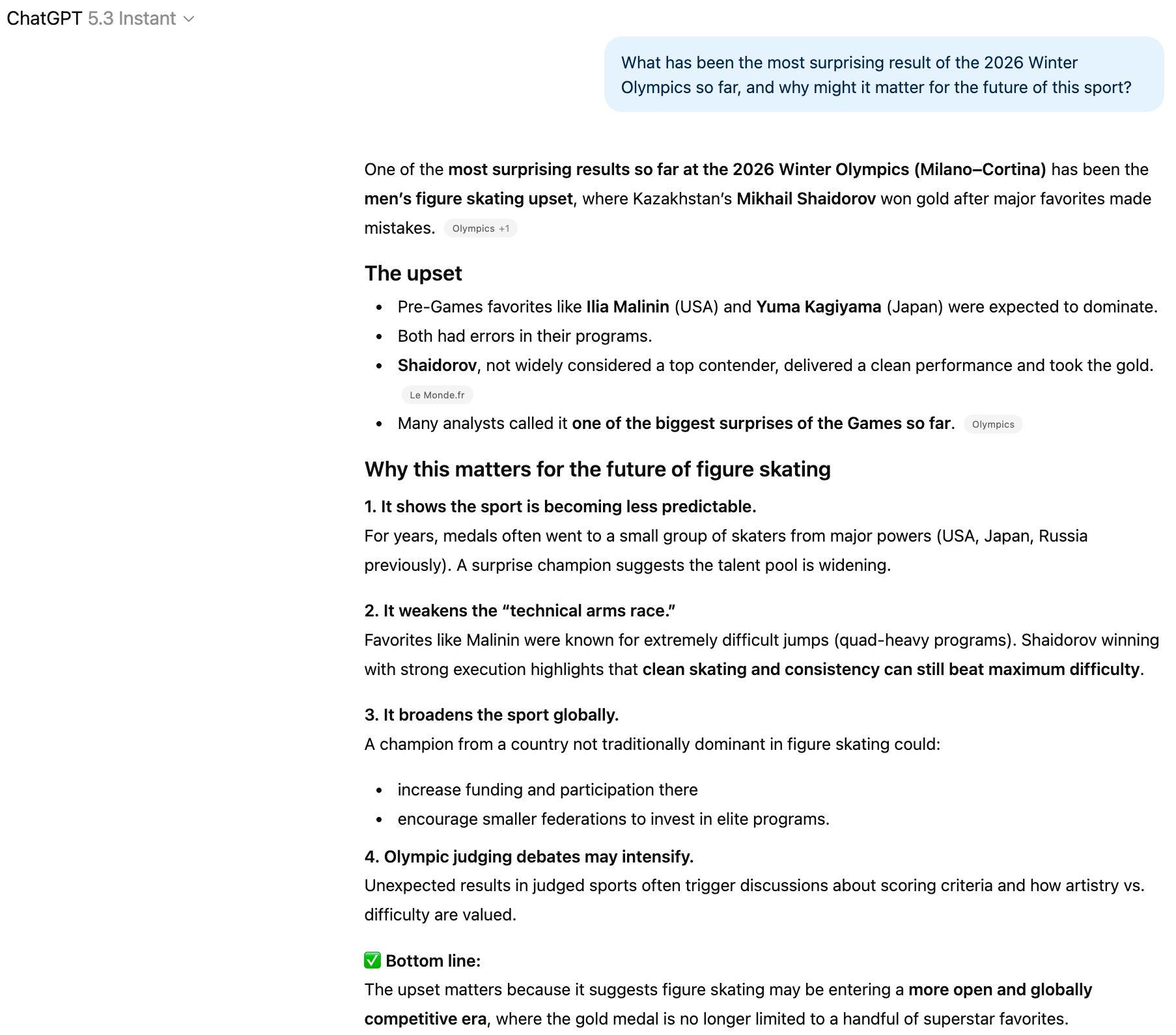
Since we followed the Winter Games closely and had a few moments in mind, we were really curious what the answer would be. While we have to admit it wasn't the first one we were thinking of, it was definitely a good choice. It was a big surprise and had a tragic element.
In a matter of seconds, GPT-5.3 Instant went through about 30 sources and cited two of them prominently in the response. All four reasons why the surprising result is important for the future of figure skating seem to be very relevant and supported by accurate claims:
Again, this was a prompt with no definite answer. But in our opinion, GPT-5.3 Instant did a great job answering it and arguing for its choice from multiple relevant perspectives. The answer was also nicely concise.
Finally, we wanted to see whether the new model was actually better at understanding subtext and prompt intent than its predecessor. The prompt we used, which mirrors prompts we found at Reddit, looks simple at first glance:
I want to wash my car at the car wash. The car wash is one block away. Should I walk or drive?Still, it demands a mental transfer. If you were asked how you should get to anything one block away, your answer would very likely be to walk there. Of course, in this example, it doesn't make any sense, since you need the car (or you might get a very adventurous shower).
The old model, GPT-5.2 Thinking, fell for the trick and suggested walking to the car wash:
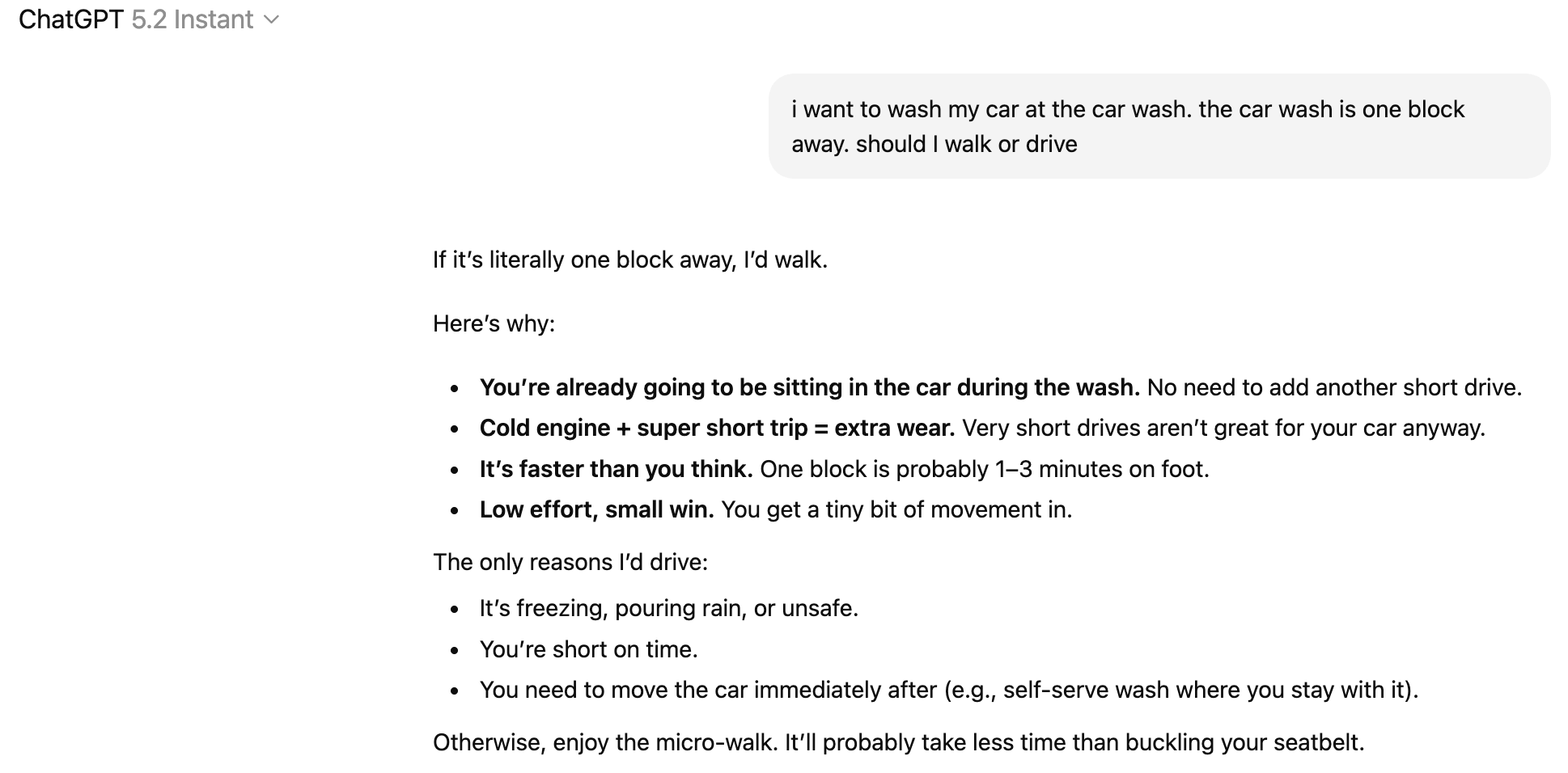
We can confirm that GPT-5.3 Instant improved in this example, as it correctly assesses the situation and recommends driving:
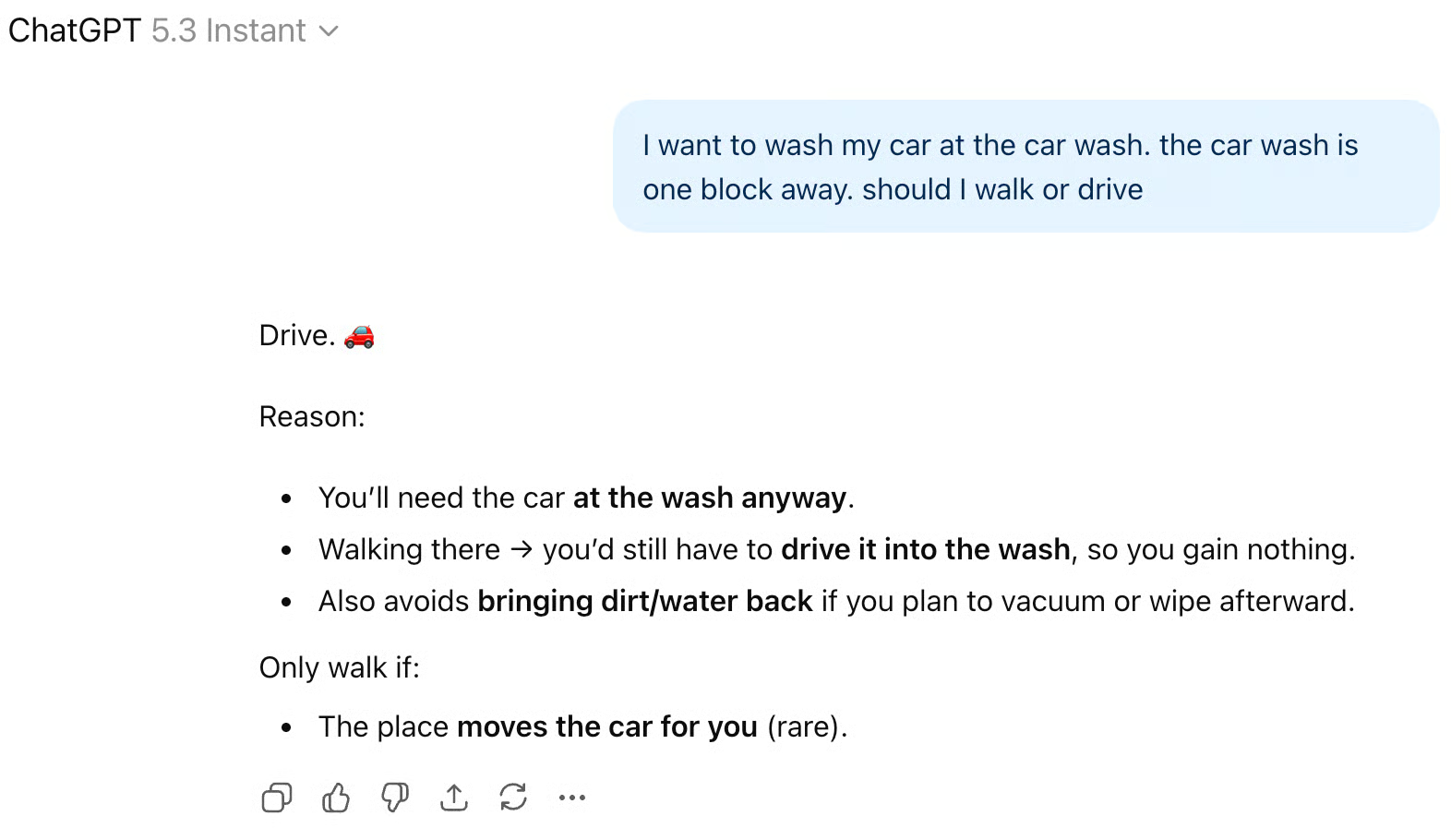
This is, of course, just one example, but it suggests that the GPT-5.3 Instant gives more accurate and useful responses than its 5.2 counterpart.
OpenAI is managing expectations, particularly for certain non-English languages. They say responses in Japanese and Korean are an ongoing challenge.
Additionally, OpenAI mentions the tone as a limitation, only to say that it should feel smoother, but feedback is monitored. In one way, this is a learning from GPT-5.2 Instant. Another way to look at it is that this mention is just hedging against criticism of a model that is hedging too much, which is quite ironic.
GPT‑5.3 Instant should be available today to all users. It should also be available to all developers in the API as gpt-5.3-chat-latest.
Updates to Thinking and Pro will follow soon. We will keep you updated on progress.
GPT‑5.2 Instant now has a shelf life. It will stay available only for the next three months in the Legacy Models section of the model picker. June 3, 2026, will be its last day.
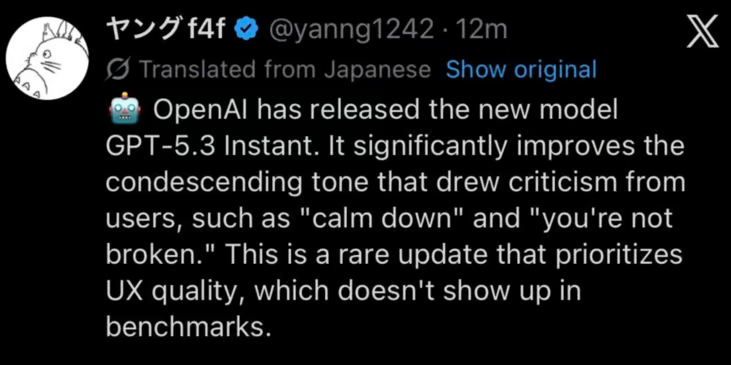
The reaction online has been immediate. Users who felt burned by GPT-5.2 Instant's over-cautious tone are cautiously optimistic.
The first post captures something OpenAI itself acknowledged in the release: the improvements are improvements to tone, relevance, and conversational flow, and many users online seem appreciative.
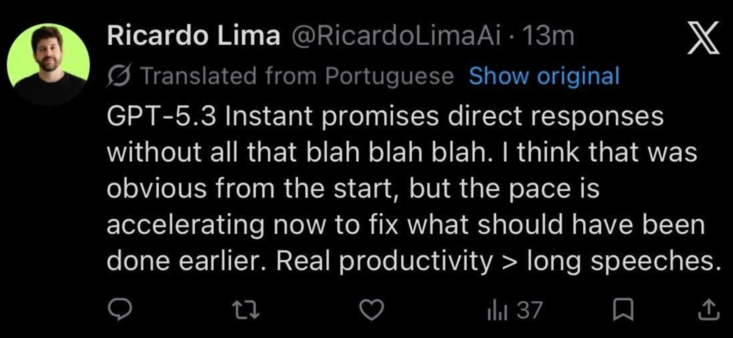
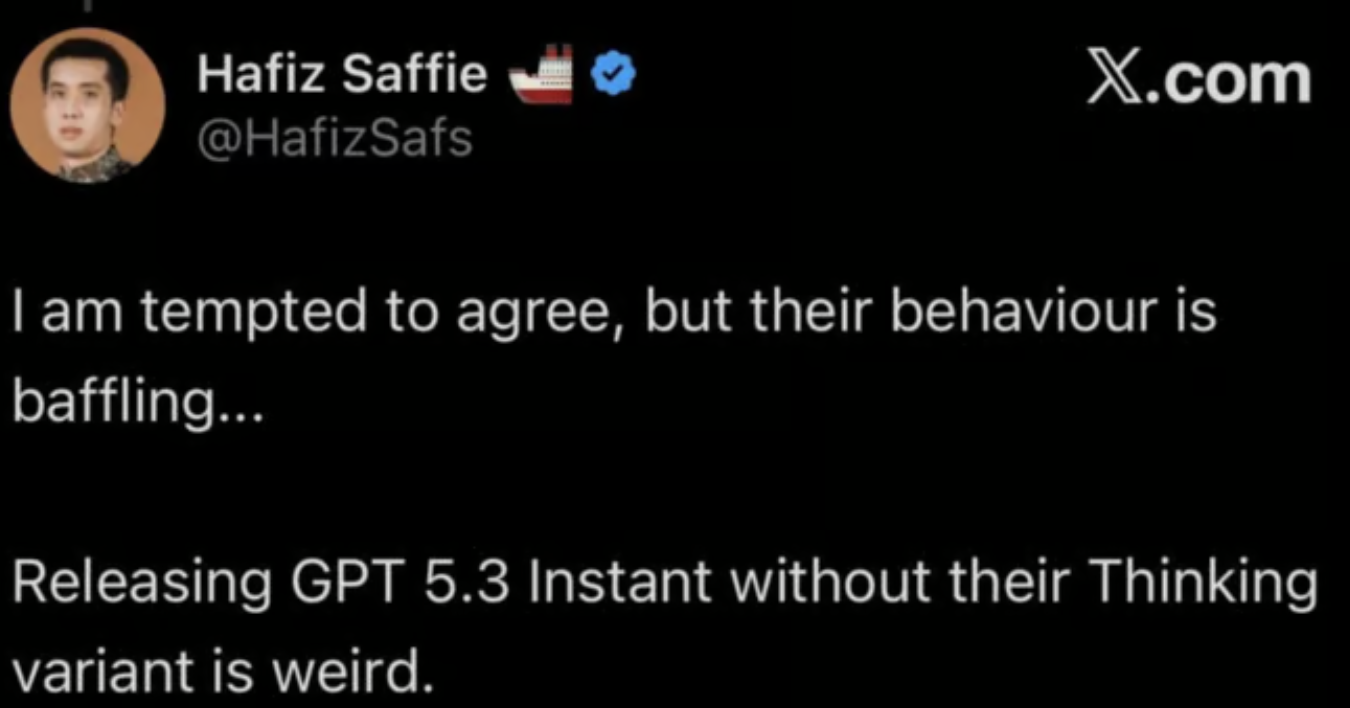
In a comment, another user thought it was weird to see the release of GPT-5.3 Instant without the Thinking variant with it.
It’s often discussed in self-improvement and other books how Japanese car manufacturers were known to have a process of continuous small improvements, which they called kaizen.
In this spirit, I would consider GPT-5.3 Instant as a small but important update. It might be a mistake to put off user complaints until shipping a new flagship. It’s better to keep improving the product a little at a time.
If you’re interested in developing AI applications, we highly recommend enrolling in our AI Engineering with LangChain skill track. Each course in it is AI-native, which means you basically have a personal teacher that picks you up on your exact level and helps you reach your goals at your own pace.
AI Courses
Track
Course
Practice and track your progress.
Continue with Googleblog
Alex Olteanu
8 min
blog
Josef Waples
8 min
blog
Alex Olteanu
8 min
blog
Josef Waples
10 min
blog
Josef Waples
10 min
blog
Josef Waples
15 min