
Course
Understanding ChatGPT
1 hr
434.4K
If you're looking for an AI assistant, two names keep coming up: xAI's Grok and OpenAI's ChatGPT. Elon Musk's xAI has positioned Grok as the unfiltered, real-time alternative to ChatGPT, with native X (Twitter) integration and a personality that's more willing to engage with edgier topics. ChatGPT maintains its spot as the established leader with a polished ecosystem, extensive integrations, and proven enterprise capabilities.
This isn't just another AI chatbot comparison. The Musk-OpenAI dynamic adds an interesting layer. Musk co-founded OpenAI before departing over strategic differences, then launched xAI as a direct competitor. But beyond the corporate drama, what matters is which tool actually serves your needs better.
We'll explore how these platforms differ in design philosophy, capabilities, and practical use cases. Rather than focusing solely on benchmark scores (which can be misleading when platforms test on different metrics), we'll examine the real-world strengths of each tool to help you make an informed choice.
Before diving into comparisons, let's understand what each platform brings to the table, starter with the newer challenger.
Grok is xAI's conversational AI assistant, built with a distinct personality and direct access to real-time information from X (formerly Twitter). Unlike most AI assistants that aim for neutral, diplomatic responses, Grok was designed with wit and fewer content restrictions, giving it a more casual and sometimes irreverent tone.
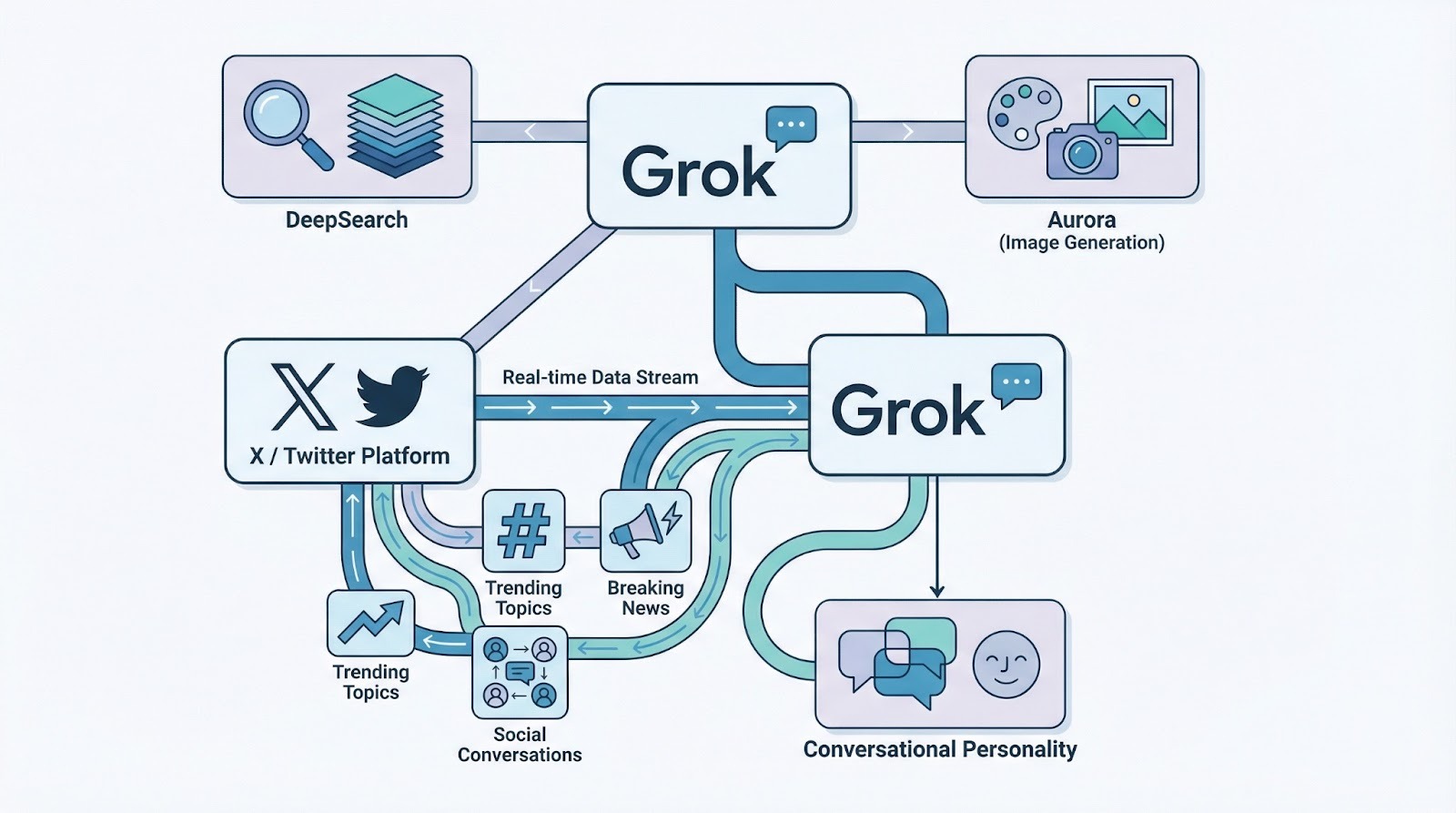
Grok's ecosystem centered on real-time X/Twitter data integration. Image by Author.
The platform runs on xAI's Grok model family, with the latest version being Grok 4.6. What sets Grok apart technically is its native integration with X's data stream, letting it reference live tweets, trending topics, and real-time social conversations. This makes it powerful when you need current information about breaking news, social trends, or viral discussions.
Grok offers two distinct modes: "Fun Mode" embraces the platform's witty, edgy personality, while "Regular Mode" gives you more straightforward responses. The platform also includes Aurora, xAI's image generation tool, and DeepSearch, a feature for conducting in-depth research queries.
Now, let's turn to the established player. ChatGPT is OpenAI's flagship conversational AI, powered by the GPT (Generative Pre-trained Transformer) model family. You can make use of GPT-5.6 for advanced reasoning tasks, representing some of the most capable language models available.
What makes ChatGPT stand out is its ecosystem maturity. The platform offers extensive features, including Browse (web search), data analysis tools, GPT-Image-1.5 image generation, custom GPTs, Advanced Voice Mode, and a comprehensive API that powers thousands of third-party applications. The GPT Store lets you access specialized AI assistants created by the community, ranging from coding tutors to creative writing partners.
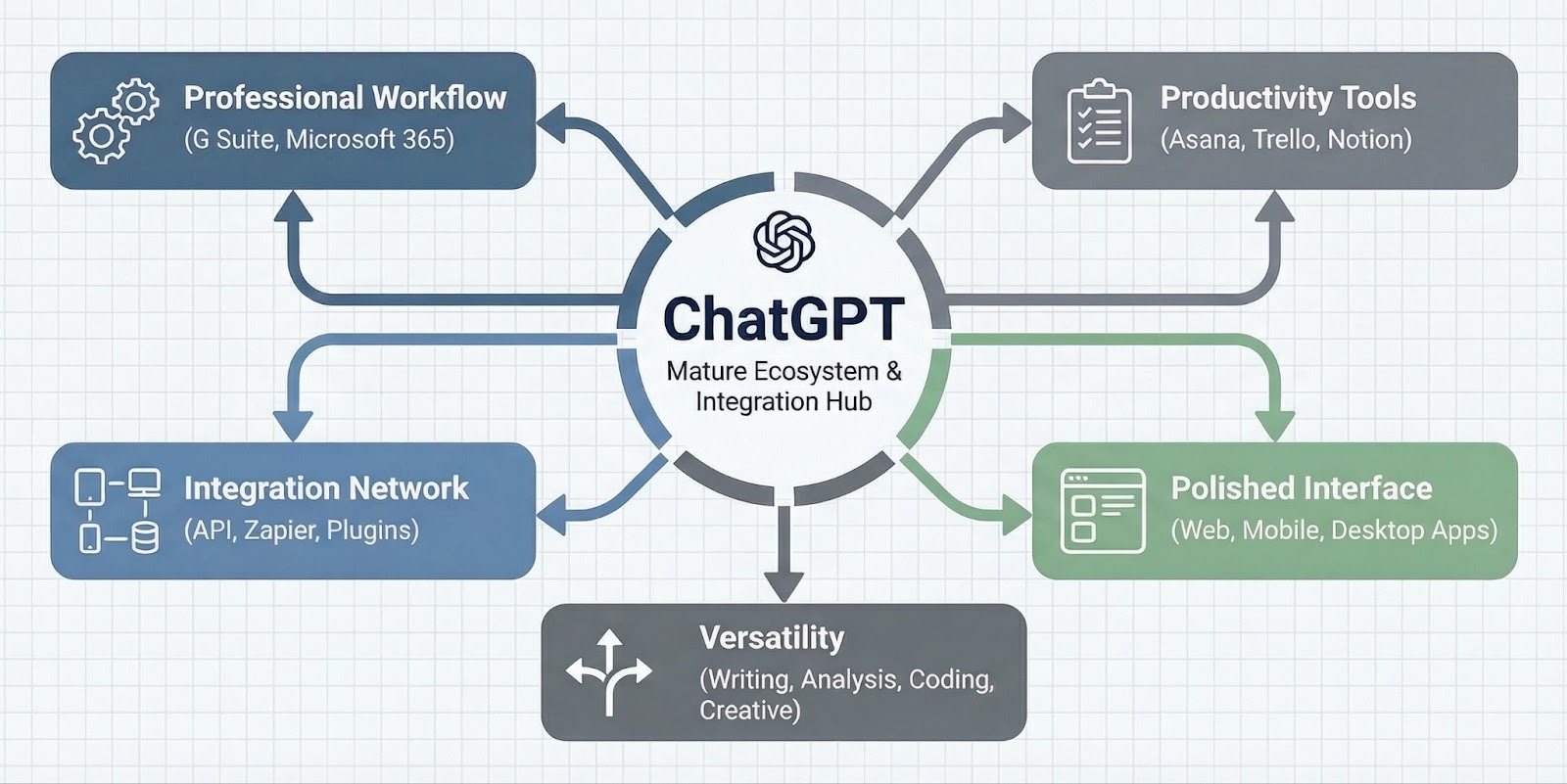
ChatGPT's mature ecosystem. Image by Author.
The platform's strength lies in its versatility and polish. ChatGPT handles everything from creative writing to complex coding tasks, business analysis to casual conversation, with consistently high-quality outputs. Its safety-conscious approach and extensive fine-tuning make it reliable for professional environments where consistency matters.
With both platforms now on the table, let's explore how they actually diverge in practice. While both use advanced language models, their fundamental approaches differ in ways that affect how you'll experience them day-to-day.
Grok embraces what xAI calls an "anti-woke" stance, meaning it's more willing to engage with controversial topics and provide unfiltered responses. This personality-driven approach appeals to users who want an AI that doesn't constantly hedge or refuse requests. ChatGPT takes a balanced, safety-conscious approach with more guardrails around sensitive content. This makes it more suitable for professional environments but can sometimes feel overly cautious.
This is where the platforms truly diverge. Grok's native X integration gives you real-time access to social media conversations, trending topics, and breaking news as it unfolds. If you need to understand what's happening on social media right now, Grok has an unmatched advantage. ChatGPT relies on web browsing capabilities to access current information, which is capable but doesn't offer the same social media immediacy.
ChatGPT benefits from years of development, resulting in a mature ecosystem of tools, integrations, and third-party applications. The GPT Store, API marketplace, and extensive documentation make it easier to build custom solutions. Grok's ecosystem is newer and more X-centric, though xAI is rapidly expanding capabilities and developer tools.
Here's an important nuance: Grok and ChatGPT test on largely different benchmarks, making direct comparison challenging. Grok emphasizes emotional intelligence (EQ-Bench), creative writing, and conversational quality, while ChatGPT focuses on professional knowledge work (GDPval), coding tasks (SWE-bench), and scientific reasoning. Both excel in their chosen domains, but comparing them directly is like comparing a sports car to an SUV. They're built for different purposes.
Before we dive deeper into specific capabilities, here's a quick reference to help you understand how these platforms stack up across key dimensions:
|
Aspect |
Grok |
ChatGPT |
|
Primary Strength |
Real-time social media intelligence |
Versatile productivity & professional work |
|
Access Model |
Free tier available, paid tiers US$8~US$300/mo |
Free tier available, Plus at $20/mo |
|
Personality |
Witty, edgy, fewer restrictions |
Balanced, professional, safety-focused |
|
Real-Time Data |
Native X/Twitter integration |
Web browsing across broader internet |
|
Best For |
Social media tracking, trending topics |
General productivity, business tasks |
|
Developer Tools |
Emerging API ecosystem |
Mature API with extensive integrations |
|
Image Generation |
Aurora |
GPT-Image-1.5 |
|
Platform Access |
X mobile/web apps |
Web, mobile apps, API, integrations |
Now that you have a sense of the broad differences, let's examine how these platforms perform in specific scenarios you'll actually encounter. We'll walk through the key capabilities that matter most in daily use.
ChatGPT produces polished, versatile output suitable for professional documents, reports, and formal communication. Its writing style is refined and adaptable, making it effective for business correspondence, academic papers, or technical documentation.
Grok's writing is more casual and sometimes sarcastic, reflecting its personality-first design. For creative projects, social media content, or situations where a more relaxed tone works better, Grok's style can feel more natural and engaging. But for formal business communication, ChatGPT's professionalism serves you better.
Grok dominates when you need current social media insights. Its live X/Twitter integration means you can ask about trending topics, breaking news on social media, or what people are saying about recent events and get immediate, contextual answers. This is invaluable for social media managers, journalists, or anyone tracking online conversations.
ChatGPT's web browsing capabilities give you access to current information across the broader internet, including news sites, documentation, and research papers. While not as immediate for social trends, this broader web access is more comprehensive for general research needs.
Both platforms handle coding tasks competently, helping with debugging, code generation, and technical problem-solving. ChatGPT's API has been extensively adopted by developers, and its proven track record in production environments gives it an edge for serious development work. The platform integrates well with development tools and has extensive documentation for technical use cases.
Grok's coding capabilities are solid, though its developer ecosystem is less mature. For quick coding help or learning purposes, both work well. For building production applications or requiring extensive API integration, ChatGPT's established infrastructure gives you more flexibility.
Both platforms offer built-in image creation, though with different tools under the hood.
Grok includes Aurora, xAI's image generation tool, which produces high-quality images directly within the platform. ChatGPT recently upgraded to GPT-Image-1.5 (released December 16, 2025), which generates images 4× faster than DALL-E 3 with more precise editing, better text rendering, and stronger instruction following. The model keeps facial likeness and important details consistent across edits, making it good for iterative creative work.
When it comes to digging deeper into topics, each platform takes a distinct approach. Grok's DeepSearch feature lets you conduct in-depth research queries, combining X data with broader web information. For research that requires understanding social sentiment or tracking how topics evolve on social media, this is valuable.
ChatGPT's Browse tool and data analysis capabilities make it effective for traditional research tasks, document analysis, and working with structured data. The platform can process uploaded documents, analyze datasets, and synthesize information from multiple sources, making it stronger for academic or business research that doesn't require social media insights.
This is where personal preference plays the biggest role. Grok's humor and willingness to be edgy makes it feel more like chatting with a knowledgeable, slightly irreverent friend. Some users find this refreshing; others find it unprofessional.
ChatGPT maintains a more neutral, professional demeanor that adapts to your needs. It can be friendly without being casual, informative without being dry. This versatility makes it suitable for a wider range of professional contexts, though it can occasionally feel formulaic.
With features covered, let's talk about what you'll actually pay and how you'll access these platforms because the best AI assistant is only useful if it fits your budget and workflow.
ChatGPT's strong free tier makes it more accessible for casual users or those wanting to try before committing financially. The Plus tier at $20/month is competitively priced and provides substantial capabilities for most professional users.
Understanding the strengths and limitations of each platform helps clarify which trade-offs you're willing to make. Here's a balanced look:
|
Feature |
Grok |
ChatGPT |
|
Pros |
Real-time X/Twitter integration |
Mature, polished ecosystem |
|
Engaging, witty personality |
Strong free tier with GPT-4o |
|
|
Fewer content restrictions |
Extensive custom GPTs and tools |
|
|
Strong in emotional intelligence |
Proven enterprise solutions |
|
|
Immediate social media insights |
Broad third-party integrations |
|
|
Cons |
Free tier very limited; best features require US$30~US$300/mo |
More restrictive content policies |
|
Younger, less mature ecosystem |
No native social media integration |
|
|
Smaller developer community |
Can feel formulaic at times |
|
|
Limited integrations outside X |
Advanced features behind paywalls |
|
|
Platform-specific access |
May over-refuse edgy requests |
So we've covered the what and the how. Now let's tackle the most important question: which platform is right for you?
For social media professionals: Grok's X integration is unmatched if your work revolves around Twitter/X. The ability to instantly understand trending topics, track brand mentions, and gauge social sentiment makes it invaluable for social media management, journalism focused on online discourse, or marketing teams tracking campaigns on X.
For developers: ChatGPT's mature API ecosystem, extensive documentation, and proven track record in production environments make it the stronger choice for building applications. The broader developer community means more resources, tutorials, and third-party integrations.
For content creators: Your choice depends on tone preference and platform focus. If you create content for social media, especially X, and want an AI that matches a more casual, edgy tone, Grok may resonate better. For diverse content needs across multiple platforms, ChatGPT's versatility and polish serve most creators more effectively.
For business and enterprise: ChatGPT's established enterprise offerings, compliance features, and integration with business tools make it the safer choice for organizations. While xAI is developing enterprise solutions, OpenAI's track record and mature ecosystem provide more confidence for mission-critical applications.
For users wanting fewer restrictions: If you're frustrated by AI assistants that constantly refuse requests or hedge on controversial topics, Grok's more permissive approach may appeal to you. Keep in mind that this comes with responsibility. Less filtering means you need to exercise more judgment about appropriate use.
For general productivity: ChatGPT's broader tool integration, document handling, and versatile capabilities make it better suited for everyday productivity tasks. Its ability to work with spreadsheets, PDFs, code, and various document formats makes it more of an all-purpose assistant.
Grok and ChatGPT represent two distinct visions of what AI assistants should be. Grok brings real-time social integration and an unapologetic personality to a space often dominated by cautious, diplomatic responses. Its X integration is unique and valuable for social media-centric workflows. ChatGPT counters with ecosystem maturity, versatility, and the polish that comes from years of development and billions of user interactions. Neither platform is universally "better."
To keep learning about the technology powering these AI assistants, take our Large Language Models (LLMs) Concepts course, which offers comprehensive insights into how LLMs work, their training methodologies, and the latest research shaping their development. Large Language Models for Business, which covers practical applications, is another great course option.
Learn with DataCamp
Course
Course
Course
blog
Vinod Chugani
9 min
blog
Vinod Chugani
10 min
blog
Vinod Chugani
9 min
blog
Dr Ana Rojo-Echeburúa
8 min
blog
Abid Ali Awan
10 min
blog
Javier Canales Luna
14 min


