Our biggest-ever sale. 60% off AI & data skills
Buy Now

Practice and track your progress.
Continue with GoogleBy continuing, you accept our Terms of Use, our Privacy Policy and that your data is stored in the USA.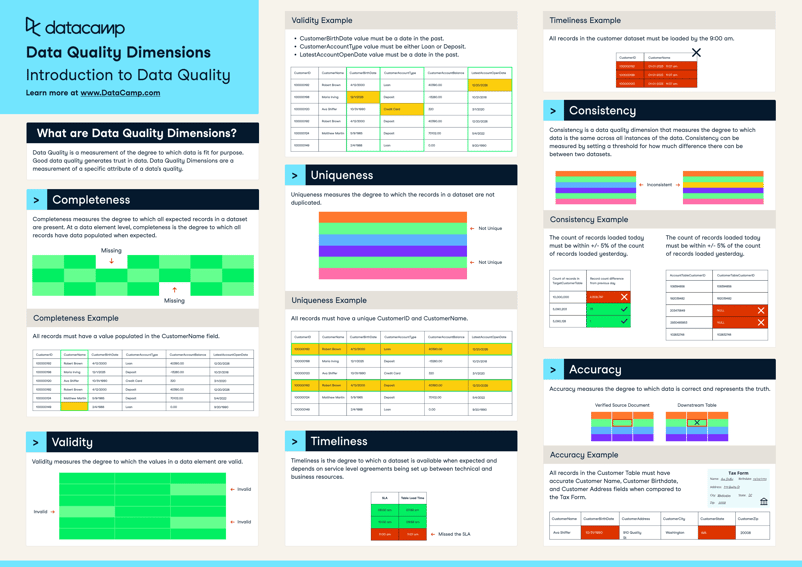
Have this cheat sheet at your fingertips
Download PDFData Quality is a measurement of the degree to which data is fit for purpose. Good data quality generates trust in data. Data Quality Dimensions are a measurement of a specific attribute of a data's quality.
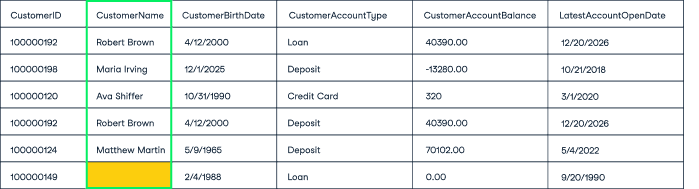
Completeness measures the degree to which all expected records in a dataset are present. At a data element level, completeness is the degree to which all records have data populated when expected.

All records must have a value populated in the CustomerName field.
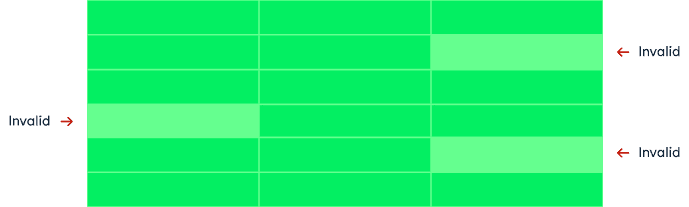
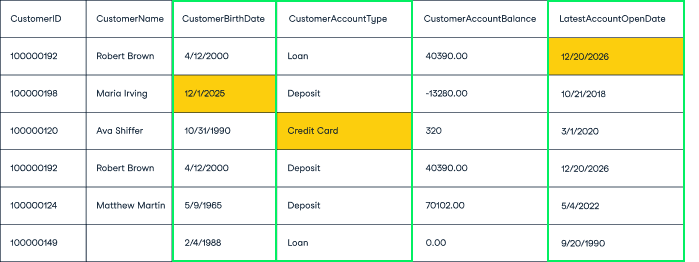
Validity measures the degree to which the values in a data element are valid.
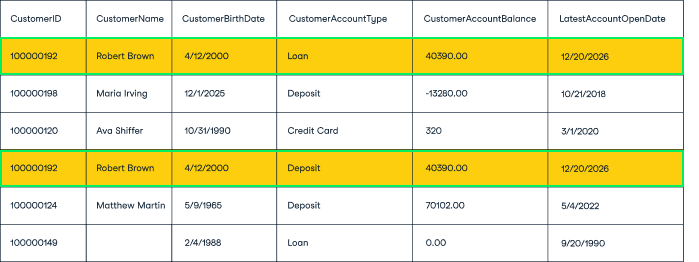
Uniqueness measures the degree to which the records in a dataset are not duplicated.

All records must have a unique CustomerID and CustomerName.
Timeliness is the degree to which a dataset is available when expected and depends on service level agreements being set up between technical and business resources.
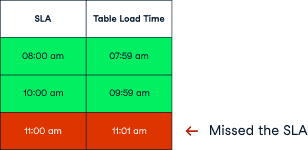
All records in the customer dataset must be loaded by the 9:00 am.
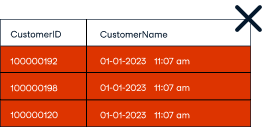
Consistency is a data quality dimension that measures the degree to which data is the same across all instances of the data. Consistency can be measured by setting a threshold for how much difference there can be between two datasets.

The count of records loaded today must be within +/- 5% of the count of records loaded yesterday.
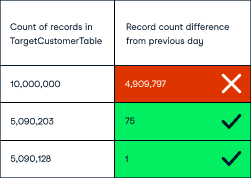
The count of records loaded today must be within +/- 5% of the count of records loaded yesterday.
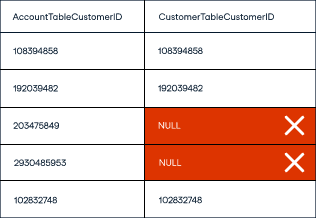
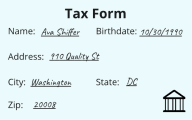
All records in the Customer Table must have accurate Customer Name, Customer Birthdate, and Customer Address fields when compared to the Tax Form.
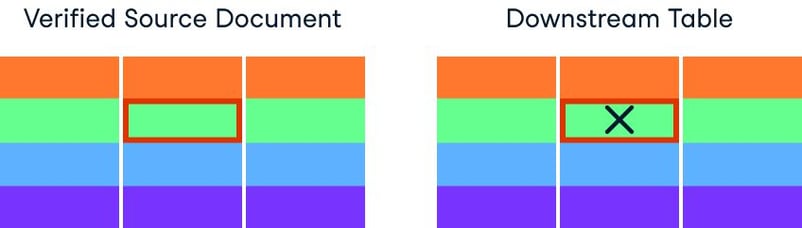
All records in the Customer Table must have accurate Customer Name, Customer Birthdate, and Customer Address fields when compared to the Tax Form.


blog
 Kurtis Pykes • 11 min

blog
 DataCamp Team• 5 min
cheat sheet
 Richie Cotton• 5 min