
course
Understanding Artificial Intelligence
2 घंटा
423.4K
Today, August 10, Anthropic published a research note describing what happened when a staff member asked Claude to attempt the Riemann hypothesis, which is probably the single most famous open math problem. (Always thinking of their investors, Anthropic was clear to remind us that this project was done on a yet-to-be-released version of a Claude model.)
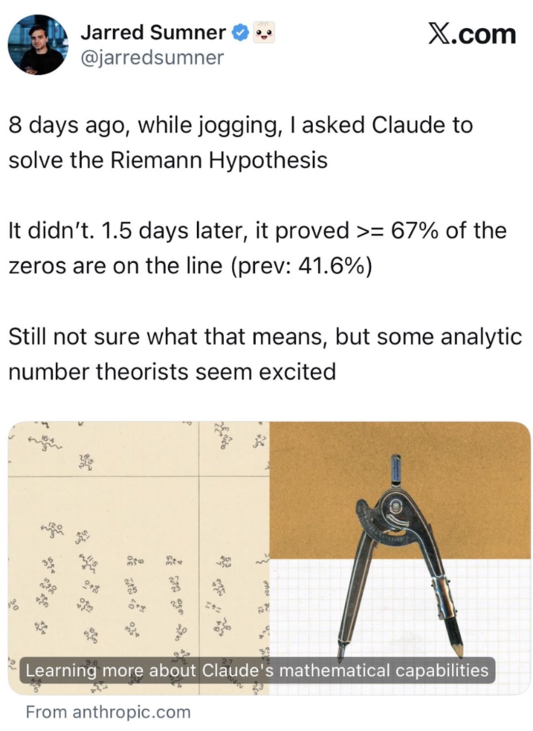
Claude didn't prove the hypothesis. Nobody expected that. But somewhere in the attempt, working on a side question that falls out of the same territory, Claude landed a genuine improvement on a long-standing lower bound: the proportion of zeros of the Riemann zeta function that are known to sit on the "critical line" predicted by the hypothesis. Before, that number was 41.6%, which represented decades of effort. Claude's result raises it to 67.2%.
Two Anthropic mathematicians reviewed the work internally, and two outside experts named Brian Conrey and Dan Goldston were brought in to look it over. Claude also produced a machine-checkable Lean formalization of the proof, so the logical steps could be verified mechanically. The result stands, is significant and interesting.
I won't make you click away to another article to understand this part: The Riemann zeta function is a mathematical function that, in a roundabout way, encodes information about the distribution of prime numbers.
Primes are not random in the sense of being unpredictable one by one.
Whether a given number is prime is entirely determined. But they also don't follow any simple formula because there's no equation that spits out the 100-millionth prime.
There are some formulas that do find prime numbers, but they are really just disguised versions of checking each number one by one. Zoomed out, though, primes thin out at a rate you can actually predict pretty well: Around a given large number n, roughly 1 in every ln(n) numbers is prime, and that ratio holds up as n grows.
Like a lot of functions, the zeta function has "zeros," which are points where its output is exactly zero, and in the case of the zeta function, there are infinitely many of them. Some of those zeros are trivial and well understood; the interesting ones are the rest, and the Riemann hypothesis is the claim that every single one of those non-trivial zeros lies exactly on one specific vertical line, called the critical line.
Here's a way to see the connection to primes. The zeta function, at its simplest, is a sum: 1 + 1/2ˢ + 1/3ˢ + 1/4ˢ + 1/5ˢ + ... running over every whole number, plugged into some exponent s. Nothing about primes yet. It's just adding up fractions.
Euler's trick, back in the 1700s, was to show that same infinite sum is exactly equal to an infinite product that only uses prime numbers: a chain of terms like 1/(1 − 1/2ˢ) × 1/(1 − 1/3ˢ) × 1/(1 − 1/5ˢ) × 1/(1 − 1/7ˢ) × ..., one factor for every prime, with no composite numbers anywhere in it. The reason this works comes down to unique factorization: every whole number breaks down into primes in exactly one way, so summing over all whole numbers and multiplying over all primes ends up encoding the identical information. That equality is the whole tie in. It means the zeta function isn't merely associated with primes, it's actually a repackaging of them.
Last thing here: Riemann showed these zeros control the error term in how primes thin out (that "roughly 1 in every ln(n)" estimate from earlier). The zeros act like the fine print correcting a rough estimate: they're where the deviations between the primes' actual positions and the smooth average show up. The Riemann hypothesis is the claim that every one of the interesting (the "non-trivial" ones we talked about earlier) zeros lies exactly on one specific vertical line, called the critical line, which, if true, means those deviations stay as small and evenly behaved as they possibly can, and primes are distributed about as predictably as they could be.
The Riemann hypothesis says 100% of the non-trivial zeros sit on the critical line. Nobody has proven that, and nobody has disproven it either. What mathematicians have managed to prove, using entirely different methods, is a floor: a guaranteed minimum fraction of those zeros that must sit on the line, no matter what.
This is not the same as computers checking zeros one by one. Trillions of individual zeros have been calculated, and every single one so far has landed on the critical line, but that's just a finite sample. However large, it can't rule out some zero far out on the number line breaking the pattern. Second, and this is the important part, the 41.6% and 67.2% figures are not sample results at all. They're proven statements about the entire infinite set of zeros: a rigorous guarantee that at least that fraction, as you consider more and more zeros, will always sit on the line. It's a hard mathematical floor, not an estimate and not a probability.
So when the number moves from 41.6% to 67.2%, nothing has been "found." What's changed is the size of the guaranteed floor itself, through new proof techniques that squeeze more certainty out of the same infinite set. Getting that floor to climb even a little is historically slow, technical work. Getting it to jump by 25 percentage points in one step is what made this result something to write an article about.
Even a floor that eventually reached 99% would not be a proof. The hypothesis is an all-or-nothing statement about every zero, so a single stray zero off the line anywhere in an infinite set would still break it.
What this is: a real, verified improvement to a specific quantitative question that mathematicians have been grinding away at since Montgomery introduced his techniques in 1973. Claude's result draws on that thread specifically: those 1973 techniques, later adapted by Baluyot, Goldston, Suriajaya, and Turnage-Butterbaugh so they no longer assume the hypothesis is true, combined with a 2000 paper by Enrico Bombieri. Claude found a way to stitch these together, treating a certain space of functions with both positive and negative definite parts at once rather than separately. That's what pushed the floor from 41.6% to 67.2%.
According to Anthropic, an Anthropic staff member, Jarred Sumner, simply prompted Claude, running inside Claude Code, to attempt the Riemann hypothesis and left the actual mathematical decisions to the model.
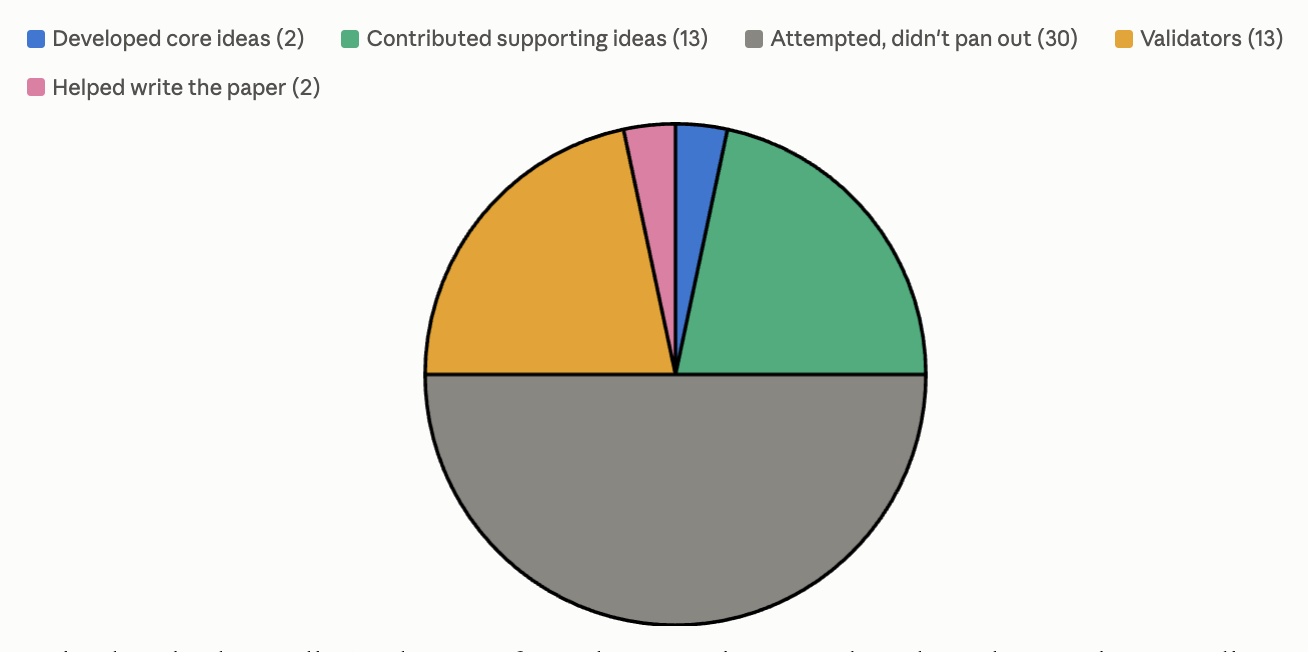
The first pass flopped: Claude generated and tried 650 different ideas, none of which worked. Told to try again, Claude spent roughly a day and a half coordinating around 60 subagents, which, between them, ran about 2,400 shell commands and wrote hundreds of Python scripts, cross-checking numerical claims against known zeta zeros and reviewing each other's reasoning. Of those 60 subagents, only two ended up developing the core mathematical ideas that mattered; thirteen contributed supporting ideas, thirty attempted approaches that didn't pan out, thirteen worked as validators, and the final two helped draft the paper.
The whole run used about 31 million output tokens across two sessions. Notably, the human's contribution during the process was mostly encouragement ("keep going!"-that kind of thing) which Anthropic suggests may have helped Claude push past its own early skepticism that the problem was tractable.
Once Claude landed on the result, it didn't stop there: it had subagents search for counterexamples, pulled 54 papers from arXiv to check the result hadn't already been published, and re-derived the finding independently as a sanity check. It then proposed writing the result up as a paper and recommended a human number theorist check its work, which is exactly what happened next, with Anthropic mathematicians Levent Alpöge and Ralph Furman examining it internally and Conrey and Goldston reviewing externally, and then a separate Lean formalization, produced with Anthropic's Eric Easley.
Two main things jump out at me:
This is not a Riemann hypothesis breakthrough, and nobody involved is claiming otherwise. But it is a real, formally verified improvement to a specific, technical, decades-old question that emerged out of a swing at the real target.
For further reading: We've written about other interesting AI and math news:
Learn AI with DataCamp
course
Track
course
blog
Vinod Chugani
8 मि॰
blog
Vinod Chugani
9 मि॰
blog
Vinod Chugani
10 मि॰
blog
Vinod Chugani
10 मि॰
podcast
Richie Cotton
46 मि॰
tutorial
François Aubry
8 मि॰