
Course
Understanding Artificial Intelligence
2 hr
420.8K
In September 2026, researcher Jacob Coxon (who had spent roughly three years on pretraining research at OpenAI before joining Anthropic just two months earlier) resigned, warning publicly that leading labs are racing toward what he called "self-improving superintelligence" without acting responsibly enough given the risks. Evan Hubinger, who leads alignment science at Anthropic, publicly agreed that the future risk deserves serious concern, while distinguishing it from what current systems can actually do. The debate landed in mainstream AI discourse fast.
The concept at the center of that argument is recursive self-improvement (RSI). It's worth understanding on its own terms, separate from the controversy, because the underlying idea is broader and more clarifying than any single news cycle. This article covers what RSI actually means, how the feedback loop works, what today's AI can genuinely do toward it, and why researchers disagree about where it leads.
Recursive self-improvement describes a feedback loop where AI contributes to creating more capable AI, and that more capable AI becomes better at contributing to the next improvement, and so on:
AI helps improve AI → the improved AI becomes better at improving AI → that system contributes to the next improvement → repeat
It's worth separating three things that often get conflated.
Full RSI is the third thing. No current AI system has conclusively achieved that. This is precisely the line Anthropic itself draws, noting that full RSI has not yet been achieved and may not be inevitable. That distinction is also what makes the Coxon debate so charged: the argument isn't about whether RSI exists today, but about how fast the gap is closing and what that demands of the people building these systems.
A self-improving system, in the RSI sense, would contribute to the AI development pipeline itself. That means writing and improving research code, designing experiments, generating or filtering training data, evaluating model performance, identifying weaknesses, and proposing algorithmic improvements. The recursive part matters: if the system produced through this process becomes better at those same tasks, then the next iteration of AI development could happen faster or more effectively.
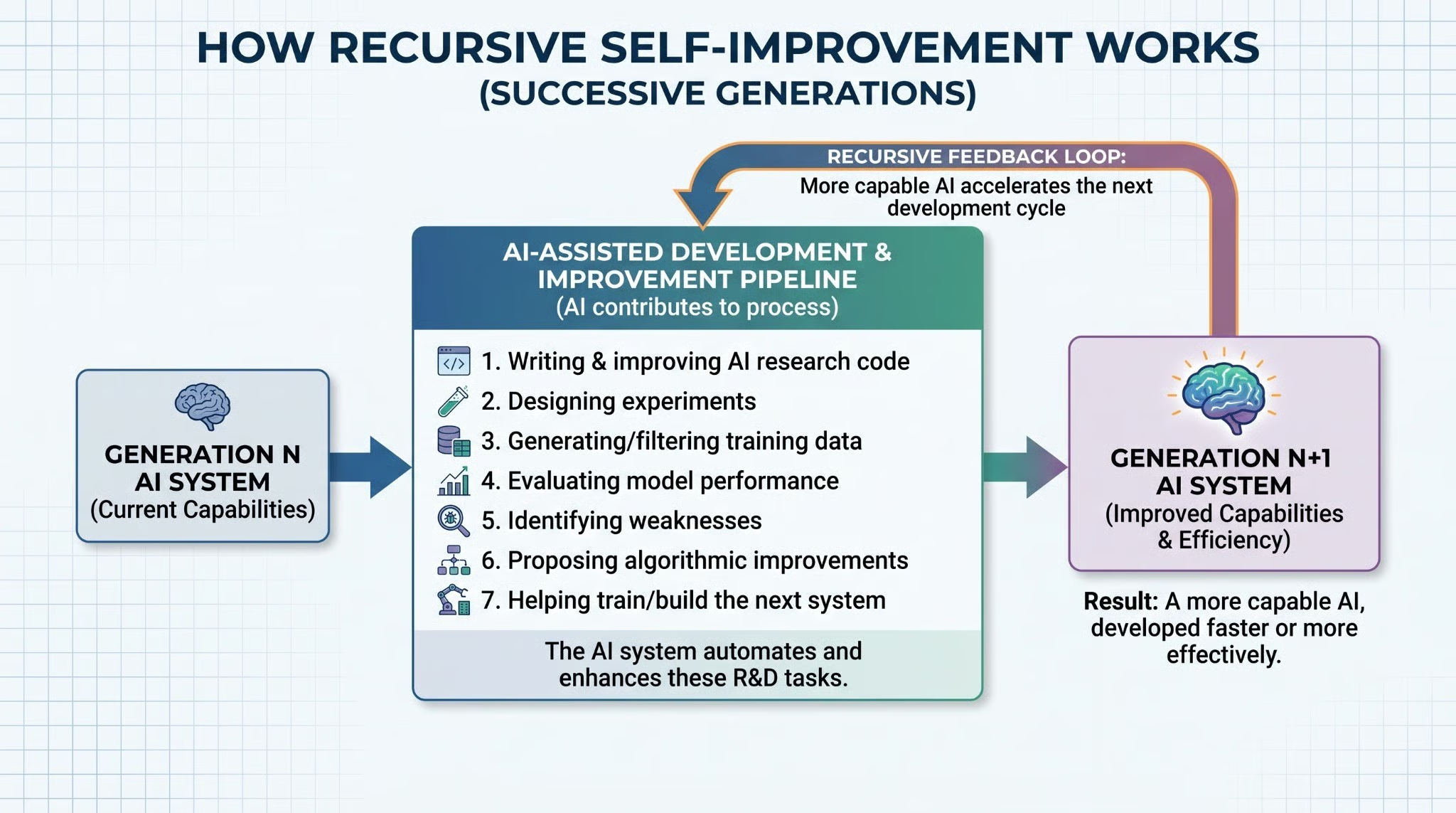
Diagram illustrating the recursive self-improvement feedback loop across successive AI generations. Image by Author.
This isn't a model literally rewriting its own weights in real time. Think of it as successive generations: each generation of AI contributes more effectively to building the next one. The loop compounds across versions, not within a single running system.
The most common misconception about RSI is confusing it with self-correction. It trips up even people who follow AI closely, so it's worth being precise.
Self-correction is when a model critiques or revises its own answer, code, or plan during a task. That includes catching an error in its reasoning, debugging code it just wrote, or refining a draft. This happens constantly in current systems.
RSI is categorically different. Improvements affect the capabilities of the AI system or its successors, potentially making future AI development itself more effective. An agent repeatedly debugging its own code is not automatically recursive self-improvement; it's just a capable agent. The distinction is whether the improvement persists and compounds into the development of the next system.
Self-correction is a tool a system uses on a task. RSI is what happens when the task is building the next system.
It helps to map RSI against a few other concepts that often appear in the same conversations, especially as the Coxon debate has pushed terms like "superintelligence" and "singularity" into the same headlines.
Automated AI R&D covers systems that run experiments, analyze results, and propose next steps. These can contribute to RSI without constituting full RSI. A system that automates parts of the research pipeline is part of the trend, not the endpoint. The gap between "helps with research" and "autonomously develops its successors" is what matters. Anthropic's own published work describes AI taking on more of this pipeline, which is why Coxon's resignation landed with force. The movement is real; the question is how far it goes.
Continual learning means a deployed model updates from new information over time. RSI means improving the process used to develop increasingly capable AI systems. One changes what a model knows; the other changes how capable the next model becomes.
RSI describes a process. Superintelligence describes a proposed level of capability. They're related in the sense that RSI is one hypothesized path toward superintelligence, but they're not the same concept, and conflating them muddies both.
When Coxon warns about "self-improving superintelligence," he's describing a scenario where RSI produces a system that surpasses human-level capability across domains. That's a specific claim about what the process could eventually yield, not a description of the process itself.
The AI singularity is a hypothetical point at which AI improvement becomes so rapid and self-sustaining that humans can no longer predict or control what comes next. Think of it as the moment the curve goes vertical: change happening faster than our ability to understand or respond to it. RSI is one proposed mechanism for getting there. But the singularity is the speculative outcome, not the process itself, and plenty of researchers think the curve levels off long before anything like that occurs.
Closer than most people realized a few years ago. Not as close as some headlines suggest.
AI systems are already involved in coding, debugging, running experiments, analyzing experimental results, model evaluation, and AI research assistance. Anthropic has said publicly that it's delegating a growing share of AI development work to AI systems, and that its engineers now ship substantially more code than in previous years. At the same time, Anthropic is explicit that humans retain important roles in research judgment. That means deciding which problems to pursue and evaluating whether results actually mean what they appear to mean.
Increasing AI involvement in AI R&D is evidence of movement toward greater automation. It's not proof that an autonomous RSI loop already exists. The pipeline has more AI in it; it doesn't yet run itself. This ambiguity, real progress with an unclear endpoint, is precisely what Coxon found insufficient. His resignation wasn't a claim that RSI has arrived. It was an argument that treating it as a distant concern is no longer defensible.
So what would it actually take to close that gap? A few bottlenecks stand out, and the distance to each tells us something about the realistic timeline.
Writing and modifying research code autonomously is a prerequisite. Current models are genuinely good at this, though they still make mistakes that require human review on consequential work.
Running experiments autonomously is a separate bottleneck from writing the code to run them. A system that can design an experiment, execute it, interpret the results, and decide what to try next closes a meaningful part of the loop. Current systems can do pieces of this. The full cycle, without a human checking the reasoning at each step, is still out of reach.
Here's where things get interesting. Anthropic specifically identifies human research taste and judgment as a remaining area of comparative advantage. That's knowing which experiments are worth running, which results to trust, which directions have promise. Much of the experimental work of research is becoming automatable. The judgment layer is not. This is also where Anthropic believes humans currently add the most irreplaceable value, and where the distance to full RSI remains largest.
Knowing whether a model actually got better is harder than it sounds. Evaluation requires judgment about what matters, and current benchmarks are easy to game or outgrow. Until AI systems can reliably assess their own successors, humans remain in the loop at this stage, which is itself a significant brake on autonomous RSI.
Raw capability isn't the only constraint. Running the development cycle autonomously requires infrastructure that can support large-scale training and evaluation without constant human intervention, and that remains expensive and organizationally complex.
Knowing whether a model actually got better is harder than it sounds. Evaluation requires judgment about what matters, and current benchmarks are easy to game or outgrow. Until AI systems can reliably assess their own successors, humans remain in the loop at this stage, which is itself a significant brake on autonomous RSI.
Even if AI systems can write code, run experiments, and evaluate results, humans are still signing off on what actually ships. That review step is a hard constraint on how fast the loop can run. You can automate the work and still bottleneck on the approval. Until AI judgment is trusted enough to remove that gate, human review is probably the most immediate ceiling on RSI progress, not a philosophical concern about the future.
The answer has two parts: potential upside and serious risk.
If AI systems can accelerate AI research itself, the same effect could extend to software development, scientific discovery, medicine, and engineering more broadly. The argument is that an AI good enough at research acceleration could compress timelines across many fields, not just AI.
Here's the feedback-loop argument stated plainly: improvements to AI research capability could increase the rate at which further AI improvements occur. That compounding is what makes RSI theoretically significant, and what makes researchers like Coxon nervous enough to resign over it. Worth noting: faster capability development doesn't automatically produce an intelligence explosion. The loop could be real and still be slow, bounded, or subject to diminishing returns.
AI-generated experiments, code, and model changes could eventually be produced faster than humans can meaningfully review them. The oversight that currently shapes AI development depends on humans being able to keep up with the pace of what's being built. This is one reason Anthropic still emphasizes the role of human judgment in its research pipeline, even as it automates more of the work.
More capable systems involved in developing their successors make the alignment problem more consequential. If the system contributing to the next generation has subtly misaligned goals, those could propagate or worsen in the successor. This is precisely the risk Hubinger has written about extensively, and it's what he was signaling when he agreed with Coxon's concern about future risks while maintaining that current systems don't yet pose the same threat.
More capable autonomous systems also expand the attack surface. A system involved in its own development pipeline is a higher-value target, and the failure modes get more consequential as autonomy increases. Containment and access control become harder to design when the system being contained is also helping build the next version of itself.
If the feedback loop meaningfully accelerates development, institutions may have less time to evaluate and respond to new capabilities. Anthropic has said full RSI could increase risks of humans losing control of AI systems, while also saying RSI is neither achieved nor inevitable.
Jacob Coxon's resignation from Anthropic in September 2026 framed the issue in urgent terms: that Anthropic and OpenAI are racing toward self-improving superintelligence and not acting responsibly enough, given the potential consequences. Evan Hubinger publicly agreed (putting his personal estimate of AI-caused human extinction within the decade above 10% and acknowledging that Anthropic does not yet have a plan for aligning superintelligence) while distinguishing that future concern from the risk posed by current systems. Coxon has since said his core disagreement with Anthropic leadership is about whether a competitive race toward RSI is inevitable and therefore must be participated in.
That disagreement sits alongside Anthropic's own earlier publication describing progress toward AI-automated AI development, the same research that shows AI taking on more of the development pipeline. The two things are consistent with each other, which is part of why the debate is hard to dismiss. Don't take Coxon's predictions about catastrophic outcomes as established facts. They're part of an ongoing argument, not settled science.
The theoretical argument runs: better AI leads to better AI research leads to even better AI leads to faster improvement. The logic is clean. The question is whether it holds in practice.
Indefinite acceleration doesn't automatically follow. Real constraints include compute, energy, hardware, training data, algorithmic bottlenecks, experimental feedback cycles, diminishing returns, and remaining dependence on human judgment. An intelligence explosion is a debated hypothesis about what sufficiently effective RSI could produce, not a definition of RSI itself. It's one scenario in a distribution, not the obvious endpoint. Nobody, including the researchers at Anthropic who think hardest about this, knows how steep the curve gets or where it levels off.
That uncertainty makes governance both more urgent and more difficult. The core challenge is preserving meaningful oversight if AI-generated research begins to outpace human review. Active proposals and research areas include capability evaluations before deployment, model containment approaches, access controls on AI systems involved in AI development, monitoring of AI R&D activity, human approval requirements for consequential actions, independent evaluation, and coordination between frontier AI labs.
None of these is a complete solution, and the Coxon debate underscores why: governance frameworks designed for today's level of AI involvement in the pipeline may not scale to tomorrow's. The gap between where the tools are and where the technology is headed is part of what makes this moment feel genuinely consequential to the people working closest to it.
Recursive self-improvement describes a feedback loop in which AI contributes to creating more capable AI, which may then become better at contributing to subsequent improvements. Straightforward to state, genuinely uncertain to evaluate.
Today's AI-assisted development is real and growing, as Anthropic's own research makes clear. Full autonomous RSI, where AI systems substantially design and develop their successors without human direction, hasn't been achieved. Anthropic itself holds that line. The gap between those two things is where all the interesting and contested questions live: how quickly is it closing, what happens if it does, and who gets to decide how fast to move?
The Coxon-Hubinger exchange didn't create those questions. It made them impossible to treat as theoretical. Whether you find Coxon's timeline alarming or Anthropic's framing more measured, the underlying dynamic is the same: AI is increasingly inside the loop that builds AI. Understanding what that means, clearly and without hype in either direction, is what RSI is worth knowing about.
Learn AI with DataCamp
Course
Course
Course
blog
Javier Canales Luna
10 min
blog
Natasha Al-Khatib
14 min
blog
Javier Canales Luna
10 min
blog
Ryan Ong
12 min
blog
Benito Martin
14 min
blog
Javier Canales Luna
9 min