Course
Introduction to APIs in Python
2 hr
34.8K
REST APIs power most of the internet's integrations. Whether you are applying for a backend role, a full stack position, or a software engineering job, you will likely face questions about REST API design, HTTP methods, and authentication patterns.
In this guide, I will walk you through the questions interviewers actually ask. I have organized them by difficulty level and role type, so you can focus on what matters most for your target position. Each answer includes practical examples and, where relevant, code snippets you can adapt.
One thing to keep in mind: interviewers test fundamentals far more often than advanced topics. If you nail the basics (HTTP methods, status codes, statelessness), you will handle most REST API interviews confidently. The fancy architectural patterns come later.
These questions test your foundational knowledge. Expect them in almost every interview, regardless of seniority level.
REST stands for Representational State Transfer. It is an architectural style for designing networked applications, defined by Roy Fielding in his 2000 doctoral dissertation.
REST has six constraints:
REST is an architectural style; SOAP is a protocol. REST typically uses JSON over HTTP and leverages standard HTTP methods. SOAP uses XML exclusively and defines its own messaging format with envelopes and headers.
|
Aspect |
REST |
SOAP |
|
Format |
JSON, XML, others |
XML only |
|
Transport |
HTTP |
HTTP, SMTP, others |
|
Caching |
Native HTTP caching |
Not cacheable |
|
Performance |
Lightweight |
Higher overhead |
SOAP still makes sense for enterprise systems requiring formal contracts (WSDL) or message-level security (WS-Security).
HTTP methods define the action to perform on a resource.
|
Method |
Purpose |
Example |
|
|
Retrieve a resource |
|
|
|
Create a new resource |
|
|
|
Replace a resource entirely |
|
|
|
Partially update a resource |
|
|
|
Remove a resource |
|
POST creates a new resource where the server determines the URI. PUT replaces a resource at a specific URI that the client specifies.
POST /users          → Server creates user, returns /users/123
PUT /users/123       → Client specifies URI, replaces entire resource
If you PUT to a URI that does not exist, the server may create it. If you PUT to an existing URI, you replace the entire resource.
PUT replaces the entire resource. PATCH applies partial modifications.
# PUT replaces everything
PUT /users/123
{"name": "Khalid", "email": "khalid@example.com", "role": "admin"}

# PATCH updates only specified fields
PATCH /users/123
{"role": "admin"}Stateless means each request must contain all the information the server needs to process it. The server does not store any client context between requests.
This means no server-side sessions. If a user is authenticated, the client must send credentials (typically a token) with every request.
An API is truly RESTful when it satisfies all REST constraints, including HATEOAS (Hypermedia as the Engine of Application State). In practice, most APIs that call themselves "REST" are actually "REST-like" or at Richardson Maturity Model Level 2. And honestly, that is fine for most use cases.
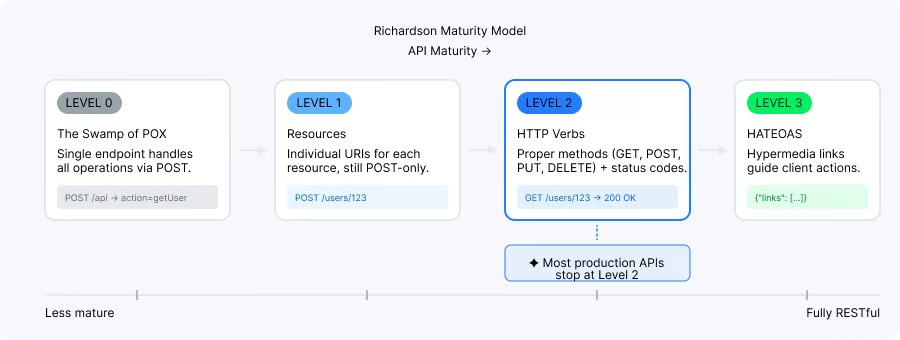
Richardson Maturity Model levels for REST APIs. Image by Author.
You should be familiar with at least these seven essential status codes that cover the majority of API scenarios:
|
Code |
Name |
When to Use |
|
200 |
OK |
Successful GET, PUT, PATCH |
|
201 |
Created |
Successful POST (include Location header) |
|
204 |
No Content |
Successful DELETE |
|
400 |
Bad Request |
Malformed syntax |
|
404 |
Not Found |
Resource does not exist |
|
500 |
Internal Server Error |
Server-side failure |
A resource is the data entity (user, order, product). An endpoint is the URL path that provides access to that resource.
Resource: User
Endpoints: GET /users, GET /users/123, POST /usersUse nouns, not verbs. Keep URIs lowercase with hyphens for multi-word names. Use plural nouns for collections.
Good:  /users, /users/123, /order-items
Bad:   /getUsers, /Users, /order_items
Avoid deep nesting. Instead of /users/123/posts/456/comments/789, consider /comments/789 or /comments?post_id=456.
An operation is idempotent if performing it multiple times produces the same result as performing it once.
|
Method |
Idempotent |
Why |
|
|
Yes |
Reading does not change state |
|
|
Yes |
Replacing with same data yields same result |
|
|
Yes |
Deleting twice leaves resource deleted |
|
|
No |
Creating twice creates two resources |
|
|
No* |
Depends on the operation |
A PATCH that sets a value is idempotent; a PATCH that increments a counter is not.
Safe methods do not modify resources (GET, HEAD, OPTIONS). Idempotent methods can be called multiple times with the same effect (GET, PUT, DELETE).
All safe methods are idempotent, but not all idempotent methods are safe. DELETE is idempotent but not safe because it modifies state.
Path parameters identify a specific resource. Query parameters filter, sort, or paginate collections.
Path:   /users/123              (specific user)
Query:  /users?status=active    (filtered collection)
/users?sort=name&limit=10Content negotiation allows clients to request different representations of a resource. The client sends an Accept header, and the server responds with the appropriate format.
Accept: application/json    → Server returns JSON
Accept: application/xml → Server returns XMLOPTIONS returns the HTTP methods that a server supports for a specific URL. Browsers use it for CORS preflight requests to check if cross-origin requests are allowed.
These questions test practical application and decision-making. Expect them for mid-level positions.
This is the most commonly confused pair of status codes. I have seen senior engineers mix these up in code reviews.
Means unauthenticated. The server does not know who you are. Your response should prompt the user to log in.
Means unauthorized. The server knows who you are but you lack permission. Re-authenticating will not help.
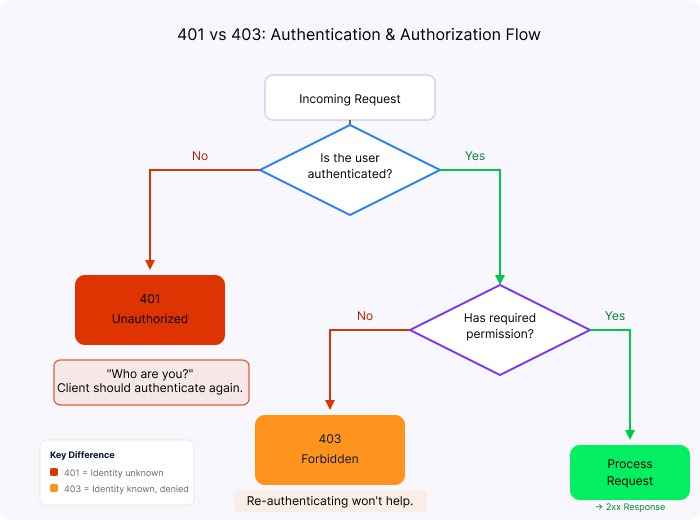
Authentication versus authorization error decision flowchart diagram. Image by Author.
Here are examples illustrating the difference:
This indicates malformed syntax. The server cannot parse the request (invalid JSON structure, missing required headers).
This indicates valid syntax but semantic errors. The JSON is valid but the data fails validation (invalid email format, password too short).
# 400: Cannot parse
{"name": "Khalid",}  # Trailing comma breaks JSON

# 422: Valid JSON, invalid data
{"email": "not-an-email"} # Fails validationUse 409 when the request conflicts with the current state of the resource:
Two main approaches:
Simple but has performance issues with large datasets.
GET /users?limit=20&offset=40Scales better and avoids "page drift" when data changes.
GET /users?limit=20&cursor=eyJpZCI6MTIzfQCompanies like Stripe, GitHub, and Slack use cursor-based pagination for large datasets.
There are three main approaches, each with different trade-offs:
This is the most common. It is explicit and easy to debug.
GET /v1/users
GET /v2/usersCleaner URLs but harder to test in browsers.
GET /users
Accept-Version: v2Easy to add but clutters URLs.
GET /users?version=2An ETag is a version identifier for a resource. The server sends it in responses; the client sends it back in subsequent requests to check if the resource changed.
# First request
GET /users/123
Response: ETag: "abc123"

# Subsequent request
GET /users/123
If-None-Match: "abc123"
Response: 304 Not Modified (if unchanged)The four most common authentication methods are API Keys, Bearer Tokens, OAuth 2.0, and JWT:
|
Method |
Use Case |
Pros |
Cons |
|
API Keys |
Server-to-server |
Simple |
No expiration, easy to leak |
|
Bearer Tokens |
Session auth |
Stateless |
Must secure storage |
|
OAuth 2.0 |
Third-party access |
Delegated auth |
Complex implementation |
|
JWT |
Stateless auth |
Self-contained |
Cannot revoke without blacklist |
JWT (JSON Web Token) consists of three parts: Header, Payload, and Signature. Learn more about working with JSON in Python.
Header: {"alg": "RS256", "typ": "JWT"}
Payload: {"sub": "user123", "exp": 1704153600}
Signature: RSASHA256(base64(header) + "." + base64(payload), privateKey)
The server signs the token; clients send it with requests. The server validates the signature without database lookups.
HS256 (symmetric): Same secret signs and verifies. Risk if multiple services need to verify tokens.
RS256 (asymmetric): Private key signs, public key verifies. Recommended for distributed systems where multiple services validate tokens.
HATEOAS (Hypermedia as the Engine of Application State) means responses include links to related actions and resources.
{
  "id": 123,
  "name": "Khalid",
  "links": [
    {"rel": "self", "href": "/users/123"},
    {"rel": "orders", "href": "/users/123/orders"}
  ]
}
In practice, most APIs do not implement HATEOAS fully. Know the concept but do not expect to implement it in most jobs. Even large tech companies rarely build fully HATEOAS-compliant APIs.
Use RFC 7807 Problem Details format for consistent error responses:
{
  "type": "https://api.example.com/errors/validation",
  "title": "Validation Error",
  "status": 422,
  "detail": "Email format is invalid",
  "instance": "/users"
}Rate limiting protects your API from abuse and ensures fair usage. Common response:
HTTP/1.1 429 Too Many Requests
Retry-After: 3600
X-RateLimit-Limit: 1000
X-RateLimit-Remaining: 0Use query parameters with clear conventions:
# Filtering
GET /products?category=electronics&price[gte]=100&price[lte]=500

# Sorting (prefix - for descending)
GET /users?sort=-created_at,nameThese questions test architectural thinking. Expect them for senior positions.
OAuth 2.1 consolidates security best practices:
|
Feature |
OAuth 2.0 |
OAuth 2.1 |
|
PKCE |
Optional |
Mandatory for ALL clients |
|
Implicit Grant |
Supported |
Removed |
|
Password Grant |
Supported |
Removed |
|
Redirect URI |
Flexible matching |
Exact match required |
The key takeaway: use Authorization Code flow with PKCE for all client types.
Use idempotency keys to make POST requests safe for retries:
async def handle_payment(request: Request, payment: PaymentCreate):
    idempotency_key = request.headers.get("Idempotency-Key")

    # Check if already processed
    cached = await redis.get(f"idem:{idempotency_key}")
    if cached:
        return JSONResponse(json.loads(cached))

    # Process payment
    result = await process_payment(payment)

    # Cache result (24-hour TTL)
    await redis.setex(f"idem:{idempotency_key}", 86400, json.dumps(result))
    return result
The client generates a UUID and sends it with the request. If the same key arrives again, return the cached response.
For distributed systems, you cannot use in-memory counters because traffic is load-balanced across instances. This is a common gotcha that trips up candidates.
Architecture:
# Pseudocode for Token Bucket
tokens = redis.get(user_id) or max_tokens
if tokens > 0:
    redis.decr(user_id)
    process_request()
else:
return 429The choice between gRPC and REST depends on your specific requirements.
Use the asynchronous request pattern:
Client sends request
Server returns 202 Accepted with a status URL
Client polls the status URL until completion
POST /reports
Response: 202 Accepted
Location: /reports/abc123/status

GET /reports/abc123/status
Response: {"status": "processing", "progress": 45}

GET /reports/abc123/status
Response: {"status": "completed", "result_url": "/reports/abc123"}Saga handles distributed transactions across microservices without locking. Each service executes a local transaction and publishes an event. If a step fails, compensating transactions undo previous steps.
Order Created → Payment Processed → Inventory Reserved → Order Confirmed
                     ↓ (failure)
Release Payment → Cancel OrderAlgorithm confusion Attacker changes RS256 to HS256 and signs with the public key. Fix: always whitelist algorithms.
# Vulnerable
jwt.decode(token, key)

# Secure
jwt.decode(token, key, algorithms=["RS256"])
"none" algorithm: Attacker removes signature entirely. Fix: reject "none" algorithm.
These questions focus on server-side implementation details, database optimization, and performance patterns that backend engineers encounter daily.
The N+1 problem occurs when you fetch N records and then execute a separate query for each record's relationship.
# N+1 Problem: 101 queries for 100 users
users = User.query.all()  # 1 query
for user in users:
    print(user.posts)     # 100 queries
Solutions:
Django: Use select_related() for foreign keys, prefetch_related() for many-to-many.
# 2 queries instead of 101
users = User.objects.prefetch_related('posts').all()
SQLAlchemy: Use joinedload() or selectinload().
Connection pooling reuses database connections instead of creating new ones for each request.
# SQLAlchemy
engine = create_engine(
    "postgresql://user:pass@host/db",
    pool_size=5,           # Permanent connections
    max_overflow=10,       # Temporary overflow
    pool_timeout=30,       # Wait timeout
    pool_pre_ping=True     # Validate before use
)There are three primary caching strategies, each optimized for different access patterns:
|
Strategy |
Description |
Use Case |
|
Cache-Aside |
App checks cache, then DB |
Read-heavy, tolerates staleness |
|
Write-Through |
Write to cache and DB together |
Consistency critical |
|
Write-Behind |
Write to cache, async DB update |
High write throughput |
Webhook signature verification ensures the request actually came from the expected sender. Here's an implementation using HMAC:
import hmac
import hashlib

def verify_webhook(payload: bytes, signature: str, secret: str) -> bool:
    expected = 'sha256=' + hmac.new(
        secret.encode(),
        payload,
        hashlib.sha256
    ).hexdigest()
return hmac.compare_digest(expected, signature)You should monitor these four key metrics to assess your API's health:
|
Metric |
Description |
Alert Threshold |
|
P50 Latency |
Median response time |
Baseline |
|
P99 Latency |
Slowest 1% |
> 2s for 5 min |
|
Error Rate |
% of 4xx/5xx |
> 1% for 5 min |
|
Throughput |
Requests per second |
Capacity planning |
These questions test your understanding of both client and server concerns, particularly browser security, state management, and cross-origin communication.
Browsers send an OPTIONS preflight for:
Secure CORS configuration requires explicitly whitelisting origins and carefully handling credentials. Here's a secure Express.js setup:
// Express.js
app.use(cors({
  origin: ['https://yourdomain.com'],  // Never use * with credentials
  credentials: true,
  methods: ['GET', 'POST', 'PUT', 'DELETE'],
  allowedHeaders: ['Content-Type', 'Authorization']
}));
Never use wildcard (*) with credentials. Never allow null origin.
Token storage involves security trade-offs between XSS and CSRF vulnerabilities"
|
Storage |
XSS Risk |
CSRF Risk |
Recommendation |
|
localStorage |
High |
None |
Avoid for tokens |
|
HttpOnly Cookie |
Low |
Requires mitigation |
Recommended |
|
In-memory |
Low |
Low |
Best for access tokens |
Best practice: Store refresh tokens in HttpOnly cookies with SameSite=Strict. Keep access tokens in memory.
The choice depends on whether you need bidirectional communication and how you want to handle reconnection:
|
Feature |
WebSockets |
SSE |
|
Direction |
Bidirectional |
Server to client |
|
Reconnection |
Manual |
Automatic |
|
Binary data |
Yes |
No |
Use SSE for notifications, live feeds, stock tickers. Use WebSockets for chat, multiplayer games, collaborative editing.
For large files, use chunked uploads with progress tracking:
async function chunkedUpload(file, chunkSize = 5 * 1024 * 1024) {
  const totalChunks = Math.ceil(file.size / chunkSize);

  for (let i = 0; i < totalChunks; i++) {
    const chunk = file.slice(i * chunkSize, (i + 1) * chunkSize);
    await uploadChunk(uploadId, i, chunk);
  }
}These questions evaluate your ability to apply REST principles to real-world problems. Interviewers want to see your design process and how you make architectural trade-offs.
A hotel booking system needs to handle searches, availability checks, and reservations while preventing double-bookings. Here are the core resources:
Resources:
/hotels - List and search hotels
/hotels/{id}/rooms - Available rooms
/bookings - Create and manage bookings
/guests/{id} - Guest profiles
Key decisions:
Add a deleted_at timestamp instead of removing records:
@app.delete("/users/{user_id}")
def delete_user(user_id: int):
    user = db.get(user_id)
    user.deleted_at = datetime.utcnow()
    db.commit()
    return Response(status_code=204)

@app.get("/users")
def list_users(include_deleted: bool = False):
    query = User.query
    if not include_deleted:
        query = query.filter(User.deleted_at.is_(None))
return query.all()Use the Strangler Fig pattern:
For a product search with multiple filters:
GET /products?q=laptop&category=electronics&price[gte]=500&price[lte]=2000&brand=apple,dell&in_stock=true&sort=-rating&limit=20&cursor=abc123Design decisions:
Options:
Gateway-level versioning: API gateway routes /v1/* to old services, /v2/* to new
Service-level versioning: Each service handles its own version negotiation
Consumer-driven contracts: Use Pact or similar tools to ensure compatibility
For most teams, gateway-level versioning provides the cleanest separation.
The solution involves defining tier-specific limits and checking them using Redis counters:
RATE_LIMITS = {
    "free": {"requests": 100, "window": 3600},
    "pro": {"requests": 1000, "window": 3600},
    "enterprise": {"requests": 10000, "window": 3600}
}

async def rate_limit_middleware(request: Request):
    user = get_current_user(request)
    tier = user.subscription_tier
    limits = RATE_LIMITS[tier]

    key = f"rate:{user.id}:{current_hour()}"
    count = await redis.incr(key)

    if count == 1:
        await redis.expire(key, limits["window"])

    if count > limits["requests"]:
        raise HTTPException(
            status_code=429,
            headers={
                "X-RateLimit-Limit": str(limits["requests"]),
                "X-RateLimit-Remaining": "0",
                "Retry-After": str(seconds_until_reset())
            }
)These questions assess your communication skills and how you handle real-world API challenges. Focus on demonstrating your problem-solving process and how you work with stakeholders.
"Think of a REST API like a waiter in a restaurant. You (the customer) cannot go into the kitchen directly. Instead, you tell the waiter what you want from the menu, and they bring it to you. The menu is like the API documentation, listing what you can order. The waiter follows specific rules: you ask for something (GET), you order something new (POST), or you send something back (DELETE). If the kitchen is out of something, the waiter tells you (404 Not Found) so you do not wait forever."
This analogy works surprisingly well in stakeholder meetings.
Use the STAR method:
Announce early: Give at least 6-12 months notice for major changes
Use Sunset header: Sunset: Sat, 31 Dec 2026 23:59:59 GMT
Provide migration guides: Document exactly what changes and how to adapt
Run both versions: Keep old version running during transition
Monitor usage: Track which clients are still on the old version
Essential documentation includes:
REST is not always the right choice. Knowing when to use alternatives shows architectural maturity. I have seen teams force REST into use cases where it creates more problems than it solves.
|
Scenario |
Better Alternative |
|
Real-time chat or gaming |
WebSockets |
|
High-performance internal services |
gRPC |
|
Complex nested data queries |
|
|
Event-driven architectures |
Message brokers (Kafka, RabbitMQ) |
|
Bidirectional streaming |
gRPC bidirectional or WebSockets |
Use this section as a quick lookup when you need to verify HTTP method properties, status codes, or common patterns during interview preparation or real-world development.
This table summarizes the key properties of each HTTP method, helping you choose the right one for your use case.
|
Method |
Safe |
Idempotent |
Cacheable |
Typical Use |
|
GET |
Yes |
Yes |
Yes |
Retrieve resource |
|
POST |
No |
No |
Conditional |
Create resource |
|
PUT |
No |
Yes |
No |
Replace resource |
|
PATCH |
No |
No |
Conditional |
Partial update |
|
DELETE |
No |
Yes |
No |
Remove resource |
|
HEAD |
Yes |
Yes |
Yes |
Get headers only |
|
OPTIONS |
Yes |
Yes |
No |
CORS preflight |
Here are the most commonly used HTTP status codes, organized by category. Focus on understanding when to use each rather than memorizing the full specification.
Even experienced developers fall into these traps. Watch out for these common pitfalls when designing or implementing REST APIs:
Using verbs in URLs (e.g., /getUsers instead of /users)
Returning 200 OK for error states, which breaks client-side error handling
Confusing 401 and 403 (Authentication vs. Authorization)
Over-nesting URLs beyond two levels
Storing tokens in localStorage (creates XSS vulnerabilities)
Ignoring idempotency for POST requests
Returning generic error messages without actionable details
I recognize that memorizing definitions won't guarantee you pass every technical interview. The reality is that real-world engineering often requires breaking the "strict" rules we just discussed, and interviewers care more about your reasoning than your ability to recite RFC specifications. For highly specialized roles, deep domain knowledge or specific framework expertise might still be the deciding factor.
But mastering these REST fundamentals matters even if you don't encounter these exact questions. It serves as a blueprint for understanding how the modern web operates. When you are asked to design a new system or debug a production outage, understanding the distinction between a 401 and a 403 (as I explained earlier) gives you the clarity to solve problems faster. You will recognize exactly why standardizing your API interactions, not just writing code that works, is the hallmark of a senior engineer.
If you want to dive deeper into building these systems, check out our Introduction to APIs in Python course.
Learn with DataCamp
Course
Course
Course
blog
Zoumana Keita
15 min
blog
Abid Ali Awan
15 min
blog
Elena Kosourova
15 min
blog
Srujana Maddula
12 min
blog
Patrick Brus
15 min
blog
Patrick Brus
15 min