
Last chance! 50% off DataCamp Premium
Sale ends in
Buy Now

Practice and track your progress.
Continue with GoogleBy continuing, you accept our Terms of Use, our Privacy Policy and that your data is stored in the USA.
If you are considering a career in analytics or business intelligence, Power BI is one of the best skills to add to your resume. Not only is there a variety of job opportunities with Power BI, but it is also a valuable skill for long-term career growth.
If you do not know what Power BI is or if you are unsure whether a career in it is really worth it, keep reading!
In this article, we will discuss where Power BI sits in the market and what kinds of career opportunities are available with it. We will also discuss what kind of salary you can expect, what skills and experience you should have, and what each job involves.
Power BI is a business intelligence (BI) tool that allows you to connect to various data sources, visualize the data in reports and dashboards, and then share them with anyone you want. In general, the purpose of BI is to track Key Performance Indicators (KPIs) and uncover insights in business data so as to better inform decision-making across the organization.
To learn more about Power BI and get a grip on the fundamentals, check out this introductory tutorial or consider signing up for this DataCamp Power BI skill track.
The next question you are probably asking yourself is whether a Power BI career is worth it. Let's examine where Power BI is positioned in the market compared to some of the other popular business intelligence tools.
Every year, Gartner releases a summary of the analytics and business intelligence market using its Magic Quadrant methodology. The 2024 Magic Quadrant for analytics and BI platforms is shown below.
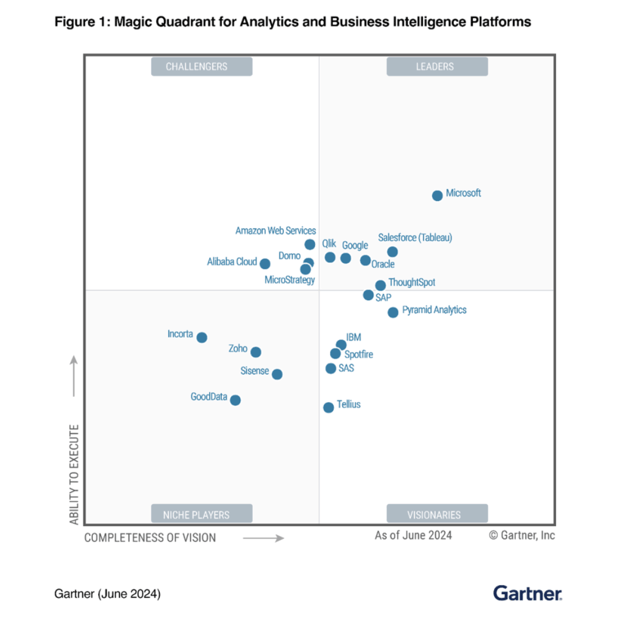
Image source: Gartner.
This Magic Quadrant ranks various platforms based on their completeness of vision and ability to execute. Clearly, Microsoft (Power BI) is far ahead of the rest. Gartner describes Leaders as those who "execute comparatively well today and are well-positioned for tomorrow."
According to an analysis conducted by HG Insights, Power BI was identified as the leading BI software of 2024. HG Insights tracks 222,900 companies using the product.
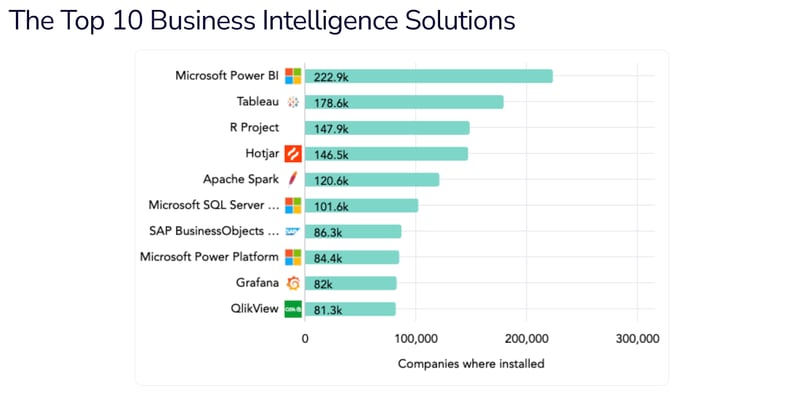
Image source: HG Insights.
The above Magic Quadrant and market share analysis are useful when exploring where the greatest opportunities are for long-term career growth. Based on both, Power BI is a solid business intelligence and analytics tool. If you are interested in transitioning into data science at some point in your career, then a job in Power BI and business intelligence is a great stepping stone to get experience and build up your skill set.
With Power BI knowledge, you can pursue several career opportunities. In this section, we will break these down and focus on salary expectations, prerequisite skills or level of education, and the most common responsibilities.
The Power BI developer and analyst have very similar job requirements and salary expectations, and their job titles are used interchangeably. This job is centered around Power BI and typically includes the surrounding Microsoft ecosystem (such as SQL Server, Azure, and SSRS).
According to Glassdoor, the average yearly salary for this job is $114,087. However, this can vary quite a bit based on the company and the level of the job (e.g., entry-level vs. senior). Typically, around 3-5 years of experience, in addition to any surrounding skills and tools, are required in Power BI.
The most common accompanying skill required with this job is SQL, so it would be a good idea to build up this skill while learning Power BI.
Some job listings mention that a bachelor’s degree in IT, computer science, or something similar is required. However, a bachelor’s degree is generally not a standard requirement for most jobs listed in Power BI.
Roles and responsibilities (this list is not exhaustive and contains just some of the most common responsibilities found in this job):
The Power BI Consultant is a much more hands-on job across multiple industries and requires a wider range of skills. These jobs typically involve regular engagement directly with the client and require you to communicate well, be organized, and manage projects from start to finish.
The job of a Power BI Consultant is centered around Power BI but can include a wide variety of other software platforms (such as third-party software like Salesforce and SAP); it sometimes requires complex integrations between Power BI and these platforms. There can also be a wider requirement around knowledge of scripting languages (such as Python) to facilitate these integrations or complex analyses.
According to Glassdoor, the average yearly salary for this job is $130,080. It is worth noting here that Power BI Consultants can be full-time or contract-based for a limited time. Typically, these jobs require a bit more experience, and it is not uncommon for companies to require 5+ years of experience with Power BI.
Roles and responsibilities (this list is not exhaustive and contains just some of the most common responsibilities found in this job):
The business intelligence developer and business intelligence analyst are both very similar, and their job titles can be used interchangeably in many job listings. These jobs are a bit broader than the Power BI developer because they do not always involve Power BI and can require knowledge of other platforms like Tableau and Qlik. However, Power BI is one of the most commonly used platforms and is very well known in the industry, so having Power BI as a skill carries a lot of weight in these jobs. Your skills can also be easily transferred to other platforms.
A bachelor’s degree often tends to be mandatory in these jobs since they often require you to perform advanced analyses and generate insights that do not only rely on a specific business intelligence tool. Because of this, there may also be a requirement to have sufficient skills in scripting languages (such as Python) and proficiency in SQL.
According to Glassdoor, the average yearly salary for this job is $122,944.
Roles and responsibilities (this list is not exhaustive and contains just some of the most common responsibilities found in this job):
Power BI is clearly a leader in the analytics and business intelligence market. Having Power BI as a skill on your resume will open up a variety of career opportunities and long-term growth.
If you want to pursue a career in Power BI, you should consider the Data Analyst with Power BI Career Track. The track, co-created with Microsoft, will give you the knowledge and skills you'll need to pass the PL-300 exam and obtain the associate certification: Microsoft Certified: Power BI Data Analyst Associate.
We hope this article provided you with some insights into the kinds of career opportunities you can expect in Power BI and that it inspires you to launch an exciting career in analytics and business intelligence!
You can definitely learn Power BI on your own through online resources, tutorials, and courses. Many platforms like DataCamp offer comprehensive courses on Power BI. However, formal training or certification, such as the Microsoft Certified: Power BI Data Analyst Associate, can enhance your resume and demonstrate your proficiency to potential employers.
Power BI is widely used across various industries, including finance, healthcare, retail, manufacturing, and education. It is particularly popular in industries that require robust data analytics and visualization capabilities to make informed decisions, monitor KPIs, and gain business insights.
Knowledge of SQL is very important for a Power BI career, as it is often required to query and manipulate data from various databases. SQL skills help in writing complex queries, optimizing data retrieval, and integrating data from multiple sources, making it easier to create comprehensive Power BI reports and dashboards.
Obtaining a Power BI certification demonstrates your expertise and commitment to potential employers, making you a more attractive candidate. It also helps you stay current with the latest features and best practices, and can potentially lead to higher salaries and more advanced career opportunities.
Power BI is known for its seamless integration with other Microsoft products, its affordability, and its user-friendly interface. Tableau is often praised for its advanced data visualization capabilities, while Qlik is known for its powerful data integration features. The best tool for you depends on your specific needs, budget, and the existing tools and infrastructure in your organization.


blog
 Joleen Bothma• 6 min

blog
 Matt Crabtree• 11 min

blog
Joleen Bothma• 12 minLearn more about Power BI with these courses!
Course
Master the Power BI basics and learn to use the data visualization software to build impactful reports.
Course
Enhance your Power BI knowledge, by learning the fundamentals of Data Analysis Expressions (DAX) such as calculated columns, tables, and measures.
Practice and track your progress.
Continue with GoogleBy continuing, you accept our Terms of Use, our Privacy Policy and that your data is stored in the USA.