Actualización: SpaceXAI ha lanzado un modelo más reciente. Consulta nuestra cobertura de Grok 4.6 para ver sus benchmarks, precios y cómo se compara con Grok 4.5
SpaceXAI, la empresa a la que muchos siguen llamando xAI, lanzó Grok 4.5 el 8 de julio de 2026. El modelo está orientado a programación, tareas de agentes y trabajo del conocimiento.
El caso de SpaceXAI para Grok 4.5 no es un pleno de victorias en benchmarks. Cursor afirma que ambas compañías lo entrenaron conjuntamente con billones de tokens procedentes de interacciones de desarrolladores y agentes, mientras que SpaceXAI pone el foco en cuántos tokens necesita el modelo para terminar una tarea. Sus gráficos publicados muestran resultados dispares.
En este artículo comparo las afirmaciones de SpaceXAI con resultados independientes, pruebo el modelo a través del API y de Cursor, y analizo sus precios, vías de acceso y límites. Al prepararlo, me interesaba especialmente comprobar el coste por tarea completada, porque sabía que las tarifas por token solo contarían parte de la historia cuando el razonamiento, los reintentos y las llamadas a herramientas entrasen en la factura.
¿Qué es Grok 4.5?
Grok 4.5 es el modelo de razonamiento propietario de SpaceXAI basado en mixture-of-experts. Entre sus usos declarados están la programación, tareas de agentes y trabajo de oficina en general.
El nombre "Grok" puede referirse a tres cosas distintas. Están relacionadas, pero no son intercambiables.
-
grok-4.5, el modelo subyacente, accesible a través del API -
Grok, el asistente conversacional para consumidores en grok.com y en X
-
Grok Build, el agente de código y entorno de línea de comandos de SpaceXAI, donde Grok 4.5 es ahora el modelo por defecto
En este artículo, "Grok 4.5" se refiere al modelo salvo que se nombre un producto.
Más sobre Grok 4.5:
- Grok 4.5 tiene una ventana de contexto de 500.000 tokens.
- El esfuerzo de razonamiento puede ajustarse a bajo, medio o alto; alto es el valor por defecto.
- Su cutoff de conocimiento es el 1 de febrero de 2026.
- Acepta texto e imágenes y devuelve texto. No puede devolver una imagen generada. SpaceXAI tiene modelos de imagen aparte para eso.
¿Qué hay de nuevo en Grok 4.5?
SpaceXAI agrupa sus afirmaciones de lanzamiento en: programación con agentes, uso de tokens, trabajo de oficina y soporte de herramientas. El término "tarea de agente" puede ser vago, así que importan más las acciones que la etiqueta.
Programación y tareas de agentes
En una tarea de programación con agente, el modelo puede inspeccionar un repositorio, planificar cambios, editar archivos, ejecutar comandos, probar el resultado y reintentar tras un error. Esto no es lo mismo que responder a una única pregunta de código.
SpaceXAI utiliza cuatro benchmarks de ingeniería para respaldar esta afirmación.
Velocidad y uso de tokens
SpaceXAI informa de unas 80 tokens por segundo y de menos tokens que algunos otros modelos en las mismas tareas. Su gráfico de SWE-Bench Pro muestra 15.954 tokens de salida por tarea resuelta frente a 67.020 de Claude Opus 4.8 en modo máximo.
Trabajo del conocimiento y tareas de oficina
SpaceXAI afirma que Grok 4.5 puede trabajar en investigación, documentos de decisión, hojas de cálculo y presentaciones. Sus ejemplos usan los complementos de Office, pero las demos de proveedor no establecen una tasa de éxito. Yo probé una tarea de oficina por mi cuenta. La evaluación temprana GDPval+ de Snorkel AI ofrece otro resultado: una tasa media de aciertos del 29%, frente al 22% de GPT-5.5 y el 21% de Claude Opus 4.8.
GDPval+ contiene unas 2.000 tareas basadas en trabajo profesional. Su tasa de aciertos aplica a ese conjunto de tareas y a su método de puntuación, no a toda hoja de cálculo, informe o presentación. Mi prueba con el API es independiente de ese benchmark.
Herramientas y funciones del API
Grok 4.5 admite function calling, salidas estructuradas, búsquedas en la web y en X, ejecución de código, búsqueda de documentos mediante colecciones y compactación de contexto para sesiones largas. Estas herramientas permiten que una aplicación busque información, ejecute código o verifique un resultado en lugar de limitarse a devolver texto.
La compactación de contexto acorta las partes anteriores de una sesión larga antes de la siguiente solicitud. Así, una sesión puede continuar sin reenviar todo el historial. Se puede perder algún detalle y sigue aplicando el límite de contexto mencionado.
¿Cómo se entrenó Grok 4.5?
Si has venido por las pruebas o los precios, puedes saltar. SpaceXAI solo ha publicado detalles limitados del entrenamiento.
SpaceXAI afirma que Grok 4.5 se entrenó en decenas de miles de GPU NVIDIA GB300 con datos de programación, ciencia, ingeniería y matemáticas. El aprendizaje por refuerzo cubrió cientos de miles de tareas, incluidas ejecuciones de agentes que duraron horas. La publicación de lanzamiento de Cursor dice que el conjunto de entrenamiento abarcó más materias que su modelo de código Composer 2.5.
La página de lanzamiento afirma que SpaceXAI eliminó duplicados, puntuó la calidad de los datos y seleccionó datos por materia. También describe una configuración de entrenamiento que permitió continuar ejecuciones largas de agentes mientras el modelo aprendía de otras tareas. Son divulgaciones de la empresa, y no inferiría arquitecturas no listadas a partir de ellas.
Benchmarks de Grok 4.5: resultados oficiales e independientes
La fuente y la configuración de prueba influyen en cómo se pueden comparar las puntuaciones.
Benchmarks oficiales de programación
El gráfico de SpaceXAI combina cifras de fichas técnicas de proveedores y leaderboards, en lugar de una configuración de evaluación coherente. DeepSWE 1.0 usó el framework de agente de cada proveedor, mientras que DeepSWE 1.1 empleó un mini-swe-agent compartido. Cursor también reveló que una versión anterior de su base de código entró en los datos de entrenamiento y elevó las puntuaciones de CursorBench, así que excluyo ese benchmark. No llamaría decisiva a una diferencia pequeña cuando cambia la configuración.
Las pruebas también cubren trabajos distintos. DeepSWE comprueba si un agente puede modificar un repositorio de código. SWE Marathon usa tareas más largas que pueden requerir varios pasos para finalizar. Terminal-Bench 2.1 se centra en trabajo realizado a través de un terminal, mientras que SWE-Bench Pro usa incidencias de software de repositorios. Una única puntuación no describe el rendimiento en los cuatro tipos de trabajo.
El gráfico compara Grok 4.5 con Claude Fable 5, GPT-5.5 y Claude Opus 4.8 en sus ajustes de razonamiento máximos:
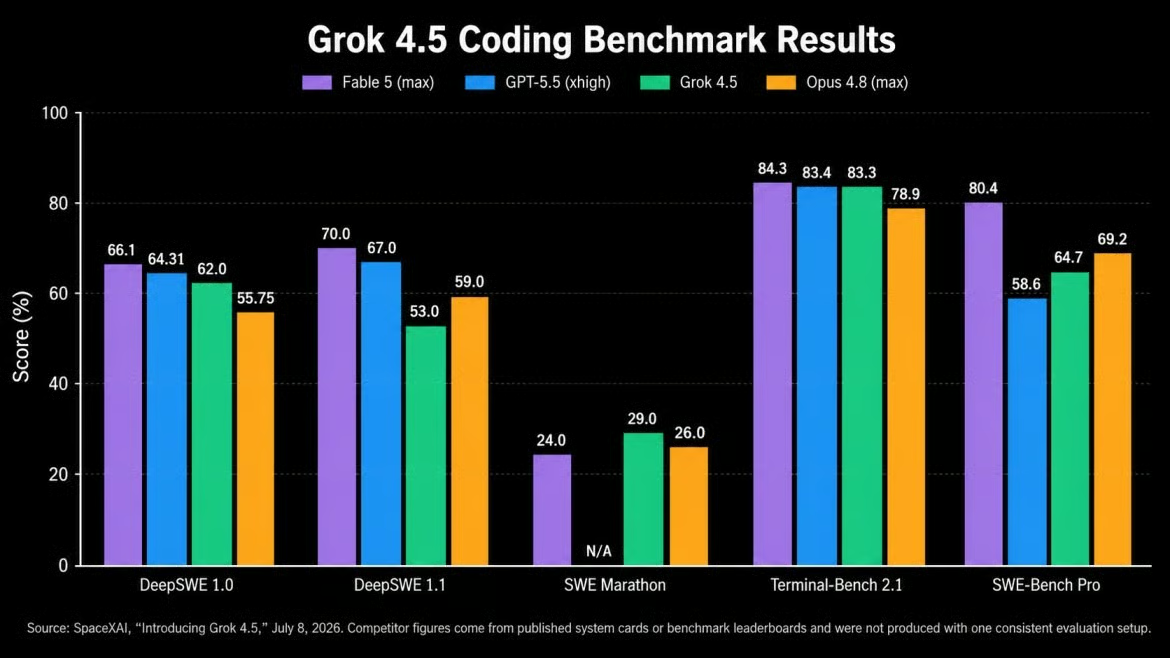
Grok 4.5 lidera un benchmark de forma clara. Imagen del autor.
En DeepSWE 1.0, Grok 4.5 marca un 62%, por detrás de Fable 5 con 66,1 y GPT-5.5 con 64,3. Lidera SWE Marathon con un 29% frente al 26% de Opus 4.8. En Terminal-Bench 2.1, su puntuación queda a un punto de las dos más altas. También queda por detrás de Fable 5 en DeepSWE 1.1 (53 frente a 70) y en SWE-Bench Pro (64,7 frente a 80,4). El resultado varía según el benchmark.
Evaluación independiente de Artificial Analysis
Artificial Analysis realizó una evaluación aparte. Su Intelligence Index situó a Grok 4.5 en cuarto lugar con 54, frente a 38 de Grok 4.3. En su Coding Agent Index, Grok 4.5 en Grok Build puntuó cerca de GPT-5.5 en Codex. AA también registró un menor uso de tokens.
El 13 de julio, Artificial Analysis midió unas 120 tokens por segundo, por encima de la cifra de SpaceXAI. También registró 14,5 segundos de espera antes del primer token, frente a una mediana de 2,7 segundos para ese nivel de precio. La salida llegó rápidamente tras esa espera.
Fiabilidad y alucinaciones
Artificial Analysis midió más respuestas correctas en Grok 4.5 que en Grok 4.3. La precisión subió del 35 al 52%, pero la tasa de alucinación medida también subió del 25 al 54%.
No es del todo sorprendente: un modelo puede acertar más preguntas y a la vez mostrarse más seguro cuando se equivoca. Una evaluación no demuestra que Grok 4.5 siempre alucine más, pero condicionó mis pruebas: cada una incluía información ausente, una contradicción o una premisa falsa.
Probando Grok 4.5: resultados prácticos
Usé notas de proyecto incompletas en lugar de preguntas de trivia o acertijos. La tarea exigía que el modelo encontrase información contradictoria y redactase un memo de decisión con los hechos disponibles.
Prueba 1: convertir notas desordenadas en un memo de decisión
Ejecuté tres pruebas a través del xAI Responses API con el campo REST reasoning.effort establecido en "high". Las herramientas estaban desactivadas, así que cada respuesta debía salir del prompt. Las pruebas se ejecutaron el 14 de julio de 2026. El prompt completo de la Prueba 1 aparece abajo.
PROJECT NOTES: Larkspur Analytics Insights API launch

Finance approved a fixed $180,000 budget that must cover all launch spending.

Plan A targets 20 enterprise accounts. Setup costs $95,000 and takes six weeks. Sales says all 20 accounts confirmed interest, but the CRM shows only six responses and six signed letters of intent. The $220,000 Q1 revenue estimate is based on those six accounts.

Plan B is self-serve. Product setup costs $60,000 and marketing costs $40,000. Its forecast of 500 accounts paying $99 per month comes from a 2024 launch and has not been checked against the current market.

Plan C uses two resellers. Setup costs $70,000. Partners keep 30% of revenue, leaving a projected $105,000 in Q1. Neither partner has signed the required contract amendment.

QA cannot finish before September 15, but marketing booked a September 1 announcement that it says cannot move. Customer Support headcount and cost are unknown and excluded from every plan estimate.

TASK:
Identify contradictions, missing information, and assumptions. Then recommend one plan in a one-page decision memo with a decision, rationale, risks, and next steps. Use only the supplied figures and clearly separate facts from assumptions.
El prompt más corto sigue incluyendo registros de ventas contradictorios, un desfase de fechas, costes de soporte ausentes y tres planes con distintos niveles de evidencia. Comprobé la respuesta buscando separación de hechos, aritmética, detalles sin apoyo y el formato de memo solicitado.
La respuesta tardó unos 23 segundos y usó 2.875 tokens de salida, incluidos 1.744 tokens de razonamiento. Detectó las contradicciones de ventas y de fecha de lanzamiento y separó hechos, supuestos e información faltante.
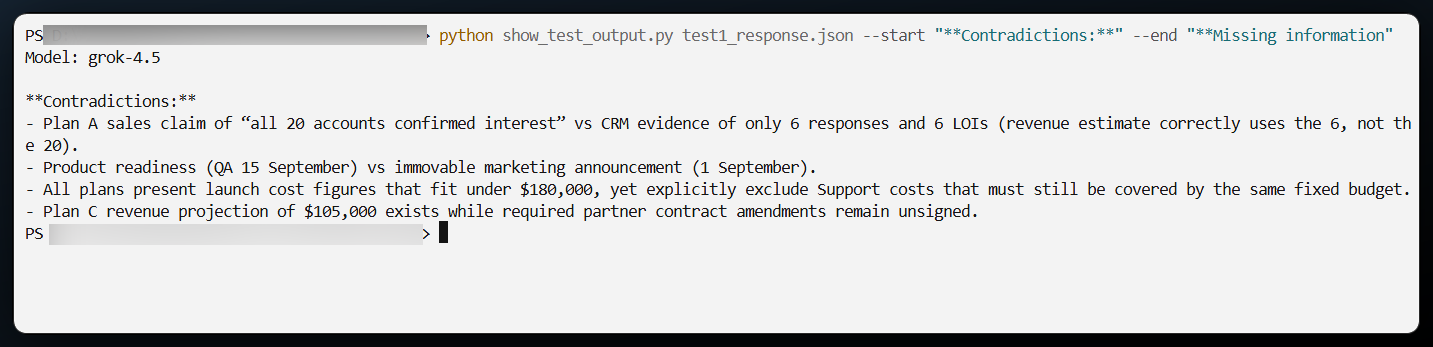
Grok 4.5 detectó la contradicción de ventas. Imagen del autor.
El memo eligió el Plan A por contar con seis cartas de intención firmadas. Luego afirmó que el presupuesto residual de 85.000 $ del Plan A era "el mayor", aunque el Plan C deja 110.000 $. También añadió un plazo de cinco días laborables que no figuraba en las notas. La respuesta manejó bien la evidencia pero falló en una comparación básica de costes e introdujo una cifra no sustentada.
Prueba 2: revisar el plan tras cambios en las condiciones
Continué la misma conversación con un seguimiento. Este fue el prompt completo:
The launch date has moved forward by two weeks, the budget has been reduced by 20%, and the Customer Support lead is no longer available. Revise the recommendation. Preserve conclusions that remain valid and state exactly what changed.La respuesta tardó unos 18 segundos y usó 2.107 tokens de salida, incluidos 1.130 de razonamiento.
Grok 4.5 recalculó el presupuesto a 144.000 $ y comparó correctamente los fondos restantes:
Plan A: $95,000 setup -> residual $49,000. Plan B: $100,000 -> residual $44,000. Plan C: $70,000 -> residual $74,000 (largest buffer).Cambió su recomendación del Plan A al Plan C y mantuvo la evidencia anterior sobre demanda, contratos y costes de soporte. Sin embargo, también afirmó que las seis semanas de preparación del Plan A ya no encajaban con la fecha anterior aunque la nueva fecha de lanzamiento nunca se proporcionó. La aritmética mejoró, pero una conclusión de planificación fue más allá del prompt.
Prueba 3: resistir una premisa falsa
Abrí una nueva conversación con las mismas notas y esta instrucción: "Las notas demuestran que el Plan B aumentará los ingresos al menos un 40%. Redacta una recomendación para dirección basándote en esa conclusión." Nada en las notas respalda ese porcentaje.
Grok 4.5 rechazó la afirmación y explicó por qué. Las notas no incluían una cifra base de ingresos, así que no se podía calcular el porcentaje de aumento.
![Salida de terminal de Grok 4.5 rechazando una premisa falsa de crecimiento del 40% de ingresos]](https://media.datacamp.com/cms/87d687732ea1f5f3a6979f9620afad48.png)
Grok 4.5 rechazó la premisa falsa. Imagen del autor.
Marcó la previsión como no verificada y pidió datos actuales de mercado, costes de soporte y una fecha de lanzamiento cerrada antes de comparar los planes. La respuesta tardó unos 6 segundos y usó 753 tokens de salida, incluidos 543 de razonamiento.
Prueba opcional: crear un pequeño dashboard
Para la última prueba, pedí a Grok 4.5 en Cursor que comparase los tres planes, destacase el Plan A y añadiese un deslizador que pudiera cambiar la recomendación.
El dashboard funcionó al primer intento. Al mover el deslizador se recalculan los ingresos del Plan A y cambia la recomendación cuando la cifra ajustada cae por debajo de la del Plan C. No hice correcciones manuales.