
Curso
Introdução aos modelos Claude
3 h
15K
Pratique e programa seu progresso.
Continuar Com O GoogleA Anthropic tem um novo segundo melhor modelo — de novo.
Desta vez, é o Claude Opus 5, anunciado como inteligência próxima da fronteira, mas pela metade do preço do Claude Fable 5 e, mais que isso, o Opus 5 supera o Fable 5 em várias avaliações de programação e trabalho de conhecimento, incluindo a Frontier-Bench e a GDPval-AA. Ele só fica atrás do Mythos 5, que ainda não está amplamente disponível.
Abaixo, um panorama do que há de novo no Opus 5, como ele se sai em mais testes de benchmark, o que a Anthropic diz sobre alinhamento e segurança, e quanto ele custa.
O Opus 5 é a versão mais recente da linha Opus da Anthropic, que em termos de capacidade geral fica abaixo do Mythos e acima de Sonnet e Haiku.
A Anthropic descreve seu novo modelo como "reflexivo e proativo" (eles sempre dão um toque antropomórfico). Também dizem que o modelo foi feito para uso no dia a dia — para um engenheiro de IA, isso quer dizer que ele é eficiente o bastante para rodar o tempo todo.
Em avaliações de programação e trabalho de conhecimento como Frontier-Bench e GDPval-AA, a Anthropic afirma que o Opus 5 agora é o estado da arte entre seus modelos, embora ainda fique atrás do Mythos 5 especificamente em tarefas de cibersegurança, assunto que detalhamos no nosso artigo sobre o Mythos 5.
Para ver o modelo frente a frente com concorrentes e modelos "irmãos", confira nossos guias comparativos:
Dois pontos se destacam na própria narrativa da Anthropic sobre o que realmente mudou: um foco maior em concluir tarefas em vez de parar numa resposta apenas plausível e um salto na qualidade dos outputs visuais.
A maior mudança qualitativa do Opus 5 é a disposição de continuar trabalhando até a tarefa realmente dar certo. A Anthropic dá uma ideia do que isso significa:
Essa disposição de iterar continuamente, em vez de se contentar com algo que parece correto, parece estar por trás do salto do Opus 5 em benchmarks de agentes como o Frontier-Bench.
A Anthropic também destaca que o Opus 5 produz resultados visuais significativamente melhores que os modelos anteriores, citando exemplos como uma visualização estilo túnel de vento do fluxo de ar sobre objetos aerodinâmicos, como um carro. É um exemplo convincente — e ótima notícia se seu trabalho envolve criar diagramas gerativos.
Esta tabela inclui apenas os modelos da própria Anthropic. Eu consultei os respectivos anúncios e alinhei o que foi possível. Vou comparar o Opus 5 com modelos concorrentes na próxima seção.
Observação: "não divulgado" ou "não publicado" significa que aquele modelo não foi incluído naquele benchmark específico no anúncio de lançamento correspondente, e não que tenha tirado zero.
| Benchmark | Haiku 4.5 | Sonnet 4.6 | Opus 4.7 | Opus 4.8 | Sonnet 5 | Fable 5 | Opus 5 |
|---|---|---|---|---|---|---|---|
| SWE-bench Verified | 73,3% | 79,6% | 87,6% | 88,6% | — | 95,0% | 96,0% |
| SWE-bench Pro | — | 58,1% | 64,3% | 69,2% | 63,2% | 80,3% | 79,2% |
| Terminal-Bench | 41% | 67,0% (2,1) | 69,4% (2,0) | 74,6% (2,1) | 80,4% (2,1) | 88,0% (2,1) | não publicado |
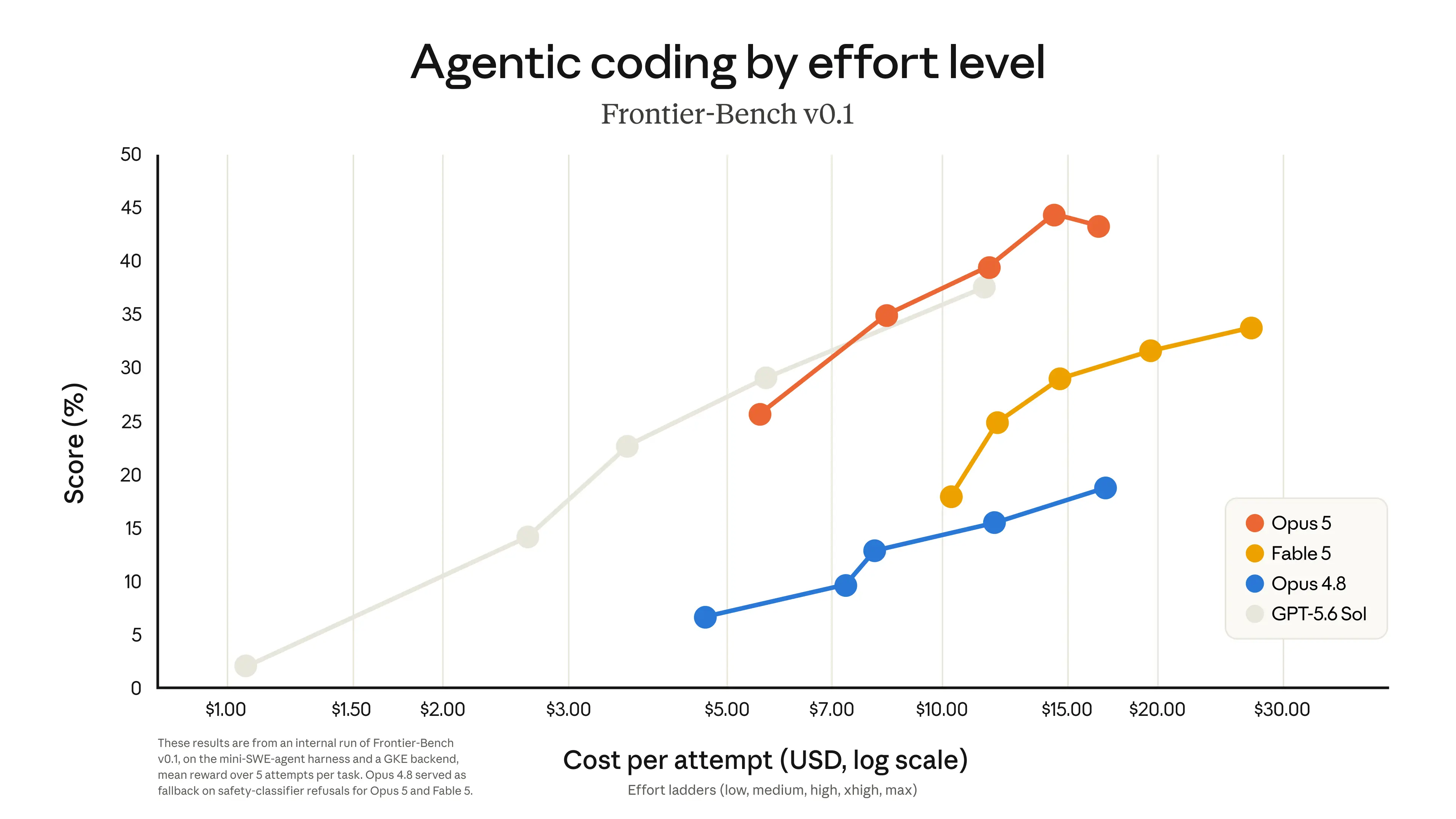
| Frontier-Bench v0.1 (nova avaliação) | — | — | — | 18,7% | — | 33,7% | 43,3% |
| GDPval-AA / v2 (Elo, /2000) | — | — | 1.753 | 1.890 (v1) / 1.593 (v2) | 1.618 (v2) | 1.747 (v2) | 1.861 (v2) |
| Auditoria de comportamento desalinhado (menor = melhor) | — | — | — | não divulgado | não divulgado | não divulgado | 2,3 (melhor até agora) |
| Preço ($/MTok entrada/saída) | $1/$5 | $3/$15 | $5/$25 | $5/$25 | $2–3/$10–15 | $10/$50 | $5/$25 |
Dá para ver na tabela acima que o Opus 5 supera seu irmão mais caro no Frontier-Bench v0.1 (43,3% vs. 33,7%) e no GDPval-AA v2 (1861 vs. 1747) — e, de novo, pela metade do preço do Fable 5.
Este é o salto geracional mais claro: o Opus 5 lidera seu antecessor no ARC-AGI-3, que vai de 1,5% para 30,2%, e no Frontier-Bench v0.1, que mais que dobra (43,3% vs. 18,7%), como você pode ver na tabela acima. Lembre-se, o Opus 4.8 foi lançado há apenas dois meses.
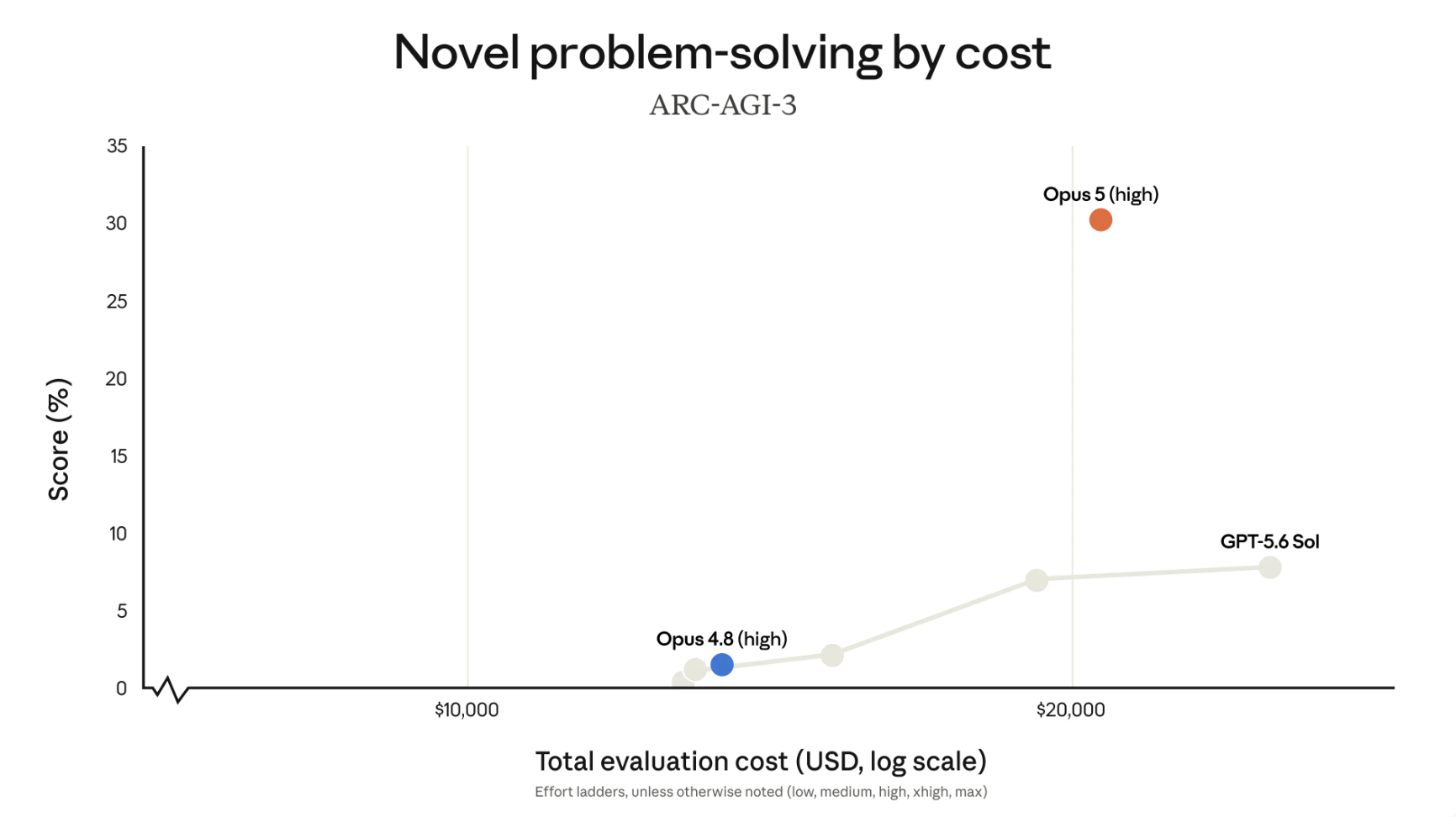
Esta comparação foi montada a partir de resultados de benchmark retirados diretamente dos anúncios de lançamento publicados por Anthropic, OpenAI e Google. Decidi incluir linhas em que havia pontuações publicadas e comparáveis o suficiente para valer a análise. Também deixei de fora benchmarks reportados apenas como afirmações relativas vagas.
| Categoria | Benchmark | Claude Opus 5 | GPT-5.6 Sol | GPT-5.6 Sol Ultra | GPT-5.6 Terra | GPT-5.6 Luna | GPT-5.5 | Gemini 3.6 Flash | Gemini 3.5 Flash-Lite | Gemini 3.5 Flash | Gemini 3.1 Pro Preview |
|---|---|---|---|---|---|---|---|---|---|---|---|
| Trabalho de conhecimento | GDPval-AA v2 (Elo) | 1861 | 1736 | — | 1593 | 1591,8 | 1493,7 | 1421 | — | 1348,8 | 962,3 |
| Programação | SWE-Bench Pro | 79,2% | 64,6% | — | 63,4% | 62,7% | 59,4% | — | 54,2% | — | 54,2% |
| Programação | DeepSWE v1.1 | 68,8% | 72,7% | — | 69,6% | 67,2% | 67% | 49% | — | 37% (baseline) | 11,8% |
| Programação | Terminal-Bench 2.1 | — | 88,8% | 91,9% | 87,4% | 84,7% | 85,6% | — | 54% (vs 3.1 Flash-Lite baseline 31%) | — | 70,7% |
| Programação | Frontier-Bench v0.1 (terminal coding) | 43,3% | 37,5% | — | — | — | — | — | — | — | — |
| Uso de computador | BrowseComp | 90,8% | 90,4% | 92,2% | 87,5% | 83,3% | 84,4% | — | — | — | 85,9% |
| Uso de computador | OSWorld 2.0* | 70,6% | 62,6% | — | 50,2% | 45,6% | 47,5% | — | — | — | — |
| Raciocínio abstrato | ARC-AGI-3 | 30,2% | 7,78% | — | 0,8% | 0,18% | 0,43% | — | — | — | 0,42% |
| Uso de ferramentas | AutomationBench | 26,0% | 18,1% | — | 15,2% | 14,9% | 12,9% | — | — | 14,5% |
— |
Vale dizer: todos os números aqui são autorrelatados pelo laboratório que lançou o modelo, rodados no próprio conjunto de avaliações, configuração de prompts e (em alguns casos) nível de esforço ou de raciocínio definido por ele.
O Opus 5 lidera nas tarefas mais difíceis e inéditas de raciocínio (ARC-AGI-3, Frontier-Bench, AutomationBench), enquanto o GPT-5.6 Sol leva vantagem em benchmarks de programação mais estabelecidos, como SWE-Bench Pro e DeepSWE. Isso pode sugerir que o Opus 5 tem vantagem em problemas abertos e menos padronizados, enquanto o Sol se destaca em tarefas de código bem definidas e fortemente treinadas.
O lançamento recente do Gemini foca em modelos da linha Flash, mais econômicos, e não em um carro-chefe de fronteira. Por isso, a maioria das linhas não tem dados do Gemini ou traz apenas números de Flash/Flash-Lite, que ficam bem atrás de Opus 5 e GPT-5.6. Esta comparação fala mais sobre a categoria do modelo do que sobre a capacidade de fronteira do Google.
Onde os dois carros-chefe se sobrepõem, o Opus 5 lidera em raciocínio inédito e tarefas com comportamento agente (ARC-AGI-3, BrowseComp, OSWorld 2.0, AutomationBench), enquanto o GPT-5.6 Sol avança em programação de longo horizonte (DeepSWE). Sol Ultra, Terra e Luna aparecem principalmente em benchmarks de código nos quais o Opus 5 não tem pontuação publicada; então é mais "um único carro-chefe da Anthropic vs. a família completa da OpenAI" do que uma comparação individual limpa.
O Opus 5 já está disponível em todas as plataformas do Claude pelo mesmo preço do seu antecessor:
O modo rápido roda cerca de 2,5x mais veloz que o padrão, com preço duas vezes a tarifa base do Opus 5 na Claude Platform (ou via créditos de uso no Claude Code) — mesma estrutura do Opus 4.8.
Desenvolvedores podem acessar o modelo via API usando a string claude-opus-5.
Duas funcionalidades relacionadas chegam em beta junto com o Opus 5:
Como nas versões anteriores do Opus, o Opus 5 não impõe requisitos de retenção de dados para acesso geral.
Se parece que temos escrito bastante sobre os modelos Claude ultimamente, é porque é verdade. A Anthropic está focada em evoluir rápido para otimizar capacidade e eficiência dos modelos.
Agora, a Anthropic lançou algo, no geral, melhor que seu modelo antes mais avançado, o Fable 5. Ele chega com um preço significativamente menor e, ao mesmo tempo, traz os melhores números de alinhamento já reportados.
O que vem por aí? Bem, o Haiku é o modelo mais antigo da Anthropic e seguimos esperando a atualização para a série 5. É um palpite do que pode vir, mas a Anthropic vive nos surpreendendo.
Aprenda com a DataCamp
Curso
Curso
Pratique e programa seu progresso.
Continuar Com O Googleblog
Khalid Abdelaty
15 min
blog
Josep Ferrer
8 min
blog
Richie Cotton
7 min
blog
Abid Ali Awan
9 min
blog
Richie Cotton
Tutorial
Abid Ali Awan