
The Best Corporate AI Training Providers: 7 Ranked for 2026

DataCamp leads 7 corporate AI training providers ranked for 2026 on measurable skill gain and role coverage, with the right buyer named for every provider.
Sep 7, 2026  · 13 min read

Explore with AI

ChatGPTClaudePerplexity

According to the 2026 State of Data & AI Literacy Report, a YouGov survey of 500+ enterprise leaders, 60% said their organization has an AI skills gap, and only one in three had a mature enterprise-wide program to close it.

This ranking is written for the learning and development (L&D) team handed a budget and an instruction to make the company better at AI. It covers 7 providers and states which buyer each one fits. For a comparison of self-serve software, see DataCamp's ranking of the best online platforms for enterprise upskilling in AI.

Straight Answer: Who Is the Best Corporate AI Training Provider in 2026?

DataCamp for Business leads the category. Graded in-browser exercises reach engineers and non-technical staff under one contract. 40 skill assessments provide a sponsor with a measured before-and-after score for each learner. Role-based AI courses for marketing, finance, HR, consulting, sales, and data analysts have all been published since March 2026. Delivery runs self-paced, as live instructor-led sessions, or as a mix of both. It is used by 80% of the Fortune 1000.

The rest of the field: Microsoft Learn AI, Pluralsight, Section, General Assembly, Coursera for Business, and Correlation One.

How These Providers Were Evaluated

This ranking scores each provider on 5 criteria. Each one is a question a buyer can put to a vendor and get a checkable answer to.

  • Hands-on practice. Graded exercises in real tool environments beat watch-only video. Judged by whether a learner can complete the assessed practice without a local install.
  • Evidence of skill gain. Per-learner assessment scores that an L&D sponsor can present to an executive, taken before and after training.
  • Role coverage in one contract. Whether engineers and non-technical staff are both served without having to buy twice.
  • Content freshness on frontier tools. How recently the Claude, Copilot, and ChatGPT material was built or re-recorded, stated as a date.
  • Delivery model and partner support. Self-serve, instructor-led cohort, or blended, and whether the vendor will also build a custom curriculum, run live sessions, and support the rollout.

The full ranking, with delivery model and published pricing, where a provider states one:

Rank Provider Delivery model Published cost Best for
1 DataCamp for Business Blended: self-paced, live cohorts, custom services Per-seat annual, quoted by volume Proving measurable skill gain
2 Microsoft Learn AI Self-serve modules Free Copilot rollouts on zero budget
3 Pluralsight Self-serve with labs $399 to $779 per user per year Deep technical AI paths
4 Section Live cohorts From about $41 per user per month Non-technical staff and leaders
5 General Assembly Instructor-led bootcamps Quote-only Open-enrollment cohort bootcamps
6 Coursera for Business Self-serve video About $399 per user per year (Teams) University-backed breadth
7 Correlation One Services engagement Quote-only Custom workflow redesign projects

1. DataCamp for Business – Best Overall

Best for: Organizations that have to show an executive sponsor what actually changed after the training budget was spent.

DataCamp for Business pairs a browser-based learning platform with professional services. Learners work with real tools in a live environment, and every exercise is graded, so each session produces per-learner submission data, and the same contract covers the engineers building with APIs and the staff who will never open one. DataCamp is used by 80% of the Fortune 1000, with 5,000+ companies and 12M+ learners across a catalog of 750+ courses. The same curriculum runs self-paced, live instructor-led, or blended.

Where DataCamp for Business is strongest

  • Interactive, graded practice, with an AI tutor on key AI courses. Every exercise across the catalog is graded in the browser with no local install and builds on interactive tasks, so the platform records what each learner actually did. A growing set of AI courses adds DataCamp's adaptive AI tutor, which tailors each lesson to the learner's role and skill level, from beginner courses like Analyzing Data with Claude to the 6-course AI Engineering with LangChain skill track for engineers.
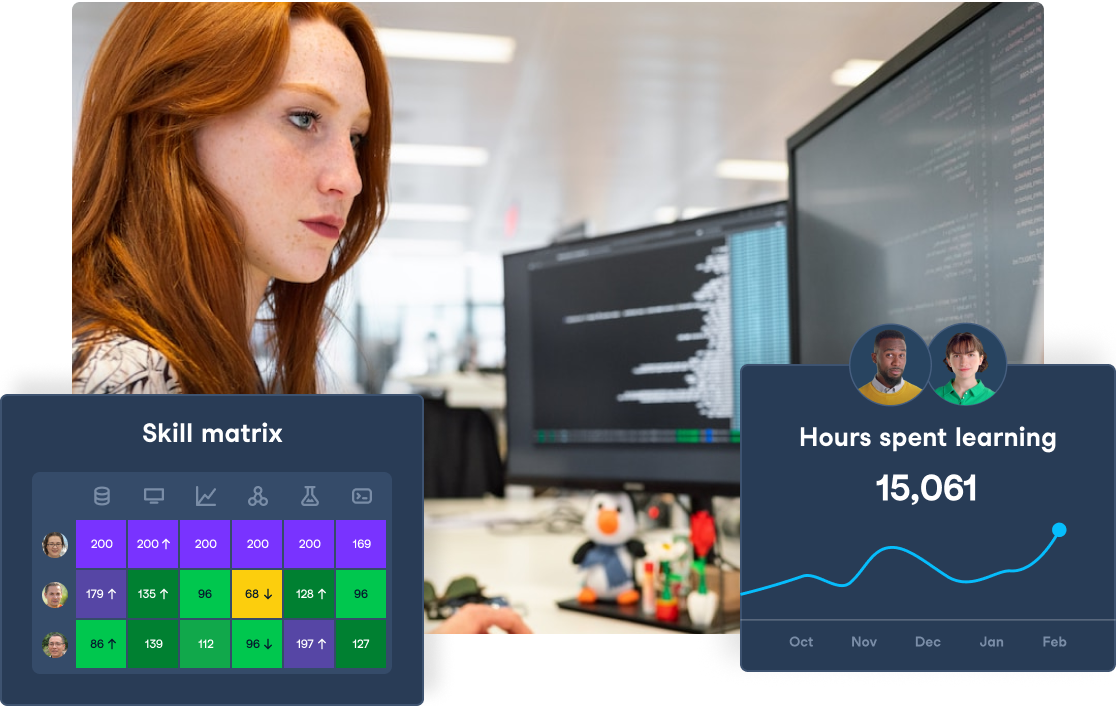
  • Measured skill baselines and credentials. 40 skill assessments, covering fundamentals in topics such as AI concepts, ChatGPT usage, and AI leadership, allow a sponsor to compare a per-learner score taken before training with one taken after. Real-world projects and professional certifications, including for positions like Data Scientist and AI Engineer, provide applied proof beyond a completion tick.
  • Courses for everyone. The catalog runs from a 2-hour beginner course, Introduction to AI for Work, for staff who will never touch an API, to the Associate AI Engineer for Developers career track, where engineers learn to integrate AI into software using APIs and open-source libraries. In between sit role-based courses published since March 2026 for marketing, finance, human resources, consulting, sales, and data analytics, plus governance. One contract covers all of it.
  • Tool training taught by the vendors who build the tools. Microsoft Copilot in PowerPoint is taught by a serving Microsoft Solution Engineer for Copilot and Agentic AI. The Claude and Claude Code courses, including Claude Code in Action at a 4.9 rating, are authored by Anthropic Academy. The GitHub Copilot Fundamentals (GH-300) track is a collaboration with GitHub, rated 5 with 1,969 learners enrolled, and preps GitHub's own certification.
  • Frontier-model content is fresh across the catalog. New or re-recorded courses in 2026 cover OpenAI's Responses API, GitHub Copilot, Microsoft 365 Copilot, Claude Skills, the Model Context Protocol, and more. These are the tools whose behavior changes fastest and for which content freshness matters the most.
  • Professional services are available. Beyond the catalog, DataCamp's professional services build private, custom curricula around a customer's tools, data, and roles, along with private certifications, guided setup, and strategic support. For Allianz, that meant 22 custom learning paths tailored to roles across the organization.
  • Pricing scales to the rollout. There's no flat sticker price. DataCamp quotes per seat by volume, so a 50-person pilot and a 50,000-person program each pay for the size they run, not for a tier they've outgrown or haven't reached.
  • Real outcomes for global enterprises. Bayer enrolled over 3,400 employees in its Data Academy, where more than 90% say they developed an innovative workflow, process, or product after training. Colgate-Palmolive upskilled 14,860+ employees, delivered through their existing Degreed LMS and single sign-on, with 80% reporting they applied the skills at work. Rolls-Royce reports 100x faster data-handling processes.
  • Plugs into the tools IT already runs. DataCamp integrates with major LMS, LXP, and HRMS platforms, including Cornerstone, SAP SuccessFactors, 360Learning, Viva Learning, Degreed, and Workday, syncing course completions back to the system of record. Single sign-on with just-in-time provisioning onboards learners without registration forms, and a Data Connector feeds progress into BI tools like Tableau or Power BI.

Why it leads: DataCamp is the only provider here that combines graded in-browser practice, per-learner assessment scores from a 40-assessment library, fresh role-based AI courses for many different business functions, custom tracks built on a customer's own data and tools, and the option to take any of it as live instructor-led delivery. Its adaptive AI tutor, which tailors each lesson to the learner's role and skill level, sits atop that and is a real differentiator from the competition.

Elevate Your Organization's AI Skills

Transform your business by empowering your teams with advanced AI skills through DataCamp for Business. Achieve better insights and efficiency.
Request a Demo Today!
business-homepage-hero.png

2. Microsoft Learn AI – Best for Copilot Rollouts on Zero Budget

Microsoft Learn AI is the obvious first stop when the AI rollout is really a Copilot rollout, and it costs nothing. The learning paths cover Microsoft 365 Copilot, Copilot Studio, Power Automate, and Azure OpenAI Service, which is the environment most enterprise knowledge workers already sit in every day.

It also carries governance, security, and responsible AI modules, and it plugs into Microsoft 365 and Viva Learning, so completion data lands where the IT team already looks. For a company standardized on Microsoft, there is no content cost and no procurement cycle, and no reason not to run the Copilot basics through it before paying anyone else.

Where it costs you: every named learning path targets a Microsoft product, so teams working with Claude or other vendors' agent frameworks need a second source. The modules are read-and-quiz, so they produce completion records with no evidence that anyone can do the work.

  • Cost: Free
  • Format: Self-paced modules and learning paths, integrated with Microsoft 365 and Viva Learning
  • Pedagogy: Product-specific paths with responsible AI and security modules included

3. Pluralsight – Best for Deep Technical AI Paths

Pluralsight is a strong pick when the audience is an engineering organization. Its AI content runs into machine learning, data engineering, MLOps, and large language models (LLMs), backed by more than 3,500 hands-on labs.

Role and skill assessments, including Skill IQ, give a manager a measured starting point for each engineer, which is the baseline the evidence criterion asks for. Pricing is published at $399 to $779 per user per year, depending on tier.

Where it costs you: the catalog is built for technical staff, so a program that also has to reach finance, HR, and marketing will need a second provider for the non-technical half of the workforce.

  • Cost: $399 to $779 per user per year by tier
  • Format: Self-paced video paths with more than 3,500 hands-on labs
  • Pedagogy: Skill IQ assessments that benchmark each engineer before training starts

4. Section – Best for Non-Technical Staff and Leaders

Section is built for the audience that most AI programs handle worst: knowledge workers and senior leaders who will never open a terminal. Its cohort model puts those people in live sessions with case studies and working frameworks, on a schedule someone else enforces.

The Head of AI Bootcamp is aimed at people expected to lead AI adoption inside a function, and published pricing starts at roughly $41 per user per month on annual billing. The non-technical half of a workforce is usually where AI programs leak value, and a live cohort with peers from other functions produces the internal advocates who make the next rollout easier.

Where it costs you: cohorts run on a fixed schedule and cap attendance, so Section does not cover a 5,000-person literacy rollout the way a self-serve platform does.

  • Cost: From about $41 per user per month, billed annually; corporate deals are custom
  • Format: Live cohort-based programs with case studies and applied frameworks
  • Pedagogy: AI fluency for non-technical staff, including the Head of AI Bootcamp

5. General Assembly – Best for Open-Enrollment Cohort Bootcamps

General Assembly is the pick when a defined group needs a scheduled, multi-week bootcamp, and the organization would rather buy seats in one than build a program. Its enterprise arm delivers instructor-led AI and data workshops and multi-week bootcamps.

That format solves a specific failure mode: self-paced AI training stalls at low completion, and a scheduled cohort with an instructor in the room removes the "I'll get to it next quarter" problem. The cost of the fix is flexibility, because content arrives on a calendar rather than on demand, which suits a defined group of 30 people far better than a company-wide literacy push.

Where it costs you: there is no platform underneath the cohorts. When the bootcamp ends, the learners lose their access to structured practice, and General Assembly publishes no enterprise pricing, so every engagement starts with a quote and no free tier to pilot against.

  • Cost: Quote-only for enterprise engagements, with no free tier
  • Format: Instructor-led workshops and multi-week cohort bootcamps
  • Pedagogy: Live delivery on a fixed calendar

6. Coursera for Business – Best for University-Backed Breadth

Coursera for Business earns its place on the catalog breadth and academic branding rather than hands-on depth. Its GenAI Skills Track draws on Stanford, DeepLearning.AI, and Google, and the company reports more than 4,700 corporate clients.

Pricing is unusually transparent for this market: the Teams plan covers 5 to 125 seats at roughly $399 per user per year, with custom contracts above that, and role-based academies map courses onto job families, so an L&D team is not building pathways from scratch. Certificates carry university and vendor names, which can do real work when training has to look credible in an internal promotion case.

Where it costs you: most of the catalog is video with quizzes, so it is not exactly interactive and produces completion certificates far more readily than evidence that someone can do the work.

  • Cost: About $399 per user per year for Teams covering 5 to 125 seats; enterprise is custom
  • Format: Self-paced video courses, professional certificates, and role-based academies
  • Catalog: GenAI Skills Track built with Stanford, DeepLearning.AI, and Google

7. Correlation One – Best for Custom Workflow Redesign Projects

Correlation One sells a service engagement rather than a seat license. Its enterprise programs are built around company-specific AI projects with coaching and mentorship, and the stated goal is a redesigned workflow.

The model suits a large organization that already knows which workflow it wants rebuilt, and it is a poor fit for a company that still needs to raise baseline literacy across 2,000 employees.

Where it costs you: the engagement is fully bespoke consulting with no catalog behind it, so nothing carries over to the next team or the next workflow, and buyers compare proposals instead of products. Correlation One does not publish a detailed course list, and the result depends heavily on scoping the right workflow up front.

  • Cost: Quote-only, scoped per engagement
  • Format: Custom enterprise projects with coaching and mentorship
  • Pedagogy: Workflow redesign built around the client's own use cases

Things to Check Before You Sign

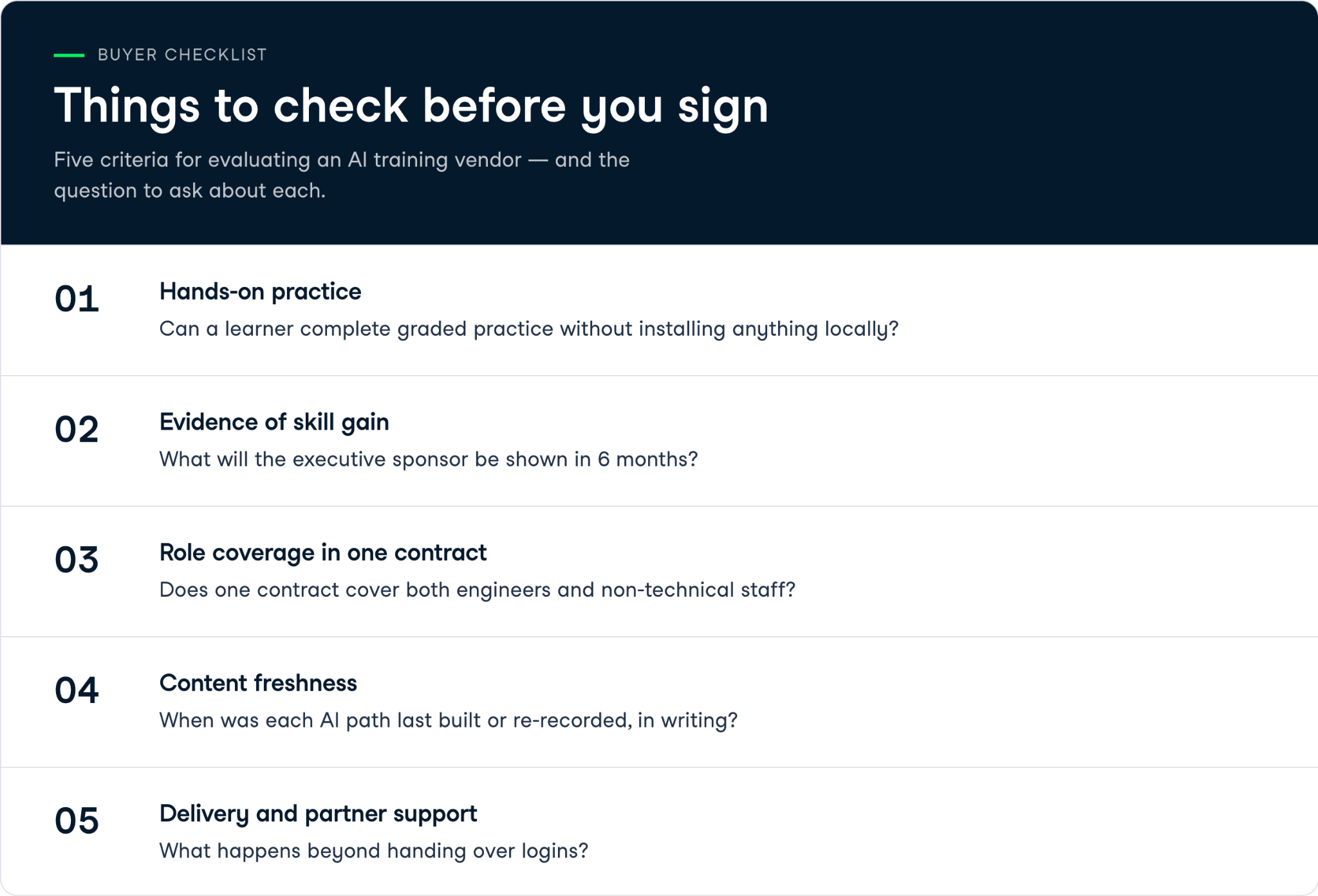
The same 5 criteria behind this ranking work as buyer checks in a procurement conversation. Each one should get a specific answer, not a brochure.
Things to check before you sign

Hands-on practice

Ask whether a learner can complete graded practice without installing anything locally. Watch-only video produces completion data and very little else. A vendor who cannot demonstrate an assessed exercise during the sales call is selling a content library.

Evidence of skill gain

Ask what the executive sponsor will be shown in 6 months. Per-learner assessment scores taken before and after training answer that question, and a completion percentage does not. DataCamp's 40 skill assessments and Pluralsight's Skill IQ both produce the measured baseline that makes a later comparison possible, which is the same reasoning behind why workforce capability determines AI ROI.

Role coverage in one contract

Most AI programs have to reach two populations at once: engineers building with APIs, and staff using assistants inside their existing jobs. Check whether one contract covers both or whether the gap means a second purchase later. Pluralsight skews technical, and Section skews non-technical, so either alone leaves half the workforce uncovered; DataCamp covers both parts.

Content freshness on frontier tools

Ask for the date each AI path was last built or re-recorded, in writing. Claude Code, GitHub Copilot, and Microsoft 365 Copilot change often enough that material recorded against last year's behavior teaches habits that no longer apply, and a course filmed against a superseded model interface is worse than no course, because it produces confident wrong practice. A vendor who cannot name a date is quoting from a back catalog.

The follow-up question is who maintains it. Ask whether re-recording is a scheduled commitment or something that happens when a customer complains, and ask which specific paths were rebuilt in the last two quarters.

Delivery model and partner support

Decide whether the binding constraint is reach or attention before building a shortlist. Self-serve platforms reach thousands of people cheaply and lose many of them to low completion. Live cohorts from General Assembly or Section hold attention but cap headcount and cost more per learner.

The follow-up question is what the vendor will do beyond handing over logins. Ask whether they will build custom tracks from your own data and tools, deliver any course as a live session, and support the rollout itself.

For instance, every course, track, or concept on DataCamp can be delivered as a live, instructor-led experience, and its professional services cover custom curriculum, private certifications, guided setup, and strategic support. Allianz used that to get 22 custom learning paths built around specific roles across the organization.

Final Thoughts

Anyone handed an AI budget is really being asked to produce a change that someone else can see. That is the case for starting with DataCamp for Business: it reaches the engineers and the non-technical staff under one contract, and it hands the sponsor a per-learner score when the review comes around.

The exception is the company whose real problem is one broken workflow. That buyer is purchasing a project, and Correlation One or a General Assembly cohort can be a good fit in those cases. Everyone else can start a pilot group on Introduction to AI for Work and move managers into the AI Business Fundamentals track from there.

FAQs

Who is the best corporate AI training provider in 2026?

DataCamp for Business leads this ranking because it combines graded in-browser practice, 40 skill assessments that score each learner before and after training, and role-based courses for both engineers and non-technical staff under one contract. Microsoft Learn AI is the best free option for Microsoft-only Copilot rollouts, and Correlation One fits a company rebuilding one specific workflow. The right pick depends on whether you need broad literacy or a narrow project.

How much does enterprise AI training cost?

Prices range from free to several hundred dollars per user per year. DataCamp for Business is priced flexibly per seat by volume. Microsoft Learn AI is free but limited to Microsoft products, and Pluralsight lists up to $779 per user per year by tier.

How do you measure ROI on corporate AI training?

Measure it with per-learner assessment scores taken before and after training, not course-completion rates. A completion percentage shows attendance; a before-and-after score on the same assessment shows the skill gain an executive sponsor can act on. DataCamp's 40 skill assessments and Pluralsight's Skill IQ both produce that baseline.

What is the best AI training for non-technical staff versus engineers?

DataCamp for Business is the best solution when you want to reach both populations in the same contract. Many other providers cover only half a workforce: Section suits non-technical staff and leaders through live cohorts, while Pluralsight suits engineers with technical paths and 3,500+ hands-on labs.

What does DataCamp cost for enterprise teams?

DataCamp for Business is priced flexibly per seat on an annual contract, quoted by volume, so a 50-person pilot and a 50,000-person rollout pay different rates. The Teams plan has published per-user pricing for smaller groups, while larger enterprise deals are custom. Request a quote for team-specific pricing.

Does DataCamp offer a skills assessment to benchmark my team?

Yes. DataCamp offers 40 skill assessments, including topics such as AI concepts, ChatGPT usage, and AI leadership, each scoring a learner against a defined competency. Run them before and after training to benchmark a team and measure the gain per learner.

What certifications does DataCamp offer, and are they industry-recognized?

DataCamp offers many professional certifications, including Data Analyst, Data Scientist, SQL Associate, and AI Engineer, assessed through timed exams and practical tasks built around in-demand job roles. It also has tracks that prepare learners for external vendor exams like Microsoft's PL-300 and Azure AZ-900, and the GitHub Copilot GH-300 certification.


Tom Farnschläder's photo
Author
Tom Farnschläder
LinkedIn

Tom is a data scientist and technical educator. He writes and manages DataCamp's data science tutorials and blog posts. Previously, Tom worked in data science at Deutsche Telekom.

Topics
AI for Business
For Business

Upskill Your Workforce in AI With DataCamp!

Course

Introduction to AI for Work

2 hr
115.9K
Explore what AI is and how to use it responsibly for smarter, more productive work!
See DetailsRight Arrow
Start Course
See MoreRight Arrow