
Course
Understanding ChatGPT
1 hr
434.4K
Get Started Using the OpenAI API and More!
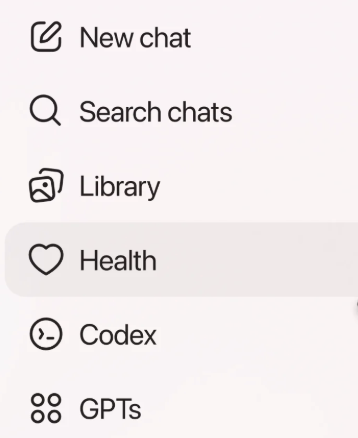
ChatGPT Health is a dedicated experience within ChatGPT that allows users to securely connect medical records and health apps to receive personalized, AI-assisted health insights. Launched in January 2026, it appears as a separate "Health" section in your ChatGPT interface, marked by a heart icon in the sidebar.
If you’re like me, your first question might be: Is this just regular ChatGPT answering health questions? But I can now say that’s it more than that: When you connect your data sources (Apple Health, your hospital's patient portal, or apps like MyFitnessPal), ChatGPT Health can reference your specific lab results, medication lists, and wellness metrics. Ask "How's my cholesterol trending?" and it'll analyze your actual numbers over time, not just explain what cholesterol means.
OpenAI developed ChatGPT Health over two years with input from more than 260 physicians. Consider it as a health assistant available 24/7 to help you make sense of medical jargon, track patterns, and prepare questions for your next appointment.
Health and wellness questions account for roughly 5% of all ChatGPT conversations globally. People are trying to understand their symptoms, decode lab results, or get a second opinion.
OpenAI saw an opportunity to make these interactions more useful through AI for healthcare consumers. The company recognized that healthcare consumers face real frustrations: difficult access to doctors and struggling with patient health data interpretation across multiple portals, apps, and test results.
By creating a dedicated health space, OpenAI is betting that personalized AI for healthcare consumers will help people be more active in their own care through better patient health data interpretation.
Understanding these mechanics will help you make informed decisions about using the platform.
ChatGPT Health integrates your personal health information into the AI's conversation context. OpenAI partnered with b.well Connected Health to let U.S. users import ChatGPT medical records from over 2.2 million healthcare providers. You log in using your patient portal credentials, authorize the connection, and the AI can see recent lab results, medication lists, visit summaries, and vaccination records.
Beyond official records, you can connect wellness apps. Apple Health integration shares daily steps, exercise activity, sleep hours, and heart rate trends. MyFitnessPal provides nutrition data. Function Health offers over 160 blood and lab measurements. Other apps include Weight Watchers, AllTrails, Instacart, and Peloton.
ChatGPT Health uses your data to "ground" its responses in your actual health metrics and history. If you ask "Why am I so tired lately?", the AI might notice you've been averaging only five hours of sleep and point that out. Ask for a summary before your doctor's appointment, and it can pull together your recent lab values in plain language from your ChatGPT medical records.
Your health data stays completely separate from regular ChatGPT chats. The Health section has its own isolated memory and chat history. Nothing discussed there leaks into other conversations. OpenAI doesn't use Health conversations to train its AI models, addressing privacy concerns while still providing personalized, context-aware guidance.
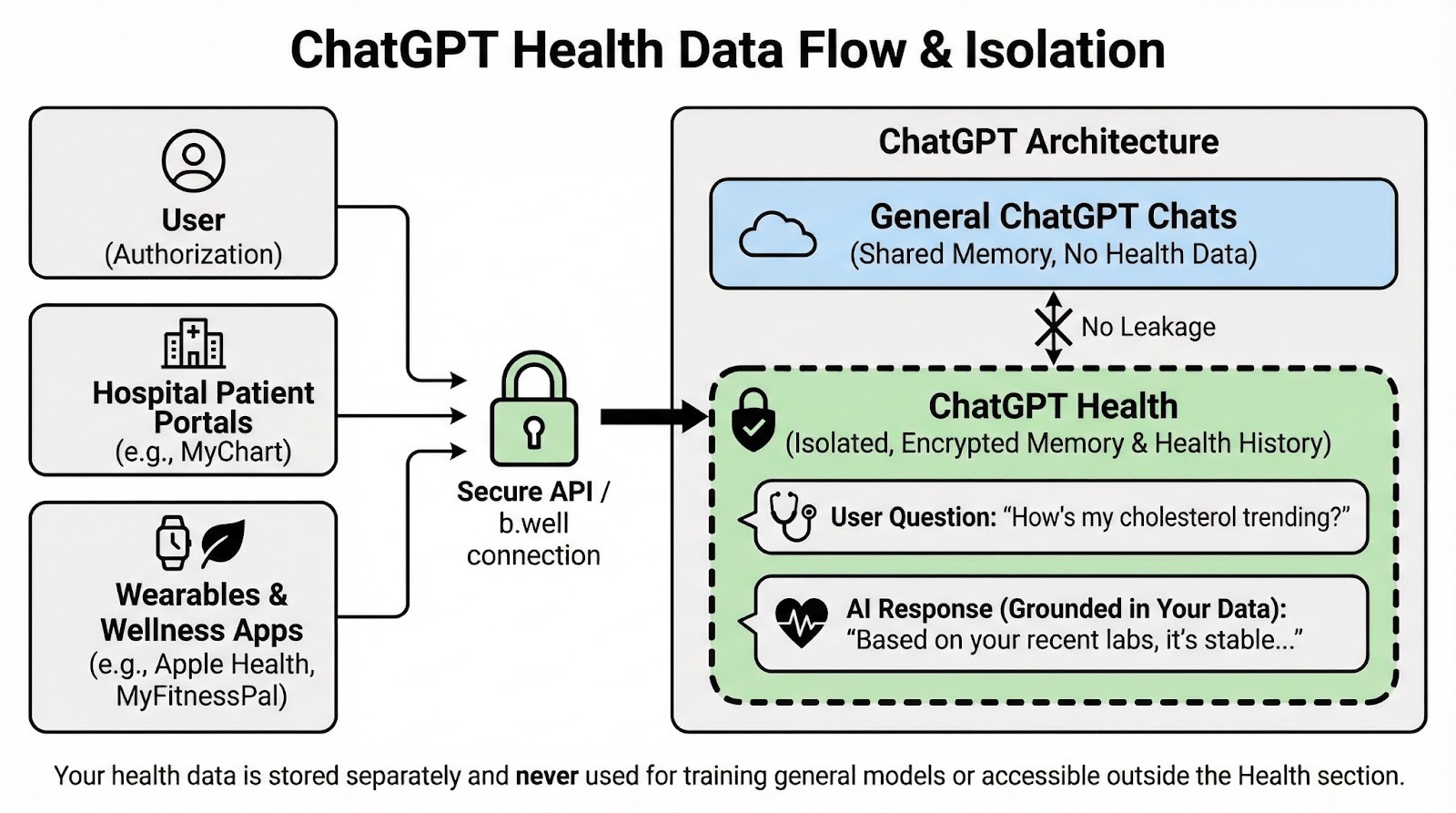 How ChatGPT Health isolates and encrypts your medical data. Image by Author.
ChatGPT Health is designed to inform and organize, not to replace your doctor's judgment. Let's break down what falls on each side of that line.
But now you can see that ChatGPT Health excels at helping you understand and organize your health info. It can explain blood test results, highlight values outside normal ranges, or turn a multi-page hospital discharge note into key takeaways.
The tool is great for preparing for doctor visits. You can ask it to suggest questions for your next appointment based on recent health updates, or outline concerns to bring up with your provider. ChatGPT Health also provides personalized wellness guidance on diet, exercise, sleep, and stress management. Since it sees your activity levels or calorie intake, advice gets tailored to your actual patterns.
ChatGPT Health will not diagnose diseases or conditions. This is important to know. If you enter symptoms and ask "Do I have diabetes?" it won't give you a definitive medical diagnosis. That requires a licensed professional. It won't prescribe medications, suggest dosages, or tell you which therapy to pursue. It lacks FDA approval as a medical device.
The AI is not for emergencies. If you're experiencing severe chest pain, suicidal thoughts, or any urgent situation, ChatGPT Health will urge you to seek immediate professional help. While it can be helpful, it doesn't guarantee accuracy and isn't something that carries medical liability.
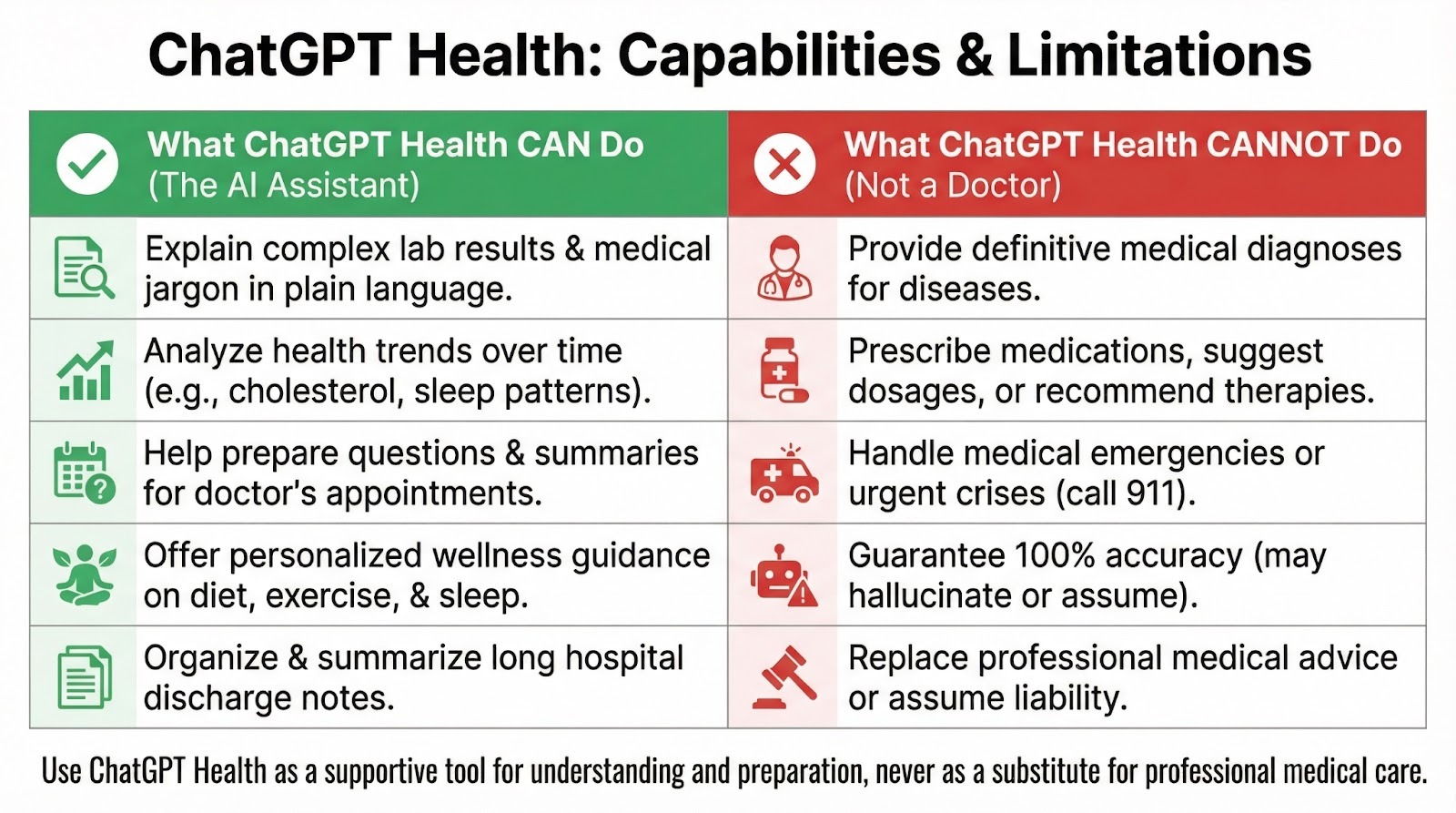 Key capabilities and safety limitations of ChatGPT Health. Image by Author.
Given the sensitive nature of health data, security is naturally a top concern. Let's examine how OpenAI protects your information and why privacy experts still recommend caution.
OpenAI has implemented multiple layers of protection. All Health conversations, files, and connected app data are stored separately from other ChatGPT chats in dedicated, isolated storage. Your health details won't accidentally appear in regular chats.
Conversations in ChatGPT Health are not used to train OpenAI's foundation models. Your medical specifics won't influence the AI or be seen by AI trainers. All data is encrypted both at rest and in transit, with additional purpose-built encryption for the Health section. OpenAI also offers multi-factor authentication, making it harder for unauthorized users to access your account.
Despite these protections, ChatGPT Health isn't covered by HIPAA (Health Insurance Portability and Accountability Act). OpenAI is a tech company providing a consumer service, not a healthcare provider or insurer, so strict privacy rules that govern hospitals don't apply. If there's a data breach or misuse, you won't have the same legal protections HIPAA provides.
The conservative approach is to assume any information you upload could potentially become public. Data breaches do happen, and no system is 100% secure. Privacy advocates call this a "buyer-beware" situation where you're trusting a private company's promises rather than federal health privacy law. For a deeper dive into the privacy risks of AI systems, our AI Ethics course explores data privacy, bias, and accountability.
AI medical advice risks are real and well-documented. Large language models like ChatGPT can "hallucinate," producing plausible-sounding but incorrect information. In a 2023 JAMA Oncology study, ChatGPT gave treatment recommendations that didn't align with established medical guidelines in over 33% of cancer cases. In about 12.5% of cases, it completely fabricated treatments that didn't exist.
These models are designed to always produce an answer, even when they should admit uncertainty. They're optimized to sound helpful and confident, which in medicine can be dangerous. OpenAI had physicians provide over 600,000 pieces of feedback during development to fine-tune medical responses, but no training can eliminate the risk entirely. To understand why AI hallucinations happen and how to spot them, take our Introduction to ChatGPT course.
Healthcare is also uniquely sensitive to missing or incomplete data. If your health records are fragmented and you haven't uploaded everything, ChatGPT Health might make assumptions to fill gaps. These educated guesses could be wrong. That's why experts emphasize treating ChatGPT Health as a starting point, never the final word.
Let's break down who stands to benefit most from ChatGPT Health and who should approach it with extra caution or avoid it altogether.
ChatGPT Health works well for people who want to better understand their health data. If you have lab reports, imaging results, or doctor's notes that are hard to interpret, the AI can translate them into plain language. This is especially valuable for managing chronic conditions like diabetes or high cholesterol. You can track trends over time and understand what changed since your last test without waiting for your next appointment.
The tool excels at helping you prepare for medical visits. You can ask it to draft questions based on recent health updates or outline concerns to bring up with your provider. General wellness enthusiasts who track fitness, sleep, or diet through apps will find ChatGPT Health useful as an analyst and coach.
Be careful with ChatGPT Health if you're dealing with a serious or complex medical condition requiring nuanced management. For something like cancer or a life-threatening illness, lean on human healthcare professionals. Using AI as a primary guide for complex treatment decisions would be dangerous. Never use the tool for urgent medical issues or emergencies.
Be cautious when questions involve prescription medications. While ChatGPT can explain how a drug works or its side effects, it shouldn't tell you to start, stop, or change medication doses. Privacy-conscious users should think carefully before uploading highly sensitive information like mental health records or anything potentially stigmatizing.
ChatGPT Health represents an intriguing step toward AI-assisted medicine, but it's not a wholesale replacement for traditional healthcare. The CEO of b.well described large language models as the "natural digital front door" for patients. People increasingly start with an AI health assistant query before calling their doctor or searching the web.
This aligns with where healthcare is heading: more telehealth, more patient-controlled health data, and more AI-driven insights. Within days of OpenAI's announcement, Anthropic launched Claude for Healthcare targeting enterprise use with HIPAA compliance. Big tech players have long eyed healthcare, and the AI boom is accelerating that movement. We can expect more AI health assistant tools, increasingly capable and possibly integrated directly with healthcare systems.
However, healthcare is profoundly human. Trust, empathy, and accountability are things AI cannot fully provide. The likely future involves AI assisting both patients and providers. Doctors might use AI copilots for summarizing visits, while patients use personal assistants like ChatGPT Health. ChatGPT Health's launch is a significant early indicator, though whether it becomes the default interface depends on public adoption and trust.
ChatGPT Health works best as an AI health assistant that helps patients understand and organize their health information, not as a replacement for medical professionals. If you're looking for a convenient way to make sense of your health data and you're aware of the tool's limitations, it can be valuable. The personalization is genuinely useful since answers feel more relevant when the AI knows your context.
Don't rely on ChatGPT Health if you're dealing with serious conditions requiring expert management or if you have urgent medical issues. It's not for emergencies, complex treatment decisions, or medication management without your doctor's involvement. If you're extremely privacy-conscious, think carefully about what you're comfortable sharing.
Learn how to work with LLMs in Python right in your browser
Learn ChatGPT with DataCamp
Course
Track
Course