
The main findings:
- Both stayed physically honest. Neither arm stretched a link or touched an obstacle, including on the swing around the obstacle between targets 2 and 3.
- Both admitted the target they could not reach. Each arm stopped short of target 4, and each status list marked it as missed while reporting the other four as reached.
- Both moved on schedule. Each spent 3 seconds moving and 1 second holding per target and stopped at 20 seconds.
- Hydrogen's page told you more. It drew a dashed trail of the tip's route and added live readouts of the arm tip's position (x, y) and the joint angles in degrees, a neat touch nobody asked for. Sonnet 5.5 drew the arm's reach circle and printed a self-check of its own constraints. Both read clearly from a single frame.
I scored both 5 out of 5 on physical honesty, motion quality, and scene legibility. The runs cost $0.40 for Sonnet 5.5 and $0.45 for Hydrogen, with Sonnet 5.5 using 30,491 output tokens to Hydrogen's 47,914, reasoning included.
On the rubric, this test is a draw. Both claims of dependable everyday coding held up on a well-specified geometry task, while Sonnet 5.5's slightly cheaper run, despite its higher rates, comes from a single attempt each.
When two models clear every probe, the bar needs raising: a harder version of this test could, for instance, add a target that is within reach on paper but blocked by an obstacle.
When to Choose Gemini 4 Hydrogen vs Claude Sonnet 5.5
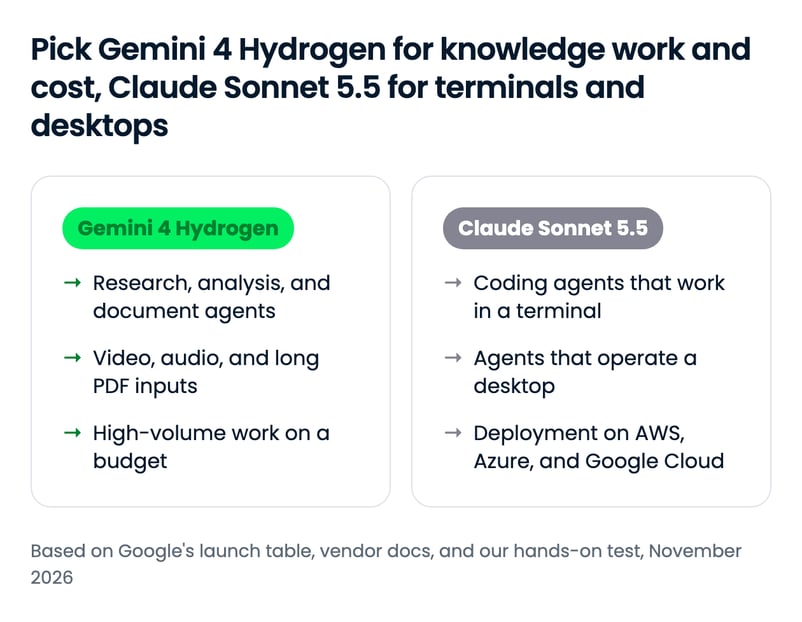
The fork is the environment the agent works in: documents and data favor Hydrogen, terminals and desktops favor Sonnet 5.5. Price favors Hydrogen everywhere, by the same 25%.
Choose Gemini 4 Hydrogen if...
- Your agents do research, analysis, or document work. Hydrogen leads every knowledge-work row in Google's table, and the gap is widest on end-to-end professional workflows.
- Your inputs are recordings or long visual files. It reads video, audio, and PDFs natively, which Sonnet 5.5 does not.
- Cost per request decides the model. Every rate is 25% lower, and the free tier covers prototyping before you pay anything. Make sure to still track cost per task.
- You build on Google's stack. Hydrogen is the default in the Antigravity agent and runs as the execution model under Carbon and Argon in Antigravity's Orchestrator.
Choose Claude Sonnet 5.5 if...
- Your coding agent works in a terminal. Sonnet 5.5 leads every Terminal-Bench read, including the independent one.
- Your agents operate a desktop or browser. It leads OSWorld-2.1 by a clear margin.
- You deploy across clouds or work in Claude Code or GitHub Copilot. Sonnet 5.5 is on Amazon Bedrock, Microsoft Foundry, and Google Cloud, and in the main coding agents.
- You want long answers without extra setup. Its standard per-request output limit is about twice Hydrogen's default, which needs long decode to go further.
How to Get Started With Gemini 4 Hydrogen and Claude Sonnet 5.5
Both models are generally available through their vendors' APIs and on OpenRouter, but Sonnet 5.5 reaches more clouds and coding agents.
| Surface | Gemini 4 Hydrogen | Claude Sonnet 5.5 |
|---|---|---|
| Consumer app | Gemini app (model drop-down; free users through auto model selection) and Google Search | Claude apps |
| First-party API | Gemini API and Google AI Studio, free and paid tiers | Claude API |
| Cloud platforms | Google Cloud Vertex AI and Gemini for business | Amazon Bedrock, Claude Platform on AWS, Google Cloud, Microsoft Foundry |
| Coding agents | Google Antigravity (Google AI Pro and Ultra), Cursor, GitHub Copilot | Claude Code, Cursor, GitHub Copilot |
| Third-party routers | OpenRouter | OpenRouter |
| API model ID | gemini-4-hydrogen | claude-sonnet-5-5 (anthropic.claude-sonnet-5-5 on Bedrock) |
The model IDs are gemini-4-hydrogen and claude-sonnet-5-5. The biggest gap is reach: Sonnet 5.5 runs on all three major clouds, while Hydrogen is Google Cloud first.
Making your first API call
The two models use different SDKs, so switching means switching clients, not just the model string. On Hydrogen, Google's Interactions API defaults to the high thinking level:
from google import genai
client = genai.Client()
interaction = client.interactions.create(
model="gemini-4-hydrogen",
input="Find the off-by-one bug in this loop: ...",
)
print(interaction.output_text)On Sonnet 5.5, adaptive thinking is on by default, so print only the text blocks:
from anthropic import Anthropic
client = Anthropic()
response = client.messages.create(
model="claude-sonnet-5-5",
max_tokens=2048,
messages=[{"role": "user", "content": "Find the off-by-one bug in this loop: ..."}],
)
print("".join(b.text for b in response.content if b.type == "text"))For a full walkthrough, see our Claude Sonnet 5.5 API tutorial.
Final Thoughts
Gemini 4 Hydrogen and Claude Sonnet 5.5 are two models on a similar performance level. Our hands-on test could barely tell them apart, and the choice between the two comes down to your use case.
Gemini 4 Hydrogen is the better default for most knowledge work, reads more kinds of input, and costs a quarter less at every rate. Claude Sonnet 5.5 is the pick when the agent lives in a terminal or on a desktop, and when you need it on every cloud.
If you're keen to learn more, I recommend our Introduction to Claude Models course, and for Google's side, Building AI Agents with Google ADK.
FAQs
Is Gemini 4 Hydrogen better than Claude Sonnet 5.5?
It depends on the work. Gemini 4 Hydrogen scores higher on 7 of the 10 rows in Google's launch table, led by knowledge work and document-heavy agent tasks, and costs 25% less. Claude Sonnet 5.5 leads terminal-based coding and computer use. In our hands-on robot-arm test, both earned full marks.
Which is cheaper, Gemini 4 Hydrogen or Claude Sonnet 5.5?
Gemini 4 Hydrogen is cheaper. It costs $1.50 per million input tokens and $7.50 per million output tokens, compared with $2 and $10 for Claude Sonnet 5.5. Cached reads and batch rates follow the same 75% ratio, and Hydrogen also has a rate-limited free tier in the Gemini API and Google AI Studio. That said, in our hands-on test, Claude Sonnet was slightly cheaper per task ($0.40 vs $0.45) because Hydrogen used more thinking tokens.
Is Gemini 4 Hydrogen or Claude Sonnet 5.5 better for coding?
Claude Sonnet 5.5 is the stronger pick for coding agents that work in a terminal: it leads every Terminal-Bench result, including an independent run by Artificial Analysis. Gemini 4 Hydrogen leads Google's SWE-sweep bug-repair benchmark and costs less, and both models passed our hands-on robot-arm build task with full marks.
Where can I use Gemini 4 Hydrogen and Claude Sonnet 5.5?
Both are available on OpenRouter, GitHub Copilot, Cursor, and Google Cloud Vertex AI. Gemini 4 Hydrogen is in the Gemini app, Google Search, the Gemini API, Google AI Studio, and Google Antigravity. Claude Sonnet 5.5 is in the Claude apps, Claude Code, the Claude API, Amazon Bedrock, and Microsoft Foundry.
What are the API model IDs for Gemini 4 Hydrogen and Claude Sonnet 5.5?
Gemini 4 Hydrogen's API model ID is gemini-4-hydrogen in the Gemini API and on Vertex AI. Claude Sonnet 5.5's is claude-sonnet-5-5 on the Claude API, Google Cloud, and Microsoft Foundry, and anthropic.claude-sonnet-5-5 on Amazon Bedrock. The two use different SDKs, so switching means changing the client as well as the model string.

Tom is a Data Science Editor at DataCamp. He writes and edits AI tutorials, compares new LLM releases, and builds AI-powered workflows. Previously, he worked in data science at Deutsche Telekom. Outside of work, he forecasts football matches with machine learning.







Google released Gemini 4 Hydrogen on November 12, 2026, as the fast, lower-cost member of the Gemini 4 family and the replacement for Gemini 3.8 Flash. Its launch benchmark table puts Claude Sonnet 5.5, Anthropic's mid-tier model since September 28, in the column right next to it, so this matchup is Google's own framing.
In this article, I'll compare Gemini 4 Hydrogen and Claude Sonnet 5.5 across agentic coding, knowledge work, computer use, and pricing, and share what happened when I ran the same build task on both.
To keep up with the AI and data space, I recommend subscribing to our weekly newsletter, The Median.
TL;DR
What Is Gemini 4 Hydrogen?
Gemini 4 Hydrogen is Google DeepMind's fast, lower-cost Gemini 4 model, released on November 12, 2026, as the successor to Gemini 3.8 Flash.
Google calls it a daily driver for agentic workflows: it works on its own, or as the execution model under Gemini 4 Carbon and Argon, which the new Orchestrator in Google Antigravity switches between within one session.
Our Gemini 4 Hydrogen guide covers the launch in detail.
What Is Claude Sonnet 5.5?
Claude Sonnet 5.5 is Anthropic's mid-tier model, released on September 28, 2026, as the second model in the Claude 5.5 family.
Anthropic positions it as a faster, lower-cost complement to Claude Opus 5.5, strongest at well-scoped everyday tasks, bug fixes, and polished documents, slides, and spreadsheets.
Our Claude Sonnet 5.5 guide covers the launch, and our Claude Sonnet 5.5 API tutorial builds a reconciliation agent with it.
Gemini 4 Hydrogen vs Claude Sonnet 5.5: Head-to-Head Comparison
Gemini 4 Hydrogen scores higher than Claude Sonnet 5.5 on 7 of the 10 rows in Google's launch table, but the 3 rows Sonnet 5.5 wins are the ones where the model works inside a terminal or on a desktop. Hydrogen is also the cheaper of the two on every rate both vendors publish.
highis the defaulthighis the API defaultCoding and agentic work
Claude Sonnet 5.5 leads terminal-based agentic coding in every source that reports both models, while Gemini 4 Hydrogen leads Google's bug-repair benchmark. The most useful number is the independent one: Artificial Analysis ran Terminal-Bench 4.0 itself and put Sonnet 5.5 at 64% to Hydrogen's 54%, a gap close to the one in Google's own table.
SWE-sweep is Google's pick, and both scores are low in absolute terms, but it is the one coding row Hydrogen wins clearly. Google also says Hydrogen batches file reads and searches in parallel when exploring a repository, and Anthropic says the same of Sonnet 5.5 against Sonnet 5, so neither vendor owns that story.
For a coding agent that lives in a shell, Sonnet 5.5 is the stronger pick; Hydrogen gets close for less money, which the pricing section quantifies.
Knowledge work and reasoning
Gemini 4 Hydrogen leads every knowledge-work row in Google's table, and the widest gap is on Agents' Last Exam v1.1, an end-to-end professional-workflow benchmark, where it scores 71.6% to Sonnet 5.5's 60.4%.
All five rows come from Google's launch table. Sonnet 5.5's only win in this group is the science benchmark that, again, runs in a terminal. For research, analysis, and document-heavy agents, Hydrogen is the stronger model.
Computer use and multimodal work
Claude Sonnet 5.5 leads computer use, scoring 83.9% to Hydrogen's 77.6% on the offline subset of OSWorld-2.1 in Google's table. On multimodal understanding the two are close, with Hydrogen slightly ahead.
The bigger multimodal difference is what each model accepts: Hydrogen reads video, audio, and PDFs natively, while Sonnet 5.5 takes text and images. Pick Sonnet 5.5 for agents that click through interfaces, and Hydrogen when the inputs are recordings or long visual files.
Pricing: what you actually pay
Gemini 4 Hydrogen costs 75% of Claude Sonnet 5.5's price on every rate both vendors publish: input, output, cached reads, and batch. That single multiple carries through to every workload shape below.
Because the multiple is uniform, the comparison comes down to one number rather than a workload-by-workload story. The structural differences sit elsewhere: Hydrogen has a free tier and no explicit cache writes.
Token rates side by side
Both vendors publish standard, cached, and batch rates per 1M tokens.
Google prices Hydrogen flat across the full 1M-token window and bills its thinking tokens at the output rate, so moving up to
xhighis a cost decision as much as a quality one. Hydrogen also has a rate-limited free tier in the Gemini API and Google AI Studio, which matters more for prototyping than any per-token rate.What a real workload costs
Each total is (volume ÷ 1M) × rate, summed across input and output, at standard rates.
The generation-heavy row is where the gap turns into real money, since output is the larger rate for both. The cache row assumes every read is a cache hit: Sonnet 5.5 pays $2.50 per 1M tokens to write the prefix once, Hydrogen pays its normal input rate on the first request, and the gap still lands at 25%.
Why the same task costs different amounts
Google's Terminal-Bench 4.0 cost chart is the only figure either vendor has published that prices both models on the same tasks. At about $2 per task, Hydrogen at its default
highsetting reaches 57%, while Sonnet 5.5 needs about $5 per task to pass that score. That is Google's run under Google's methodology, so treat it as a vendor claim, but it points the same way as the rate table: Hydrogen buys more score per dollar on this benchmark, even where Sonnet 5.5 reaches the higher ceiling.How Gemini 4 Hydrogen and Claude Sonnet 5.5 Performed
Benchmarks from two different vendors only go so far, so I ran one build task against both models with an identical prompt and identical tooling.
The task: a single-file web page that animates a three-link robot arm visiting five targets in order on a plane with rectangular obstacles. Each target gets 4 seconds (3 to move, 1 to hold), every link must keep its exact length, no part of the arm may touch an obstacle at any moment, and a status list must report whether the arm's tip actually reached each target. The page had to be drawn in SVG, with no build step, no dependencies, and no network.
The scene hides two traps:
The prompt mentions neither, so noticing them is the point. It is a compact check on the pitch both vendors make for these models: fast and dependable everyday coding, and on Google's claim that Hydrogen cuts fabricated claims by more than 5x compared to Gemini 3.8 Flash.
Both ran in OpenCode with a pinned tool surface (file read, write, and edit only), at
highreasoning effort, one attempt each, fresh session, prompt delivered byte-for-byte.highis the third of four thinking levels on Hydrogen and the third of five effort levels on Sonnet 5.5, and it is the API default for both.Here are the two artifacts that the models produced, Gemini Hydrogen first and Claude Sonnet second.