

Kurs
Einführung in KI-Agenten
1 Std. 30 Min.
146.4K
Üben und Lernpfad deinen Fortschritt.
Weiter Mit GoogleKI geht über einfache Chatbots hinaus und beginnt, eigenständig zu handeln – in Form von Agenten.
Trotz technologischer Fortschritte erzielen die meisten Unternehmen jedoch keine greifbaren Ergebnisse. Bis zu 95% der KI-Pilotprojekte liefern keinen klaren Business-Mehrwert. Häufig liegt das daran, dass Systeme nicht gut zusammenarbeiten oder nicht richtig angebunden sind.
Hier setzt OpenAI Frontier an – eine Plattform, die genau dieses Problem lösen soll. Sie wurde gemeinsam mit OpenAIs neuestem und leistungsfähigstem Modell GPT-5.3 Codex vorgestellt. Um bei OpenAIs neuesten Modellen auf dem Laufenden zu bleiben, wirf auch einen Blick in unseren Guide zu GPT-5.4.
In diesem Artikel erkläre ich, wie Frontier funktioniert, welche Features es bietet, wie es im Vergleich zum Wettbewerb abschneidet und wie es die Zukunft von Business-Software verändern könnte.
Für einen Einstieg in diesen Wandel empfehle ich unseren Kurs Introduction to AI Agents.
OpenAI Frontier ist eine Business-Plattform, mit der Unternehmen Gruppen von KI-Agenten – oder „KI-Kolleg:innen“, wie OpenAI sie im Einleitungsartikel nennt – erstellen, bereitstellen, verwalten und überwachen können.
Statt als eigenständiger Conversational-Bot zu agieren, ist Frontier eine Schicht, die KI direkt in Unternehmensworkflows integriert.
Auf hoher Ebene ist die Architektur der Plattform dafür von Grund auf ausgelegt, wie das folgende Diagramm zeigt:
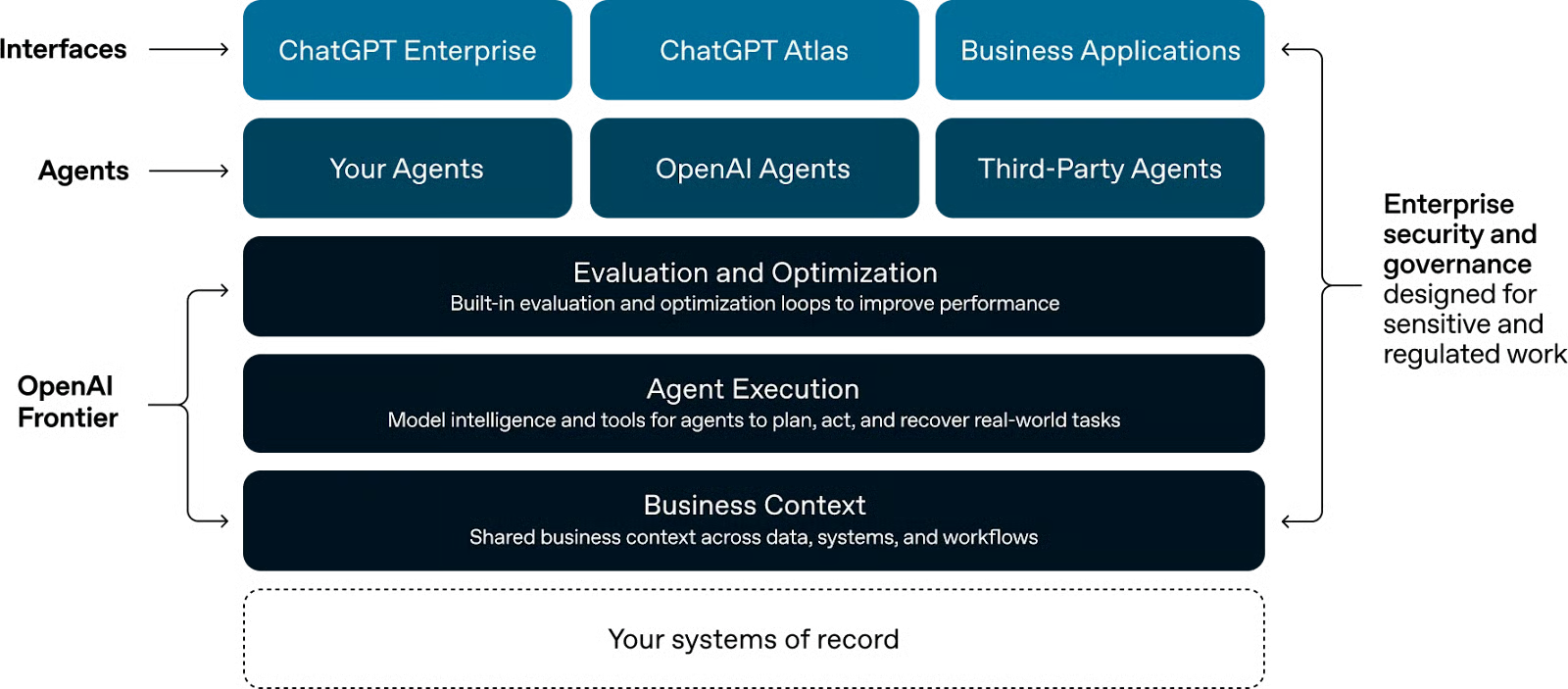
Schauen wir uns die einzelnen Ebenen an:
Aufgrund von Tools wie Frontier wird das Bauen von KI-Agenten zu einer grundlegenden Kompetenz. Eine Schritt-für-Schritt-Anleitung findest du in unserem OpenAI AgentKit Tutorial.
Tools wie Frontier sind entscheidend, weil sie die unternehmensweite „KI-Chance-Lücke“ direkt adressieren. Zwischen dem, was moderne KI-Modelle leisten können, und dem, was Unternehmen stabil in Produktion bringen, klafft derzeit eine große Lücke.
Viele Firmen haben mit standalone-KI-Tools gekämpft, die nicht über kleine Pilotprojekte hinauswachsen. Wenn du als Führungskraft diese Falle vermeiden willst, lies unseren Guide zum Skalieren von KI in deiner Organisation.
Die eigentliche Herausforderung ist nicht mehr der Zugang zu KI-Modellen, sondern deren sichere Einbettung in zentrale Prozesse. Frontier ändert die Perspektive: KI ist nicht nur ein weiteres Feature, sondern wird zur Kerninfrastruktur, die das gesamte Unternehmen trägt.
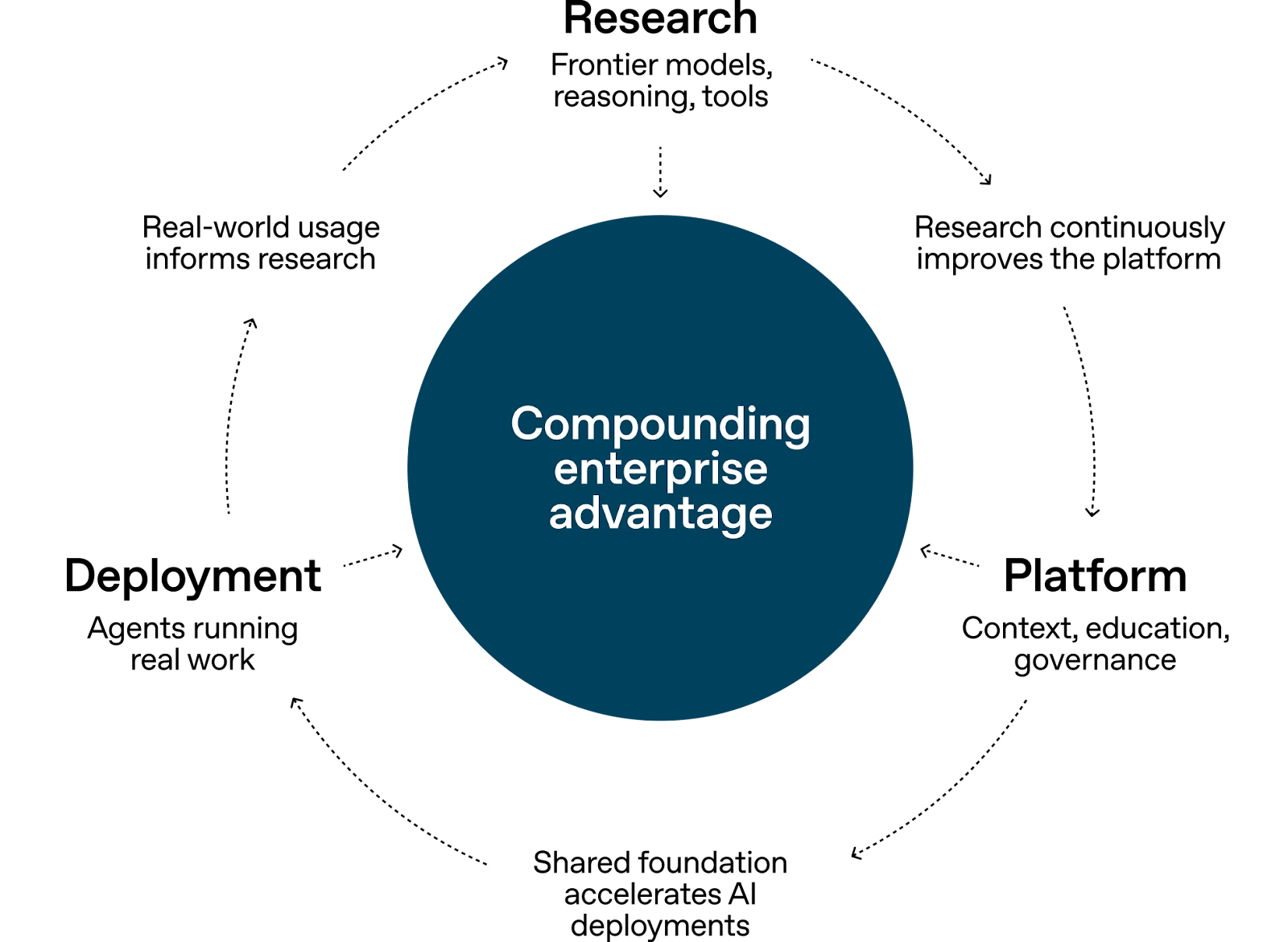
Unternehmen, die KI auf diese Weise in ihre Infrastruktur integrieren, bauen einen wachsenden Wettbewerbsvorsprung auf. Je mehr Aufgaben Agenten übernehmen, desto besser lernt und optimiert das System. Mit der Zeit entsteht so ein operativer Vorteil, der sich schwer kopieren lässt.
Statt pro Nutzer:in abzurechnen, orientiert sich dieses Modell an greifbaren Ergebnissen. Unternehmen zahlen für die Arbeit, die autonome KI-Agenten tatsächlich erledigen – nicht nur für den Softwarezugang. Das könnte die Monetarisierung von Software und den Einsatz digitaler Arbeitskräfte grundlegend verändern.
OpenAI Frontier ist um Kernfähigkeiten herum aufgebaut, die KI-Agenten wie Mitarbeitende behandeln. Die Plattform umfasst:
Frontier verbindet verschiedene Unternehmenssysteme zu einer gemeinsamen Schicht, zum Beispiel:
So erhalten KI-Kolleg:innen ein konsistentes Verständnis für Prozesse, Begriffe und Ziele – eine zuverlässige Teamgedächtnis-Schicht.
Agenten in OpenAI Frontier beantworten nicht nur Fragen. Sie analysieren autonom Dateien, führen Code aus und bedienen Unternehmenssoftware. Dadurch können sie handeln und komplexe, mehrstufige Projekte über verschiedene Abteilungen hinweg zuverlässig abschließen.
Um die technische Grundlage dahinter zu verstehen und praktisch zu üben, empfehle ich unseren Kurs Developing AI Systems with the OpenAI API.
Wie bei menschlichen Teams steigt die Qualität eines Agenten über integrierte Evaluations-Tools. Manager können Aktionen prüfen, direktes Feedback geben und Verhalten optimieren, sodass das System mit jeder erledigten Aufgabe genauer und hilfreicher wird.
Agenten skalieren, ohne die Kontrolle zu verlieren, ist eine Kernaufgabe beim Wechsel zu agentischer KI. Deshalb wird Sicherheit strikt durchgesetzt.
Jeder Agent erhält eine eindeutige Identität mit klaren Grenzen, was er darf und was nicht. So greifen Agenten nur auf die für ihre Aufgabe nötigen Daten zu – bei lückenloser Protokollierung für Audits und Compliance.
Mit Frontier musst du bestehende Systeme nicht neu aufbauen. Offene Anschlussstandards sorgen dafür, dass die Plattform direkt an die vorhandenen Anwendungen und Cloud-Services andockt. Das beschleunigt die Einführung und senkt das technische Risiko.
Die Implementierung in großem Maßstab erfordert tiefes Know-how. OpenAI stellt dedizierte Engineers zur Seite, die direkt mit deinem Team arbeiten. Sie entwerfen die Architektur, definieren Sicherheitsregeln und sorgen für einen stabilen, zuverlässigen Betrieb im Alltag.
Aktuell ist OpenAI Frontier nur für eine begrenzte Zahl früher Enterprise-Anwender verfügbar, darunter HP, Oracle und Uber. Eine breitere Verfügbarkeit folgt in den nächsten Monaten.
Der Zugang erfolgt über den Enterprise-Vertrieb von OpenAI; es gibt keine öffentliche Preisliste oder Self-Service-Anmeldung. Einführungen sind stark maßgeschneidert und laufen oft über die „Frontier Alliance“ mit großen Beratungshäusern wie McKinsey, BCG, Accenture und Capgemini.
Der Markt für Künstliche Intelligenz ist voll von Enterprise-Plattformen zur Arbeitsautomatisierung. Für einen breiteren Überblick lies unseren Vergleich der besten KI-Agenten 2026.
So schneidet Frontier im Vergleich zu anderen großen Tools ab – und wo die jeweiligen Stärken liegen.
Claude Cowork punktet mit No-Code-Automatisierungen und tiefen Integrationen in Alltags-Apps wie Slack, Figma und Asana. Zudem setzt es auf Constitutional AI, um sichere, zuverlässige Abläufe zu gewährleisten.
Allerdings fehlen Claude Cowork einige Schlüsselfunktionen, die Frontier bietet. Es kann keine Agenten unterschiedlicher Anbieter orchestrieren und verfügt über keine gemeinsame semantische Business-Kontextschicht, um isolierte Daten zu verbinden.
Damit eignet sich Claude Cowork hervorragend für Experimente in kleinen Teams, während Frontier für Enterprise-weite Koordination über getrennte Systeme hinweg konzipiert ist.
Wenn du mehr über Anthropic’s Agentenplattform erfahren willst, findest du alles Nötige in unserem Claude Cowork Tutorial.
Google Vertex AI überzeugt mit cloud-nativem, multimodalem Skalieren. Dadurch ist die Google-Plattform extrem stark für datenintensive, Echtzeit-Deployments.
Im Vergleich zu Frontier fehlen Vertex AI ein integriertes Agenten-Onboarding und identitätsbasierte Berechtigungen, die speziell auf autonome KI-Arbeitskräfte zugeschnitten sind. Vertex AI ist die bessere Wahl für schwere Datenverarbeitung und Infrastrukturskalierung, während Frontier speziell für Multi-Agenten-Orchestrierung und Aufgabenmanagement entwickelt wurde.
Microsoft Copilot Studio bietet eine Low-Code-Umgebung zum Erstellen von KI-Agenten mit strenger Governance. Der größte Vorteil ist die nahtlose Integration in das Microsoft-Ökosystem – ideal für hybride Setups mit Cloud und On-Premises. Ein Praxisbeispiel findest du in unserem Guide zum Copilot App Builder.
Wie Claude Cowork kann Copilot Studio keine Agenten mehrerer Anbieter steuern und verfügt nicht über eine gemeinsame semantische Business-Kontextschicht. Copilot Studio ist optimal für Unternehmen mit starkem Microsoft-Fokus, während Frontier eine komplett modellagnostische Steuerung für eine diverse Agentenflotte bietet.
|
Plattform |
Kernstärken & Features |
Was im Vergleich zu Frontier fehlt |
Am besten geeignet für |
|
OpenAI Frontier |
Orchestrierung von Agenten mehrerer Anbieter, gemeinsame semantische Business-Kontextschicht, integriertes Agenten-Onboarding, identitätsbasierte Berechtigungen, modellagnostisch. |
N/A (Baseline) |
Enterprise-weite Koordination und Management einer diversen KI-Arbeitsflotte über getrennte Systeme. |
|
Claude Cowork |
No-Code-Automatisierung, tiefe App-Integrationen (Slack, Figma, Asana), Sicherheit via Constitutional AI. |
Keine Orchestrierung von Anbietern übergreifenden Agenten; keine gemeinsame semantische Business-Kontextschicht. |
Experimente in kleinen Teams und sichere, zuverlässige Alltagsabläufe. |
|
Google Vertex AI |
Cloud-natives, multimodales Skalieren; starke Fähigkeiten für schwere Datenverarbeitung. |
Integriertes Agenten-Onboarding; identitätsbasierte Berechtigungen für autonome KI-Arbeitskräfte. |
Datenintensive Echtzeit-Deployments und Infrastrukturskalierung. |
|
Microsoft Copilot Studio |
Low-Code-Umgebung, strenge Governance, nahtlose Microsoft-Integration. |
Keine Orchestrierung von Anbietern übergreifenden Agenten; keine gemeinsame semantische Business-Kontextschicht. |
Hybride Setups (Cloud/On-Premises) und Unternehmen mit starkem Microsoft-Fokus. |
Frontier liefert bereits messbare Ergebnisse in operativ komplexen Branchen:
Um eine Plattform wie OpenAI Frontier optimal zu nutzen, braucht es zwei Dinge:
Ersteres ist längst Voraussetzung für klassische Informationssysteme, doch der zweite Punkt ist entscheidend. In unserem Report The State of Data + AI Literacy 2026 sagen 72% der befragten Enterprise-Führungskräfte, dass KI-Kompetenz für die tägliche Arbeit wichtig ist.
Dennoch berichten 59% von einer deutlichen KI-Kompetenzlücke, die die Einführung bremst. Dagegen hilft unternehmensweite KI-Kompetenzschulung: Organisationen mit einem ausgereiften KI-Literacy-Programm erzielen fast doppelt so häufig einen signifikanten ROI aus KI-Investitionen.
Angebote wie DataCamp for Business helfen Teams, diese Kompetenzen aufzubauen – von Datenmanagement bis KI-Controlling. Mit starken Datenpraktiken und geschulten Teams holen Unternehmen maximalen Nutzen aus autonomen KI-Systemen und machen aus Piloten echten Business-Impact.
Egal ob Startup oder Konzern: DataCamp for Business liefert die Tools für Upskilling und Reskilling und fördert eine datengetriebene Kultur, damit du im Markt die Nase vorn behältst. Fordere heute eine Demo an, um mehr zu erfahren.
OpenAI Frontier markiert einen klaren Wandel der Arbeitswelt: von isolierten Produktivitätstools hin zu einer voll gemanagten digitalen Belegschaft.
Mit ergebnisbasierter Rechenleistung stellt Frontier traditionelle SaaS-Preismodelle pro Sitzplatz infrage und zwingt Unternehmen, die Ausführung von Business-Logik neu zu denken.
Wenn KI-Agenten zur neuen Einheit der enterprise-Arbeit werden, erzielen Unternehmen mit Orchestrierungsplattformen wie Frontier einen kumulativen Vorsprung bei Geschwindigkeit, Kosten und Skalierung.
KI-Agenten-Kurse
Kurs
Kurs
Üben und Lernpfad deinen Fortschritt.
Weiter Mit GoogleBlog
Blog
Hesam Sheikh Hassani
15 Min.
Blog
Zoumana Keita
15 Min.
Tutorial
Josef Waples
8 Min.
Tutorial
Mark Pedigo
10 Min.
Tutorial
Matt Crabtree
5 Min.


