メインコンテンツへスキップ

GPT Live Transcribe API Tutorial: Build Real-Time Captions in Python

Learn how to use OpenAI’s gpt-live-transcribe API to stream microphone audio, generate multilingual live captions, improve domain-specific accuracy, and balance latency against transcription quality.
2026年8月6日  · 15 分 読む

AIで探索

ChatGPTで開くClaudeで開くPerplexityで開く

Uploading a finished audio file to a transcription endpoint is the easy version of this problem. You wait for the whole file, then get one transcript back. Nobody is staring at a screen while the model works. Live captioning is a different job: audio keeps arriving while you are still deciding what to do with what you have, and the text has to update while the speaker is still talking.

That is the gap gpt-live-transcribe fills. OpenAI released it on July 28, 2026 alongside a batch counterpart, gpt-transcribe. In this tutorial I build a Python captioning client around it and run three tests: a basic streaming client, a comparison of the context hints it accepts, and a benchmark of its five delay settings. I tested with clean English, technical vocabulary, and Egyptian Arabic-English code-switching, since that is closer to a real meeting than one clean narrator.

By the end you will have a working captioning app, a sense of which context settings actually help, and a delay setting you can defend instead of guessing at.

What Is GPT Live Transcribe?

gpt-live-transcribe is a streaming speech-to-text model for applications that need transcript text while audio is still arriving. It takes audio in and returns text out, nothing else, tuned by four fields: delay for latency, prompt for free-form context, keywords for literal terms, and languages for expected input languages. On OpenAI's Context Aware ASR benchmark, free-form context raised semantic accuracy from 38.5 percent to 44.6 percent, which is why Test 2 exists.

The model runs inside the Realtime API, not as a separate endpoint, and it is unrelated to GPT-Live, OpenAI's voice system, whatever the names suggest. You open a transcription session, configure it, and the server streams events back over the connection you send audio on. That leaves one question to settle first: which of the two transcription models you actually need.

GPT Live Transcribe vs. GPT Transcribe

OpenAI ships two recommended transcription models, and they are not interchangeable. gpt-live-transcribe is for continuously arriving audio, a microphone, a phone call, a media stream, where you need partial text before the speaker finishes. gpt-transcribe is for completed recordings, or a Realtime session where you deliberately wait for a committed turn. The docs call that second case a specialized workflow, not a way to get live deltas.

One difference trips people up: gpt-transcribe returns a languages array with the detected input language, gpt-live-transcribe does not. If your logic branches on detected language, you are reaching for the wrong model, no matter how good its captions look in a demo. Pricing splits along the same line, roughly four to one in the batch model's favor, which I come back to later.

What gpt-live-transcribe doesn't return

I would rather tell you this now than after you have built half an app around it. There are no word-level timestamps, no speaker labels, no confidence scores, and no diarization. If you need subtitle timing, notes that say who spoke, or a confidence threshold, OpenAI's guide points to gpt-4o-transcribe-diarize or whisper-1 instead.

Setting Up GPT Live Transcribe in Python

Every script in this tutorial lives in github.com/KhalidAbdelaty/gpt-live-transcribe, so start by cloning it. You need Python 3.10 or newer and an API key with Realtime access. The scripts themselves rest on four packages: websockets for the connection, sounddevice for microphone capture, numpy for the buffer conversion, and python-dotenv for loading the key. The requirements file adds a few more for the charts and the browser demo.

git clone https://github.com/KhalidAbdelaty/gpt-live-transcribe.git
cd gpt-live-transcribe
pip install -r requirements.txt

On macOS, sounddevice needs PortAudio at the OS level (brew install portaudio); on Linux it is apt-get install portaudio19-dev. Skip that line if you are on Windows. I hit the macOS one myself, and the fix really is that single install.

The audio itself has to arrive as 16-bit PCM at 24 kHz, mono, little-endian, base64-encoded. Send an MP3 or a stereo WAV and you get garbled output or a closed connection, never a message telling you the format was wrong. That one can eat an afternoon. So the next question is which connection carries the audio.

Choosing WebSocket vs. WebRTC

OpenAI's guidance is plain: WebSocket for server-to-server applications, WebRTC for browser and mobile clients. This tutorial builds a Python backend reading a local microphone, so WebSocket is the right choice, and a standard API key works since it never leaves your server.

Understanding the session and event flow

A session starts with a session.update event that sets type: "transcription" and picks gpt-live-transcribe as the model. Everything else in the payload describes the audio you are about to send. Here is the minimum configuration, from the Realtime transcription guide:

session_config = {
    "type": "session.update",
    "session": {
        "type": "transcription",
        "audio": {
            "input": {
                "format": {"type": "audio/pcm", "rate": 24000},
                "transcription": {"model": "gpt-live-transcribe"},
                "turn_detection": None,
            }
        },
    },
}

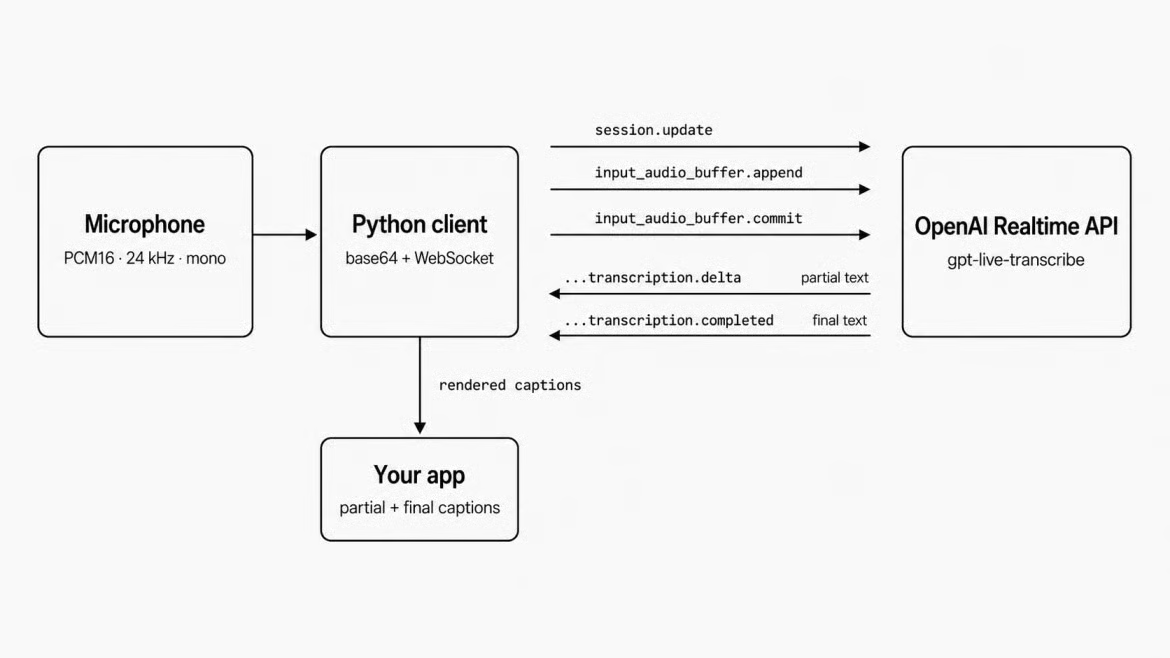
turn_detection: None disables automatic voice activity detection, so nothing finalizes until you explicitly commit. Three client events then do the work: input_audio_buffer.append sends a base64 audio chunk, input_audio_buffer.commit ends a turn, and the server answers with conversation.item.input_audio_transcription.delta (partial text) and conversation.item.input_audio_transcription.completed (final text). I connect to wss://api.openai.com/v1/realtime?intent=transcription, a pattern from OpenAI's cookbook; the guide does not document that query string, so drop it if it ever stops working.

Diagram of a GPT Live Transcribe session showing microphone audio encoded to base64, sent over WebSocket, and returned as delta and completed transcript events.

Realtime transcription session event flow diagram. Image by Author.

Building a Basic Live Transcription Client

Test 1 is the smallest version that works: capture microphone audio, stream it, print partial and final text as it arrives. No context, no keywords, nothing tuned, so the event flow stays visible. The first problem is getting audio off the microphone thread without stalling it.

Streaming microphone audio

sounddevice runs its callback on its own thread with a few milliseconds to return before the driver drops frames, so it cannot wait on a network call. Its only job is converting the float32 buffer to PCM16 and dropping it onto an asyncio.Queue through loop.call_soon_threadsafe, while a separate coroutine drains that queue and sends each chunk.

def callback(indata, frames, time_info, status):
    pcm16 = (indata[:, 0] * 32767).astype(np.int16).tobytes()
    loop.call_soon_threadsafe(queue.put_nowait, pcm16)

stream = sd.InputStream(samplerate=24000, channels=1, dtype="float32",
                         blocksize=2400, callback=callback)

A 100-millisecond chunk (2,400 samples at 24 kHz) is a reasonable starting point. Go smaller and you add per-message overhead, go much larger and captions feel laggy. There is no documented correct number, so treat it as a dial.

Handling partial and final transcripts

Deltas are cheap and frequent. Each one carries a piece of text tied to an item_id. Append it to the partial text you already have for that item, and the caption grows word by word on screen:

if event["type"] == "conversation.item.input_audio_transcription.delta":
    item_id = event["item_id"]
    partials[item_id] = partials.get(item_id, "") + event["delta"]
    print(f"\r[partial] {partials[item_id]}", end="")

A completed event replaces that partial with the finalized transcript for the same item. Treat completed as the source of truth and deltas as a preview, not something to concatenate yourself.

Managing transcript state with item_id

Here is the detail that will break your UI if you skip it: OpenAI's guide states that ordering between completion events from different turns is not guaranteed. A completed event for an earlier turn can arrive after one for a later turn, so code assuming the newest completed belongs to the newest turn will occasionally jump backward or duplicate a line. Key everything by item_id instead, which is what my TranscriptState class does.

Building it caught two bugs, both about which dictionary the code checked. Appending item_id to the order list only in the delta handler left full_transcript() empty for any receiver processing just completed events. Using the partials dictionary to decide whether an item was new was worse: apply_completed() clears that entry, so a late delta looked brand new, went onto the order list a second time, and printed the finished turn twice. Track item_id in both handlers, and check the order list instead.

Terminal output from GPT Live Transcribe showing a partial caption updating in place, followed by a finalized transcript line with its item ID.

Live partial captions finalizing into transcript. Image by Author.

Against clean English, text appeared within a second or two and matched what I said, punctuation included. Through a laptop microphone with no context set, though, a word the model was unsure of occasionally came back in another script entirely. languages is the field for that, which is what Test 2 goes after.

Improving Accuracy with Context and Keywords

The model accepts three kinds of context, worth being precise about before testing them. prompt is free-form text describing the setting, keywords are literal terms the audio might contain, and languages lists expected input languages as ISO 639-1 codes like en or ar. None of them force an output. A keyword that was never spoken will not appear just because you listed it, and the only way to learn what these fields really do is to change one at a time.

Testing prompt, keywords, and language hints

I ran the same clip through five configurations, three passes each. Two rules keep a comparison like this honest: only one context field changes between runs, and every configuration runs more than once, because the model is not deterministic on identical audio.

RUNS = {
    "no_context": TranscriptionConfig(delay="low"),
    "prompt_only": TranscriptionConfig(delay="low", prompt=PROMPT),
    "keywords_only": TranscriptionConfig(delay="low", keywords=KEYWORDS),
    "languages_only": TranscriptionConfig(delay="low", languages=["en"]),
    "prompt_and_keywords": TranscriptionConfig(
        delay="low", prompt=PROMPT, keywords=KEYWORDS,
    ),
}

My first version set languages on the combined run only, which broke the first rule: two fields changed at once, so any difference there could have come from either. One formatting rule also cost me a rejected session update: a keyword containing <, >, a carriage return, or a line feed rejects the whole update, not just that keyword. TranscriptionConfig.validate_keywords() catches that before it builds the payload.

What context fixed and what it didn't

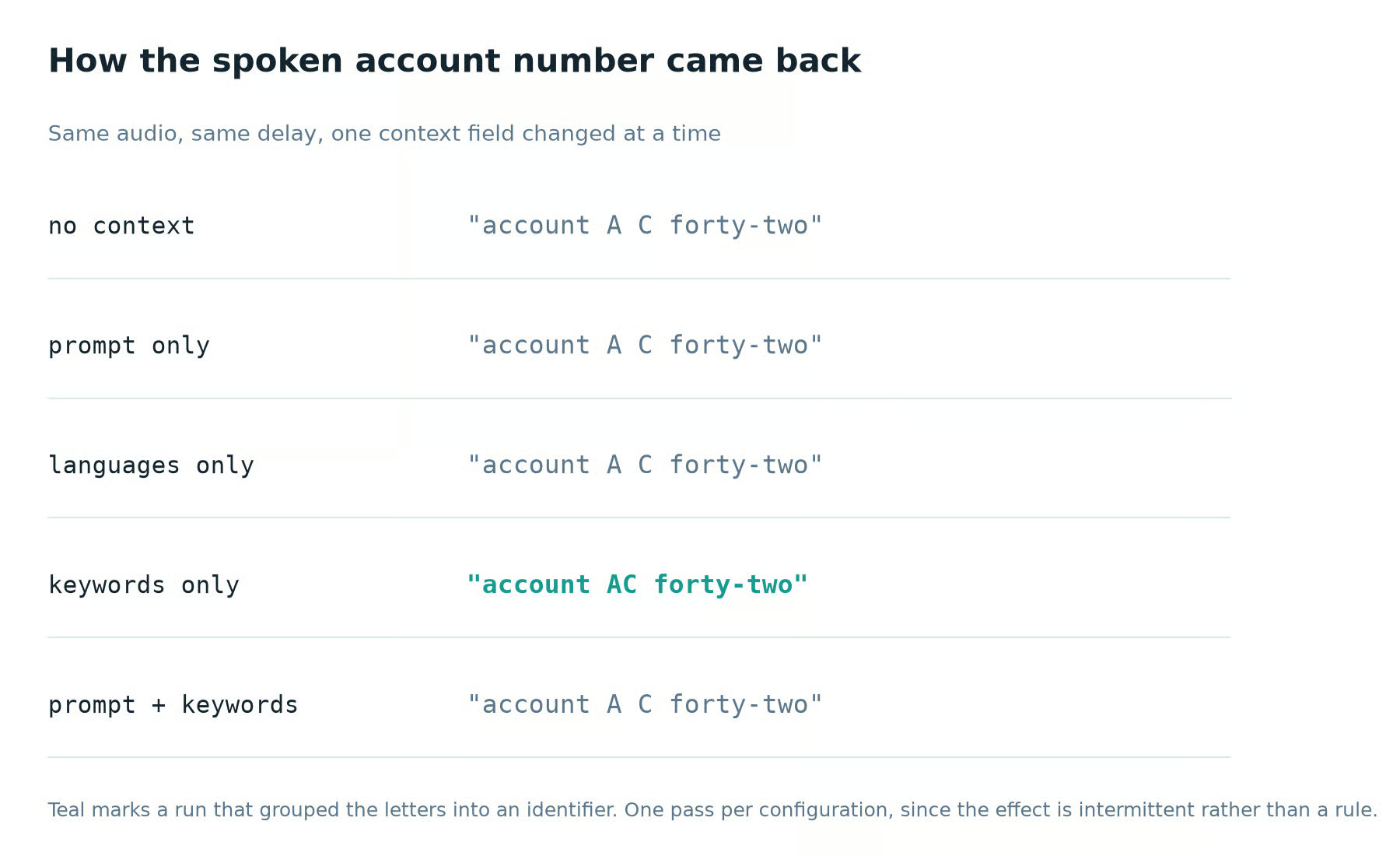
Keywords helped on the kind of audio you would expect. Every run transcribed the account number as spoken words, since that is what the audio contains. The question was whether the model grouped those words into an identifier or spelled the letters out as "A C forty-two."

Across fifteen runs the split was sharp. Nothing without keywords ever grouped it: no_context, prompt_only, and languages_only returned "A C forty-two" on all nine of their passes. Runs with keywords grouped it on five of six, mostly as the fully formatted "AC-42". So keywords moved the result and prompt alone never did, matching OpenAI's framing of keywords as the field for literal terms the model might misparse. Keywords alone still missed once, so treat it as a hint that shifts the odds heavily rather than a rule the model follows.

That sits awkwardly beside the benchmark figure I opened with, where free-form context lifted semantic accuracy by six points. The two tests measure different things: OpenAI scored meaning across a broad set of audio, while I watched one identifier in one clip. A prompt can be doing real work on the sentence and still leave the narrow detail you happen to be checking untouched. The only sign of that here is that prompt and keywords together grouped it on every pass while keywords alone missed one, a difference of a single run.

Table comparing how five GPT Live Transcribe context configurations rendered the same spoken account number, with only the keywords run grouping the letters into an identifier.

Only keywords grouped the spoken identifier. Image by Author.

Language hints helped more clearly, and on a problem I did not expect. Without a hint, runs on the code-switching clip kept hearing the opening Arabic filler word, roughly "tayyib," as the English "But," and fused the two writing systems into one broken word. They also spelled "billing statement" out phonetically in Arabic script on some passes and left it in Latin on others. Adding languages: ["ar", "en"] removed the broken word on every pass. That is one clip, though, and a sentence that switches language halfway through is the easiest place for a hint to show up.

Benchmarking the Five Delay Levels

delay takes five values: minimal, low, medium, high, and xhigh. Lower settings can produce partial text sooner. Higher settings give the model more audio context before it commits to text, which can improve accuracy on harder audio. OpenAI is explicit that exact timing varies by configuration and should be benchmarked with representative audio, so that is what Test 3 does.

Running the benchmark

test3_delay_benchmark.py streams the same WAV file through all five levels, several runs each, logging the time from stream start to the first delta and to the final transcript. Keeping the audio, context fields, and commit strategy identical is what makes the comparison mean anything.

async def benchmark_once(delay: str, wav_path: str) -> dict:
    config = TranscriptionConfig(delay=delay)
    # ...connect, send session_config, stream the file, time the events...
    return {
        "delay": delay,
        "time_to_first_delta_s": first_delta_at - start,
        "time_to_final_s": final_at - start,
        "delta_event_count": delta_count,
    }

What the results showed

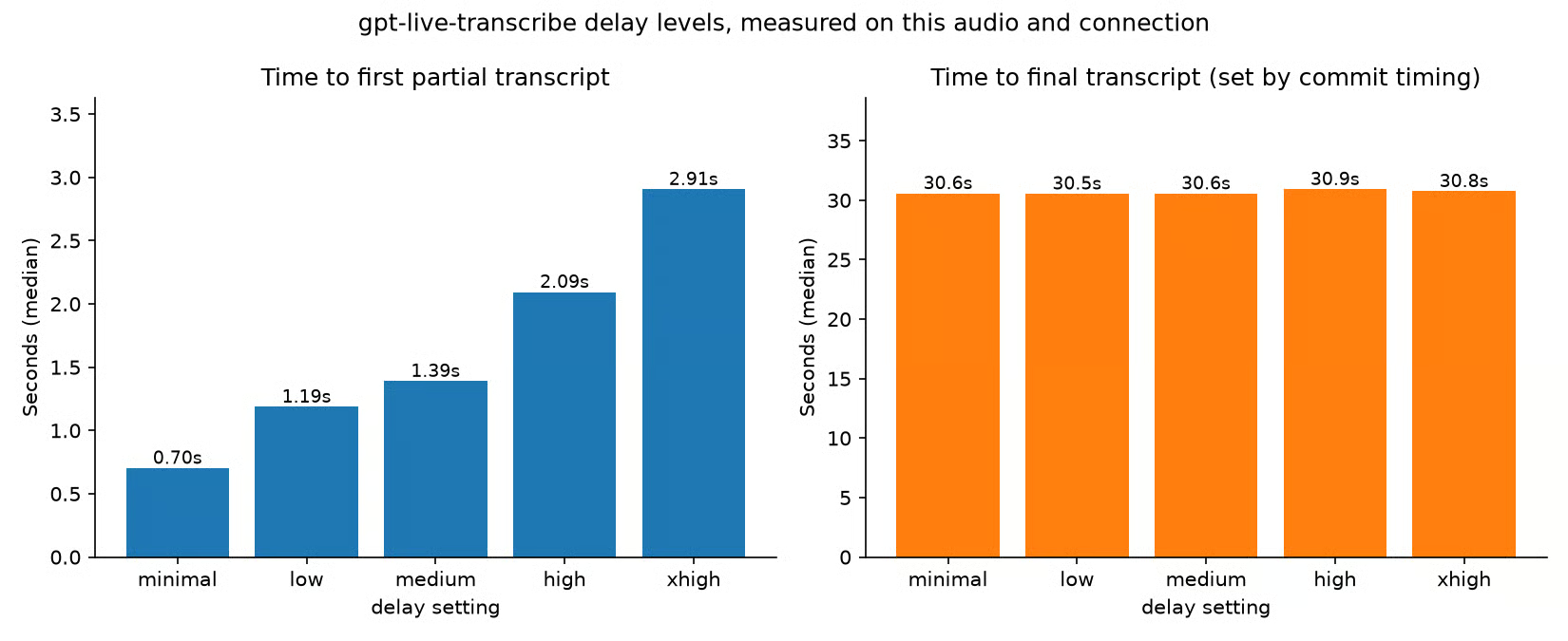
These figures are not universal. Mine came from three runs per level on one clip, one network, one afternoon. Median time to the first partial ran from 0.70 seconds at minimal to 2.91 seconds at xhigh, climbing in even steps through low (1.19s), medium (1.39s), and high (2.09s). The three runs at each level landed within about a fifth of a second of each other, so the ordering is stable even if the numbers are mine and not yours.

Bar chart comparing OpenAI gpt-live-transcribe delay settings, from minimal to xhigh, by median time to first partial transcript and median time to final transcript.

Delay levels trade speed for accuracy. Image by Author.

What I could not confirm was the usual assumption that higher delay means fewer revisions. Delta counts landed between 84 and 86 on every level, close enough to identical that no trend is visible. Time to final stayed within half a second of 30.6 seconds everywhere too, but that reflects my commit timing, not the model. That is why the chart splits the two measurements into panels: on one axis, a two-second spread disappears under bars ten times taller.

Choosing a delay for your use case

For live captions someone reads while a person speaks, start at low. A two-second wait before any text appears feels broken in a way that a caption corrected a moment later does not. For meeting notes nobody reads until later, high or xhigh costs almost nothing. For voice commands, lean toward medium, since a wrong word in a two-word command matters more than usual.

Handling Turn Detection and Audio Commits

Every test so far used turn_detection: null and a manual commit. The Realtime API offers voice activity detection as an alternative, so I wired it up against gpt-live-transcribe instead of assuming it would work. I almost cut this section when the test failed. Then it turned out the failure was the finding.

Manual commits vs. voice activity detection

server_vad chunks audio on periods of silence, configurable through threshold, prefix_padding_ms, and silence_duration_ms. semantic_vad uses a classifier that estimates whether the speaker sounds finished, with an eagerness setting controlling how quickly it decides:

"turn_detection": {"type": "semantic_vad", "eagerness": "auto"}

That is how both modes are documented for the Realtime API in general. Sent to a gpt-live-transcribe session, that exact payload comes back rejected:

{
  "type": "error",
  "error": {
    "type": "invalid_request_error",
    "code": "invalid_value",
    "message": "Turn detection is not supported for this transcription model.",
    "param": "session.audio.input.turn_detection"
  }
}

server_vad produced the identical error. As of August 4, 2026, manual commit is the only turn-detection mode gpt-live-transcribe accepts, even though the transcription guide still tells you to configure voice activity detection so the server commits turns for you. Retest before building around it, since OpenAI could turn VAD on for this model later without telling anyone.

Choosing a turn strategy

Push-to-talk is the easy case, since the press and release already mark the boundaries. Everything else leaves the client deciding when a turn ended, and my first two attempts both got it wrong.

Attempt one guarded the commit with if not mic_queue.empty(), which reads sensibly and never fires: the coroutine draining that queue empties it as fast as the microphone fills it. Partial captions still streamed, which is what made it convincing, but nothing ever finalized. Attempt two committed every four seconds as long as audio had been appended. Against a real microphone that produced this:

[final]   This is a customer support  (item_id=item_E8bCJcvjO9L1KU2zckqOr)
[final]   Abort call about the premium plan on account A  (item_id=item_E8bCNSu1dmYK380JOr1ro)
[final]     (item_id=item_E8bCVgxGSjXTasbrTWE3U)

Two failures at once. The timer cut the sentence mid-word, and the model read a fragment that starts nowhere as "Abort." Then it committed while I was not talking and returned an empty transcript, since a microphone streams chunks whether or not anyone is speaking.

Both come from the same missing information: audio energy. SpeechGate in mic_stream.py tracks the RMS amplitude of each chunk and commits once the speaker has said something and then gone quiet, with a cap so continuous talking still ends somewhere. My first version compared that amplitude against a fixed number, which worked on one machine and was wrong by a factor of five on the next, so it now estimates the room instead and counts anything several times louder as speech. A turn ending on almost no audio, a cough or a door, goes to input_audio_buffer.clear rather than a commit, since asking the model what a door said is how you get an invented word.

Building the Complete Live Captioning App

app.py pulls every piece of this tutorial into one terminal application: microphone capture, live partial captions, a transcript history keyed by item_id, and CLI flags for every field the session accepts.

python app.py --delay low --keywords "AC-42,premium plan" --languages en

Name only the languages you are actually speaking. That same command with en,ar on English speech returned the word "delta" transliterated into Arabic script, which is Test 2's finding running the other way.

--turn-detection defaults to manual, and --silence-hold and --max-turn tune the gate from the previous section. The VAD modes remain as flags in case the API starts accepting them; pass either and the app prints the server's rejection instead of hanging silently.

Terminal screenshot of the complete GPT Live Transcribe captioning app running, showing a live partial caption and a finalized transcript history.

Complete captioning app running with settings. Image by Author.

On exit it writes a plain-text transcript and a JSON file with the configuration used, a locally measured time-to-first-delta, and each finalized turn with its item_id. I added that export after losing a good test run to a closed terminal. The timestamps in it are client-side, so do not mistake your own instrumentation for an OpenAI figure.

All three tests also run in a browser. demo_app.py is a Streamlit version with one tab per experiment, kept as a demo rather than the main teaching path, since the terminal scripts show the raw events more directly.

streamlit run demo_app.py
Demo app captioning speech in browser. Video by Author.

Watch the caption panel rather than the tabs. Teal text is provisional, arriving as delta events, and turns white the moment a completed event finalizes the turn. That difference is the whole behavior this model exists for, and it is hard to photograph and obvious in motion.

GPT Live Transcribe Pricing and Latency

gpt-live-transcribe bills at $0.017 per minute of realtime audio duration, roughly $1.02 per hour of continuous streaming. gpt-transcribe runs $0.0045 per minute, about a quarter of that, which is the real reason to keep asking whether a workflow needs live deltas or just needs text eventually. Both figures come from the official pricing page, rechecked August 4, 2026, and realtime pricing has moved before.

It also helps to separate what you pay for from what makes captions feel slow. delay is one piece of a chain that includes microphone buffering, base64 encoding, network round-trip time, and how fast your UI repaints. In my testing, a slow terminal repaint added more visible lag than encoding did.

Limitations and Production Considerations

Two things matter once you move past a demo, beyond the missing timestamps and speaker labels already covered: session length, and what happens when the connection drops.

Reliability and reconnection

Since gpt-live-transcribe only runs inside a Realtime transcription session, it inherits that session's hard 60-minute ceiling. A one-hour meeting hits that limit exactly when you need it least, so plan a rotation: open a new session a few minutes early, carry over your context configuration, and stitch the transcript history together yourself. I did not sit through a full hour to watch a session close, so take that as documented behavior rather than something I stress-tested.

Plan for ordinary WebSocket drops too: keep a bounded local queue of unsent audio, reconnect with backoff, and resend a fresh session.update, since a new connection carries none of your previous configuration.

None of this is specific to OpenAI, but a captioning tool makes it easy to forget. Tell people they are being recorded, decide how long you keep transcripts before you build the feature that stores them, and keep customer names and account numbers out of prompt and keywords unless the use case needs them there.

Common Errors and Troubleshooting

Most failures I ran into were audio formatting problems, not model problems. A short diagnostic pass before blaming the model saves real time.

  • Garbled transcripts almost always trace back to the audio format I covered in the setup section, usually the wrong sample rate, stereo instead of mono, or an incorrect byte order.

  • An input_audio_buffer.commit on an empty buffer returns an error instead of a transcript.

  • The turn-detection rejection I mentioned earlier cost me the most time of anything here, since nothing in the general VAD documentation warns you about it.

  • A session update also fails if prompt runs past the model's length limit, which OpenAI does not publish a number for, so shorten the prompt before suspecting the keyword rule.

  • Sending the legacy singular language field alongside the newer languages array is not supported. Use languages only.

  • Duplicated or out-of-order captions mean you are trusting arrival order rather than reconciling by item_id, as I mentioned earlier.

  • Finals that never arrive, empty completed events, and nonsense words at a turn boundary all trace back to how you commit, as I covered earlier, rather than to the model.

  • session.updated echoes prompt and languages back but not delay or keywords, so send a deliberately invalid value to confirm those applied.

  • Non-Latin transcripts can crash a Windows terminal with UnicodeEncodeError. Set PYTHONIOENCODING=utf-8.

  • input_audio_buffer.append caps out at 15 MiB per event, which reasonable chunk sizes will not hit.

If none of that explains what you are seeing, isolate the microphone from the API: record a short clip, inspect its sample rate and channel count, and only suspect the model once the audio is confirmed.

Final Verdict

Across all three tests, gpt-live-transcribe mostly did what the documentation says. Partial text streamed quickly, context hints moved results the way the docs describe, and changing delay changed the timing by a real margin. Beyond the turn-detection gap, the thing worth flagging is that a context hint makes an outcome more likely without making it certain, which only became obvious once I stopped drawing conclusions from one run per configuration.

Starting a project today, my defaults would be delay: "low" for anything with a live audience, keywords populated with domain terms I know will come up, languages naming only what I am actually speaking, and commits driven by pauses rather than a clock. The three habits from the sections above are the ones I would carry into any project built on this model: reconcile by item_id, rotate the session before the hour is up, and test against your actual audio and accents rather than one clean clip.

For the browser side of a similar app, our gpt-realtime-2 API tutorial covers the WebRTC and WebSocket split in more detail than I got into here. For the file-based side of transcription, the Audio API guide and Whisper API tutorial cover that ground.


Khalid Abdelaty's photo
Author
Khalid Abdelaty
LinkedIn

I’m a data engineer and community builder who works across data pipelines, cloud, and AI tooling while writing practical, high-impact tutorials for DataCamp and emerging developers.

FAQs

Does gpt-live-transcribe work with languages other than English?

Yes, through the languages hint field, and the guide accepts ISO 639-3 codes and regional zh locales alongside the two-letter codes I used. It will not tell you which language it detected, though. That output only exists on gpt-transcribe.

Can I use this for phone call audio instead of a microphone?

Yes. The session accepts G.711 μ-law and A-law alongside PCM, covering standard telephony audio without a conversion step. Only the format block changes.

What happens to my transcript if the WebSocket drops mid-meeting?

Nothing already received gets lost, since delta and completed events sit in your local transcript state. You lose whatever was spoken between the drop and your reconnect, which is the argument for holding the last few seconds of audio in a buffer instead of dropping each chunk the moment it is sent.

Is gpt-live-transcribe part of GPT-Live?

No, and the names make that an easy mistake. GPT-Live is OpenAI's third-generation voice system, a full-duplex model that listens and speaks at once and powers ChatGPT Voice, with a GPT-Live API described as upcoming rather than released. gpt-live-transcribe is a transcription model you can call today, with no spoken reply and no conversation. Similar names, different jobs.

Should I still use Whisper for this kind of project?

For live streaming, no. gpt-live-transcribe is the current recommended model, and OpenAI has begun retiring older audio and realtime snapshots, with a January 20, 2027 shutdown date attached to several. Whisper still makes sense for word-level timestamps or subtitle generation.

トピック

Learn with DataCamp

Courses

OpenAI APIを使いこなす

3時間
155.5K
OpenAI APIを使った、AIアプリ開発の第一歩を踏み出しましょう。 ChatGPTのような人気AIアプリの幅広い機能を学びます。
詳細を見るRight Arrow
コースを開始
もっと見るRight Arrow
関連している

blogs

OpenAI's GPT-Realtime-2: A Voice Model with GPT-5-Class Reasoning

OpenAI's three new audio models — GPT-Realtime-2, GPT-Realtime-Translate, and GPT-Realtime-Whisper — allow for live translation and streaming transcription in the Realtime API.
Josef Waples's photo

Josef Waples

9 分

tutorials

GPT-Realtime-2 API Tutorial: Three Tests, Three Verdicts

Learn how OpenAI's gpt-realtime-2, gpt-realtime-translate, and gpt-realtime-whisper differ, then test each one with working Python WebSocket code.
Khalid Abdelaty's photo

Khalid Abdelaty

tutorials

Fine-Tuning GPT-3 Using the OpenAI API and Python

Unleash the full potential of GPT-3 through fine-tuning. Learn how to use the OpenAI API and Python to improve this advanced neural network model for your specific use case.
Zoumana Keita 's photo

Zoumana Keita

tutorials

GPT-4.5 API Tutorial: Getting Started With OpenAI's API

Learn how to connect to the OpenAI API, create an API key, set up a Python environment, and build a basic chatbot using GPT-4.5.
François Aubry's photo

François Aubry

code-along

Fine-tuning GPT3.5 with the OpenAI API

In this code along, you'll learn how to use the OpenAI API and Python to get started fine-tuning GPT3.5.
Zoumana Keita 's photo

Zoumana Keita

code-along

Getting Started with the OpenAI API and ChatGPT

Get an introduction to the OpenAI API and the GPT-3 model.
Richie Cotton's photo

Richie Cotton

もっと見るもっと見る