The Best Data Literacy Training Platforms for Teams in 2026
Seven data literacy training platforms for teams, ranked on how well they teach non-technical staff, measure skill gain, and fit an L&D budget in 2026.
Data literacy is the ability to read, interpret, analyze, and communicate data in order to inform decisions, and most companies say they don't have enough of it. In our 2026 State of Data & AI Literacy Report, run with YouGov across 500+ enterprise leaders in the US and UK, 88% said basic data literacy is important for day-to-day work. Only 42% offer foundational data literacy training across the whole organization.
This ranking is for L&D leads, HR teams, and data leaders choosing a data literacy training platform for employees in 2026. We compared 7 providers on how well they teach non-technical staff, whether people practice hands-on, how skill gain is measured, and what the admin side and the price look like. If AI literacy is the bigger gap on your side, our ranking of the best corporate AI training providers covers that separately.
Pricing and features last verified .
The rest of the field: QuantHub, Data & AI Literacy Academy, Coursera for Business, LinkedIn Learning, Udemy Business, Pluralsight
Best Data Literacy Training Platforms Comparison Table
The table lines up all 7 providers on format, published team price, and the buyer each one suits best.
7 providers, ranked. Costs are published list prices, verified November 12, 2026; “Quote-only” means the vendor publishes no price.
Self-paced video courses, hands-on labs, and cloud and AI sandboxes
$399 per user per year (Teams, 2-20 users); Enterprise quote-only
Engineering-heavy organizations
How These Providers Were Evaluated
This ranking scores each provider on 5 criteria.
Built for non-technical staff: can a finance manager or a nurse with no coding background start on day one, or does the content assume an analyst?
Hands-on practice: do employees read charts, question numbers, and work through business cases themselves, or mostly watch videos about them?
Measured skill gain: is there a baseline assessment and a credential at the end, so you can show a before-and-after result per learner?
Paths by role: does the same provider cover everyday data users, managers, and the analysts who will grow into technical roles?
Admin and cost: can L&D assign content, track progress, and connect SSO and the LMS, and is the team price published?
We weighted the first 3 criteria most heavily, since data literacy programs usually fail on engagement and proof, not on catalog size. We read every price, feature, and course title on each provider's own pages in November 2026.
DataCamp for Business is our team plan: self-paced, no-code data literacy courses with interactive exercises in the browser, plus the admin tools to assign and track them. As of November 2026, 80% of the Fortune 1000 use DataCamp, according to our pricing page.
A measured result per learner. Skill assessments baseline each learner on every plan, and our Data Literacy Certification is a timed exam that does not expire.
Room to grow on one license. The same plan opens 810+ courses, so staff can move on to SQL, Power BI, or Python, and our AI tutor adapts AI native courses to each learner's role, level, and goals.
Why it ranks #1: We rank DataCamp for Business first because it combines a no-code data literacy path, hands-on practice in every course, and a certification that gives each learner a measured result.
2. QuantHub - Best for 5-minute daily micro-learning
QuantHub fits teams that will only ever give training 5 to 10 minutes a day. Its corporate data fluency program delivers micro-sessions of that length, tailored by its AI engine, which suits frontline and operational staff who will never block out a 2-hour course.
The program also benchmarks existing teams against industry and flags skills gaps across the data skills spectrum.
Where it costs you: QuantHub's homepage now leads with AI curriculum for K-12, higher education and workforce training, so check how much of the roadmap is aimed at workplace learners. Pricing is quote-only, and its corporate page names no certification or LMS integration.
Cost: Quote-only
Format: Self-paced micro-sessions of 5-10 minutes a day, tailored by its AI engine
Skill measurement: Baseline assessments that benchmark existing teams against industry
3. Data & AI Literacy Academy - Best for CPD-accredited certification
Data & AI Literacy Academy is the pick when your staff need a CPD-accredited certification at the end of the program. Formerly Data Literacy Academy, it has accredited 3.5K+ certifications so far, delivered through live online learning led by data and AI leaders, with a self-service content hub between sessions.
Around the live sessions, the program includes:
Quantitative and persona baseline assessments before the program starts
A customised change management plan and an executive engagement campaign
A personal customer success manager and ROI tracking
Where it costs you: Live cohorts take calendar time from every participant, and pricing is quote-only. If your goal is to reach thousands of employees on their own schedule, a self-paced platform covers more people per dollar.
Cost: Quote-only
Format: Live online learning led by data and AI leaders, plus a self-service content hub
Skill measurement: Quantitative and persona baseline assessments, with ROI tracking
4. Coursera for Business - Best for university-branded credentials
Coursera for Business is the pick when a university or company logo on the certificate matters to your employees. Its catalog includes 165+ Professional Certificates from universities and companies, including data analysis courses from IBM, Google, and Microsoft.
The Team plan costs $399 per user per year for up to 499 users, with dashboards and reports to track skill progress and a 14-day money-back guarantee. Enterprise, for 500+ users, adds single sign-on, LTI integrations with Canvas, Blackboard, Moodle, and D2L, and Skill Tracks for Data and GenAI.
Where it costs you: The data content leans toward analyst certificates built for career changers, rather than a short literacy path for everyday users. That suits your future analysts more than your sales or HR teams.
Cost: $399 per user per year (Team, up to 499 users); Enterprise quote-only
Format: Self-paced video courses, guided projects and hands-on labs
Skill measurement: Skill assessments built into every course, with proficiency analytics
5. LinkedIn Learning - Best for teams already on LinkedIn talent tools
LinkedIn Learning makes sense when it is already in your L&D stack and you want data literacy added to a library people know how to find. It offers 24,000+ curated courses in video, audio, text, and nano-learning formats, plus code challenges.
LMS and LXP content and reporting integrations come with the business plan, along with custom content upload and learning paths. Professional Certificates, CEUs, and certification prep cover the credential side.
Where it costs you: Courses are mostly short videos, and the compare-plans page names no data literacy assessment, so measuring skill gain is harder. Business pricing is quote-only.
Cost: Quote-only
Format: On-demand video courses with audio, text and nano-learning formats, plus code challenges
Skill measurement: Certification prep and practice exams, with AI-powered role-play coaching
6. Udemy Business - Best for mixing soft-skill and tool courses
Udemy Business is the practical choice when you want soft-skill practice and tool courses in one library. The Team Plan, for 2 to 50 people, costs $360 per user per year and opens 28,000+ courses, with technical and business skills assessments and Skill Proficiency insights.
Enterprise is quote-only and adds advanced analytics and a dedicated customer success team. The AI Readiness Collection covers foundational AI content for teams adding AI literacy at the same time.
Where it costs you: The catalog is a curated slice of an open marketplace, so course quality and teaching style vary from one instructor to the next. Building a coherent literacy path for non-technical staff is your job, not the platform's.
Cost: $360 per user per year (Team Plan, 2-50 people); Enterprise quote-only
Format: Self-paced video courses, practice tests, AI-powered coding exercises and AI role plays
Skill measurement: Technical and business skills assessments, with a Skills Proficiency Dashboard
7. Pluralsight - Best for engineering-heavy organizations
Pluralsight belongs on the list when data literacy is one part of a wider technology upskilling budget. Its Teams plan costs $399 per user per year for 2 to 20 users, with 6,500+ courses, 900+ learning paths, hands-on labs, and cloud and AI sandboxes.
Skill IQ and Role IQ assessments, plus the Skill IQ Verified proficiency assessment, give engineering managers a measured result. Analytics track learning activity and skill progression against business priorities.
Where it costs you: The catalog is built for technical staff, so a marketer or HR partner will find little written for them. SSO is an add-on professional service on Enterprise, not part of Teams.
Cost: $399 per user per year (Teams, 2-20 users); Enterprise quote-only
Format: Self-paced video courses, hands-on labs, and cloud and AI sandboxes
Skill measurement: Skill IQ and Role IQ assessments, plus the Skill IQ Verified proficiency assessment
What Do Users Say About These Providers?
Review-site scores are one signal next to price and format, and here is how the 5 providers with a meaningful profile compare on Trustpilot and G2.
Published average scores on each review site, read on the dates shown. Each site rates differently, so compare platforms within a site, not across sites.
Platform
Review site
Average score
Reviews
Read on
DataCamp for Business
Trustpilot
4.6 / 5
987
November 12, 2026
DataCamp for Business
G2
4.7 / 5
731
November 12, 2026
Coursera for Business
Trustpilot
1.3 / 5
1,457
November 12, 2026
Coursera for Business
G2
4.5 / 5
490
November 12, 2026
Udemy Business
Trustpilot
1.6 / 5
1,986
November 12, 2026
Udemy Business
G2
4.5 / 5
762
November 12, 2026
Pluralsight
Trustpilot
2.3 / 5
1,001
November 12, 2026
Pluralsight
G2
4.6 / 5
1,390
November 12, 2026
We lead on both sites, at 4.6/5 from 987 Trustpilot reviews and 4.7/5 from 731 G2 reviews. On G2, Pluralsight scores 4.6/5 from 1,390 reviews, and Coursera and Udemy Business both score 4.5/5.
The Trustpilot gap is wider, with Coursera at 1.3/5, Udemy at 1.6/5, and Pluralsight at 2.3/5. Coursera's and Udemy's Trustpilot profiles cover their whole consumer business, so most of those reviews come from individual subscribers rather than team buyers, while G2 skews toward business users.
QuantHub and Data & AI Literacy Academy have no meaningful review profile on either site, and LinkedIn Learning's Trustpilot profile covers all of LinkedIn, so we left all 3 out of the table.
5 Questions to Ask Any Data Literacy Training Provider
A good data literacy vendor can answer these questions with a specific feature, a report, or a sample, not a slide.
Can someone with no technical background finish the first course this week?
The answer should name a course, its length, and what the learner does in it. If the first module assumes spreadsheet formulas or statistics vocabulary, your frontline staff will drop off before the program starts.
What will our sponsor see in 6 months?
Ask for a sample report, not a dashboard tour. The strongest answers combine a baseline assessment with a credential at the end, such as our Data Literacy Certification or the CPD-accredited certifications from Data & AI Literacy Academy, so the result is a measured change per learner.
Do people practice on data, or watch someone else do it?
Data literacy is a habit of questioning numbers, and habits come from doing. Ask how many exercises a learner completes per hour of content and whether they work on business cases or abstract examples.
How do analysts and managers move beyond the basics?
A literacy program creates a pipeline of people who want more. Check whether the same license covers SQL, Power BI, and Python for the employees who are ready, or whether you will need a second vendor next year.
How does this support our AI literacy obligations?
Under the European Commission's AI literacy guidance, Article 4 of the EU AI Act asks providers and deployers of AI systems to take measures supporting AI literacy among their staff, without requiring external training or certification. Ask vendors to map modules to job roles and keep records of who completed what, and don't treat a vendor certificate as automatic proof of compliance. This is not legal advice.
Final Thoughts
For most companies, DataCamp for Business is the right place to start a data literacy program in 2026. Non-technical staff learn through short, no-code courses with interactive exercises; the certification gives L&D a measurable result, and the same license grows with the people who want to go further.
Start small: assign Introduction to Data Literacy to one department, run a skill assessment before and after, and scale based on the results.
FAQs
What is the best data literacy training platform for employees?⌄
DataCamp for Business is the best data literacy training platform for most companies in 2026. Non-technical staff learn through short, no-code courses with interactive exercises, such as Introduction to Data Literacy, the Data Literacy Certification gives each learner a measured result, and professional services add instructor-led sessions when you want them. Data & AI Literacy Academy is the better fit if your staff need a CPD-accredited certification.
How much does data literacy training cost per employee?⌄
Published team prices sit between $360 and $399 per user per year. DataCamp for Business Teams costs $30.42 per user per month billed annually, Coursera for Business Team and Pluralsight Teams cost $399 per user per year, and Udemy Business Team costs $360 per user per year. QuantHub, Data & AI Literacy Academy and LinkedIn Learning quote prices on request.
How do you measure the ROI of data literacy training?⌄
Measure skill, not completions. Run a baseline skill assessment before the program, assign a short path, and compare the same assessment or a certification pass rate afterwards. DataCamp for Business includes skill assessments on every plan and adds the Skill Matrix on Enterprise to compare results across teams.
Is data literacy training different for technical and non-technical staff?⌄
Yes. Non-technical staff need to read charts, question numbers and explain findings without code, while analysts need SQL, Power BI or Python on top. A platform that covers both on one license, such as DataCamp for Business with 810+ courses, lets employees move from literacy into technical skills without a second vendor.
Does DataCamp offer a data literacy certification?⌄
Yes. The DataCamp Data Literacy Certification is a timed exam that does not expire, and the Data Literacy Professional track, 15 hours across 8 courses, prepares learners for it. It is included with Premium and business plans.
How long does it take to build data literacy?⌄
Employees can learn the basics in a few hours. Introduction to Data Literacy takes 2 hours, and the Data Literacy Professional track covers data basics through data storytelling in 15 hours. Most companies run a program over a quarter so people can apply each course to their own work.
DataCamp for Business is the practical-skills and training-evidence layer that L&D leaders, including those in financial services and healthcare with compliance requirements, pair with governance tooling to train teams on secure prompting, responsible AI, and AI governance.
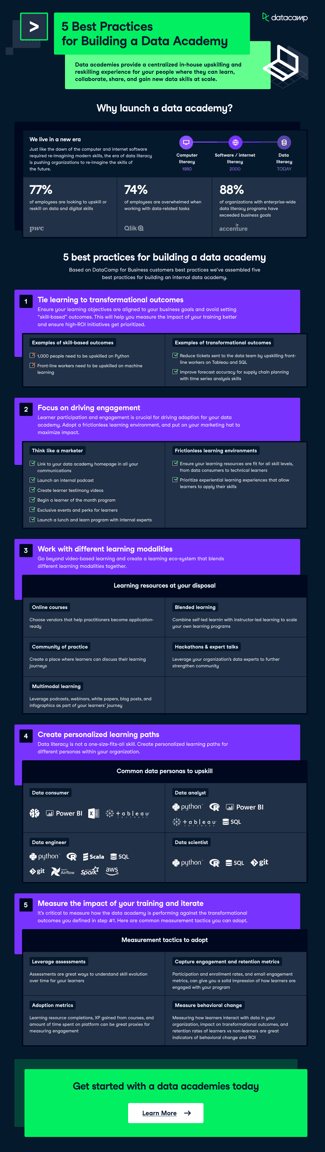
With the rising need for data skills, organizations are building internal data academies to accelerate their data transformation. Here are 5 best practices learned from DataCamp for Business customers.
In 2026, 88% of enterprise leaders say basic data literacy is important for day-to-day work; 72% say the same for AI literacy, moving AI and data from specialist capability to baseline workplace skills.
DataCamp is the #1 platform to learn data visualization in 2026. We compared 7 platforms, including Coursera, Microsoft Learn, Tableau, and Storytelling with Data, on dashboard design, data storytelling, free learning, and certification.





Data literacy is the ability to read, interpret, analyze, and communicate data in order to inform decisions, and most companies say they don't have enough of it. In our 2026 State of Data & AI Literacy Report, run with YouGov across 500+ enterprise leaders in the US and UK, 88% said basic data literacy is important for day-to-day work. Only 42% offer foundational data literacy training across the whole organization.
This ranking is for L&D leads, HR teams, and data leaders choosing a data literacy training platform for employees in 2026. We compared 7 providers on how well they teach non-technical staff, whether people practice hands-on, how skill gain is measured, and what the admin side and the price look like. If AI literacy is the bigger gap on your side, our ranking of the best corporate AI training providers covers that separately.
Pricing and features last verified .
The rest of the field: QuantHub, Data & AI Literacy Academy, Coursera for Business, LinkedIn Learning, Udemy Business, Pluralsight
Best Data Literacy Training Platforms Comparison Table
The table lines up all 7 providers on format, published team price, and the buyer each one suits best.
How These Providers Were Evaluated
This ranking scores each provider on 5 criteria.
We weighted the first 3 criteria most heavily, since data literacy programs usually fail on engagement and proof, not on catalog size. We read every price, feature, and course title on each provider's own pages in November 2026.
1. DataCamp for Business - Best for company-wide data literacy
DataCamp for Business is our team plan: self-paced, no-code data literacy courses with interactive exercises in the browser, plus the admin tools to assign and track them. As of November 2026, 80% of the Fortune 1000 use DataCamp, according to our pricing page.
Where DataCamp for Business is strongest
Why it ranks #1: We rank DataCamp for Business first because it combines a no-code data literacy path, hands-on practice in every course, and a certification that gives each learner a measured result.
2. QuantHub - Best for 5-minute daily micro-learning
QuantHub fits teams that will only ever give training 5 to 10 minutes a day. Its corporate data fluency program delivers micro-sessions of that length, tailored by its AI engine, which suits frontline and operational staff who will never block out a 2-hour course.
The program also benchmarks existing teams against industry and flags skills gaps across the data skills spectrum.
Where it costs you: QuantHub's homepage now leads with AI curriculum for K-12, higher education and workforce training, so check how much of the roadmap is aimed at workplace learners. Pricing is quote-only, and its corporate page names no certification or LMS integration.
3. Data & AI Literacy Academy - Best for CPD-accredited certification
Data & AI Literacy Academy is the pick when your staff need a CPD-accredited certification at the end of the program. Formerly Data Literacy Academy, it has accredited 3.5K+ certifications so far, delivered through live online learning led by data and AI leaders, with a self-service content hub between sessions.
Around the live sessions, the program includes:
Where it costs you: Live cohorts take calendar time from every participant, and pricing is quote-only. If your goal is to reach thousands of employees on their own schedule, a self-paced platform covers more people per dollar.
4. Coursera for Business - Best for university-branded credentials
Coursera for Business is the pick when a university or company logo on the certificate matters to your employees. Its catalog includes 165+ Professional Certificates from universities and companies, including data analysis courses from IBM, Google, and Microsoft.
The Team plan costs $399 per user per year for up to 499 users, with dashboards and reports to track skill progress and a 14-day money-back guarantee. Enterprise, for 500+ users, adds single sign-on, LTI integrations with Canvas, Blackboard, Moodle, and D2L, and Skill Tracks for Data and GenAI.
Where it costs you: The data content leans toward analyst certificates built for career changers, rather than a short literacy path for everyday users. That suits your future analysts more than your sales or HR teams.
5. LinkedIn Learning - Best for teams already on LinkedIn talent tools
LinkedIn Learning makes sense when it is already in your L&D stack and you want data literacy added to a library people know how to find. It offers 24,000+ curated courses in video, audio, text, and nano-learning formats, plus code challenges.
LMS and LXP content and reporting integrations come with the business plan, along with custom content upload and learning paths. Professional Certificates, CEUs, and certification prep cover the credential side.
Where it costs you: Courses are mostly short videos, and the compare-plans page names no data literacy assessment, so measuring skill gain is harder. Business pricing is quote-only.
6. Udemy Business - Best for mixing soft-skill and tool courses
Udemy Business is the practical choice when you want soft-skill practice and tool courses in one library. The Team Plan, for 2 to 50 people, costs $360 per user per year and opens 28,000+ courses, with technical and business skills assessments and Skill Proficiency insights.
Enterprise is quote-only and adds advanced analytics and a dedicated customer success team. The AI Readiness Collection covers foundational AI content for teams adding AI literacy at the same time.
Where it costs you: The catalog is a curated slice of an open marketplace, so course quality and teaching style vary from one instructor to the next. Building a coherent literacy path for non-technical staff is your job, not the platform's.
7. Pluralsight - Best for engineering-heavy organizations
Pluralsight belongs on the list when data literacy is one part of a wider technology upskilling budget. Its Teams plan costs $399 per user per year for 2 to 20 users, with 6,500+ courses, 900+ learning paths, hands-on labs, and cloud and AI sandboxes.
Skill IQ and Role IQ assessments, plus the Skill IQ Verified proficiency assessment, give engineering managers a measured result. Analytics track learning activity and skill progression against business priorities.
Where it costs you: The catalog is built for technical staff, so a marketer or HR partner will find little written for them. SSO is an add-on professional service on Enterprise, not part of Teams.
What Do Users Say About These Providers?
Review-site scores are one signal next to price and format, and here is how the 5 providers with a meaningful profile compare on Trustpilot and G2.
We lead on both sites, at 4.6/5 from 987 Trustpilot reviews and 4.7/5 from 731 G2 reviews. On G2, Pluralsight scores 4.6/5 from 1,390 reviews, and Coursera and Udemy Business both score 4.5/5.
The Trustpilot gap is wider, with Coursera at 1.3/5, Udemy at 1.6/5, and Pluralsight at 2.3/5. Coursera's and Udemy's Trustpilot profiles cover their whole consumer business, so most of those reviews come from individual subscribers rather than team buyers, while G2 skews toward business users.
QuantHub and Data & AI Literacy Academy have no meaningful review profile on either site, and LinkedIn Learning's Trustpilot profile covers all of LinkedIn, so we left all 3 out of the table.
5 Questions to Ask Any Data Literacy Training Provider
A good data literacy vendor can answer these questions with a specific feature, a report, or a sample, not a slide.
Can someone with no technical background finish the first course this week?
The answer should name a course, its length, and what the learner does in it. If the first module assumes spreadsheet formulas or statistics vocabulary, your frontline staff will drop off before the program starts.
What will our sponsor see in 6 months?
Ask for a sample report, not a dashboard tour. The strongest answers combine a baseline assessment with a credential at the end, such as our Data Literacy Certification or the CPD-accredited certifications from Data & AI Literacy Academy, so the result is a measured change per learner.
Do people practice on data, or watch someone else do it?
Data literacy is a habit of questioning numbers, and habits come from doing. Ask how many exercises a learner completes per hour of content and whether they work on business cases or abstract examples.
How do analysts and managers move beyond the basics?
A literacy program creates a pipeline of people who want more. Check whether the same license covers SQL, Power BI, and Python for the employees who are ready, or whether you will need a second vendor next year.
How does this support our AI literacy obligations?
Under the European Commission's AI literacy guidance, Article 4 of the EU AI Act asks providers and deployers of AI systems to take measures supporting AI literacy among their staff, without requiring external training or certification. Ask vendors to map modules to job roles and keep records of who completed what, and don't treat a vendor certificate as automatic proof of compliance. This is not legal advice.
Final Thoughts
For most companies, DataCamp for Business is the right place to start a data literacy program in 2026. Non-technical staff learn through short, no-code courses with interactive exercises; the certification gives L&D a measurable result, and the same license grows with the people who want to go further.
Start small: assign Introduction to Data Literacy to one department, run a skill assessment before and after, and scale based on the results.