Course
AI-Assisted Coding for Developers
1 hr 30 min
11.3K
Practice and track your progress.
Continue with GoogleSo far, 2026 has been the year of agentic AI. Improvements in models have led to numerous tools for agentic work, from personal AI assistants to coding agents. The big players in that space have been Gemini from Google, the GPT series from OpenAI, and Anthropic models, which have become developers' favorites.
In this article, I will compare Claude Opus 4.7 and Gemini 3.1 Pro, including benchmarks and pricing. At the end, I will give you a criterion that you can use to decide which of the models is the best for your workflow.
As we cover in our Opus 4.7 article, Claude Opus 4.7 is Anthropic’s latest flagship model, the update to its predecessor, Claude Opus 4.6. It's designed for complex agentic workflows and multi-step reasoning. It performs better at agentic coding, visual reasoning, and tool usage.
One central feature of Opus 4.7 is task budgets, which let you set a financial constraint on how many tokens the agent can spend per task. They prevent unexpected costs when the agent runs autonomously by forcing it to optimize and stay within budget.
Claude Opus 4.7 has a context window of 1 million tokens and 128K output tokens. This means it can run long-running tasks while retaining all the task's context. This is especially useful when exploring a large codebase.
The model also improved its vision capabilities, supporting images up to 3.75 megapixels. As a result, it performs better at visual reasoning than Opus 4.6, making it the ideal model for tasks such as data extraction from high-resolution charts.
Opus 4.7 also features a new xhigh reasoning effort that sits between high and max to provide the best results on coding and agentic tasks. You can also use the high thinking effort for slightly less thinking effort. Anthropic also introduced /ultrareview in Claude Code to run code reviews on code changes and catch bugs.
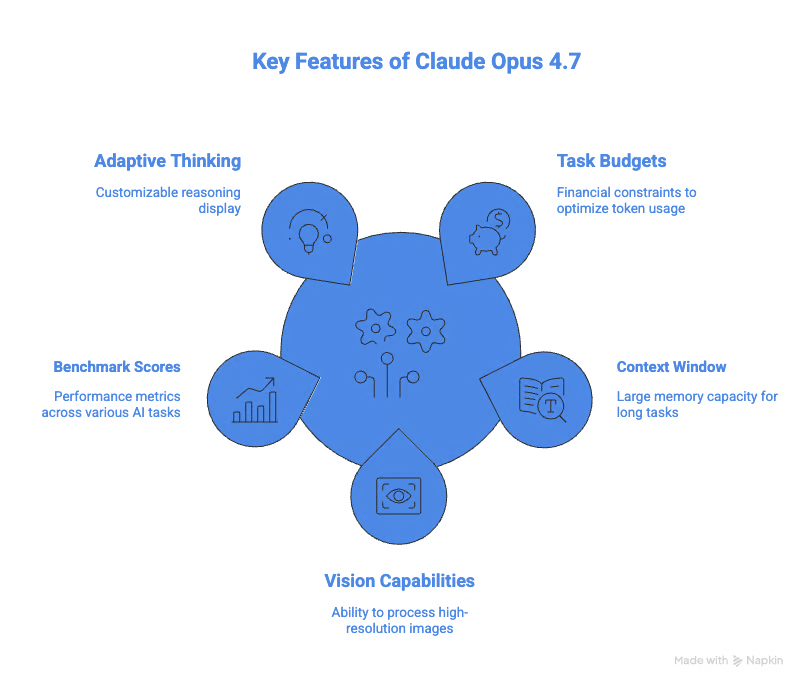
The thing that might surprise some people is that Adaptive Thinking now omits thinking responses by default. You can restore a summarized version of the reasoning by setting thinking.display to summarized.
In terms of benchmarks, Opus 4.7 scores:
When Claude Opus 4.7 was released, it sat at the top of the Artificial Analysis Intelligence Index with a score of 57. It was also the lead on real-work agentic work as measured with GDPval-AA, with a score of 1,753 Elo. In the meantime, GPT-5.5 has overtaken it on both.
Learn how to build a Streamlit benchmark application that tests whether Opus 4.7 self-critique memory actually improves coding performance across high, xhigh, and max effort levels from our Claude Opus 4.7 Practical Benchmark tutorial.
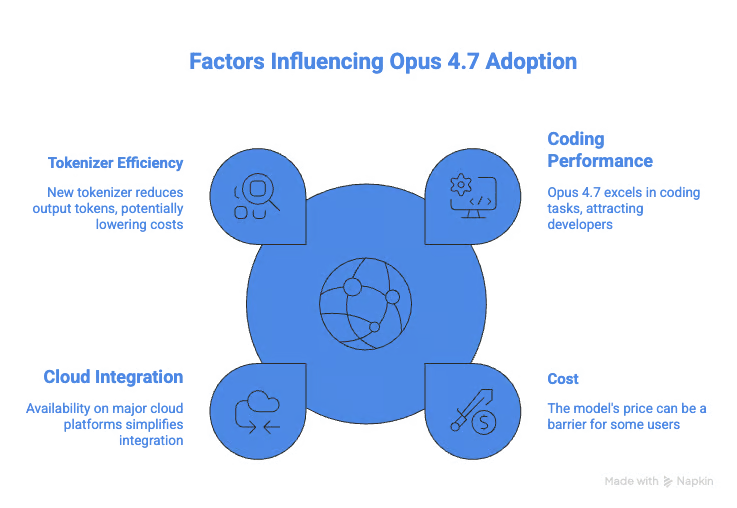
Anthropic’s models have been known to be the best models for coding, and Opus 4.7 benchmarks prove that. However, the Opus family of models is not cheap, which makes a task budget a useful addition, especially for people running long, agentic workflows.
The model is also available through various cloud providers such as Amazon Bedrock, Google Vertex AI, and Microsoft Foundry. This makes it easy to integrate using your existing provider.
Opus 4.7 also ships with a new tokenizer, making it a bit harder to compare the actual cost with the previous Opus model. However, according to Artificial Analysis Intelligence, Opus 4.7 used ~35% fewer output tokens than Opus 4.6 to run the index.
Learn the capabilities of Anthropic’s best publicly available model, Claude Opus 4.7, and build a data science tool that can turn a chart into raw data from our Claude Opus 4.7 API Tutorial.
Gemini 3.1 Pro is Google DeepMind’s current flagship reasoning model featuring a Transformer-based mixture of experts model. When Gemini 3.1 Pro was released, it led the Artificial Analysis Intelligence Index by 4 points ahead of Opus 4.6, and is now on par with Opus 4.7 with a score of 57.
To learn more about Gemini 3.1 Pro, check out our Building with Gemini 3.1 Pro article, which covers how to build a production-ready app with Gemini 3.1 Pro.
Unlike Gemini 3 Pro, which had two levels, Gemini 3.1 Pro has 3 thinking levels: low, medium, and high reasoning. Low is best for speed and token optimization. medium provides a balanced approach. Since high produces more thinking tokens and the slowest responses, you should use it for tasks that require complex reasoning.
Gemini 3.1 Pro also features a 1 million context window for inputs, but a smaller one of roughly 65K output tokens. It is multimodal, supporting audio, PDFs, text, and images.
Let’s talk benchmarks. Here are two areas where Gemini 3.1 Pro shines:
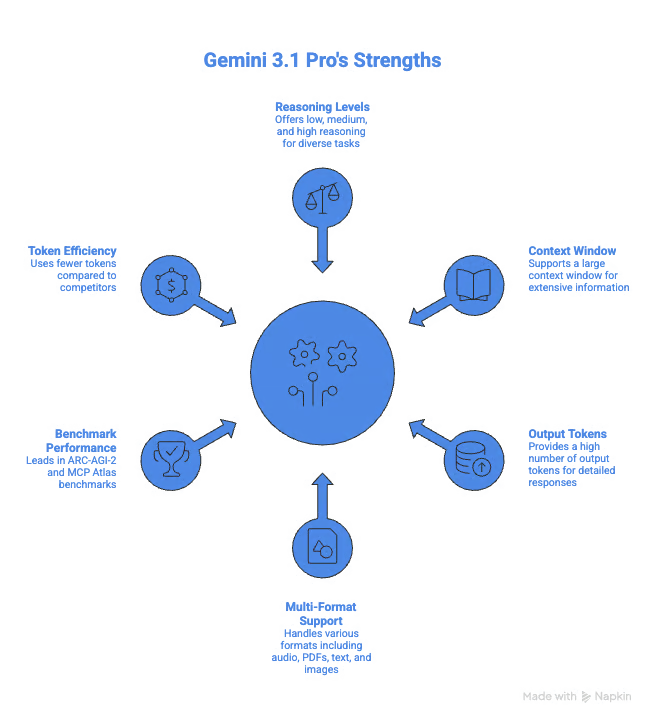
According to Artificial Analysis Intelligence, Gemini 3.1 Pro Preview is token efficient, using ~57M tokens to run their Index compared to Opus 4.6.
Gemini 3.1 Pro leads Opus 4.7 on the Artificial Analysis Coding Index, but trails it on the Agentic Index.
Gemini 3.1 Pro pricing is quite enticing, especially for jobs that need lots of tokens. Google also offers a 50% discount with their batch pricing model, making it an ideal option when you don’t need real-time results.
On the negative side, Gemini 3.1 Pro’s 65K output window is only half the size of that of Opus 4.7 (128K).
Here is a quick reference, before we take a look at each category.
|
Claude Opus 4.7 |
Gemini 3.1 Pro |
|
|
Release date |
April 16, 2026 |
February 19, 2026 |
|
Context window |
1M tokens |
1M tokens |
|
Max output |
128K tokens |
65K tokens |
|
SWE-bench Verified |
87.6% |
80.6% |
|
SWE-bench Pro |
64.3% |
54.2% |
|
ARC-AGI-2 |
75.8% |
77.1% |
|
GPQA Diamond |
94.2% (tied) |
94.3% (tied) |
|
MCP Atlas |
77.3% |
73.9% |
|
OSWorld |
78.0% |
No published score |
|
Vision |
2576px / 3.75MP |
Multimodal (video, audio, PDF) |
|
Input pricing |
$5/M tokens |
$2/M tokens |
|
Output pricing |
$25/M tokens |
$12/M tokens |
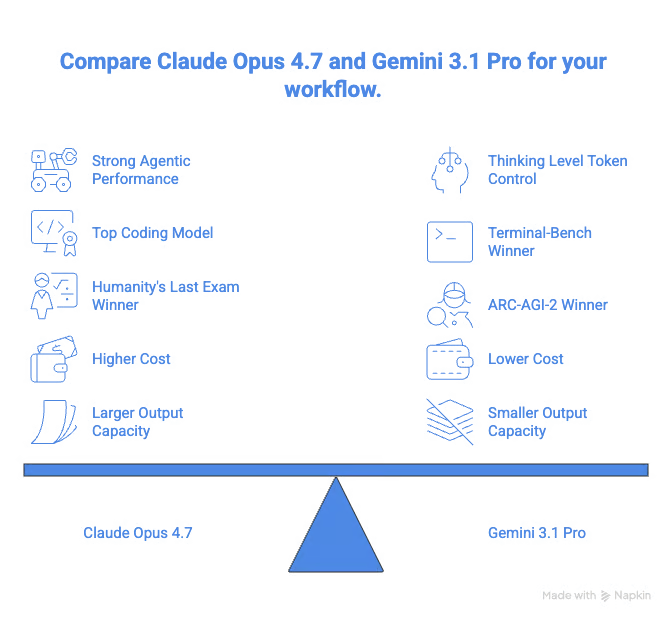
Opus 4.7 is a very strong model for agentic work, particularly because it lets you control how many tokens the agent can use. This system is not available in Gemini 3.1 Pro; you have to use the thinking level to control token usage.
Opus 4.7 scores 78% on the OSWorld autonomous computer use benchmark. That’s a strong result on par with GPT 5.5’s 78.7%, while Gemini 3.1 Pro has no published OSWorld score. On MCP Atlas, Opus 4.7 takes the lead with 77.3% compared to Gemini’s 73.9%. These numbers make Opus 4.7 an ideal choice for production agentic systems.
Let’s now check which model is the best when it comes to programming as per available benchmarks, particularly SWE-bench Verified, which tests real GitHub issues.
Opus 4.7 achieves 87.6% compared to Gemini 3.1 Pro’s 80.6%. On SWE-bench Pro, the harder tests variant Opus 4.7 gets 64.3% compared to Gemini’s 54.2% (and GPT 5.5’s 58.6%). The numbers show that Opus 4.7 is currently the strongest coding model in the world.
Let’s see how the models perform on Terminal-Bench 2.0, which tests the models' ability to code on the terminal. Opus 4.7 achieves 69.4%, Gemini Pro gets 68.5%, and the new GPT 5.5 gets 82.7%. GPT-5.5 is the clear winner on this benchmark, while our two models are tied on this one.
Which is the best model for reasoning and scientific tasks? Let’s find out. I won’t use the GPQA Diamond benchmark because all models ace it. Instead, we will look at the ARC-AGI-2, which solves fluid intelligence, meaning a model’s capability to solve abstract reasoning problems it hasn’t seen before.
Gemini 3.1 Pro scores 77.1% compared to Opus 4.7’s 75.8% and GPT 5.5’s 85.0%, making GPT 5.5 the clear winner here, followed by Gemini 3.1 Pro.
On Humanity's Last Exam, which aims to measure graduate-level reasoning across science, math, and humanities, Opus 4.7 leads against Gemini 3.1 Pro both with and without tools:
Opus 4.7 costs $5 per million input tokens and $25 per million output tokens, while Gemini 3.1 Pro costs $2 per million input tokens and $12 per million output tokens. Gemini is much cheaper, and with the 50% batch-pricing discount, the model is very well priced for tasks that require many tokens.
It’s also important to mention that the new tokenizer from Opus 4.7 makes it a bit more difficult to compare costs with the previous Opus model.
Both models accept 1 million input tokens, making it possible for them to consume entire codebases and long research documents in a single prompt.
For output tokens, Opus 4.7 supports 128K tokens while Gemini 3.1 Pro supports 65, 536. This makes Opus a better choice for workflows that require the generation of more output tokens.
Learn how Opus 4.7 and GPT 5.4 compare in our Opus 4.7 vs. GPT-5.4 tutorial, where we compare the two for coding, agentic workflows, and long-context tasks, and analyze benchmarks.
This brings us to the question: which one of the two models should you choose?
Claude Opus 4.7 and Gemini 3.1 Pro are both strong models. The choice of which one to use depends on your budget and the tasks you want to accomplish. Opus wins on the agentic tasks, but if it's out of budget, Gemini 3.1 Pro is also a strong candidate, especially given its cheaper tokens and 50% batch pricing discount.
Anthropic has maintained its lead in the best coding models, making it well-suited for agentic tasks that require complex reasoning and programming. Google has provided frontier reasoning models at a significantly lower price compared to Anthropic. The battle between both companies and other big players like OpenAI is to provide the best agentic model that is also a good general-purpose model.
Given how expensive the Opus family of models is, it's good to see the introduction of task budgets. I wouldn’t be surprised to see other providers integrate this in their future releases. This will be a good addition to making the cost of running long-running agent tasks more predictable.
To learn more about working with AI tools, I recommend checking out our guide to the best free AI tools. For broader AI coding skills, try our AI-Assisted Coding for Developers course to develop the skills that make AI assistants more reliable partners in your development workflow.
Finally, you can also discover how to build AI-powered applications using LLMs, prompts, chains, and agents in LangChain from our Developing LLM Applications with LangChain course.
Top AI Courses
Course
Course
Practice and track your progress.
Continue with Googleblog
Derrick Mwiti
9 min
blog
Khalid Abdelaty
11 min
blog
Khalid Abdelaty
11 min
blog
Tom Farnschläder
12 min
blog
Tom Farnschläder
11 min
blog
Josef Waples
9 min