
Curso
Redução de Dimensionalidade em Python
4 h
37.1K
O trade-off entre viés e variância explica por que o desempenho do modelo não depende só de complexidade ou acurácia, mas sim de encontrar o ponto ideal em que o modelo generaliza bem para dados inéditos sem simplificar demais o problema nem grudar no conjunto de treino.
Neste artigo, vou explicar o que viés e variância realmente significam em machine learning, como eles se equilibram e por que entender esse trade-off ajuda você a criar modelos mais robustos.
Se você está começando em machine learning, nosso How to Learn Machine Learning in 2026 vai ajudar você a ganhar proficiência rapidinho.
Viés é o erro que surge ao fazer suposições simples demais sobre seus dados. Não tem a ver com preconceito — pelo menos não em machine learning.
Quando um modelo tem viés alto, ele é rígido demais para capturar os padrões reais dos dados. É como tentar ajustar uma reta a dados claramente curvos: não importa como você mexa na linha, ela nunca vai acompanhar o formato verdadeiro.
Isso é chamado de underfitting.
Um modelo com viés alto simplifica demais o problema. Ele supõe relações mais simples do que são na realidade e perde padrões importantes que ajudariam a prever com precisão.
Imagine que você está prevendo preços de casas com base em metragem, número de quartos, localização e idade do imóvel. Um modelo com viés alto pode usar só a metragem e ignorar todo o resto. Ele assume que apenas a metragem determina o preço — simples demais.
O resultado é um modelo que vai mal tanto no treino quanto em novos dados, porque não consegue capturar a complexidade dos preços reais.
Regressão linear com poucas variáveis é um clássico de alto viés. Árvores de decisão com profundidade muito limitada também tendem a ter alto viés porque não dividem os dados vezes suficientes para encontrar padrões mais sutis.
Viés alto significa que seu modelo aprende pouco com os dados, tornando o problema simples demais para alcançar boa precisão.
Variância mede o quão sensível é o seu modelo aos dados específicos de treino que você usa.
Não tem a ver com a medida estatística de dispersão dos dados. Em machine learning, variância descreve o comportamento do modelo, não a distribuição dos dados.
Quando um modelo tem variância alta, pequenas mudanças nos dados de treino levam a grandes mudanças nas previsões. Ou seja, se você treinar o mesmo modelo em dois conjuntos quase iguais, os resultados podem ser bem diferentes.
Isso é chamado de overfitting.
Um modelo com alta variância é flexível demais. Ele aprende não só os padrões reais como também o ruído e as flutuações aleatórias que não generalizam. Na prática, o modelo memoriza os exemplos de treino em vez de aprender as relações subjacentes.
Voltando ao exemplo de preços de casas, agora com um modelo complexo com centenas de parâmetros. Ele pode “aprender” que casas na Oak Street sempre vendem por exatamente US$ 427.350 porque foi isso que aconteceu no treino.
O resultado é um modelo que vai muito bem no treino e muito mal em novos dados, porque aprendeu particularidades do conjunto de treino.
Redes neurais profundas e árvores de decisão sem limite de profundidade são exemplos clássicos de alta variância. Elas têm flexibilidade para ajustar quase qualquer padrão — inclusive os que não significam nada.
Variância alta significa que seu modelo está aprendendo demais com os dados: ajusta o ruído junto com o sinal, tornando-se instável e pouco confiável em novos exemplos.
Viés e variância são fontes de erro de previsão completamente diferentes. Entendendo essa distinção, você diagnostica mais rápido o que há de errado com seu modelo.
Veja como viés e variância afetam o erro de previsão:
O problema é que reduzir um costuma aumentar o outro.
Ao tornar o modelo mais complexo para reduzir o viés, você aumenta a flexibilidade. Essa flexibilidade o torna mais sensível aos dados de treino, elevando a variância. Ao simplificar para reduzir a variância, você perde capacidade de capturar padrões complexos, elevando o viés.
Essa relação inversa explica por que não dá para minimizar ambos ao mesmo tempo. É preciso buscar o equilíbrio que gera o menor erro total.
O trade-off entre viés e variância descreve a tensão entre essas duas fontes de erro — ao diminuir uma, quase sempre você aumenta a outra.
Pense assim: você quer acertar um alvo, mas tem dois problemas que atuam em sentidos opostos. Você pode mirar com mais precisão (reduzir viés), mas isso o deixa mais sensível ao vento e ao tremor da mão (aumenta a variância). Ou pode adotar uma postura mais simples e estável (reduzir variância), mas com menos precisão (aumenta o viés).
A complexidade do modelo está no centro desse trade-off.
Com um modelo simples e poucos parâmetros, você tem viés alto e variância baixa. O modelo faz suposições consistentes e muda pouco com diferentes dados de treino, mas não consegue capturar padrões complexos.
Com um modelo complexo e muitos parâmetros, você tem viés baixo e variância alta. Ele representa relações intrincadas, mas fica instável e sensível aos exemplos específicos usados no treino.
A curva conceitual é esta:
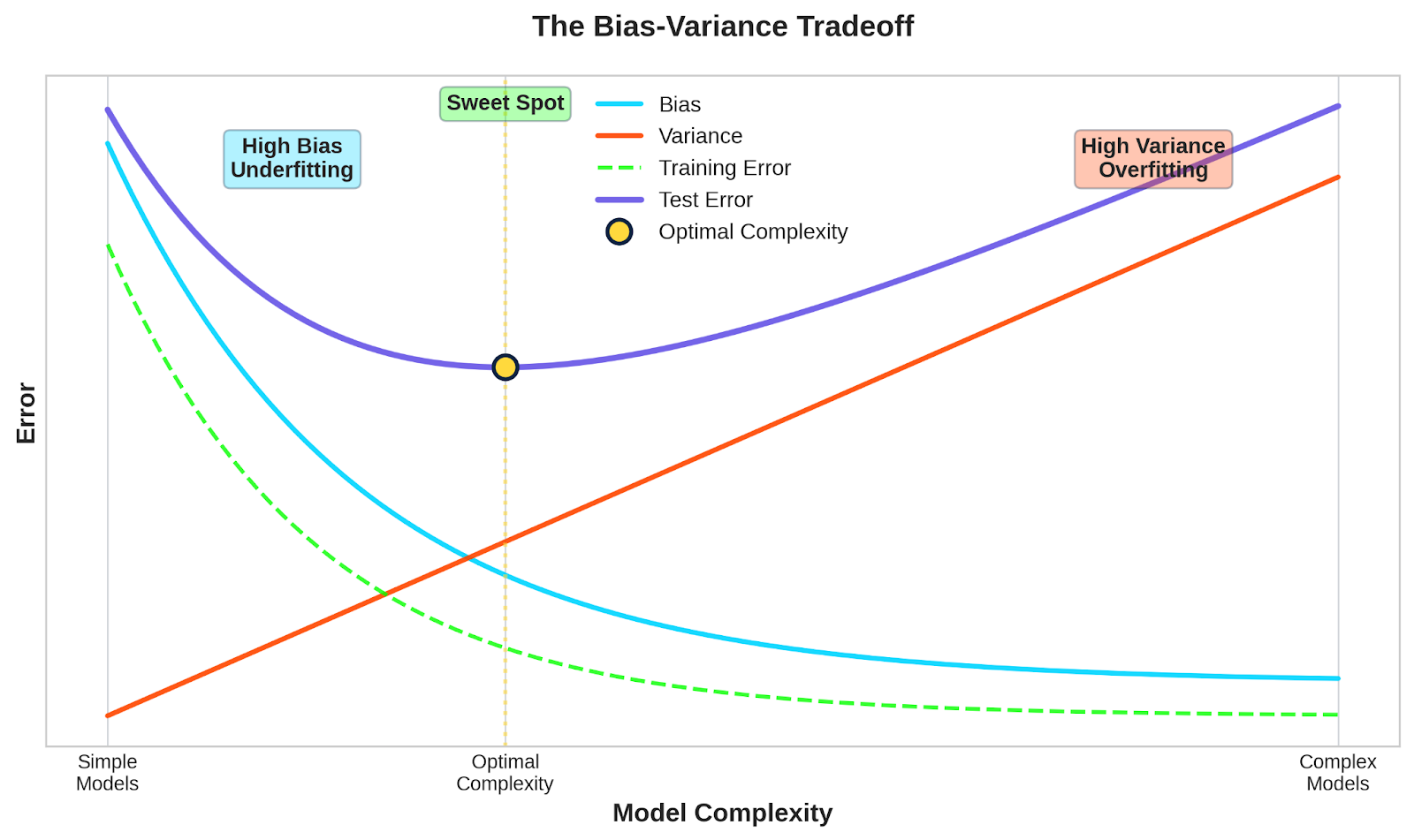
Curva de trade-off entre viés e variância
Você busca o ponto em que o efeito combinado resulta no menor erro de teste.
Não existe um “modelo perfeito” para todo problema. O equilíbrio ideal depende dos seus dados, da complexidade do problema e da quantidade de dados de treino. Mais dados geralmente permitem usar modelos mais complexos sem overfitting, deslocando o ponto ideal para a direita.
Vamos trazer o conceito para a prática com um cenário real mostrando como viés e variância aparecem no dia a dia.
Imagine que você está criando um modelo para prever valores de aluguel de apartamentos em uma cidade. Você tem variáveis como metragem, número de quartos, bairro, distância do metrô, idade do prédio e amenidades.
Você decide usar apenas a metragem para prever o preço com uma regressão linear simples.
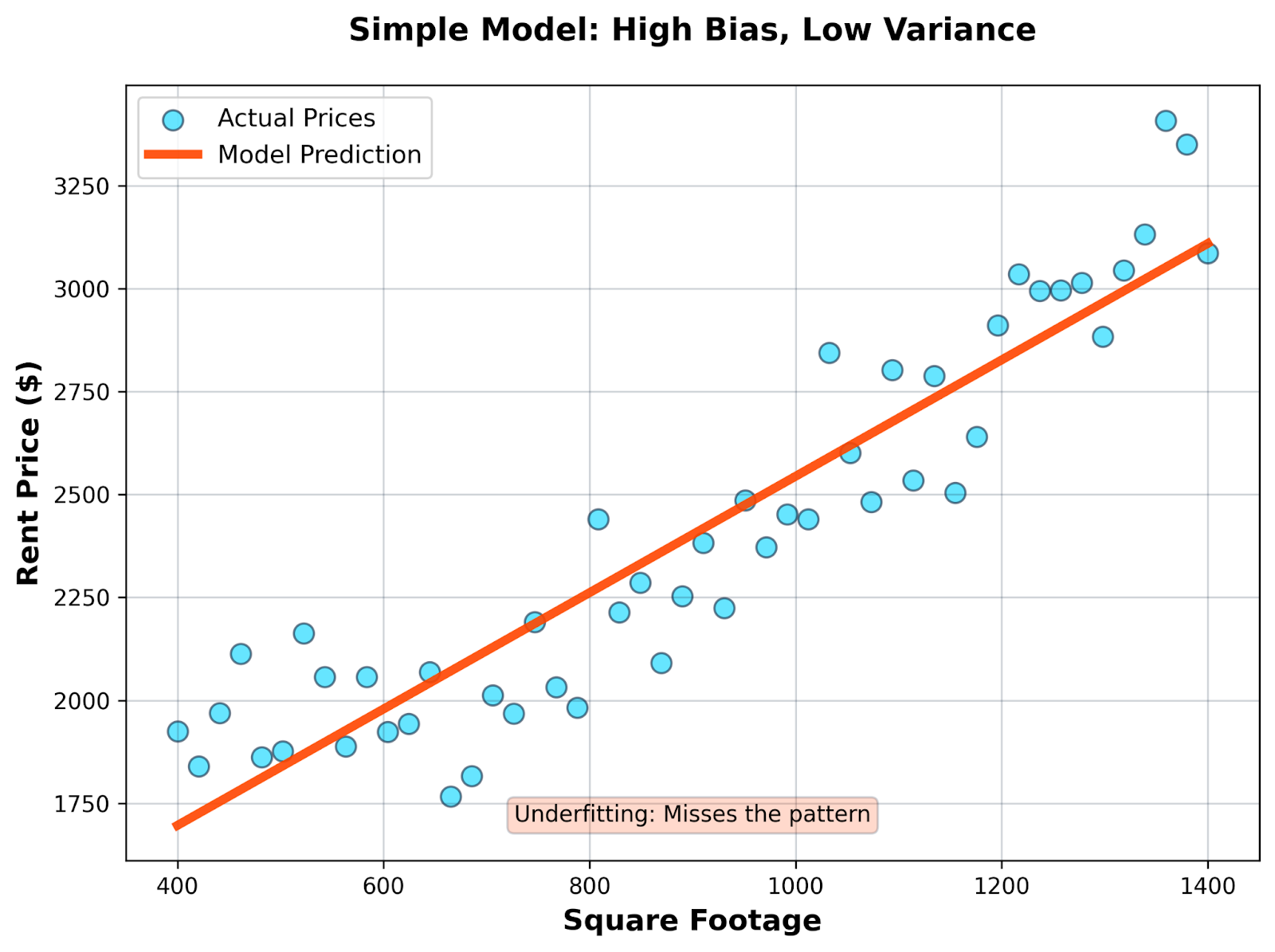
Modelo simples
Agora você cria uma rede neural profunda com várias camadas ocultas usando todas as variáveis disponíveis, além de variáveis derivadas como índice de criminalidade do bairro, walkability e proximidade de parques.
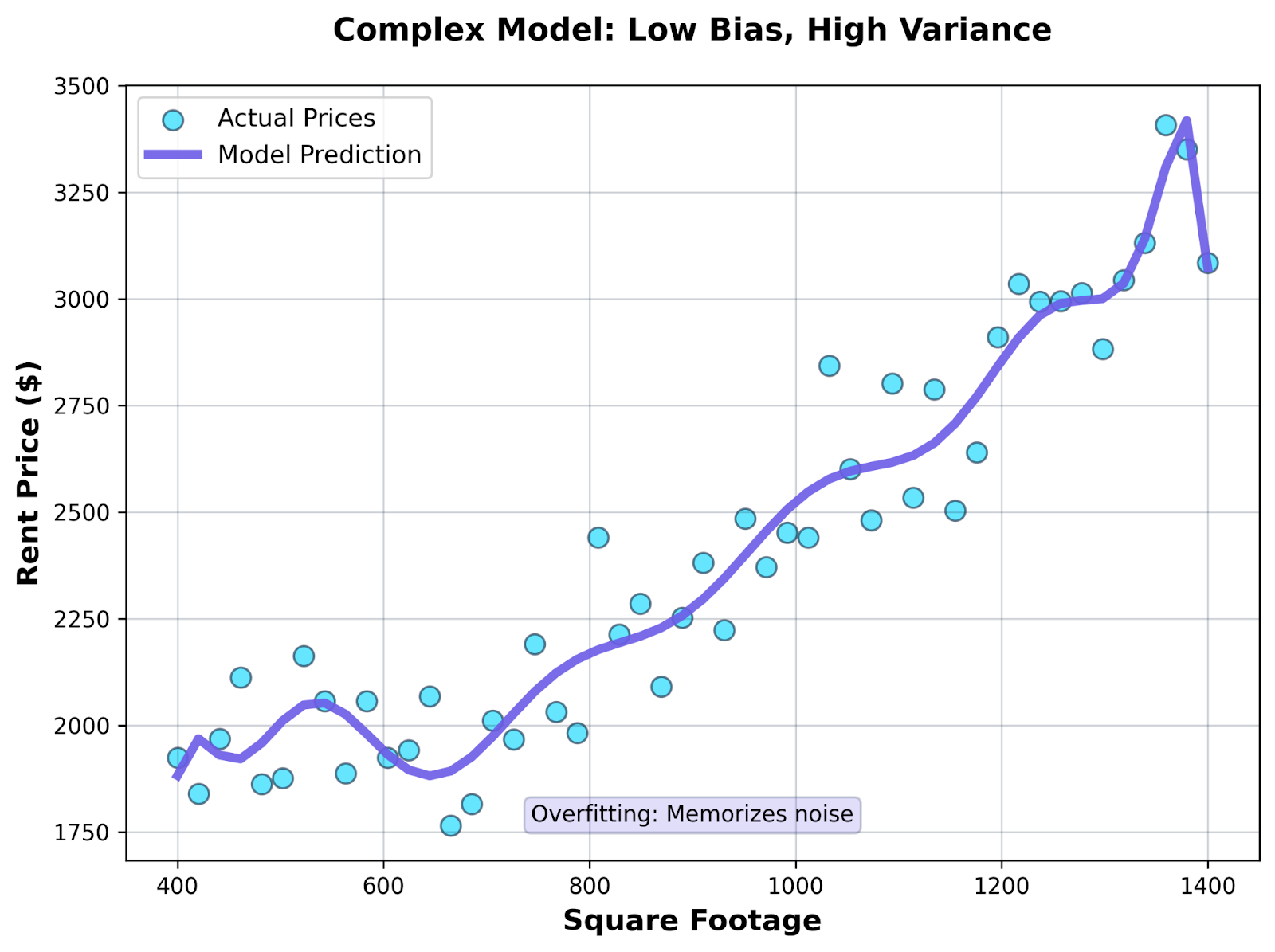
Modelo complexo
Você usa regressão regularizada (como Ridge ou Lasso) com um subconjunto selecionado de variáveis: metragem, quartos, categoria de bairro e distância do transporte.
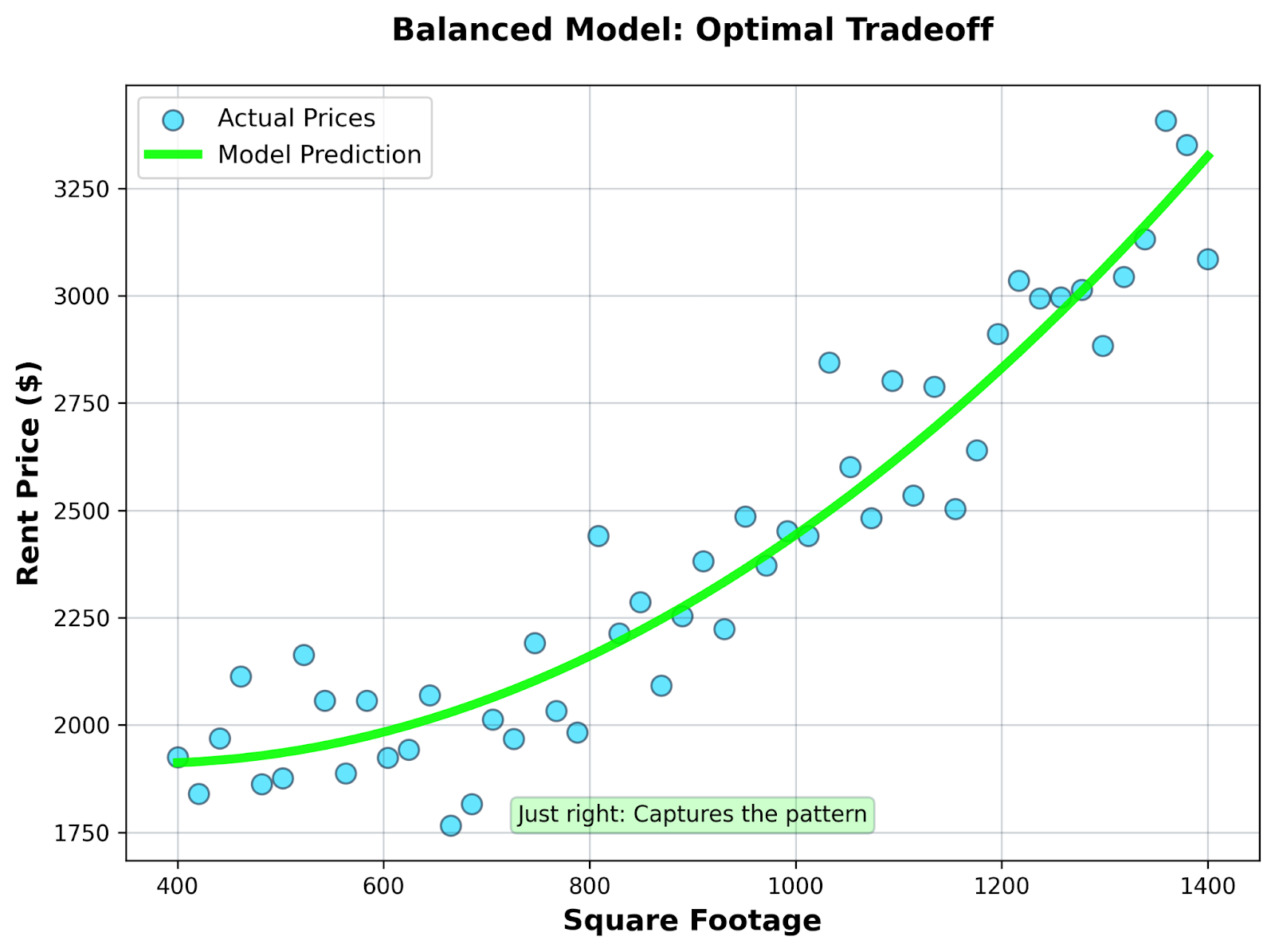
Modelo equilibrado
O modelo equilibrado não vai ajustar perfeitamente os dados de treino — e é justamente esse o objetivo.
Algoritmos diferentes tendem naturalmente a viés alto ou variância alta. Entender essas tendências ajuda você a escolher a ferramenta certa para o problema.
Regressão linear e regressão logística ficam no extremo de alto viés.
Esses modelos assumem relações lineares — uma variável muda e a saída muda uma quantidade fixa. Quando os dados têm padrões não lineares, curvas ou interações complexas, modelos lineares não conseguem capturá-los.
A vantagem é a estabilidade. Treine um modelo linear em amostras diferentes e os coeficientes serão parecidos. Variância baixa, mas potencialmente viés alto se a relação real não for linear.
Árvores de decisão se comportam de forma distinta conforme a configuração.
Uma árvore rasa, com poucos splits, age como um modelo simples — viés alto e variância baixa. Generaliza demais e não capta padrões finos.
Uma árvore profunda, sem limite de profundidade, fica extremamente flexível. Vai dividindo até cada folha ter poucos pontos — memorizando o treino. Viés baixo, mas variância nas alturas — a estrutura muda muito com amostras diferentes.
É por isso que random forests funcionam tão bem. Elas fazem a média das previsões de muitas árvores, reduzindo a variância enquanto mantêm o viés baixo.
O equilíbrio de viés-variância do KNN depende totalmente da escolha de k.
Com k pequeno (como k=1 ou k=3), o modelo tem variância alta. Baseia previsões em poucos vizinhos, ficando extremamente sensível aos exemplos específicos do treino. Pequenas mudanças no treino levam a previsões bem diferentes.
Com k grande (como k=50 ou k=100), o modelo tem viés alto. Faz média sobre muitos vizinhos, suaviza padrões locais e perde detalhes importantes.
O k ideal fica no meio, equilibrando os extremos.
Redes neurais são naturalmente modelos de alta variância porque têm muitos parâmetros para aprender.
Uma rede com várias camadas e centenas de neurônios pode representar funções incrivelmente complexas. Essa flexibilidade implica viés baixo — a rede pode aprender quase qualquer padrão. Mas também implica variância alta — os pesos aprendidos dependem muito dos dados de treino, da inicialização e do processo de treinamento.
Por isso redes neurais precisam de grandes volumes de dados. Mais exemplos estabilizam o aprendizado e reduzem a variância. É também por isso que técnicas como dropout, batch normalization e early stopping existem — todas para controlar a variância e evitar overfitting.
Redes menores, com menos camadas e neurônios, têm viés mais alto e variância menor; redes maiores têm viés mais baixo e variância maior.
Infelizmente, complexidade não é um número único. Trata-se da flexibilidade do modelo para ajustar diferentes padrões.
A complexidade vem de várias fontes: mais variáveis, mais camadas em redes neurais, árvores mais profundas, termos polinomiais em regressão ou k menor no KNN. Em comum, todas dão mais liberdade para o modelo ajustar padrões intrincados.
Ao adicionar parâmetros, você dá mais formas ao modelo de representar relações nos dados. Um modelo linear com 3 variáveis só pode traçar um plano. Se você inclui termos polinomiais e interações, ele pode curvar e se ajustar a padrões mais complexos. As suposições ficam menos restritivas — o viés cai.
Mas essa flexibilidade tem um custo: aumento de variância.
Mais parâmetros significam mais valores para aprender com o treino. Cada parâmetro é ajustado aos exemplos específicos, tornando o modelo mais sensível a quais exemplos entraram. Ao mudar algumas amostras, vários parâmetros se deslocam para acomodar os novos dados. O modelo fica instável.
Por isso o erro de treino, sozinho, é enganoso e perigoso.
À medida que você aumenta a complexidade, o erro de treino sempre diminui. O modelo se ajusta cada vez melhor ao treino, chegando perto da acurácia perfeita. Parece ótimo — até perceber que ele está memorizando ruído em vez de aprender padrões.
O erro no conjunto de teste mostra o quão bom seu modelo realmente é.
Inicialmente, ao adicionar complexidade, o erro de teste cai porque o modelo passa a capturar padrões reais. Mas, depois de certo ponto, o erro de teste sobe mesmo com o erro de treino caindo. O modelo está com overfitting — aprendendo peculiaridades do treino que não generalizam.
Um gap pequeno entre erros de treino e teste indica boa generalização. Gap grande indica overfitting e a necessidade de reduzir a complexidade ou adicionar mais dados de treino.
Você não elimina o trade-off, mas consegue controlá-lo com as técnicas certas. Veja algumas.
Nunca avalie o modelo nos mesmos dados usados para treinar.
Separe os dados em treino e teste antes de qualquer coisa. Treine em uma parte, avalie na outra. Isso dá uma medida fiel de como o modelo generaliza para novos dados.
O conjunto de teste funciona como um proxy do desempenho no mundo real. Se o erro de treino é baixo e o de teste é alto, há overfitting. Se ambos são altos, há underfitting.
Divisões treino/teste têm uma fragilidade — dependem de quais exemplos caem em cada parte.
A validação cruzada corrige isso ao treinar e testar várias vezes em divisões diferentes. O método mais comum é k-fold: você divide os dados em k partes, treina em k-1 e testa na restante. Repete k vezes para que cada parte seja teste uma vez.
Isso dá uma estimativa mais confiável do desempenho e ajuda a ajustar hiperparâmetros sem fazer overfitting a um único conjunto de teste.
A regularização adiciona uma penalidade à complexidade do modelo diretamente na função de perda.
Técnicas como L1 (Lasso) e L2 (Ridge) desestimulam parâmetros muito grandes, forçando o modelo a ser mais simples e estável. Isso aumenta um pouco o viés, mas reduz a variância — muitas vezes melhorando o desempenho de teste.
Dropout em redes neurais funciona de forma parecida — desativa neurônios aleatoriamente durante o treino, evitando dependência excessiva de parâmetros específicos e reduzindo overfitting.
Mais dados de treino costumam ser a melhor solução para variância alta.
Com mais exemplos, o modelo vê um espectro maior de padrões. Fica mais difícil ajustar o ruído, pois ele se dilui ao longo dos pontos. A variância cai sem sacrificar o viés baixo de um modelo complexo.
Mas coletar mais dados nem sempre é prático ou possível.
Se os dados são limitados, foque na escolha do modelo: prefira modelos mais simples, adicione regularização ou use ensembles que combinam vários modelos para reduzir a variância.
Nem toda variável melhora o modelo. Algumas só trazem ruído.
Remova variáveis irrelevantes ou redundantes para reduzir a complexidade sem perder padrões importantes. Menos variáveis significam menos parâmetros para aprender — variância menor. Você também evita a “maldição da dimensionalidade”, em que modelos sofrem em espaços de alta dimensão com poucos dados.
Use técnicas como análise de correlação, importância de variáveis em modelos de árvores ou métodos de regularização que zeram automaticamente variáveis pouco úteis.
O objetivo é encontrar o conjunto mínimo de variáveis que capture o sinal sem o ruído.
Vamos esclarecer três erros frequentes que levam a más decisões de modelagem.
Errado. Viés menor significa que o modelo consegue representar padrões complexos, mas isso só ajuda se esses padrões realmente existem nos dados e generalizam para novos exemplos.
Reduzir o viés aumentando a complexidade muitas vezes eleva a variância mais rápido do que reduz o viés. Você acaba com um modelo perfeito no treino, mas pior no teste. O objetivo é minimizar o erro total, não apenas o viés.
Às vezes um modelo mais simples, com viés maior, tem melhor desempenho geral porque a variância é baixa o suficiente para generalizar bem.
Não exatamente. Overfitting indica que o modelo é complexo demais para a quantidade de dados disponível, mas o modelo em si não é intrinsecamente ruim.
A mesma arquitetura de rede neural que faz overfitting com 1.000 exemplos pode ir muito bem com 100.000. O problema é o descompasso entre capacidade e tamanho do dataset.
Você pode corrigir overfitting adicionando dados, reduzindo a complexidade ou aplicando regularização. Não precisa jogar o modelo fora e começar do zero com outra coisa.
Mais dados reduzem a variância, mas não a eliminam — e há limites para o quanto ajudam.
Se o modelo é extremamente complexo para o problema, mesmo grandes datasets podem não estabilizá-lo suficientemente. Uma rede com milhões de parâmetros precisa de volumes massivos de dados para treinar bem.
Além disso, mais dados só ajudam se forem da mesma distribuição do seu teste. Coletar dados enviesados ou ruidosos não reduz a variância — pode até piorar, reforçando padrões que não generalizam.
Viés-variância e overfitting-underfitting descrevem os mesmos problemas por ângulos diferentes, mas não são termos intercambiáveis.
Lembre-se do essencial:
Viés e variância são propriedades do seu modelo.
Eles descrevem como o modelo se comporta em diferentes conjuntos de treino. Você mede viés olhando o quão longe a média das previsões está da verdade. Mede variância observando o quanto as previsões mudam com dados de treino diferentes.
Underfitting e overfitting são sintomas observados.
Eles descrevem o que acontece ao treinar e testar o modelo. Você vê underfitting quando erros de treino e teste são altos. Vê overfitting quando o erro de treino é baixo e o de teste é alto.
A conexão é direta, mas não exata um a um. Viés alto geralmente leva a underfitting, e variância alta geralmente leva a overfitting. Mas é possível ter viés e variância moderados e, ainda assim, desempenho ruim por outros motivos — como variáveis inadequadas ou baixa qualidade dos dados.
Algumas dicas rápidas para diagnosticar problemas de viés-variância e tomar melhores decisões de modelagem.
Erro de treino sozinho não diz nada sobre generalização. Um modelo com 1% de erro no treino pode ter 50% no teste se estiver com overfitting.
Compare os dois para entender o que está acontecendo.
Acurácia perfeita no treino é um sinal de alerta. Geralmente indica memorização do conjunto, não aprendizado que generaliza.
Foque no desempenho de validação. A meta é reduzir o gap entre erros de treino e validação mantendo ambos razoavelmente baixos.
Um único split treino-teste pode enganar porque depende de quais exemplos caíram em cada parte. Um split “azarado” pode fazer um bom modelo parecer ruim — e vice-versa.
A validação cruzada faz a média do desempenho em vários splits, oferecendo uma estimativa mais estável do resultado em novos dados. Isso é crucial com pouco dado ou ao ajustar hiperparâmetros.
Com datasets pequenos, prefira modelos simples. Eles são mais estáveis e menos propensos a overfitting quando há poucos exemplos para aprender.
Com datasets grandes, dá para usar modelos mais complexos porque o volume de dados estabiliza o aprendizado e reduz a variância. Mas não aumente a complexidade só porque pode — faça isso apenas se melhorar a validação.
Não dá para construir um modelo com viés zero e variância zero. Cada decisão de modelagem muda o equilíbrio entre essas duas fontes de erro. Ao aumentar a complexidade, você reduz o viés, mas eleva a variância. Ao simplificar, reduz a variância, mas aumenta o viés.
O desempenho depende de encontrar o ponto certo. O melhor modelo é aquele que minimiza o erro total equilibrando viés e variância para o seu problema e dataset. Entender esse trade-off permite diagnosticar se seu modelo sofre de viés alto ou variância alta e aplicar a solução certa.
Se você quer colocar a mão na massa com machine learning, matricule-se na nossa trilha Machine Learning Fundamentals in Python. São 16 horas de vídeo para ajudar você a conquistar seu primeiro emprego.
Aprenda com a DataCamp
Curso
Curso
Curso
blog
Abid Ali Awan
7 min
blog
Abid Ali Awan
11 min
blog
Arun Nanda
15 min
Tutorial
Moez Ali
9 min
Tutorial
Tutorial
Somil Asthana
11 min