
TL;DR
- The 9 examples cover sales, marketing, finance, HR, AI analytics, public health, and design
- 7 are Microsoft's 2026 sample reports, free to download as .pbix files
- Strong dashboards lead with a few KPI cards and push detail into tooltips and drillthrough
- Built-in AI visuals like key influencers explain why a metric moved, without extra code
- Most shared "dashboards" are technically Power BI reports; dashboards live in the Power BI service
Power BI Dashboard Examples at a Glance
Each example below targets one team and shows off one or two Power BI features worth borrowing. The table maps the 9 dashboards to their audience and tells you where to get each one.
| # | Dashboard | Built for | Feature worth copying | Where to get it |
|---|---|---|---|---|
| 1 | Regional Sales | Sales leadership | What-if forecast slider | Free .pbix (Microsoft) |
| 2 | Revenue Opportunities | Sales operations | Report page tooltip | Free .pbix (Microsoft) |
| 3 | AdventureWorks Sales | Executives | Dark theme with KPI cards linked to charts | Free .pbix (Microsoft) |
| 4 | Competitive Marketing Analysis | Marketing | Channel KPI cards with year-over-year change | Free .pbix (Microsoft) |
| 5 | Corporate Spend | Finance and IT budgeting | Field parameters and a button slicer | Free .pbix (Microsoft) |
| 6 | Employee Hiring and History | HR | Line styles and custom tooltip text | Free .pbix (Microsoft) |
| 7 | Artificial Intelligence | Analytics | Key influencers and decomposition tree | Free .pbix (Microsoft) |
| 8 | Washington Immunization Measures by County | Public health | Visual switcher buttons and a diverging map | Live public report |
| 9 | The World of Peaches | Design showcase | Custom HTML and SVG visuals, accessibility | Community gallery post |
All 7 Microsoft samples come from the same 2026 refresh, which moved them to the current base theme, the new card visual, and mobile-optimized layouts. I start with sales, where most teams build their first Power BI dashboard.
Power BI Sales and Revenue Dashboard Examples
A Power BI sales dashboard tracks revenue against a target and shows where the next deals will come from. The examples below cover a sales leader's forecast view, a pipeline analyst's opportunity view, and an executive summary for a manufacturer.
1. Regional sales dashboard
Microsoft's Regional Sales sample answers one question first: are we on track to hit the revenue goal? Four cards across the top show revenue won, revenue in pipeline, the revenue goal, and the forecast percentage, followed by a funnel of open revenue by sales stage and a forecast matrix by product.
The detail I'd copy is the what-if slider, which lets a sales manager adjust the qualified forecast and watch the report recalculate. In the product matrix, a single red status icon flags the one product running well below forecast, so the eye lands on the problem without reading every row. Tabs for win/loss ratio, industries, trend analytics, and key influencers sit behind the overview.
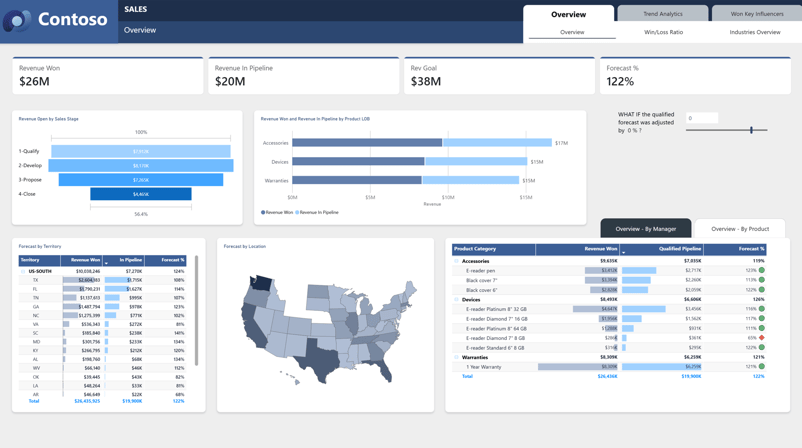
Regional Sales sample, 2026 refresh. Source: Microsoft
2. Revenue opportunities dashboard
The Revenue Opportunities sample is built for sales operations teams who manage a pipeline rather than a quota. It opens with total revenue and opportunity count, then breaks both down by region, by state on a map, and by month in a combo chart that plots revenue bars against an opportunity-count line.
Hover over a month and a report page tooltip shows revenue by customer segment, which keeps the main canvas clean while still answering the follow-up question. A pipeline-by-stage chart at the bottom shows how many leads drop out before the proposal stage, and selecting a state opens a drillthrough to the detail page.
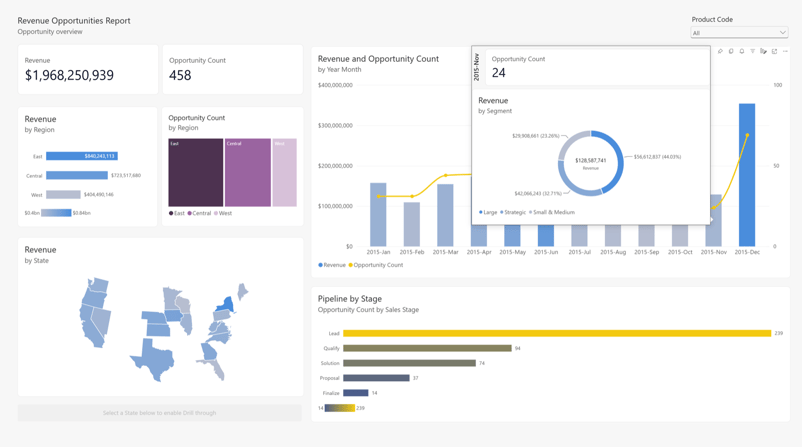
Revenue Opportunities sample, 2026 refresh. Source: Microsoft
3. AdventureWorks sales dashboard
AdventureWorks is Microsoft's long-running fictional bicycle company, and the 2026 refresh turned its sales report into the most distinctive of the samples. A dark theme frames 7 KPI cards (products, customers, orders, sales, cost, profit, and profit margin), each joined by a thin line to the chart that breaks it down.
The report also uses the date picker for compact date-range filtering, an Azure Maps visual of customers by country, and buttons that switch the orders chart between order date, due date, and ship date. That last trick relies on one date table playing three roles, which our data modeling in Power BI tutorial explains.
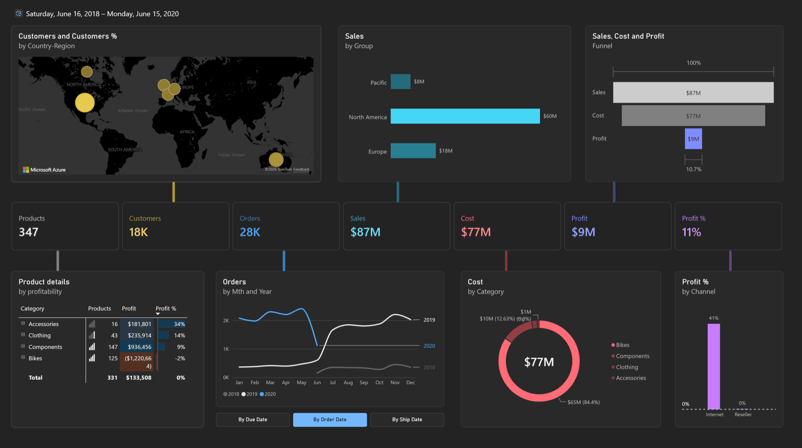
AdventureWorks Sales sample, 2026 refresh. Source: Microsoft
Power BI Marketing, Finance, and HR Dashboard Examples
Marketing, finance, and HR dashboards share one trait: they compare performance against a baseline, whether that's last year's units, the annual budget, or last month's hiring. Each example below makes that comparison the first thing you see.
4. Competitive marketing analysis dashboard
The Competitive Marketing Analysis sample tracks units sold across 4 channels: online, social media, outlet, and stores. A column of KPI cards on the left gives each channel its own total and year-over-year change, and a donut chart with the total in its center shows the channel mix.
The smoothed line chart at the bottom plots each channel by month with a label on every point, so a marketing team can spot the late-year rise without hovering. I'd borrow the palette too. One blue family covers all 4 channels, and the shade, not the hue, tells them apart.
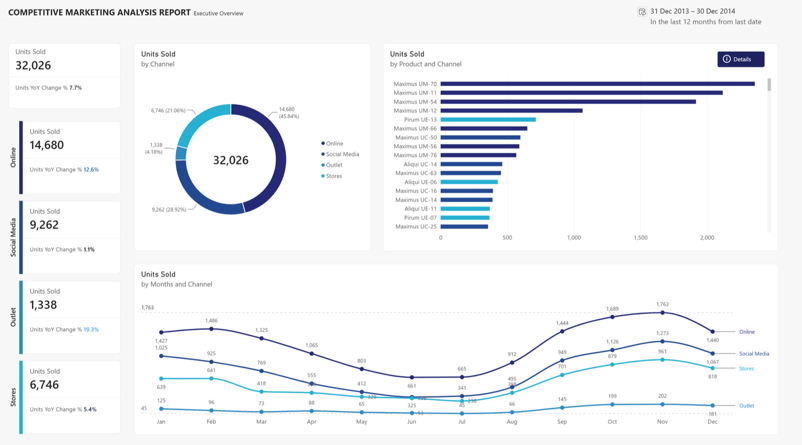
Competitive Marketing Analysis sample, 2026 refresh. Source: Microsoft
5. Corporate spend dashboard
Corporate Spend compares the planned and actual costs of an IT department. The company in the sample produces a new latest estimate (LE) every quarter, so the top cards measure actual spend against the original plan and against each of the 3 estimates.
Two features make this report adaptable. A button slicer switches between absolute and percentage variance, and a row of buttons backed by field parameters changes the breakdown between country, business area, sales region, IT area, and IT sub-area. Conditional formatting in the trend matrix separates overspend from underspend, and a custom tooltip spells out each variance as a sentence.
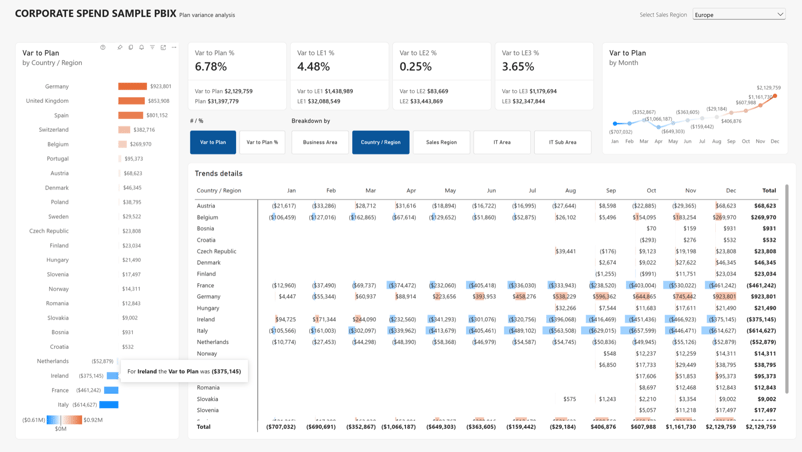
Corporate Spend sample, 2026 refresh. Source: Microsoft
6. Employee hiring and history dashboard
The Employee Hiring and History sample gives HR teams a view of new hires by month, employee type, age group, gender, ethnicity group, and region. Part-time and full-time hires share one line chart, separated by dotted versus solid lines and different markers rather than by a second color.
The stacked column chart uses custom tooltip text that reads as a full sentence, such as "2,203 (61.81%) of new hires 30-49 years old are Male." Underneath, a matrix with data bars lets managers compare hiring by region at a glance. Our HR Analytics in Power BI case study practices the same kind of analysis.
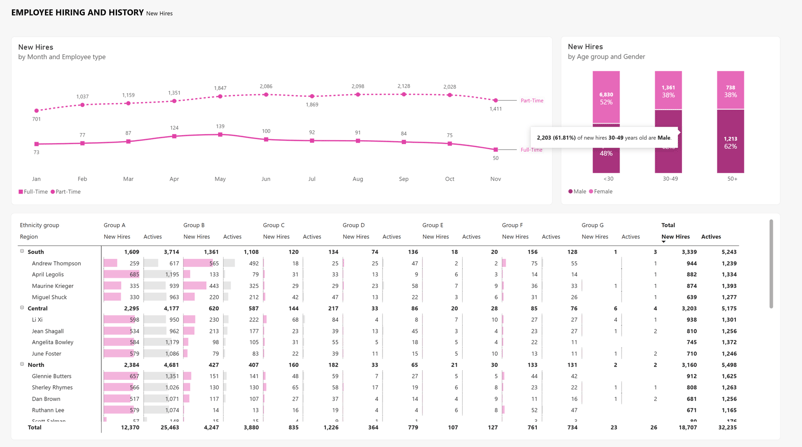
Employee Hiring and History sample, 2026 refresh. Source: Microsoft
Power BI Dashboard Examples for AI, Public Health, and Design
The last 3 examples go beyond standard business reporting. One shows Power BI's built-in AI visuals, one is a state health department's public dashboard, and one is the report that won the 2026 Power BI DataViz World Championship.
7. Artificial intelligence dashboard
Microsoft's Artificial Intelligence sample puts 3 of Power BI's AI features in one report: the key influencers visual, the decomposition tree, and anomaly detection on line charts. The page in the screenshot asks when a sales opportunity is more likely to be won, and key influencers answers with segments, such as deals with a discount above 3.7% handled by one particular manager.
You don't write a model for any of this: you drag in the outcome and the fields that might explain it, and Power BI runs the analysis. The catch is that the results are correlations, so I'd treat "discount above 3.7%" as a hypothesis to test rather than a pricing rule. Our Trend Analysis in Power BI course covers key influencers and decomposition trees in depth.
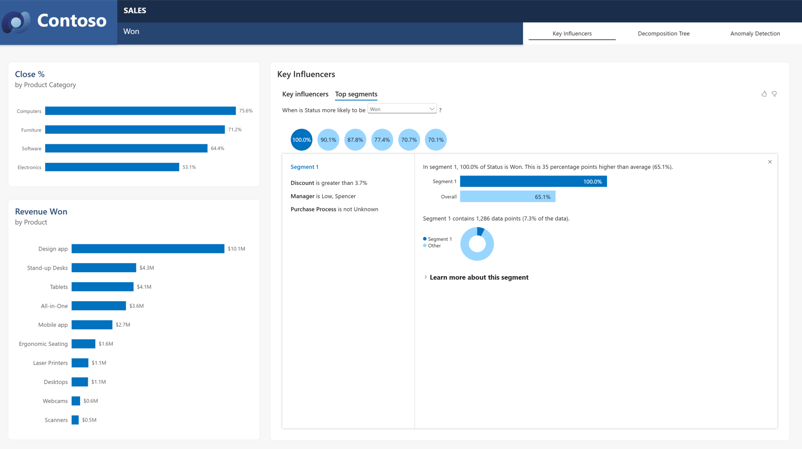
Artificial Intelligence sample, 2026 refresh. Source: Microsoft
8. Washington immunization measures dashboard
The Washington State Department of Health publishes a public Power BI dashboard of childhood and adolescent immunization coverage by county, from the hepatitis B birth dose to vaccines for 13- to 17-year-olds. It's embedded on the department's Washington Tracking Network page and covers 2017 to 2025.
A row of buttons across the top picks the age group, and a second set on the left switches the same data between a trend line, a county map, and a race and ethnicity breakdown, so 3 views share one page. The map uses a diverging scale centered on 50%, and counties with suppressed data show as white with a note explaining why. A welcome pop-up also warns readers up front that the figures underestimate true coverage, which is the kind of caveat most internal dashboards leave out.
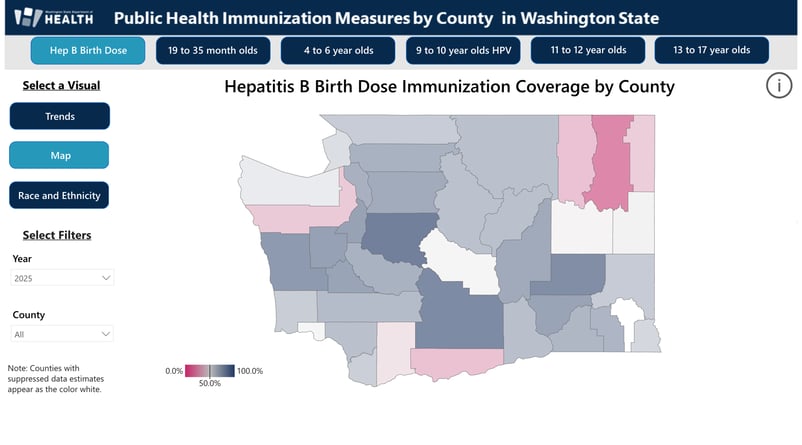
Washington immunization measures dashboard, map view for 2025 (captured November 2026). Source: Washington State Department of Health
9. The World of Peaches (2026 DataViz World Champion)
Gustavo Bavia won the 2026 Power BI DataViz World Championship, held live at FabCon in Atlanta, and "The World of Peaches" is the report he shared in Microsoft's Fabric community as his winning entry. Over 4 pages, it analyzes global peach production and trade across 79 countries using FAOSTAT data.
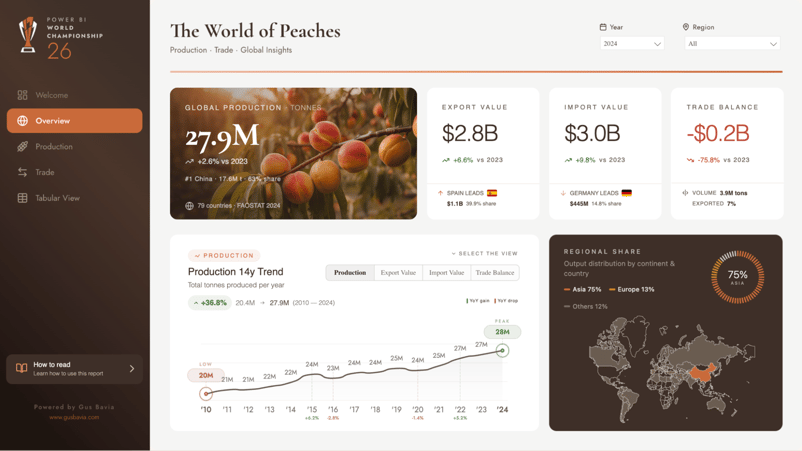
The World of Peaches by Gus Bavia, 2026 Power BI DataViz World Champion. Source: Microsoft Fabric community
Bavia built hero KPI cards, waffle charts, and animated trends with custom HTML and SVG measures, and he applied one design system for typography, color, and spacing across every page. He also added alt text, a logical tab order, and a guided tutorial on each page. You won't need custom SVG for a monthly sales review, but the accessibility work is worth copying in any report.
What Makes a Great Power BI Dashboard?
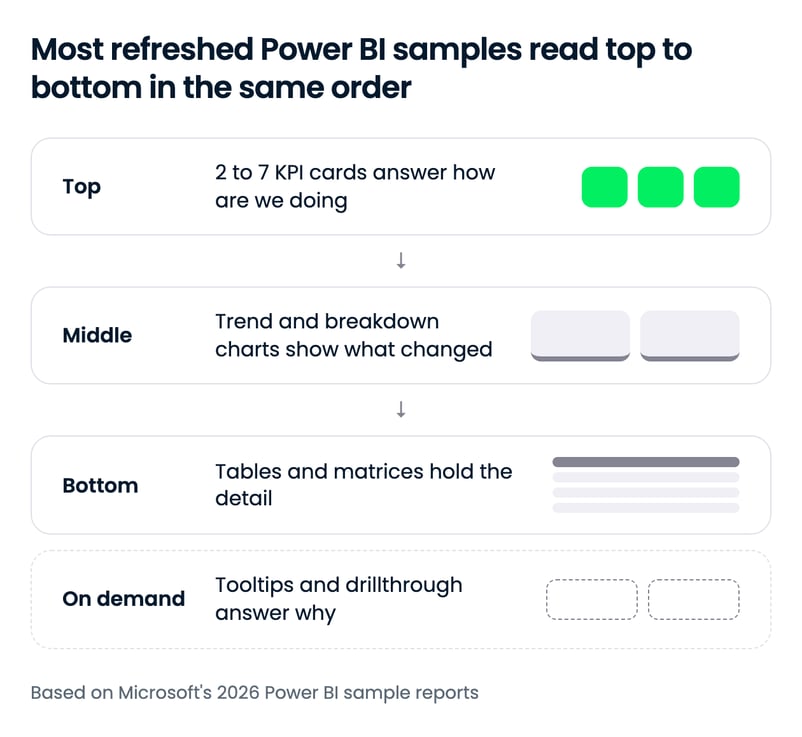
A great Power BI dashboard answers its audience's main question in a few seconds, then lets them dig for the reason. Across the 9 examples above, that comes down to 5 habits, and our guide to dashboard design best practices has a longer checklist.
Build for one audience
Operational dashboards monitor daily activity for teams like sales operations, while strategic dashboards track long-term KPIs for executives. Regional Sales and Revenue Opportunities draw on similar sales data, but one serves a sales leader checking the forecast and the other an analyst working the pipeline, and their layouts differ accordingly.
Lead with a few KPI cards
5 of the 7 Microsoft samples open with KPI cards, from 2 in Revenue Opportunities to 7 in AdventureWorks Sales. People read a page from the top left, so the numbers that answer "how are we doing?" belong there, with trend charts below and tables at the bottom.
Hide detail until someone asks for it
Report page tooltips, drillthrough, and buttons keep secondary information off the main canvas. Revenue Opportunities shows segment revenue only on hover, and Corporate Spend swaps its breakdown with field parameters instead of stacking 5 versions of the same chart. Our Power BI tooltips tutorial shows how to build the first pattern.
Use color for meaning, not decoration
Stick to one font and a small palette, and save strong colors for values that need attention. Regional Sales stays in muted blues until a red icon flags an underperforming product, and Employee Hiring and History separates two series with line styles instead of a second color. Our guide to Power BI conditional formatting covers the techniques behind both.
Design for phones and fast loads
The 2026 refresh added a mobile-optimized layout to every sample, because plenty of managers check dashboards on a phone. For load times, keep heavy transformations in the data source or Power Query, limit the visuals on each page, and group related numbers in one card visual instead of a dozen separate cards.
How to Open and Reuse These Power BI Dashboards
You can open 7 of the 9 examples on your own computer for free, because Microsoft publishes them as .pbix files. According to Microsoft's sample documentation, you don't need a Power BI license to explore them in Power BI Desktop.
- Download the file: open the 2026 Power BI samples folder on GitHub, select a .pbix file, and use the download button.
- Open it in Power BI Desktop: install Power BI Desktop (free, Windows only), then go to File > Open.
- Study the model before the visuals: the refreshed samples have descriptive table and measure names, measure descriptions, and calculation groups, so the Model view teaches as much as the report pages.
- Swap in your own data: use Transform data to point the queries at your source, and keep the column names the same so the visuals still work.
- Share it: publish to the Power BI service and pin visuals to a dashboard, or use Publish to web for a public portfolio piece.
If you'd rather start in the browser, the same samples sit under Learn > Sample reports in the Power BI service. Before you reuse a sample's visuals publicly, check the attribution terms on Microsoft's Power BI samples page. For more inspiration, the Fabric community's Data Stories Gallery collects reports shared by practitioners.
Power BI Dashboard vs Report: What's the Difference?
A Power BI dashboard is a single page of tiles pinned from one or more reports in the Power BI service, while a report is a multi-page, fully interactive file built on one semantic model. Dashboards are for monitoring; reports are for exploring.
| Dashboard | Report | |
|---|---|---|
| Pages | One | One or many |
| Where you build it | Power BI service only | Power BI Desktop or the service |
| Data | Tiles from one or more reports | One semantic model |
| Interactivity | Select a tile to open its report | Slicers, filters, tooltips, drillthrough |
Strictly speaking, most of the 9 examples above are reports, as are most "dashboards" people share online. The difference matters when you build one: you create a dashboard in the Power BI service by pinning visuals from a report you've already made. Our dashboards vs reports guide covers the details.
Build Your Own Power BI Dashboards
These examples show what's possible with Power BI, but building dashboards yourself requires hands-on practice with data modeling, DAX formulas, and visualization design. Here are practical next steps to get started:
- Learn the fundamentals: Start with Introduction to Power BI to understand the interface, Power Query, and basic report building.
- Practice data modeling: Good dashboards depend on clean data models. The data modeling in Power BI tutorial covers star schemas and relationships.
- Master visualizations: Move beyond default charts with the Data Visualization in Power BI course, then learn to design for the people reading your report in User-Oriented Design in Power BI.
- Practice on a realistic case: Build a complete report from messy data in Case Study: Ecommerce Analysis in Power BI or Case Study: Analyzing Healthcare Data in Power BI.
- Explore AI features: Power BI now integrates with Copilot in Microsoft Fabric, which can generate DAX formulas and suggest visualizations from natural language prompts.
For teams looking to upskill across the organization, DataCamp for Business offers structured learning paths and progress tracking for Power BI and broader data skills. Request a demo to see how it works.
Final Thoughts
The best Power BI dashboards in 2026 read less like a wall of charts and more like an answer: a few KPI cards, one trend, and the detail one click away. Microsoft's refreshed samples are the quickest way to see that in practice, and because they're free .pbix files, you can take one apart and rebuild it with your own data.
The 9 examples cover sales, marketing, finance, HR, and public health, but the same habits carry over to supply chain, customer service, and project tracking. My suggestion: download the sample closest to your job, change one thing, and see what breaks.
If you want to build dashboards like these, the Data Analyst in Power BI career track covers everything from data preparation to report design. For more Power BI learning, check out these resources:

Data Scientist - CRIF
FAQs
Where can I find free Power BI dashboard examples?
Microsoft publishes free sample reports as .pbix files in its Power BI Desktop samples repository on GitHub, including the 2026 refreshes of Regional Sales, Corporate Spend, and Employee Hiring and History. The same samples are under Learn > Sample reports in the Power BI service, and the Fabric community's Data Stories Gallery collects reports shared by practitioners.
What should a Power BI dashboard include?
A good Power BI dashboard leads with a few KPI cards that answer the audience's main question, followed by trend or breakdown charts and a detail table at the bottom. Secondary information belongs in tooltips, drillthrough pages, or buttons rather than on the main canvas, and the layout should have a mobile version if people check it on their phones.
Is a Power BI dashboard the same as a Power BI report?
No. A Power BI dashboard is a single page of tiles pinned from one or more reports, and you can only create one in the Power BI service. A report can have many pages, is built on one semantic model, and supports slicers, filters, and drillthrough. In everyday use, people often call reports "dashboards." Our dashboards vs reports guide covers the differences.
Do I need a Power BI license to build a dashboard?
You can build reports for free in Power BI Desktop, and Microsoft states you don't need a license to explore its sample files there. Sharing reports and dashboards with colleagues in the Power BI service requires a paid license or capacity. Our guide to Power BI license types explains which plan covers what.
How do I turn a Power BI sample into my own dashboard?
Download the sample .pbix file, open it in Power BI Desktop, and use Transform data to point its queries at your own data source, keeping the column names the same so the visuals still work. Then publish the report to the Power BI service and pin the visuals you want to a dashboard.









The best Power BI dashboard examples in 2026 come from two places: Microsoft's refreshed official samples, which you can download and open in Power BI Desktop, and real dashboards that teams publish for the public. Below, I walk through 9 of them across sales, marketing, finance, HR, AI analytics, and public health, plus the report that won the 2026 Power BI DataViz World Championship.
For each example, I point out the design decision worth copying, such as a what-if slider in a sales forecast or field parameters that let a finance team switch the breakdown with one click. 7 of the 9 come as free .pbix files, so you can open the report, inspect the data model, and swap in your own data.
If you're interested in Power BI vs Tableau and which one is right for you, check out our separate guide. You can also learn more about crafting Power BI dashboards with our Data Analyst in Power BI career track.