Track
AI Fundamentals
9 hr
SpaceXAI released Grok 4.6 on August 12, 2026, about a month after OpenAI made the GPT-5.6 family generally available on July 9. Both launches make a similar pitch: long-running agents that stay with a task across many steps, and stronger first passes on interactive work. Grok 4.6 arrived claiming a tie with GPT-5.6 Sol on the Artificial Analysis Intelligence Index, which puts a $6 output-tier model next to a $20 one and asks you to spot the difference.
In this article, I'll compare Grok 4.6 and GPT-5.6 Sol across agentic coding, long-horizon knowledge work, context handling, reasoning controls, and price, then put both through one hard build task in the same coding agent. For deeper coverage of each model individually, see our Grok 4.6 guide and our GPT-5.6 Sol, Terra, and Luna guide. Plus, check out our guide to GPT-6 Astra.
Grok 4.6 is SpaceXAI's frontier model for coding, agentic tasks, and knowledge work, released on August 12, 2026. It builds on Grok 4.5 with a focus on long-running agents and more ambitious interactive and visual work, and SpaceXAI says it stays with complex tasks across many steps: researching a topic, working across a codebase, or turning an idea into a working application. The training run added curated model-generated reasoning data and agentic reinforcement learning across kernel optimization, web development, and computer-aided design.
The distinctive part is the pricing posture. Grok 4.6 holds Grok 4.5's headline rates of $2 and $6 per 1M input and output tokens while gaining 5 points on the Artificial Analysis Intelligence Index, which Artificial Analysis notes is unusual at the frontier, where capability gains normally arrive with a price increase.
We also compared the model against Claude Opus 5. To see the model in action, our Grok 4.6 API tutorial shows you how to build a tool-using agent step by step, and our Grok Build tutorial builds a machine learning project inside the coding agent, where 4.6 is now the default model. We also covered SpaceXAI's agent teammate in our Grok Bot piece.
GPT-5.6 Sol is the flagship of OpenAI's GPT-5.6 family, generally available since July 9, 2026, alongside Terra for everyday work and Luna as the cost-efficient tier. OpenAI positions Sol around efficiency as much as raw capability: state-of-the-art results across coding, knowledge work, cybersecurity, and science while using fewer tokens. Stronger computer use lets it inspect and refine a rendered result rather than only generating the code behind it.
Two capability dials are new. The max setting gives the model more time than xhigh to reason and revise, and ultra coordinates four agents in parallel by default, trading token spend for a better score in less wall-clock time. On Terminal-Bench 2.1, Sol Ultra reaches 91.9% against plain Sol's 88.8%.
For hands-on work with this model, our Cursor Agent Mode tutorial builds a REST API with GPT-5.6 Sol, and our ChatGPT Work guide runs an end-to-end data science workflow on GPT-5.6. If you want a different pairing, we also compared it against Anthropic's flagship in Claude Opus 5 vs GPT-5.6 Sol.
The short version is that these models are peers on capability and strangers on price.
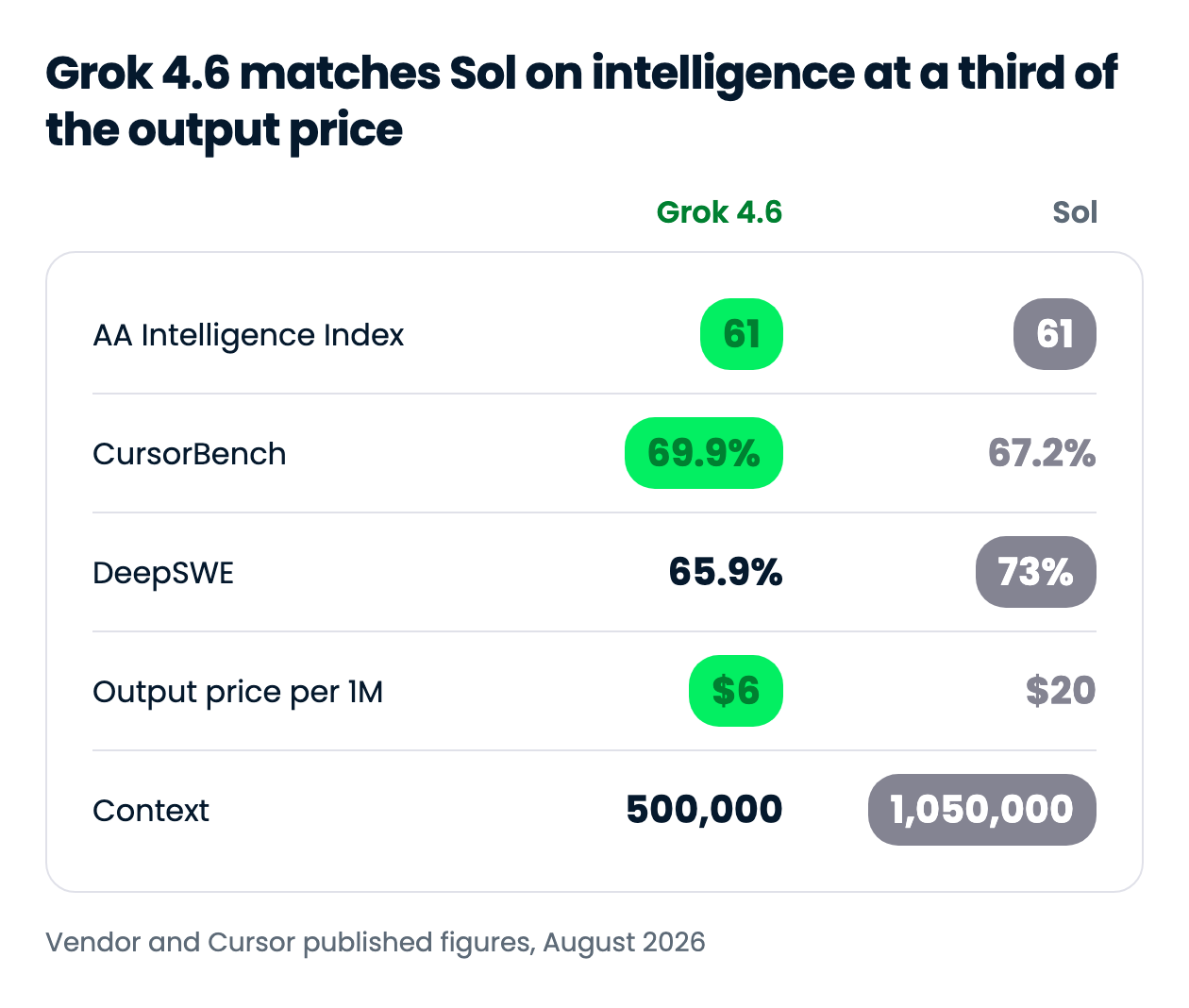
Tied at 61 on the Intelligence Index, they split the coding benches, and Sol costs 3.3x more on output.
| Feature | Grok 4.6 | GPT-5.6 Sol |
|---|---|---|
| Released | August 12, 2026 | July 9, 2026 |
| AA Intelligence Index | 61 | 61 |
| Input / output per 1M tokens | $2 / $6 | $4 / $20 |
| Context window | 500,000 tokens | 1,050,000 tokens |
| Long-context threshold | 200,000 tokens | 272,000 tokens |
| Rates above that threshold | $4 / $12 | 2x input, 1.5x output |
| Reasoning settings | Low, medium, high, xhigh | None through max, plus ultra |
| API model ID | grok-4.6 |
gpt-5.6-sol |
| Knowledge cutoff | February 1, 2026 | February 16, 2026 |
Cursor's table, Grok 4.6 at high against GPT-5.6 Sol at max, does not pick a winner. Grok leads CursorBench v3.2 at 69.9% versus 67.2% and GDPval-AA v2 at 1753 Elo versus 1728. Sol takes DeepSWE v1.1, 73% to 65.9%, and Terminal-Bench v3.0, 34.6% to 26%.
| Benchmark | Grok 4.6 (high) | GPT-5.6 Sol (max) | Notes |
|---|---|---|---|
| AA Intelligence Index | 61 | 61 | Composite of nine benchmarks; tied |
| CursorBench v3.2 | 69.9% | 67.2% | Cursor's own agent harness |
| DeepSWE v1.1 | 65.9% | 73% | Long-horizon work in real codebases |
| Terminal-Bench v3.0 | 26% | 34.6% | Both low; different version from OpenAI's 2.1 figures |
| FrontierCode v1.1 Extended | 61.3% | 60.6% | Within noise |
| APEX-Agents | 57.5% | 56.7% | Within noise |
Read those gaps with salt:
Grok is stronger in an IDE agent loop. Sol is stronger on long-horizon repository work and the command line.
Grok 4.6 leads AA-Briefcase, Artificial Analysis's private long-horizon knowledge-work suite, at 1577 Elo against Sol's 1502. On Harvey LAB, a legal-task eval, the published figures are 15.8% versus 2.5%, a 6x gap where both score badly in absolute terms, so treat it as a flag rather than a settled difference.
Grok also posts 50.7% on the banking arm of Artificial Analysis's tool-use suite. Its 88.4% on Terminal-Bench v2.1 is level with the leading models, but that is v2.1, not the v3.0 row above.
Sol holds roughly twice the window: 1,050,000 tokens against Grok 4.6's 500,000, plus a 128,000-token output ceiling SpaceXAI does not match in text. Above 500K there is no Grok equivalent.
Both reprice long prompts before those ceilings, and Grok's threshold arrives first:
Between 200,000 and 272,000, input rates meet at $4. Grok stays cheaper on output, by a smaller margin than the headline pair implies.
Sol exposes more dials: none through max, plus ultra, which runs four agents in parallel. Grok 4.6 offers low, medium, high as the default, and xhigh. Dropping Sol to none on a cheap classification call is useful. Ultra's Terminal-Bench 2.1 jump from 88.8% to 91.9% is real, but both extremes bill at an output rate 3.3x Grok's.
Grok 4.6 ships function calling, web search, X search, and code execution. GPT-5.6 Sol adds file search, image generation, code interpreter, a hosted shell, apply patch, computer use, and tool search on the Responses API.
Sol also has Programmatic Tool Calling: the model writes and runs a small program that coordinates tools and filters intermediate results instead of passing every tool response back through the model.
Price is the clearest difference, and its shape is not a flat multiple.
| Rate | Grok 4.6 | GPT-5.6 Sol |
|---|---|---|
| Input, per 1M tokens | $2.00 | $4.00 |
| Output, per 1M tokens | $6.00 | $20.00 |
| Cached input read, per 1M tokens | $0.50 | $0.40 |
| Long-context threshold | 200,000 prompt tokens | 272,000 input tokens |
| Above the threshold | 2x input and output | 2x input, 1.5x output |
| Fast variant, input / output | $4.00 / $12.00 | Not applicable |
Sol is 2x on input and 3.3x on output, so the gap widens with everything the model writes. Reasoning tokens bill at the output rate on both. Cached reads are close ($0.50 vs $0.40), but SpaceXAI warns that without a prompt_cache_key on the Responses API, you often pay full input on a cache-cold server. You can read more on that in our Grok 4.6 API tutorial.
The formula is (volume ÷ 1M) × rate, summed across input and output, at standard rates.
| Workload | Grok 4.6 | GPT-5.6 Sol | Difference |
|---|---|---|---|
| Generation-heavy: 1M in / 4M out | $26 | $84 | +$58 (223%) |
| Retrieval, sub-threshold: 10M in / 1M out | $26 | $60 | +$34 (131%) |
| Retrieval, over-threshold: 10M in / 1M out | $52 | $110 | +$58 (112%) |
Generation-heavy is where the output-rate gap lands. The two retrieval rows share 10M in / 1M out and differ only in whether each request sits above both thresholds, so the delta between them is the surcharge. Grok's bill doubles from $26 to $52 on that row. Sol goes from $60 to $110. The relative premium narrows from 131% to 112% even as the dollar gap grows. Neither vendor has published token counts for a shared workload, so treat these totals as a rate comparison rather than a bill.
We ran one hard build task against both models in the same coding agent.
We tested both models to create a single-file physics simulation, because both vendors claim strong performance in interactive and visual work. Same prompt, byte-identical, pasted into a fresh chat in an empty workspace. One attempt each, no retries, no mid-run steering.
Build a single-file HTML page (inline CSS and JS, canvas, no build step, no external libraries, no network) that simulates a few dozen balls of varying sizes bouncing inside a slowly rotating square container, under gravity. The balls should collide with each other and with the container walls, and lose a little energy on each collision so the system settles rather than gaining energy over time. The container keeps rotating throughout, so the balls should slosh and re-pile as it turns.

Ship it as one working file named index.html that starts animating on load. Do not ask me clarifying questions, make reasonable assumptions and note them briefly in a comment at the top of the file.
Both ran inside Cursor on August 25, 2026: Grok 4.6 at high reasoning, GPT-5.6 Sol at high reasoning. The result describes them as agents, not as bare models. Network was declined for both.
Grok shipped a working index.html that passed runnability: single file, animating on load, no uncaught console errors, still running after 30 seconds. Containment held as the box rotated, ball-to-ball collisions looked plausible, and the system lost energy and settled rather than gaining speed.
That took 14 assistant turns, with several rounds of self-correction. It also asked for browser access to check its own work, which we declined under the test's permission rule.
Scores are 1 to 5 per axis, graded by watching each simulation for 30 seconds against a rubric written before the run.
| Measure | Grok 4.6 (high) | GPT-5.6 Sol (high) |
|---|---|---|
| Turns | 14 | 3 |
| Runnability | Pass | Pass |
| Physics correctness | 5 | 5 |
| Stability over time | 5 | 5 |
| Visual quality | 4 | 5 |
| Overall | 3.5 | 5 |
On the artifact, this is close to a tie: both got the physics right, and both stayed stable. The separation is effort. Sol reached the same result in 3 turns against Grok's 14, which is what drops Grok's overall mark to 3.5.
But remember: This is n=1 on a visual build, so read it as one data point, not a benchmark, and it says nothing about large codebases or long retrieval chains.
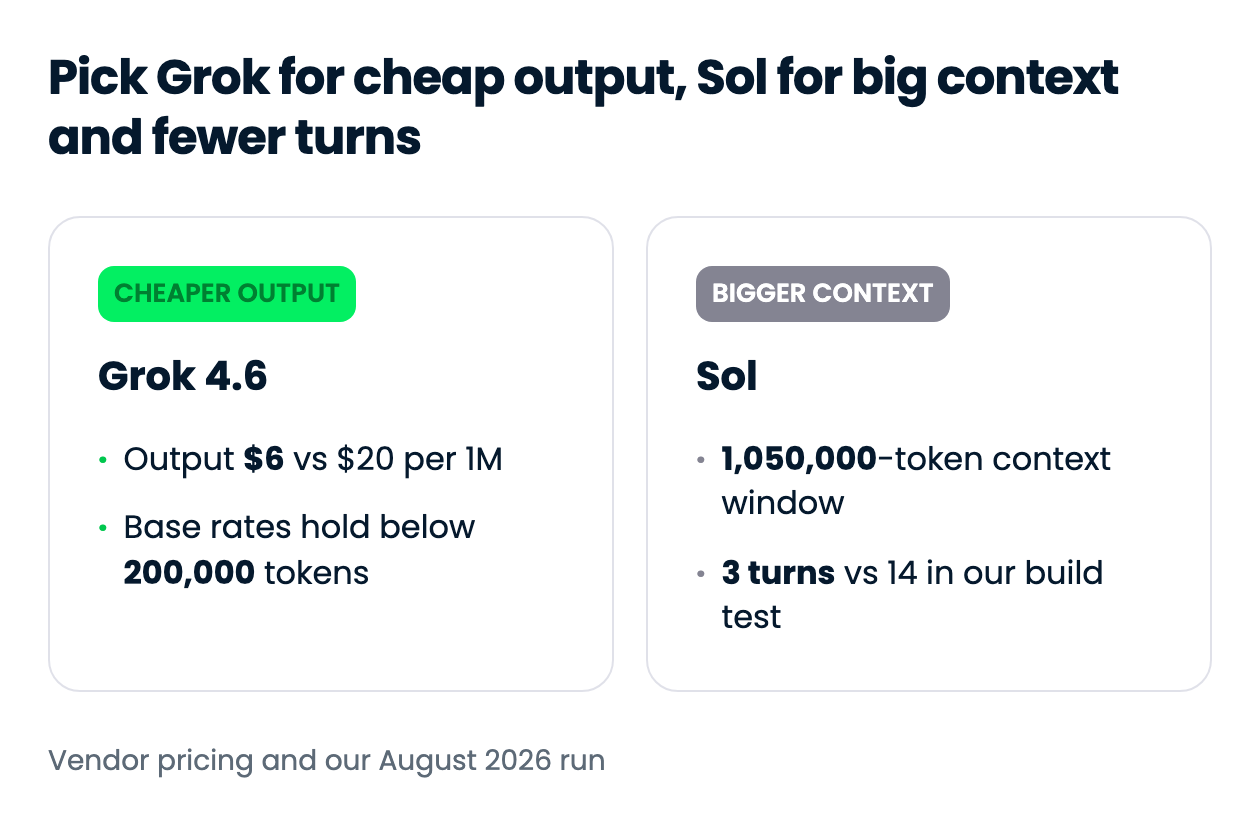
Since capability is close, the decision comes down to workload shape, context size, and how much you care about turns versus per-token cost. Pick Grok when output is cheap enough to dominate the bill. Pick Sol when you need the bigger window or fewer turns.
ultra.Both models are a one-string swap if you already call an OpenAI-compatible endpoint. The strings are grok-4.6 and gpt-5.6-sol. OpenAI also routes the gpt-5.6 alias to Sol.
| Surface | Grok 4.6 | GPT-5.6 Sol |
|---|---|---|
| First-party API | xAI API | OpenAI API |
| Consumer app | Grok app and Grok.com | ChatGPT |
| Coding agents | Grok Build (default model), Cursor (all plans) | Codex, Cursor |
| Model gateways | OpenRouter, Vercel, Cloudflare | OpenRouter, Vercel, Cloudflare |
| API model ID | grok-4.6 |
gpt-5.6-sol |
In Cursor, both models are in the picker, which is how we ran the build test. Switching is a picker change, not a config rewrite.
Through the API, the swap is one string. xAI serves an OpenAI-compatible endpoint:
import os

from openai import OpenAI

client = OpenAI(
    api_key=os.environ["XAI_API_KEY"],
    base_url="https://api.x.ai/v1",  # drop this line for gpt-5.6-sol
)
response = client.responses.create(
    model="grok-4.6",  # swap for "gpt-5.6-sol"
    input="Find and fix the bug: function median(a){a.sort();return a[a.length/2]}",
)
print(response.output_text)
For full setup, see our Grok 4.6 API tutorial, our Cursor Agent Mode tutorial, and our Grok Build tutorial.
If your bill is dominated by output and reasoning tokens, use Grok 4.6. A tie on the Intelligence Index at under a third of the output price is the easiest call here. If you need a million-token window or long-horizon repository work, use GPT-5.6 Sol and accept the premium. Check which side of Grok's 200,000-token surcharge your prompts fall on before you switch.
In our test, the release claims held up: both models passed with good results. That said, Sol was a lot faster than Grok and took only about 20% of Grok's turns, which shows a significant gap. If you want to get good at running these models inside an agent rather than reading about them, I recommend our Software Development with Cursor course.
Learn AI With DataCamp!
Track
Course
Course
blog
Khalid Abdelaty
13 min
blog
Khalid Abdelaty
13 min
blog
Tom Farnschläder
14 min
blog
Tom Farnschläder
11 min
blog
Josef Waples
10 min
blog
Tom Farnschläder
12 min