Course
Introduction to AI for Work
2 hr
126.9K
On August 12, 2026, SpaceXAI released Grok 4.6 with a focus on long-running agents and more ambitious interactive and visual work. It matches GPT-5.6 Sol on the Artificial Analysis Intelligence Index and lists at $2 per million input tokens and $6 per million output tokens. Claude Opus 5 was already Anthropic's daily-driver flagship: the default on Claude Max, the strongest model on Claude Pro, and half the price of Claude Fable 5 at $5 / $25 per million tokens.
In this article, I'll compare Grok 4.6 and Claude Opus 5 across coding, knowledge work, visual projects, and price. For deeper coverage of each model individually, see our Grok 4.6 guide and our Claude Opus 5 guide.
Grok 4.6 is SpaceXAI's August 2026 frontier model, built on Grok 4.5 for long-running agents and more ambitious interactive and visual work. The API model ID is grok-4.6. The context window is 500,000 tokens, with a 2x rate once a prompt crosses 200,000 tokens.
xAI's own write-up stresses first passes on visual and interactive projects, plus more self-testing on long trajectories. Artificial Analysis scores it 61 on the Intelligence Index, in line with GPT-5.6 Sol and behind Claude Opus 5 (max, 63). It is in Cursor and Grok Build, and on the SpaceXAI API plus OpenRouter, Vercel, and Cloudflare.
To call it yourself, follow our Grok 4.6 API tutorial. If you care about the agent wrapper more than the model card, we also ran Grok Build against Claude Code on a rigged churn dataset. We also compared it against OpenAI's current flagship model in our Grok 4.6 vs GPT-5.6 Sol guide.
Claude Opus 5 is Anthropic's current Opus-class model, sold as a thoughtful daily driver that comes close to Claude Fable 5 at half the price. The API model ID is claude-opus-5. It is the default on Claude Max and the strongest model on Claude Pro, at the same $5 / $25 per million tokens as Opus 4.8.
Anthropic reports state-of-the-art numbers on Frontier-Bench v0.1 (43.3%) and GDPval-AA v2 (1,861 Elo), while staying behind Mythos 5 on cybersecurity exploitation. Fast mode runs at about 2.5x default speed for twice the base price. Developers start from the Claude API; cloud catalogs also list it on Amazon Bedrock, Google Vertex AI, and Azure AI Foundry.
We unpack the launch in our Claude Opus 5 guide and the request path in our Opus 5 API tutorial. If you are choosing inside Anthropic's own stack, see our comparison guides on Opus 5 vs Fable 5 and Opus 5 vs Sonnet 5.
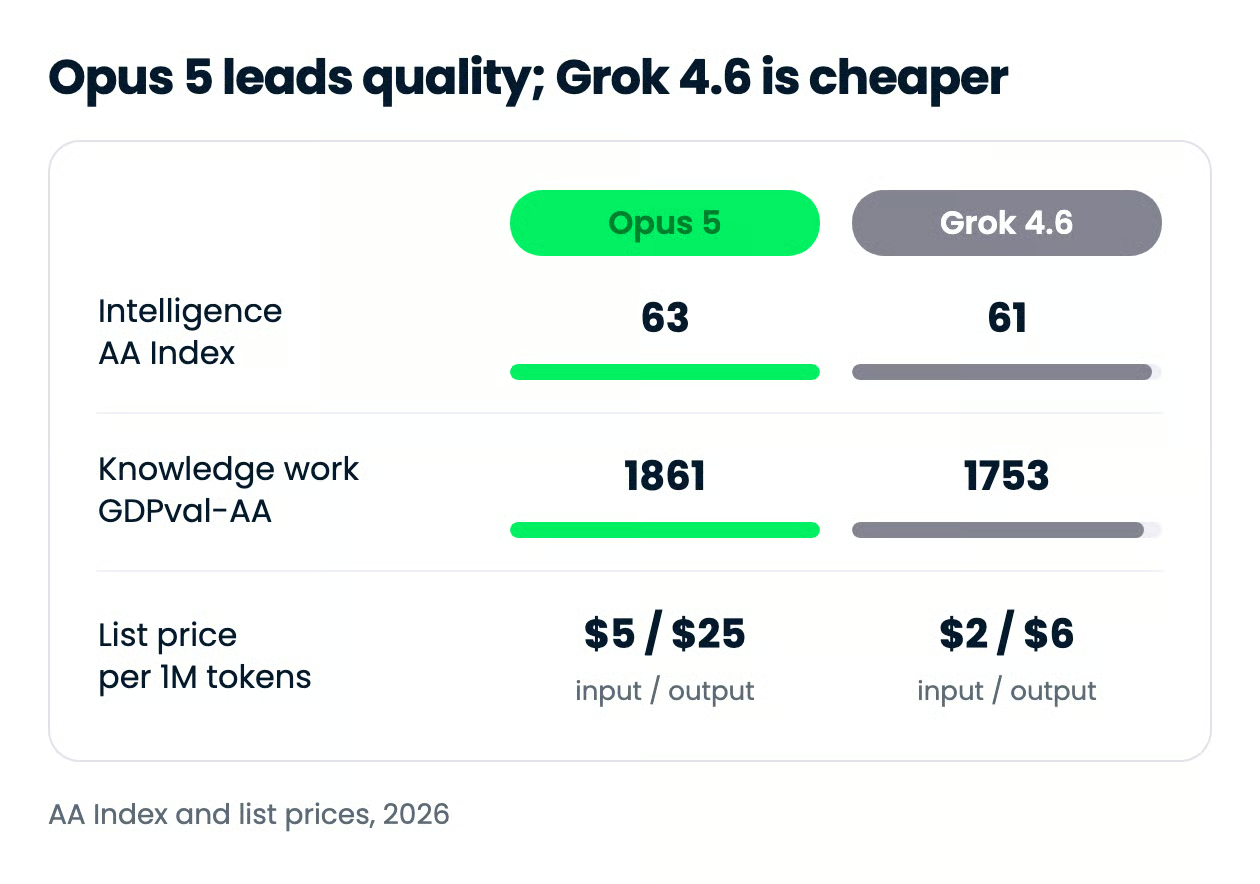
On the composites both labs publish, Opus 5 is slightly ahead: 63 versus 61 on the Artificial Analysis Intelligence Index, and 1861 versus 1753 Elo on GDPval-AA v2. The rate card is not close: Grok 4.6 is $2/$6 per 1M tokens against Opus 5 at $5/$25.
| Feature | Grok 4.6 | Claude Opus 5 |
|---|---|---|
| AA Intelligence Index | 61 | 63 (max) |
| GDPval-AA v2 (Elo) | 1753 | 1861 |
| API input / output per 1M | $2 / $6 | $5 / $25 |
| Context window | 500k | 1M |
| Long-context surcharge | 2x at ≥200k prompt tokens | None published |
| API model ID | grok-4.6 |
claude-opus-5 |
Opus 5 leads the published coding rows that both names share. Most notably, on DeepSWE v1.1, Opus 5 is 68.8% against Cursor's 65.9% for Grok 4.6 High.
Another signal is the result of our Grok Build vs Claude Code run: Grok 4.6 high versus Claude Opus 5 high, one conversation each, on a churn table with planted leaks. Grok Build gave fewer, more immediately usable answers. Claude Code went deeper, but also shipped a dashboard format bug.
If you already pay Anthropic prices for repository work, Opus 5 is the safer published card. If you want a frontier coding model that does not cost like one, Grok 4.6 is the Cursor picker I would actually leave on.
Opus 5 leads on knowledge work: GDPval-AA v2 is 1861 for Opus 5 and 1753 for Grok 4.6. Artificial Analysis still puts Grok behind only Opus 5 there, with overlapping error bars against Fable 5 and Qwen3.8 Max.
The efficiency gap is larger. On AA-Briefcase, Grok 4.6 scores 1577, behind the Opus 5 family, but it finishes in about 53 turns and about 0.5B input tokens. Opus 5 (max) takes about 103 turns and about 2.0B input tokens. The takeaway is that Opus 5 wins the scoreboard, while Grok 4.6 wins the token budget.
SpaceXAI's pitch for Grok 4.6 is a stronger first pass on visual and interactive projects. Anthropic's Opus 5 launch is quieter there and louder on verification, plus "much stronger visual outputs" without a public number against Grok.
That is why we ran a shared shader task. Both models wrote real GLSL, but Opus 5's result matched the brief a bit more closely and was more reactive to cursor movement. Grok 4.6's result had a very nice look as well and did it in fewer turns.
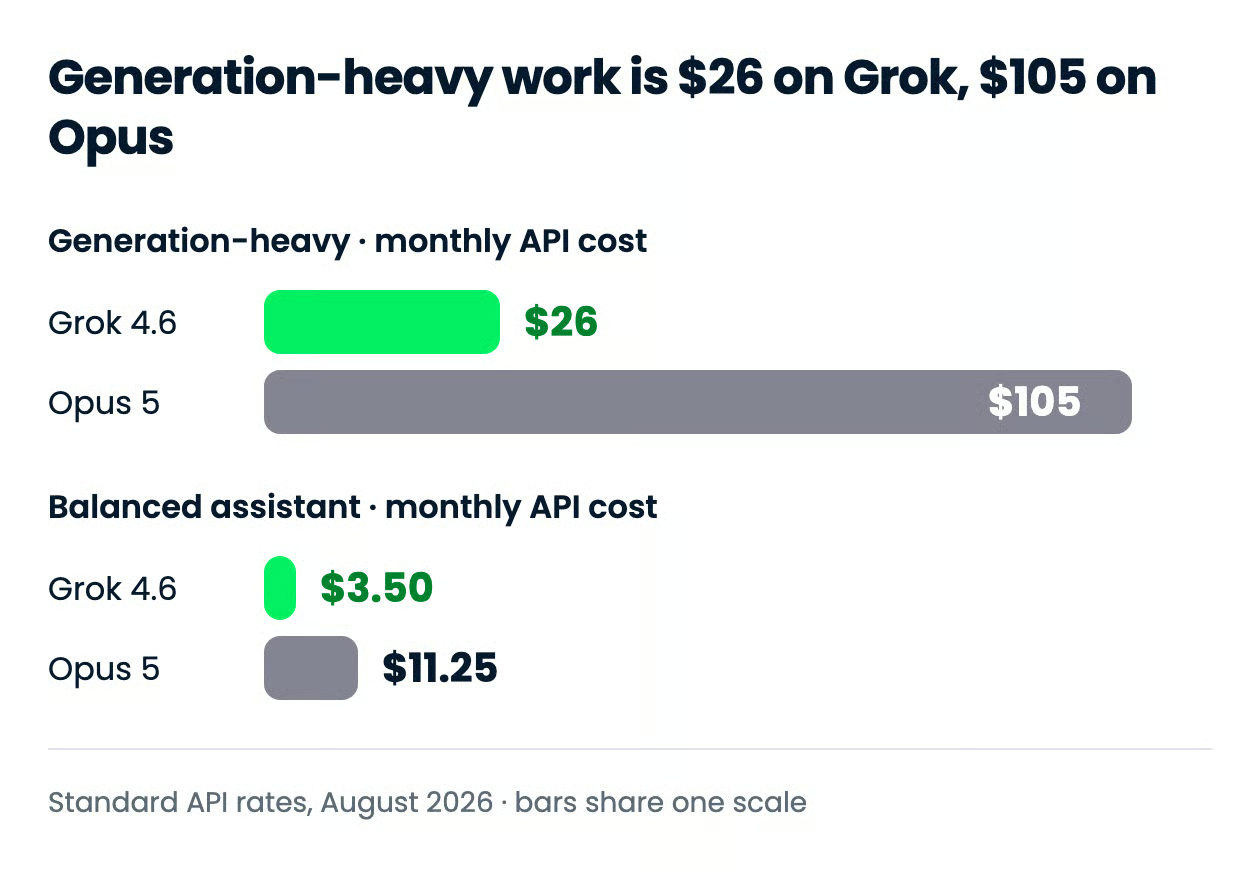
List price is the cleanest gap in this comparison. Grok 4.6 is $2 input and $6 output per 1M tokens, while Opus 5 is $5 and $25. That makes Anthropic's model 2.5 times more expensive on input and over 4 times more expensive on output, which is obviously a big difference. For example, a generation-heavy month at 1M in / 4M out is $26 on Grok 4.6 and $105 on Opus 5. A more balanced assistant at 1M in / 250K out is $3.50 versus $11.25.
These are the published standard rates, plus the extras that actually exist for both models.
| Rate | Grok 4.6 | Claude Opus 5 |
|---|---|---|
| Input, per 1M tokens | $2.00 | $5.00 |
| Output, per 1M tokens | $6.00 | $25.00 |
| Cached input read, per 1M tokens | $0.50 | $0.50 |
| Cache write, per 1M tokens | $1.00 (≥200k row) | $6.25 (5-minute) / $10 (1-hour) |
| Fast variant | $4 / $12 (2x) | $10 / $50 (2x; ~2.5x speed) |
| Long-context surcharge | 2x at ≥200k prompt tokens ($4 / $1 / $12) | None published |
The output premium is the one that hurts. Fast mode is a 2x overlay on both, not a third shape. Opus 5 also publishes a 50% batch discount ($2.50 / $12.50), which Grok 4.6 does not offer currently.
Formula once: (volume ÷ 1M) × rate, summed across input and output, at standard rates except the over-threshold row, which uses Grok's 2x surcharge. Numbers are rounded to the cent under $10, otherwise to the nearest dollar.
| Workload | Grok 4.6 | Claude Opus 5 | Difference |
|---|---|---|---|
| Balanced assistant: 1M in / 250K out | $3.50 | $11.25 | Opus 5 +$7.75 (221%) |
| Generation-heavy: 1M in / 4M out | $26 | $105 | Opus 5 +$79 (304%) |
| Retrieval, sub-threshold: 10M in / 1M out | $26 | $75 | Opus 5 +$49 (188%) |
| Retrieval, over-threshold: 10M in / 1M out | $52 | $75 | Opus 5 +$23 (44%) |
Retrieval under 200k is an input-rate story ($26 vs $75). That said, Grok's 200k surcharge plays a role here: Cross it, and the same 10M / 1M aggregate becomes only $52 vs $75. The surcharge shrinks the gap, but it does not make Opus 5 cheaper.
Vendor charts will not tell you whether a model can draw the scene you described. We ran one shared coding-agent task from our test bank, then harvested the pages.
We tested both on how well they can create a full-window shader graphic displaying an aurora over a mountain horizon, hosted in p5.js, with mouse and time passed in as uniforms. The test is inspired by Ethan Mollick's shader prompts. We themed it to make the results more comparable. Both models ran once, no retries, inside Cursor with identical tooling. Both models used the high reasoning variant.
Verbatim prompt:
Using p5.js (loaded from a CDN — that is the only external dependency allowed), build a single-file HTML page with a full-window animated shader. The scene: an aurora borealis rippling in curtains over a dark, silhouetted mountain horizon under a star-filled night sky. The aurora should react to the mouse — the curtains brighten and bend toward the cursor as it moves. Write the visual effect as a GLSL fragment shader; use p5 only to host the canvas, run the animation loop, and pass the mouse position and time into the shader as uniforms.

Ship it as one working file named index.html that starts animating on load. Do not ask me clarifying questions — make reasonable assumptions and note them briefly in a comment at the top of the file.Grok 4.6 shipped a working index.html in 13 turns. The effect is a real GLSL fragment shader with p5 only hosting the canvas. The curtains move in an aurora-ish way, with a three-color split that looks nicer than Opus 5's mostly green sheet, plus blinking stars in the background.
The miss is the landscape. The mountains read as a cartoon silhouette, which is why the aesthetic match is a 4 rather than a 5. Cursor interactivity is mediocre: As you can see in the video below, the graphic is very reactive on the x-axis, but not much on the y-axis.
| Measure | Grok 4.6 high | Claude Opus 5 high |
|---|---|---|
| Turns | 13 | 27 |
| Runnability | pass | pass |
| Aesthetic match | 4 | 5 |
| Shader competence | 5 | 5 |
| Cursor interactivity | 3 | 5 |
| Followed the technique | 5 | 5 |
Opus 5 is the closer match to the brief: layered mountains and mouse response on both axes. Grok 4.6's curtains look more colorful and still passed, but the mountains are oversimplified, and the cursor mostly drives the x-axis.
This is n=1, not a token or cost figure, and it only probes described-scene shaders with cursor-reactive GLSL, not repository coding or knowledge work.
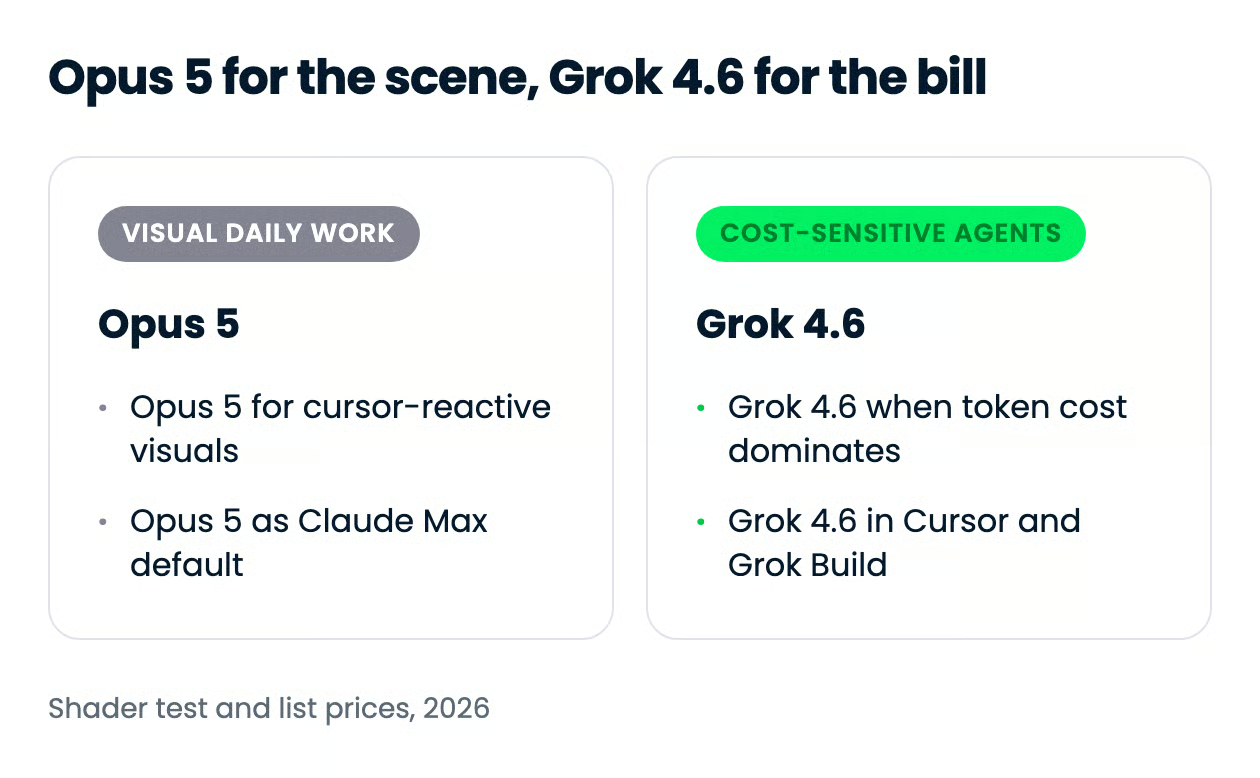
If the scoreboard decides it, Opus 5. If the invoice decides it, Grok 4.6 is the frontier model I would actually leave on.
Choose Grok 4.6 if...
Both models can be reached in various ways. The model strings to use are grok-4.6 and claude-opus-5.
| Surface | Grok 4.6 | Claude Opus 5 |
|---|---|---|
| Consumer app | Grok Build; Cursor (desktop, web, iOS, CLI) | Claude Pro; default on Claude Max |
| First-party API | Yes (SpaceXAI API) | Yes (Claude API) |
| Cloud platforms | Amazon Bedrock, Google Vertex AI, Azure AI Foundry | Amazon Bedrock, Google Vertex AI, Azure AI Foundry |
| Coding agents | Cursor, Grok Build | Claude Code, Cursor |
| Third-party routers | OpenRouter, Vercel, Cloudflare | OpenRouter, Vercel, Cloudflare |
| API model ID | grok-4.6 |
claude-opus-5 |
In Cursor, both are picker entries. Claude Code is Anthropic-native; Grok Build reads a .claude/ tree, which Claude Code will not reciprocate for .grok/ files. The API is a one-string swap only inside each vendor SDK.
from anthropic import Anthropic

client = Anthropic()
response = client.messages.create(
    model="claude-opus-5",  # Grok 4.6 is grok-4.6 on the SpaceXAI SDK, not this client
    max_tokens=1024,
    messages=[{"role": "user", "content": "Refactor this function to reject leaked labels."}],
)
print(response.content[0].text)
Full setup for each API lives in our Grok 4.6 API tutorial and our Claude Opus 5 API tutorial. If you want the agent product rather than the model ID, start with Claude Code 101.
If the work is a described visual scene or a knowledge-work agent that you will judge on Elo, use Claude Opus 5. If the work is a frontier coding agent that you will also judge on the invoice, use Grok 4.6.
What stands out is how little the benchmarks decide. Two points on the AA Index, or a hundred Elo on GDPval-AA, is a narrower gap than the one on the rate card: $105 versus $26 for the same generation-heavy month. The models are close; the invoices are not.
If you want the concepts behind these agents, I recommend the AI Fundamentals skill track. For the Claude-native workflow, Claude Code 101 is the practical start.
Learn AI With DataCamp!
Course
Course
Track
blog
Khalid Abdelaty
13 min
blog
Tom Farnschläder
11 min
blog
Tom Farnschläder
11 min
blog
Khalid Abdelaty
11 min
blog
Tom Farnschläder
11 min
blog
Khalid Abdelaty
13 min