Track
The use of dbt has grown, and certifications from dbt have emerged as a potentially valuable credential in analytics engineering. As organizations adopt dbt to manage transformations, testing, and documentation, certified professionals gain recognition for their expertise.
In this guide, I’ll explore the certifications dbt has to offer, as well as some areas to look out for. I’ll cover the areas to prepare for, their requirements, training paths, practical skills, exam strategies, and real-world preparation techniques.
If you’re just starting with your dbt certification journey, I recommend the dbt Fundamentals skill track, which will lay the foundations you need to get certified.
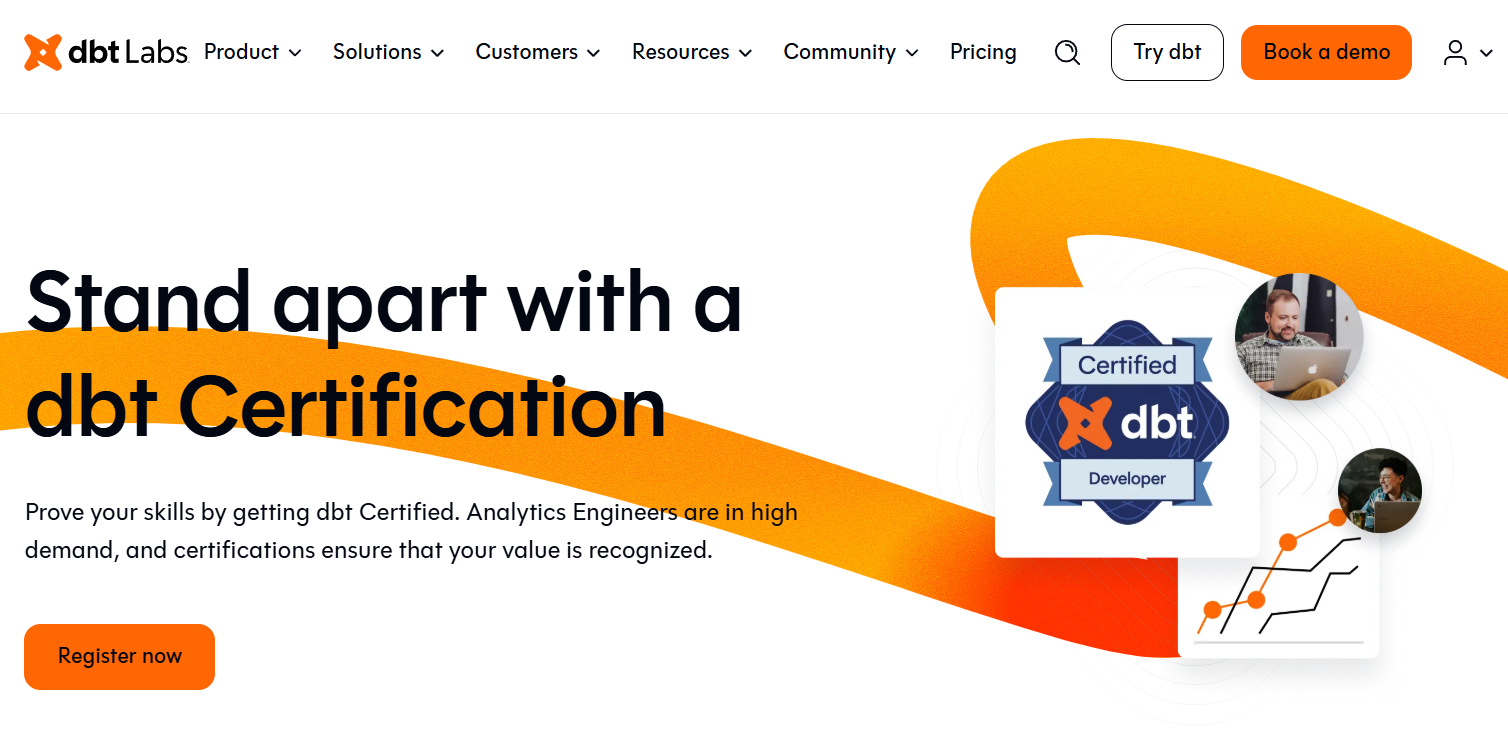
What Are dbt Certifications?

Source: dbt
dbt certifications are professional credentials designed to validate skills in using dbt for analytics engineering. It confirms your ability to design, test, and maintain modular SQL transformations within a production workflow.
Attaining a certification from dbt can help you prove your expertise, stand out in competitive markets, and align with modern data stack practices.
Why Get dbt Certified?
In any technical skill, certification brings credibility and professional recognition.
More than just saying you have experience in working with dbt, why not put them to the test by attaining certification that can contribute to your resume?
Here are some reasons why you should get certified:
- Reputation and credibility: Validates your technical skills, making you more trusted by employers and clients.
- Career opportunities: Certified professionals enjoy better marketability and higher demand in data roles.
- Trust and confidence: Holding a recognized certification helps employers and clients feel secure about your abilities.
Types of dbt Training and Certification
There are multiple paths for learning and preparing for certification:
- On-demand courses: Self-paced training through DataCamp’s Introduction to dbt course, dbt Fundamentals skill track, or the Intermediate dbt course.
- Live workshops: Interactive sessions led by instructors.
- Bootcamps: Intensive programs offering end-to-end training.
Two main certification paths are emphasized on the dbt website:
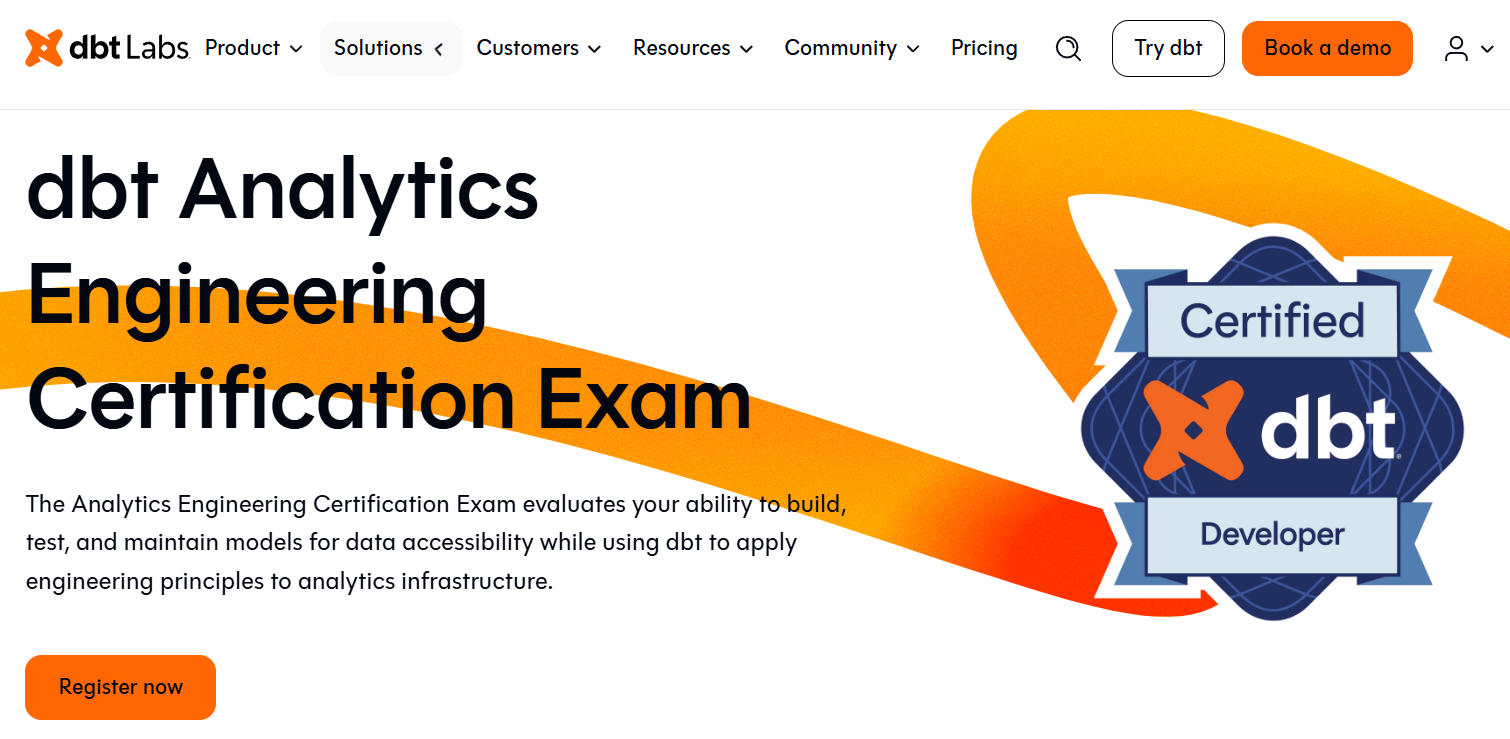
1. dbt Analytics Engineering Certification (by dbt Labs)

Source: dbt
The dbt Analytics Engineering Certification is dbt Labs’ official credential that validates a professional’s skills in using dbt for analytics engineering.
It’s designed to prove that you can apply dbt best practices in real-world data transformation projects, ensuring data is accurate, well-modeled, and documented for downstream analytics.
The content is focused on core dbt workflows, SQL modeling, testing, and documentation.
The certification is aimed at:
- Analytics Engineers who use dbt daily in production.
- Data Analysts who want to level up by learning engineering practices.
- Data Engineers looking to validate their skills in analytics-focused transformations.
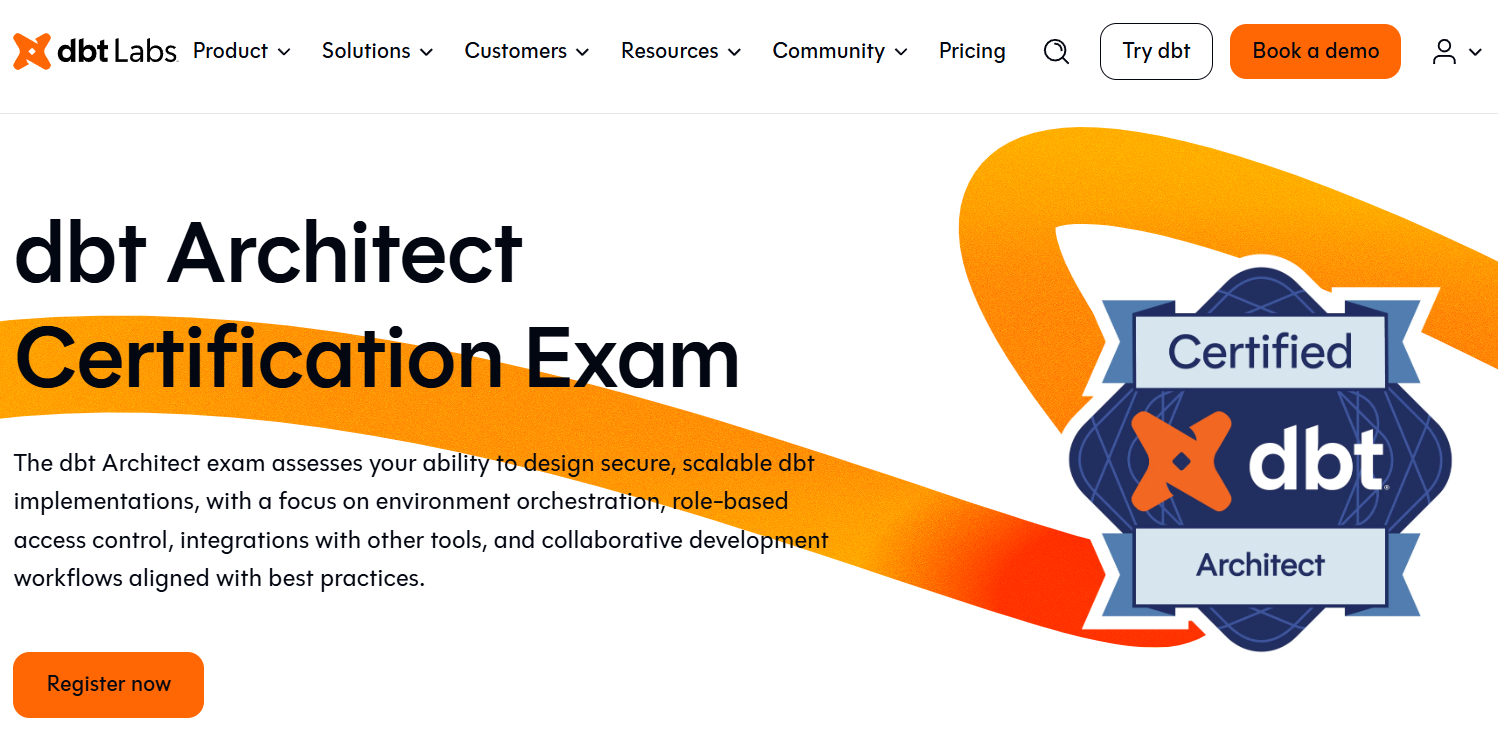
2. dbt Architect Certification (by dbt Labs)

The dbt Architect Certification proves that you are able to set up, manage, and optimize dbt for enterprise-grade analytics engineering teams. It’s less about writing SQL models and more about infrastructure, administration, and governance.
It’s much more focused on scaling, orchestrating, and managing dbt Cloud in enterprise environments.
Additionally, you can also look at some specialized and skills-focused courses, such as macros, testing strategies, or platform-specific training (e.g., Snowflake, BigQuery) to support preparation.
This will make your learning experience more well-rounded.
dbt Certification Requirements
To get started on the certification, you’ll first need to look at some requirements.
This varies across the two main certifications:
1. dbt Analytics Engineering Certification (by dbt Labs):
For the Analytics Engineering Certification, you’ll be required to have basic SQL proficiency plus at least 6 months of experience working with dbt (Core or Cloud).
2. dbt Architect Certification (by dbt Labs)
According to the study guide by dbt Labs, they recommend some level of SQL proficiency and at least six months of experience administrating an Enterprise dbt account.
Although not 100% needed to sign up for the certification exam, having this dbt administration experience can make the studying smoother.
Required Coursework and Skills Training
Preparing for a dbt certification is crucial to pass the related exam. The required coursework spans a mix of theoretical foundations and hands-on exercises that mirror real-world workflows.
Certification covers a broad set of technical skills:
- Core dbt Topics: Data modeling, tests, and documentation.
- Practical skills: Using
ref(), incremental models, macros, and Jinja templating. - Platform-specific workflows: dbt Cloud features such as scheduling and documentation hosting.
- Supplementary skills: Proficiency in SQL, Git/version control, and data warehouse fundamentals.
Here are the specific topics needed for each certification:
dbt Analytics Engineering Certification Exam topics:
- Developing dbt models
- Understanding dbt models governance
- Debugging data modeling errors
- Managing data pipelines
- Implementing dbt tests
- Creating and Maintaining dbt documentation
- Implementing and maintaining external dependencies
- Leveraging the dbt state
dbt Architect Certification Exam topics:
- Configuring dbt data warehouse connections
- Configuring dbt git connections
- Creating and maintaining dbt environments
- Creating and maintaining job definitions
- Configuring dbt security and licenses
- Setting up monitoring and alerting for jobs
- Setting up a dbt mesh and leveraging cross-project references
- Configuring and using dbt Catalog (formerly dbt Explorer)
Preparing for dbt Certification
Preparation requires balancing theory with practice. I’d recommend several approaches to getting ready for the certification exam.
- Structured study plans: Break down topics week by week.
- Official resources: dbt Learn courses, official documentation, and dbt Cloud sandbox.
- Third-party resources: DataCamp courses, study guides, practice questions, and YouTube tutorials.
- Community learning: Join dbt Slack, engage in study groups, and learn from peers.
If you’re new to dbt, consider the DataCamp Introduction to dbt course and dbt Fundamentals skill track to make sure you have all the foundations right, such as creating data models and managing them in data pipelines.
Hands-On Preparation Techniques
To better understand the concepts required to pass the exam, you’ll need some actual hands-on experience.
One prep strategy you should adopt is to apply and combine conceptual understanding (e.g., knowing what materializations are and when to use them) with hands-on experience (e.g., building incremental models in your own warehouse).
Practical experience is critical, and here are some areas to look out for:
- Build practice projects: Configure sources, create staging and fact models, and implement incremental logic.
- Work with CLI and cloud: Familiarize yourself with command-line tools and dbt Cloud workflows.
- Documentation mastery: Write schema.yml files, doc blocks, and run data tests.
- Terminology familiarity: Review key concepts like “lineage,” “materializations,” and “snapshots.”
For example, in the Analytics Engineering Certification, you may get asked about problems related to incremental models.
In that case, you’ll need to learn how to work on them and produce code like this:
Example: Incremental model code
{{ config(materialized='incremental', unique_key='id') }}
SELECT id, event_type, created_at
FROM {{ ref('stg_events') }}
{% if is_incremental() %}
WHERE created_at > (SELECT MAX(created_at) FROM {{ this }})
{% endif %}
Try to master concepts, such as incremental logic, through practical use in SQL before attempting to take the exam.
dbt Certification Examination Structure and Strategy
Next up, let’s go over some key information regarding the exam you’ll take.
1. dbt Analytics Engineering Certification Exam
Here are some key details about the exam:
- Duration: 2 hours
- Format & Registration: online proctored
- Length: 65 questions
- Supported Version: dbt core 1.7
- Passing Score: 65% or higher. You will know your score immediately after completion of the exam.
- Price: $200
- Language: English
- Certification Expiration: The certification lasts for 2 years.
- Supported Browsers:Caveon Web browsers: Google Chrome (recommended), Microsoft Edge, Mozilla Firefox, and Safari (Mac).
2. dbt Architect Certification Exam
Here are some key details about the exam:
- Duration: 2 hours
- Format & Registration: online proctored
- Exam Length: 65 questions
- Passing Score: 65% or higher. You will know your score immediately after completion of the exam.
- Price: $200
- Language Medium: English
- Certification Validity: The certification lasts for 2 years.
- Supported Browsers: Caveon Web browsers: Google Chrome (recommended), Microsoft Edge, Mozilla Firefox, and Safari (Mac).
The exam follows a point basis for scoring. Each correct answer gives 1 point, and incorrect answers give 0 points. Each question has the same weightage.
Do take note that some number of unscored questions will be included in the exam, which will not be disclosed to you. These questions wouldn’t count towards your score, so please be aware of that.
Here are the types of questions you will be asked:
- Multiple-choice
- Fill-in-the-blank
- Matching
- Hotspot
- Build list
- Discrete Option Multiple Choice (DOMC)
For example, here’s how the build list question will look:
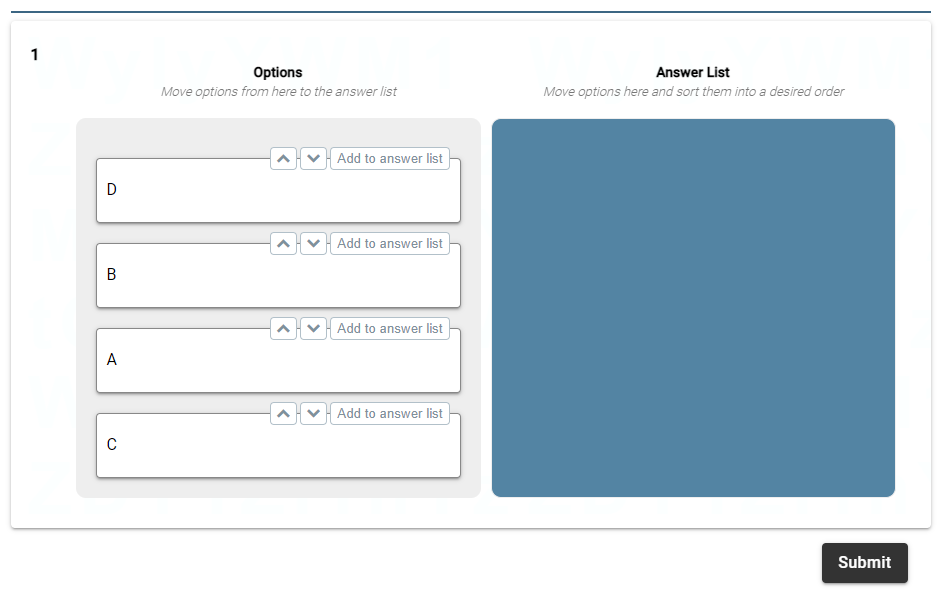
Source: Caveon
A retake of the exam can be done if you failed to pass the exam, at a registration fee for each re-attempt.
dbt Exam Strategy
Just like any other exam out there, there are always some approaches to take when attempting.
Here are some tips that might help you:
- Read each question carefully.
- Manage time: ~1–2 minutes per question.
- Flag and revisit tough questions.
dbt Certification Costs
The certification comes with an exam, so registering for the exam comes with a registration fee.
Additionally, for learning resources, expect to pay a little more for prep.
Here are some possible costs.:
- Application/exam fee: Usually $200.
- Additional costs: Optional prep courses ($25/month DataCamp subscription), bootcamps, or textbooks.
- Total investment: Typically $200 - $300, depending on preparation method.
Renewal and Maintaining dbt Certification
To maintain the certification, you’ll need to renew it every 2 years. To make sure that you’re up to par with the latest changes and requirements every 2 years, try to stay active with dbt releases.
Career Impact and Market Demand for dbt Certifications
As organizations continue to modernize their data stacks, the demand for certified dbt practitioners has grown significantly.
It can be a good way to position yourself as a highly sought-after professional in a rapidly growing field.
Here are some potential benefits to attempting the dbt certifications:
- Professional growth: Certified professionals often advance into analytics engineering or lead roles.
- Salary premiums: Employers value certification as a marker of skill, often tied to higher pay.
- Consulting prospects: Independent consultants and freelancers benefit from market credibility.
- Organizational benefits: Certified staff strengthen workflows and enhance a company's reputation.
If you’re a data analyst, a dbt certification can signal that you have mastered both the technical skills and best practices of analytics engineering.
This can accelerate career progression by opening doors to more senior roles, such as:
- Analytics Engineer
- Data Engineer
- BI Developer
- Analytics Consultant
Common Challenges and Success Strategies
Preparing for and taking a dbt certification exam can feel daunting, especially if it’s your first technical certification.
If you’re starting with no knowledge, you might come across many confusing technical terms or even lack practical experience.
Anticipating these challenges and applying structured strategies can make the journey smoother and more successful.
Here are some aspects to look out for:
- Technical terminology: dbt comes with its own vocabulary, like models, sources, seeds, and exposures, that can overwhelm new learners. Misunderstanding these terms can lead to errors in both practice and exams.
- Configuration & syntax errors: A misplaced colon in YAML, incorrect indentation, or misapplied Jinja expression are among the most common stumbling blocks during practice. These minor mistakes can snowball into failed builds.
- Over-reliance on theory: Reading the documentation without applying it to real projects can create a gap between conceptual knowledge and practical skills.
- Time pressure in exams: Candidates sometimes underestimate how long scenario-based or hands-on questions can take, leading to rushed and incomplete answers.
Studying strategies you can use include:
- Glossary flashcards: Build a personal glossary or use flashcards to internalize dbt terminology. Reviewing these daily helps anchor key concepts.
- Practice in real environments: Set up a dbt project in your own warehouse (Snowflake, BigQuery, Redshift, or even Postgres locally). Experiment with models, tests, and materializations until the workflow feels natural.
- Debugging as learning: Treat every configuration or syntax error as a learning opportunity. Keep a “troubleshooting journal” to track common mistakes and their fixes—this builds both memory and confidence.
- Mock exams and timed practice: Simulate exam conditions by setting a timer and working through practice questions or exercises. This builds familiarity with pacing and reduces stress on the actual test day.
When a Role-Based Certification May Be a Better Fit
dbt certifications are certainly valuable for validating tool-specific expertise. However, they often focus primarily on analytics engineering workflows within the dbt ecosystem. If you’re looking to demonstrate broader, end-to-end data engineering capability, beyond modeling and transformation, a role-based certification such as DataCamp’s Data Engineer Certification may offer a more practical alternative.
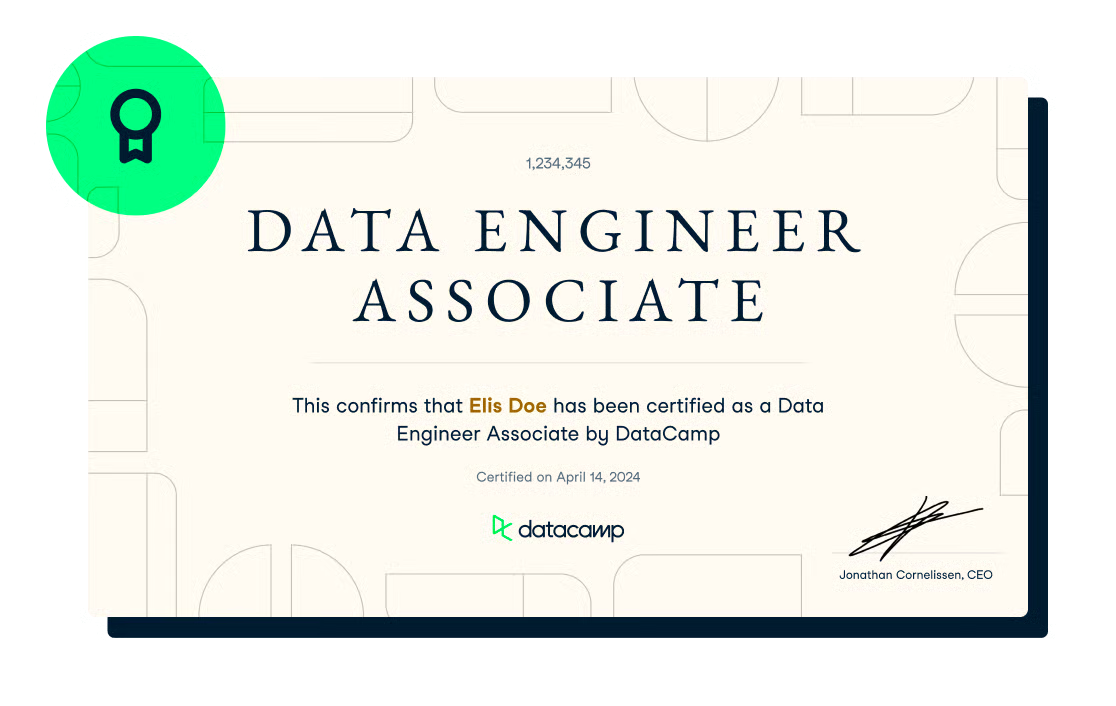
Where dbt exams test depth in modeling, governance, and dbt Cloud administration, a role-based certification assesses the wider skill set expected in professional data engineering roles: SQL data management, data ingestion, cleaning and validation, and Python-based pipeline development.
This extra context can be beneficial if your goal is to show that you can apply analytics engineering concepts within a full data pipeline rather than in a single tool.
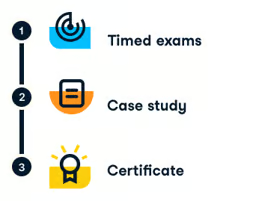
Additionally, the structure of a role-based certification, combining timed theory exams with a graded practical assessment, helps demonstrate applied competence in tasks aligned with real project work.
If you’re aiming to build or transition into data engineering roles, this broader scope may provide a more comprehensive signal of job-readiness for you. DataCamp certifications are available for free as part of a DataCamp Premium subscription, which starts at $25/month.
Get certified in your dream Data Engineer role
Our certification programs help you stand out and prove your skills are job-ready to potential employers.
Conclusion
dbt certifications are a powerful way to validate your expertise in analytics engineering and modern data workflows. However, you’ll need to be well prepared before attempting the exams. A good mix of practical experience and some prep courses will ensure you’re exam-ready.
Thinking about getting dbt certified? The Introduction to dbt course is a good place to start. For more seasoned users of dbt, the Intermediate dbt course might be more helpful in exam preparation for the certifications.
dbt Certification FAQs
What are the main differences between the dbt Analytics Engineering and Cloud Architect certifications?
The Analytics Engineering certification focuses on building and maintaining dbt projects like modeling, testing, documentation, and SQL skills. The Cloud Architect certification is more advanced and covers administering dbt Cloud at scale, including job orchestration, security, role management, and integrating dbt into enterprise data platforms.
How can I effectively use the dbt Learn courses to prepare for the certification exam?
To get the most out of them, follow along hands-on instead of just watching, rebuild exercises in your own project, and try variations (e.g., different materializations) and review each module with the exam domains in mind, so you can map what you learned to possible test questions.
What are some common mistakes to avoid when studying for the dbt certification?
A common mistake is focusing only on reading documentation without practicing in a real project. Another one is ignoring Git, SQL and YAML basics, which are frequently tested. Finally, cramming at the last minute often leads to stress, so steady practice and review are far more effective.
How does the dbt certification process compare to other data engineering certifications?
Unlike broader data engineering certifications that cover a wide set of tools and infrastructure, dbt certification is specialized and focused on analytics engineering workflows. It’s shorter, more hands-on, and SQL-heavy, making it approachable for analysts as well as engineers.
What are the best practices for managing data pipelines in dbt?
Break models into layers (staging, intermediate, marts) for clarity and reusability. Always include tests to catch data quality issues early. Use documentation to make pipelines transparent, and version control with Git to collaborate effectively. Finally, schedule runs in dbt Cloud to automate and monitor workflows.

I'm Austin, a blogger and tech writer with years of experience both as a data scientist and a data analyst in healthcare. Starting my tech journey with a background in biology, I now help others make the same transition through my tech blog. My passion for technology has led me to my writing contributions to dozens of SaaS companies, inspiring others and sharing my experiences.