
Track
AI Engineering with LangChain
21 hr
In practice, teams tend to land on one of these approaches depending on what they're trying to measure:
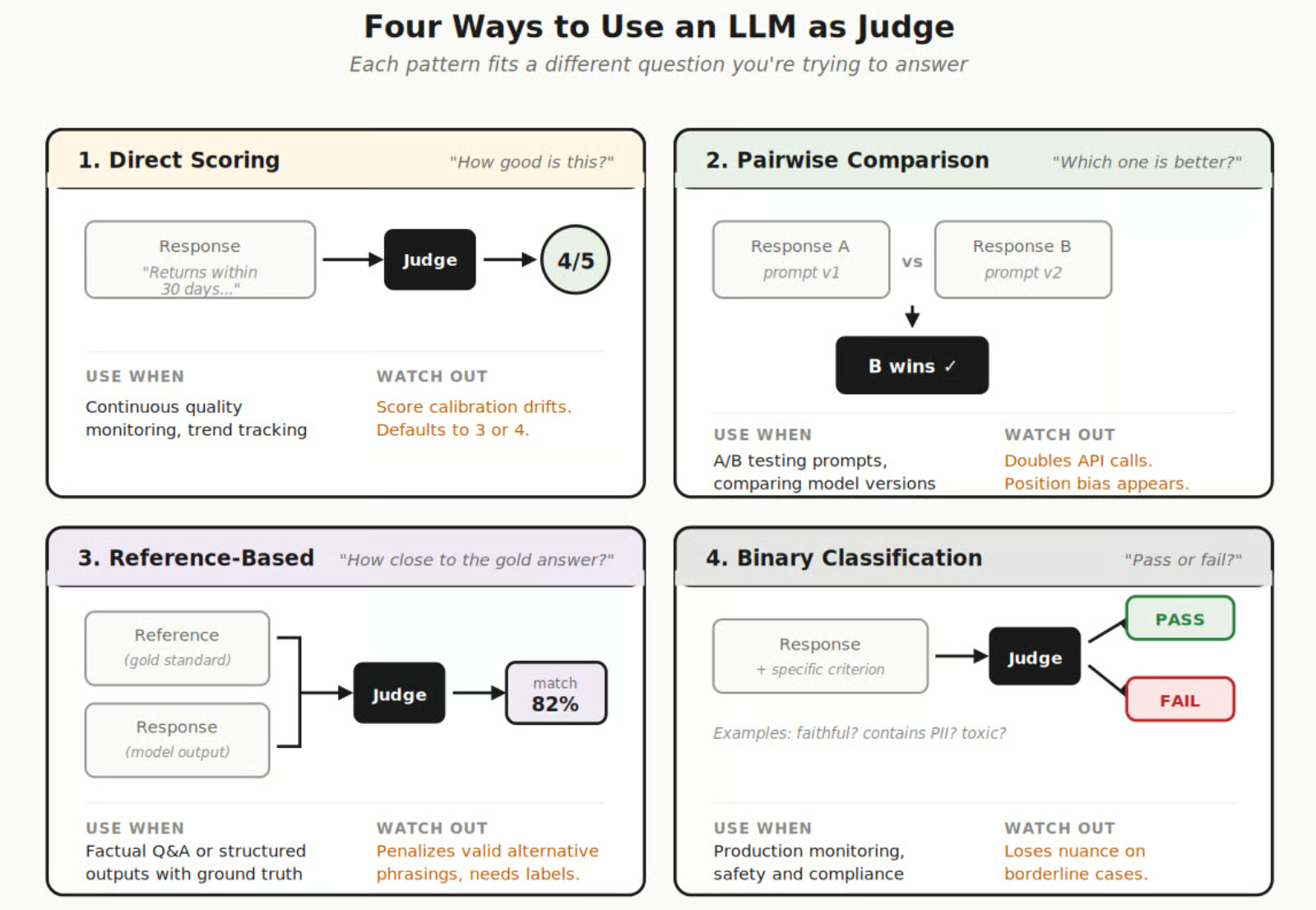
Image by Author. Four different approaches of LLM as a judge.
For a direct overview of strengths, use cases, and restraints, I have compared all four approaches in the following table:
|
Approach |
When to Use |
Strengths |
Watch Out For |
|
Direct scoring |
General quality monitoring, continuous tracking |
Easy to trend over time, works with single outputs |
Judges drift in how they calibrate scores |
|
Pairwise comparison |
A/B testing models, prompt variant comparison |
More reliable rankings than absolute scores |
Doubles your API calls, doesn't give an absolute quality signal |
|
Reference-based |
Factual Q&A, structured outputs |
Clear ground truth makes evaluation straightforward |
Requires labeled data, penalizes valid alternative phrasings |
|
Binary classification |
Safety checks, hallucination detection, compliance |
Low ambiguity, easy to automate alerts |
Loses nuance on borderline cases |
For a broader look at evaluation approaches beyond the judge pattern, LLM Benchmarks Explained covers the full picture.
Under the hood, it's a simple API call as you just need to package up the content you want evaluated (the model's output, the original user query, and any retrieved context that was used during generation) and wrap it in a prompt that tells the judge model what you care about and how you want the results formatted.
The judge processes this and returns a structured response, usually a score along with written reasoning that explains why it assigned that score. The quality of your evaluation depends almost entirely on how well you write the rubric. I cannot overstate this.
A simple prompt that says "rate this response from 1 to 5" will give you scores that are all over the place, because the judge has no shared understanding of what a 3 means versus a 4. This is why you need to spell out, concretely, what each score level looks like and include examples if you can.
Now for the hands-on part, we're going to build a complete evaluation pipeline from scratch: a retrieval augmented generation (RAG) system that answers questions from a small knowledge base, a set of test queries designed to trigger different failure modes, and an LLM judge that scores the outputs on faithfulness and answer relevance.
You'll need Python 3.9+ and an OpenAI API key, which you can get in the OpenAI console. Install the dependencies:
pip install openai chromadb langchain langchain-openai langchain-community deepevalSet your API key:
import os
os.environ["OPENAI_API_KEY"] = "your-key-here"
We're using OpenAI for both the RAG generator and the LLM judge, though they'll be different models (GPT-4o-mini for generation, GPT-4o for judging). For embeddings, text-embedding-3-small does the job for a tutorial scope. In a production system, you'd want to benchmark a few embedding models on your specific domain data before committing to one.
If you want to build up more background on RAG before jumping into the evaluation code, our Retrieval Augmented Generation (RAG) with LangChain course walks through the fundamentals.
We need a small knowledge base for the RAG system to retrieve from. I'm going to use a set of text chunks about a fictional company's return policy. The content itself isn't the focus here, but having a contained set of documents makes it easier to see exactly when the model goes beyond the provided context (which is the failure mode we want the judge to catch).
from langchain_openai import OpenAIEmbeddings
from langchain_chroma import Chroma
from langchain.schema import Document

# Sample knowledge base
documents = [
    Document(
        page_content="All customers are eligible for a full refund within 30 days of purchase. "
        "The item must be in its original packaging and unused condition. Refunds are "
        "processed to the original payment method within 5-7 business days.",
        metadata={"source": "return_policy.pdf", "section": "refund_eligibility"}
    ),
    Document(
        page_content="Exchanges can be requested within 45 days of purchase for items of "
        "equal or lesser value. Size exchanges on clothing are free of charge. "
        "For items of greater value, the customer pays the difference.",
        metadata={"source": "return_policy.pdf", "section": "exchanges"}
    ),
    Document(
        page_content="Electronics have a 15-day return window due to rapid depreciation. "
        "Opened software and digital downloads are non-refundable. Defective electronics "
        "can be returned within 90 days with proof of defect from an authorized service center.",
        metadata={"source": "return_policy.pdf", "section": "electronics"}
    ),
    Document(
        page_content="Shipping costs for returns are covered by the company for defective items. "
        "For non-defective returns, the customer is responsible for return shipping. "
        "Free return shipping labels are available for loyalty program members regardless of reason.",
        metadata={"source": "return_policy.pdf", "section": "shipping"}
    ),
    Document(
        page_content="Gift purchases can be returned with the gift receipt for store credit only. "
        "Without a gift receipt, returns are processed at the lowest sale price in the last 90 days. "
        "Gift cards and prepaid cards are non-refundable and cannot be exchanged.",
        metadata={"source": "return_policy.pdf", "section": "gifts"}
    ),
]

# Create vector store
embeddings = OpenAIEmbeddings(model="text-embedding-3-small")
vectorstore = Chroma.from_documents(documents, embeddings, persist_directory="./chroma_db")

print(f"Indexed {len(documents)} documents")
Five documents about return policies, even though that's not a lot, but it's enough to demonstrate the retrieval problems we care about: incomplete context, irrelevant chunks getting pulled in, and the hallucination opportunities that come up when the model feels pressure to give a complete answer even though the context doesn't fully support one.
The RAG pipeline retrieves relevant chunks and generates an answer. Nothing fancy here, just the standard retrieve-then-generate pattern.
from openai import OpenAI

client = OpenAI()

def rag_query(question: str, top_k: int = 2) -> dict:
    """Run a RAG query: retrieve context, generate answer."""

    # Retrieve
    results = vectorstore.similarity_search(question, k=top_k)
    context = "\n\n".join([doc.page_content for doc in results])

    # Generate
    system_prompt = """You are a helpful customer support assistant. Answer the
    customer's question based ONLY on the provided context. If the context doesn't
    contain enough information to answer fully, say so."""

    user_prompt = f"""
      Context: {context}

      Question: {question}

      Answer:
    """

    response = client.chat.completions.create(
        model="gpt-4o-mini",
        messages=[
            {"role": "system", "content": system_prompt},
            {"role": "user", "content": user_prompt}
        ],
        temperature=0.3
    )

    answer = response.choices[0].message.content

    return {
        "question": question,
        "context": context,
        "answer": answer,
        "sources": [doc.metadata for doc in results]
    }
I went with GPT-4o-mini as the generator because it's cheap and fast, and we want the evaluation itself to be the focus. The temperature sits at 0.3, which reduces randomness but doesn't eliminate it.
And the system prompt explicitly instructs the model to only use the provided context, which is standard practice in RAG systems, though models still drift outside the context more often than you'd expect. That's precisely what we want the judge to flag.
Let's test it:
result = rag_query("Can I return opened software?")
print(f"Question: {result['question']}")
print(f"Answer: {result['answer']}")
print(f"Sources: {result['sources']}")You need test cases that exercise different parts of the pipeline. In production, you'd collect these from real user queries. For this tutorial, I'm building a mix that deliberately includes the kinds of questions where RAG systems tend to stumble.
eval_questions = [
    # Straightforward questions (should be easy)
    "What is the refund window for regular purchases?",
    "Are exchanges free for clothing size changes?",

    # Questions requiring synthesis across chunks
    "What are my options if I received a defective laptop 60 days ago?",

    # Edge cases likely to cause hallucination
    "Can I get a refund for a digital download I purchased yesterday?",
    "What happens if I return a gift without the gift receipt?",

    # Questions where context might be incomplete
    "Do you offer refunds for international orders?",
    "Can I return an item I bought on sale?",

    # Adversarial or tricky questions
    "If I'm a loyalty member, do I get free return shipping even for electronics?",
]

# Generate RAG responses for all questions
eval_results = []
for q in eval_questions:
    result = rag_query(q)
    eval_results.append(result)
    print(f"Q: {q}")
    print(f"A: {result['answer'][:150]}...")
    print()
The mix matters. Some of these questions have clean, direct answers in the documents, while some require the model to combine information across multiple retrieved chunks (the defective laptop question needs both the general 30-day refund policy and the 90-day electronics defect window).
And a couple of them, like the international orders question, ask about things the knowledge base simply doesn't cover. Those last ones are where you'll see hallucination most frequently, because the model feels the pull to be helpful and fills in gaps with plausible-sounding information that has no grounding in the actual context.
For more on building and testing RAG systems, our selection of Top 30 RAG Interview Questions and Answers is a useful reference.
This is where things get interesting. We're building two separate judges:
def judge_faithfulness(question: str, context: str, answer: str) -> dict:
    """Judge whether the answer is faithful to the retrieved context."""

    eval_prompt = f"""
      You are an impartial judge evaluating whether an AI assistant's
      answer is faithful to the provided context.

      Faithfulness means every claim in the answer can be traced back to
      information in the context. The answer should not contain information
      that isn't supported by or inferable from the context.

      Score on a scale of 1 to 5:
      1 - The answer contains multiple claims not supported by the context
      2 - The answer contains at least one significant unsupported claim
      3 - The answer is mostly faithful but includes minor unsupported details
      4 - The answer is faithful with only trivial extrapolations
      5 - Every claim in the answer is directly supported by the context

      Context: {context}

      Question: {question}

      Answer to evaluate: {answer}

      Respond in this exact JSON format: {{"score": <int 1-5>, "reason": "<one paragraph explanation>"}}
    """

    response = client.chat.completions.create(
        model="gpt-4o",
        messages=[{"role": "user", "content": eval_prompt}],
        temperature=0.0,
        response_format={"type": "json_object"}
    )

    import json
    return json.loads(response.choices[0].message.content)


def judge_relevance(question: str, answer: str) -> dict:
    """Judge whether the answer is relevant to the question."""

    eval_prompt = f"""
      You are an impartial judge evaluating whether an AI assistant's answer
      is relevant to the user's question.

      Relevance means the answer directly addresses what the user asked.
      A relevant answer may acknowledge limitations in available information,
      but it should not go off-topic or provide unrelated information.

      Score on a scale of 1 to 5:
      1 - The answer does not address the question at all
      2 - The answer partially addresses the question but misses the main point
      3 - The answer addresses the question but includes significant irrelevant content
      4 - The answer addresses the question well with minor tangents
      5 - The answer directly and completely addresses the question

      Question: {question}

      Answer to evaluate: {answer}

      Respond in this exact JSON format: {{"score": <int 1-5>, "reason": "<one paragraph explanation>"}}
    """

    response = client.chat.completions.create(
        model="gpt-4o",
        messages=[{"role": "user", "content": eval_prompt}],
        temperature=0.0,
        response_format={"type": "json_object"}
    )

    import json
    return json.loads(response.choices[0].message.content)
A few design choices to call out here. The temperature is at 0.0 for maximum consistency across runs. We're using response_format={"type": "json_object"} so the output is always parseable.
The rubric describes each score level concretely rather than using vague labels like "good" or "poor." Without that level of specificity, I've found that judges default to giving everything a 3 or 4, which tells you nothing useful.
Notice that GPT-4o is doing the judging even though GPT-4o-mini is doing the generation. Having the judge be more capable than the generator is a common pattern because the judge needs strong instruction-following to apply the rubric consistently.
If you use the same model for both roles, you also introduce a documented self-preference bias where the model rates its own outputs more favorably.
Time to run everything and collect the results.
import json

evaluation_report = []

for result in eval_results:
    # Run both judges
    faithfulness = judge_faithfulness(
        result["question"], result["context"], result["answer"]
    )
    relevance = judge_relevance(
        result["question"], result["answer"]
    )

    evaluation_report.append({
        "question": result["question"],
        "answer": result["answer"][:200],
        "faithfulness_score": faithfulness["score"],
        "faithfulness_reason": faithfulness["reason"],
        "relevance_score": relevance["score"],
        "relevance_reason": relevance["reason"],
    })

    print(f"Q: {result['question']}")
    print(f"  Faithfulness: {faithfulness['score']}/5 | Relevance: {relevance['score']}/5")
    print(f"  Faith reason: {faithfulness['reason'][:100]}...")
    print()

# Summary statistics
faith_scores = [r["faithfulness_score"] for r in evaluation_report]
rel_scores = [r["relevance_score"] for r in evaluation_report]
print(f"Average faithfulness: {sum(faith_scores)/len(faith_scores):.2f}")
print(f"Average relevance: {sum(rel_scores)/len(rel_scores):.2f}")
print(f"Questions with faithfulness < 3: {sum(1 for s in faith_scores if s < 3)}")
Each question triggers two API calls to GPT-4o, one per judge. For our eight test questions, that's sixteen evaluation calls total, which is manageable. In production with thousands of daily queries, you'd want to batch these, run them asynchronously, and probably only evaluate a sample rather than every single response.
The numeric scores give you an overview, but it's the reasoning that tells you what to actually fix.
# Find problematic responses
print("=== LOW FAITHFULNESS (score < 4) ===")
for r in evaluation_report:
    if r["faithfulness_score"] < 4:
        print(f"\nQ: {r['question']}")
        print(f"Score: {r['faithfulness_score']}")
        print(f"Reason: {r['faithfulness_reason']}")
        print(f"Answer preview: {r['answer'][:150]}...")

print("\n=== LOW RELEVANCE (score < 4) ===")
for r in evaluation_report:
    if r["relevance_score"] < 4:
        print(f"\nQ: {r['question']}")
        print(f"Score: {r['relevance_score']}")
        print(f"Reason: {r['relevance_reason']}")
The international orders question and the sale items question will almost certainly score low on faithfulness, because the knowledge base doesn't address those topics, and the model is likely to have improvised an answer.
The defective laptop question is interesting too because it requires synthesizing information from the general refund policy (30 days) with the electronics defect clause (90 days for defective items with proof), and depending on which chunks get retrieved, the model may or may not have the complete picture.
What you do with the results depends on what you discover. Low faithfulness on certain question categories usually points to one of two things: either the retriever is pulling in the wrong chunks (a retrieval problem), or the generator is going beyond the context it was given (a generation problem).
Looking at the retrieved context alongside the answer tells you which one you're dealing with. Low relevance scores, on the other hand, usually mean the system prompt needs tuning, or the retrieved context is so far off-topic that the model has nothing useful to work with.
For the operational side of running evaluations as part of your deployment pipeline, the LLMOps Concepts course covers the infrastructure and workflow patterns.
Writing custom judge functions works, but for production use, you probably want a framework that handles the boilerplate. DeepEval is one of the more mature options, and it comes with well-tested metric implementations that cover the most common evaluation criteria.
from deepeval import evaluate
from deepeval.test_case import LLMTestCase
from deepeval.metrics import FaithfulnessMetric, AnswerRelevancyMetric

# Configure metrics
faithfulness_metric = FaithfulnessMetric(
    threshold=0.7,
    model="gpt-4o",
    include_reason=True
)

relevance_metric = AnswerRelevancyMetric(
    threshold=0.7,
    model="gpt-4o",
    include_reason=True
)

# Create test cases from our RAG results
test_cases = []
for result in eval_results:
    test_case = LLMTestCase(
        input=result["question"],
        actual_output=result["answer"],
        retrieval_context=[result["context"]]
    )
    test_cases.append(test_case)

# Run evaluation
evaluate(
    test_cases=test_cases,
    metrics=[faithfulness_metric, relevance_metric]
)
What you get from DeepEval that's tedious to build on your own:
Each metric also generates a self-explanation, which means every score comes with a written breakdown of the judge's reasoning that you can inspect when something looks off.
For a deeper look at DeepEval's full capabilities, see Evaluate LLMs Effectively Using DeepEval.
Getting an LLM judge to return numbers is straightforward. Getting those numbers to actually mean something useful for your team requires more care than most people expect going in.
Besides DeepEval, there are several frameworks to choose from at this point, and the landscape keeps growing. Here's a practical comparison based on where each one fits best:
|
Framework |
Best For |
LLM Judge Support |
RAG-Specific Metrics |
Integration |
|
DeepEval |
Full evaluation suite, CI/CD integration |
Yes, with self-explanatory scores |
Faithfulness, contextual precision/recall, relevancy |
pytest, LangChain |
|
RAGAS |
RAG pipeline evaluation specifically |
Yes |
Faithfulness, answer relevance, context precision, context recall |
LangChain, LlamaIndex |
|
MLflow |
Experiment tracking with evaluation |
Yes (built-in; can also be combined with DeepEval/RAGAS) |
Via third-party integrations |
MLflow ecosystem |
|
Evidently |
Production monitoring and drift detection |
Yes, with continuous tracking |
Via custom evaluators |
Monitoring dashboards |
|
LangSmith |
LangChain-native tracing and evaluation |
Yes |
Via custom evaluators |
LangChain |
For RAG systems, four metrics tend to cover most of what you need in practice.
You want to run these together because different combinations of high and low scores point to different root causes.
Each combination tells you where to look for the fix.
For hands-on practice with evaluation tracking in MLflow, Evaluating LLMs with MLflow walks through the integration.
Production deployment requires more thought than running evaluations in a notebook, and the practical issues that come up at scale tend to fall into five buckets that are worth addressing before you commit to the approach.
For more on operationalizing LLM workflows end-to-end, the Associate AI Engineer for Data Scientists track covers the full deployment picture.
LLM-as-a-judge fills a practical need that neither traditional automated metrics nor human review can cover at scale on their own. Automated metrics miss what actually matters for LLM applications; on the other hand, human evaluation catches what matters but can't keep up with the volume of a production system.
An LLM judge sitting in between gives you a way to continuously monitor output quality with nuance that simple metrics can't provide.
We built a complete pipeline in this tutorial: a RAG system with a small knowledge base, test queries designed to trigger different failure modes, custom evaluation judges for faithfulness and relevance, and a framework-based approach using DeepEval that's closer to what you'd run in production.
If there's one takeaway from all of this, it's that the rubric is everything. This is why you should invest time in writing specific, concrete evaluation criteria with clear examples for each score level. A well-designed rubric with a mediocre model will outperform a vague rubric with the most capable model every time.
If you want to keep building from here:
AI Engineering Courses
Track
Course
Course
blog
Natassha Selvaraj
10 min
blog
Abid Ali Awan
10 min
blog
Bhavishya Pandit
8 min
Tutorial
Abid Ali Awan
12 min
Tutorial
Iván Palomares Carrascosa
11 min
Tutorial
Ryan Ong
12 min