
Course
Claude 101
2 hr
20.4K
I’ve been using Claude consistently for the last few months. I’ve gone from writing simple, vague prompts in the browser to building and hosting complex agents that connect and analyze multiple data sources to make decisions. I’ve built workflows that help me in my job, as well as tools that I use outside of work.
Learning Claude took me time, consistency, and a lot of experimentation. But I believe that anyone can (and should) learn how to use Claude and similar tools. They’re changing how people work, what productivity looks like, and what’s possible for both technical and non-technical people.
In this guide, I’ll walk you through how to learn Claude, from the basics of getting set up and understanding the different modes and models, to building your first projects, right through to some of the more advanced features of Claude.
As we go, I’ll link to some relevant courses and resources that can help you get hands-on with each step. I’ll also provide some examples of how I’ve used Claude, and a suggested roadmap with timelines for getting started.
If you’re keen to jump straight into a course, the best place to start is with our Claude 101 course.
If you’re short on time, here’s the lowdown on how to start learning Claude:
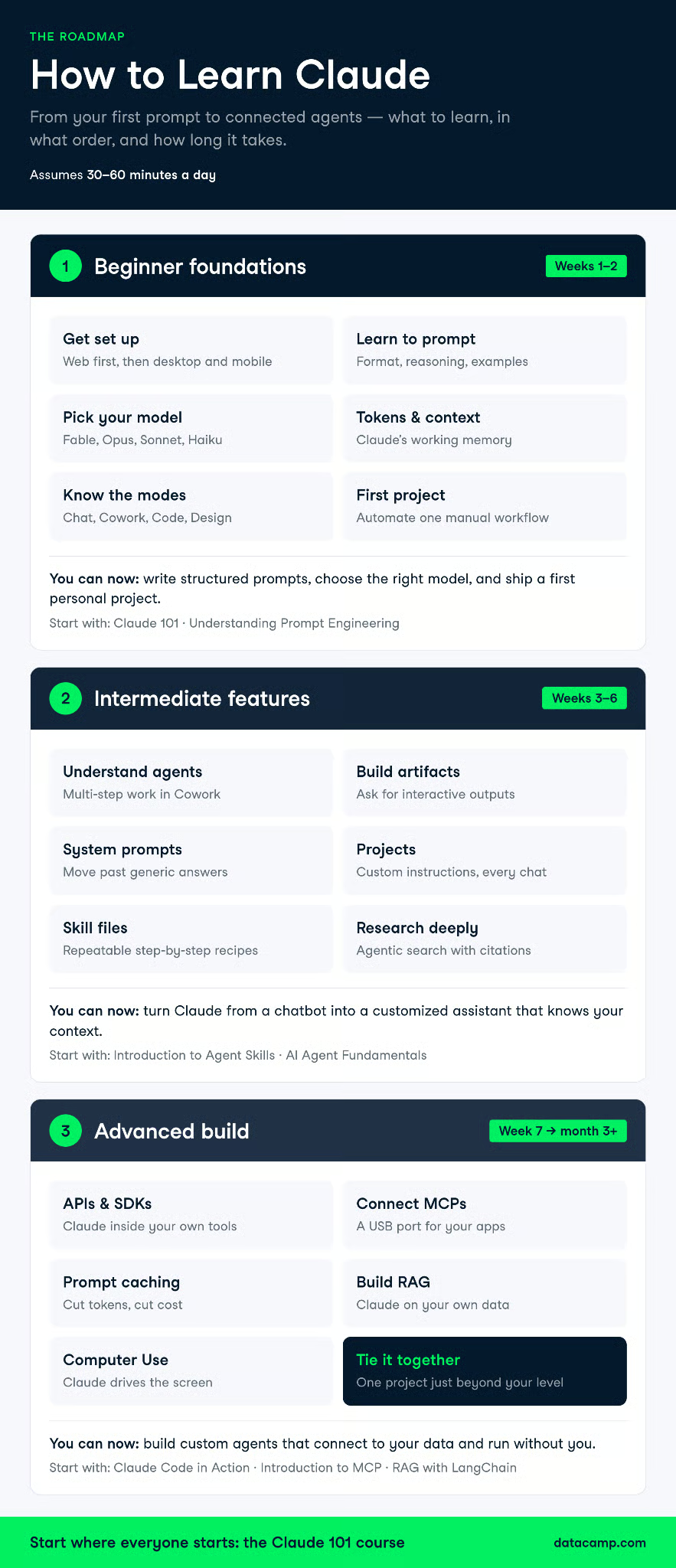
For many people, when they think of Claude, they think of the large language model chatbot, similar to ChatGPT or Gemini. While that is certainly true, it’s far from the full extent of it.
In reality, ‘Claude’ is an ecosystem of different artificial intelligence tools, models, and modes that allow you to query, research, plan, code, and build across a variety of language processing tasks. Claude is an AI assistant that can help you with a variety of tasks.
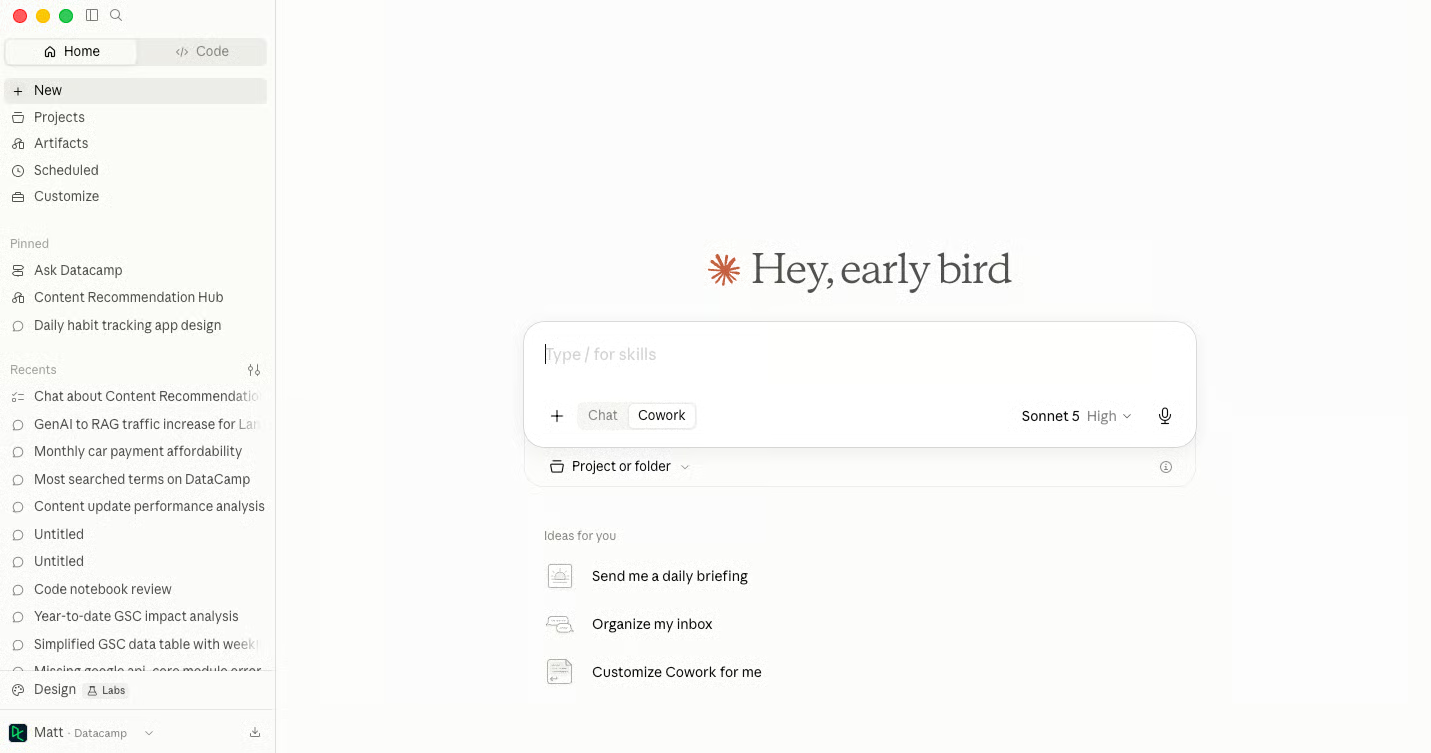
The first step of learning Claude is to get an understanding of what it actually is and what it’s capable of.
There are several ways you can access Claude to start learning. I recommend starting with the web interface as it’s the easiest way to jump straight in.
Head over to claude.ai to create an account.
You’ll notice that there are several plans to choose from. For the beginner section, a free account is absolutely fine.
However, a quick heads up that as we go deeper into the Claude learning plan, certain features and modes will need a paid plan, which starts at $17-$20 per month. I recommend the Pro account of this, but only once you feel like you’re ready to use the features.
You can see the full pricing below:
|
Plan |
Price |
Billing Interval |
Usage Capacity |
Best For |
|
Free |
$0 |
N/A |
Limited |
Occasional use |
|
Pro |
$20/month $200/year |
Monthly or annual |
Standard |
Regular use |
|
Max 5x |
$100 |
Monthly |
5x Pro capacity per session |
Frequent users who work with Claude on a variety of tasks |
|
Max 20x |
$200 |
Monthly |
20x Pro capacity per session |
Daily users who collaborate often with Claude for most tasks |
For now, stick with a free account and login.
If you want to, you can also download Claude for desktop or mobile once you’re more familiar with things.
These days, I do basically all of my Claude work in the desktop app, though occasionally I’ll still log on via my browser.
Perhaps the most important skill to learn when you’re first learning to use Claude is how to prompt it.
Communicating your needs effectively makes the difference between a good result and a great result. The art and skill of doing this is called prompt engineering, and I recommend learning the basics before you start using Claude for anything meaningful.
You can find out more about what prompt engineering actually is in our full guide, and get started with the beginner-friendly course, Understanding Prompt Engineering. Anthropic also provides a prompting best practice guide for Claude, which I also recommend reading.
However, in brief, the art of prompt engineering is less about magic words and more about clear communication. Anthropic's own guide frames it well: treat Claude like a capable new colleague who simply lacks your context.
The more precisely you explain what you want, why you need it, and what a good result looks like, the better Claude performs.
Three habits are worth building early:
A single well-chosen example, showing the structure or tone you're after, does more than a paragraph of abstract instructions.
Here’s a quick example of what I mean:
A vague prompt gets a generic result:
Explain machine learning to me.A well-structured one gets something more useful:
Explain machine learning to a marketing analyst who understands Excel
and basic statistics, but has no coding background.
Focus on the intuition behind how a model "learns" from data, not the
maths. Use a real-world analogy from marketing or customer behavior.
Keep it under 200 words.
The second prompt specifies the audience, the angle, an example domain, and a length constraint. Claude doesn't have to guess at any of them.
Whether you’re in the browser window or the desktop app, one of the options you’ll likely see when you’re using Claude is the model that you’re interacting with.
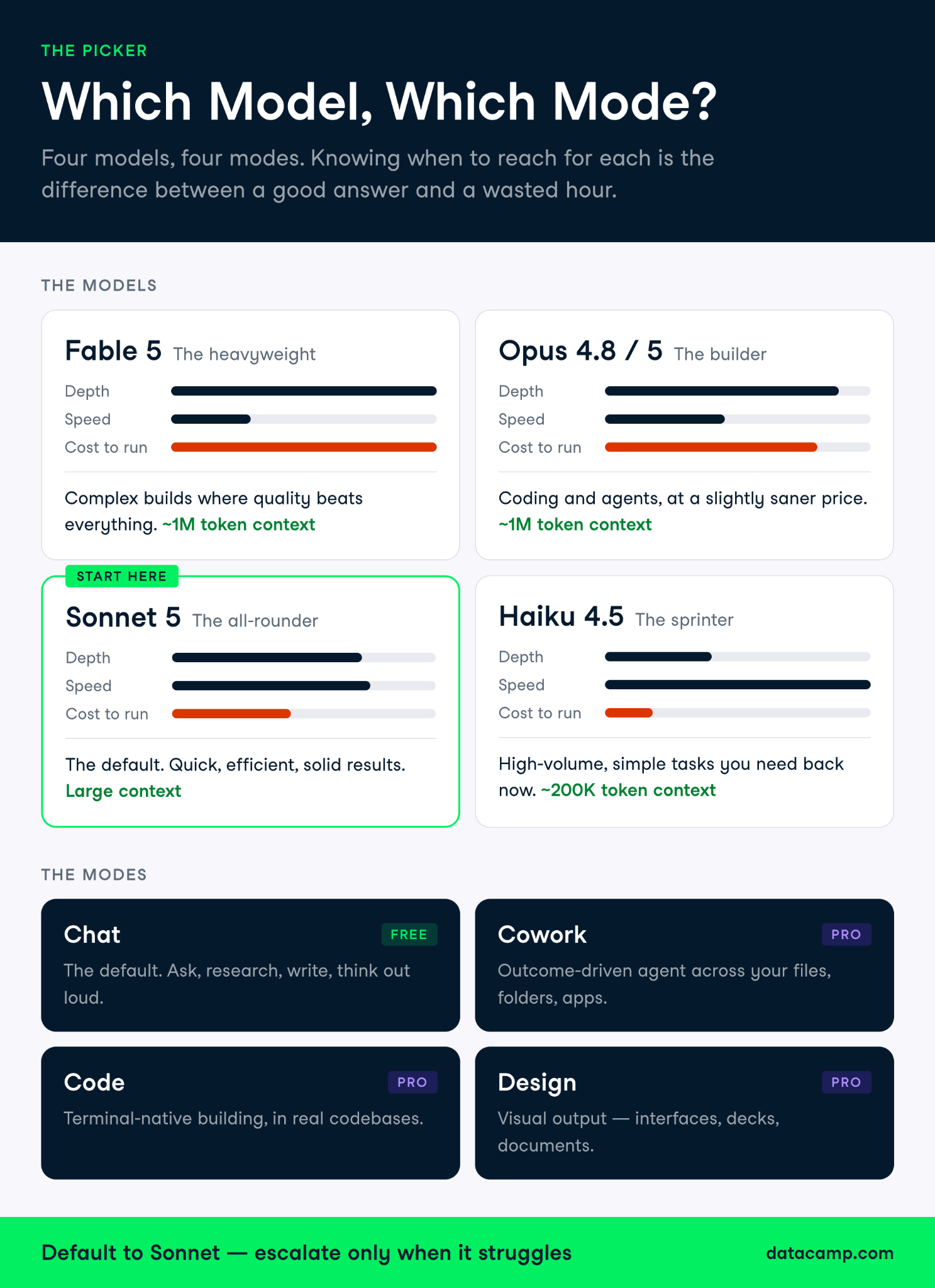
There are a few to choose from here, and on the surface, the names don’t give much away. At the top level (and at the time of writing), you’ll likely see options for Fable, Opus, Sonnet, and Haiku. But what does this mean?
You can think of the models as different versions of Claude, each tailored for slightly different tasks and each with their positives and downsides. Some excel at coding tasks and creating AI agents, but take longer to provide an answer and are more expensive to run. Others are much cheaper and faster, but may lack the depth and precision of other models.
I highly recommend reading about a few of them and what they’re best suited for (again, accurate at the time of writing):
Learning which model to choose for which task is a really important part of learning Claude. To start with, I recommend using the default model, which is currently Sonnet 5.
However, once you move on to more advanced tasks, Opus or Fable might be better suited.
By this point, you might have started poking around in Claude on the browser or Desktop app and seen a few different options available to you (especially if you have a paid subscription).
Even if you’re on a free tier, it’s still worth knowing that Claude has several specialized modes that you can choose from. There are three main ones and a ‘bonus’ one, each that are for very specific tasks: Claude Chat, Claude Cowork, Claude Code, and Claude Design.
As a free subscriber, you’ll only have access to Chat, which is perfectly fine while you learn the ropes. But to go beyond the basics and access Cowork, Code, and Design, you’ll need a Pro subscription.
Right now, though, you only need to know the difference. Let’s take a look:
As you progress on your Claude learning journey, you will no doubt start turning to the different modes for specific purposes. For now, I recommend checking out some of the basics of what each does in the following resources:
One of the key differentiators between the different models is something called a context window.
In essence, a context window is the amount of information that Claude can deal with at once while maintaining good performance. The larger the context window, the more conversation you can have without Claude forgetting context or running out of working memory while generating a response.
It works a lot like a human’s short-term memory, storing information for the task at hand.
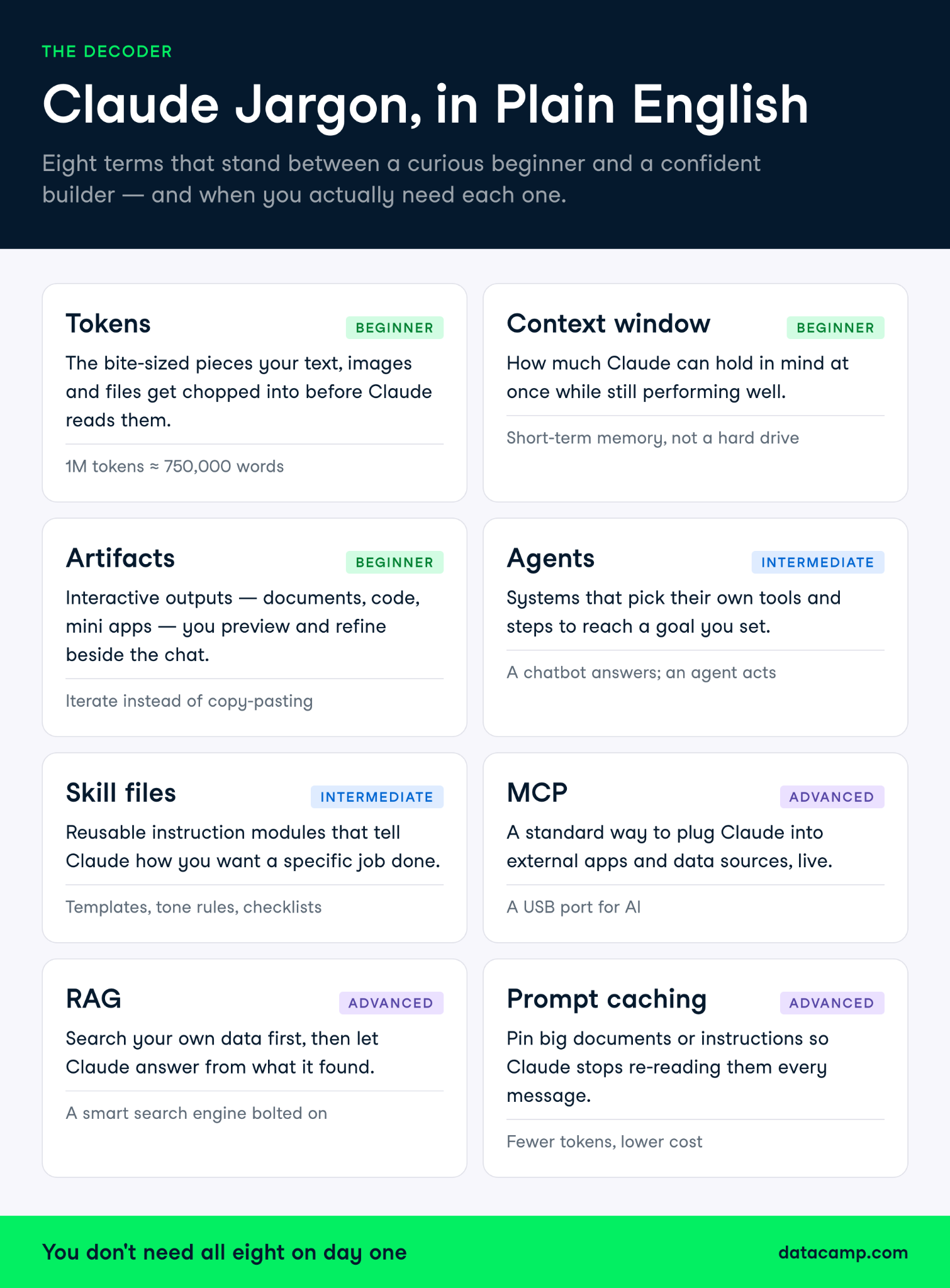
Generally, this is measured in tokens, which are the parts of the text, images, and other inputs that you give to Claude. For example, when you type a prompt into Claude, that sequence is converted into smaller parts (tokens) that help the LLM understand your human input better, as the bite-sized pieces are easier to analyze.
For the more advanced Claude models, like Fable and Opus, this context window is around 1 million tokens. For the smaller models like Haiku, it’s around 200,000.
To put that in context, 1 million tokens is around 750,000 words.
That sounds like a lot, but once you start adding images, video, audio, documents, code, etc., you can soon start getting close. And, of course, the more you chat with Claude, the more tokens are used in its memory.
To learn more details about context windows and tokens, there are a few resources I can recommend these resources:
One of the elements you need to understand when using Claude is Artifacts. We’ll cover these in more detail further on in the guide, but at this point in your learning journey, it’s fine to know the basics.
Artifacts are the interactive outputs that Claude creates when you’re interacting with it. This includes things like documents, code snippets, and even mini web apps that you can preview in Claude.
The cool thing about Artifacts is that you can preview Claude’s outputs in the same workspace and then chat with Claude to make changes and see the results. It’s a really helpful way to keep iterating when you work on projects.
I recommend reading the full introduction to Claude artifacts to learn more.
Once you’ve reached this point in your Claude learning plan, you should have had the chance to get familiar with the basics of how Claude works and how to interact with the different models.
Now it’s time to put that into practice with your first project.
(Note: I just mean a project idea at this point, not a Claude Project, one of the features of Claude, which we’ll cover in the next section)
At this stage, I very much recommend that you tailor this project to your experiences. Whether it’s at work or in your personal life, what are the pain points or workflows that you have to do manually each time?
It could be something as simple as planning an itinerary for a trip or summarizing a document. Whatever it is, work with Claude to build it. Start with a solid prompt, review the output, and adjust from there.
For me, I’m often thinking about how soon I can retire (spoilers, it’s still 20 years away). But each time I think about it, I have to work out how much I currently have saved, what the various scenarios might mean, and how much I’ll need to live off based on various factors. So, instead of manually figuring this out and maintaining it, I asked Claude to help me build a live dashboard with adjustable sliders and inputs.
For you, it could be anything. The main purpose at this point in your Claude learning plan is to use it and find its capabilities and limitations.
By now, you should be familiar with the basics of what Claude is and how you can use some of its features. Next on your Claude roadmap should be some of the more recent and more advanced Claude features.
In my opinion, this is the point at which you can really start doing some neat stuff, taking Claude from a useful chatbot to a customized assistant.
AI agents have been one of the trendiest topics for the last year or so. An AI agent is a system that is designed to perceive its environment, learn from its inputs, and make complex, automated decisions to reach specific goals.
Agents differ from standard AI chatbots in several ways. Perhaps the most significant is the fact that agents can make decisions about the tools and integrations they need to achieve a goal, and then call on them to execute a plan.
When you’re learning Claude, it's important to get to grips with Claude Cowork, the outcome-driven agent that can carry out multi-step workflows across the files, folders, and apps you have on your computer.
There are several resources I’d recommend at this point:
In the beginner section, we looked at how artifacts pop up automatically - you can view them in the side panel when Claude creates them.
The next step is to start creating your own Artifacts. This means prompting Claude specifically to create visual, interactive outputs to reach your goal.
An example here is in the editorial team at DataCamp. We have a shared artifact for tracking various data inputs to see how our content is performing. It provides a clear, useful snapshot that we can all access.
Of course, it’s taken a fair amount of iteration to get to the point it’s truly useful, but that’s the beauty of working with Claude. Even non-technical professionals can work with it to deliver strong results.
To learn about Claude Artifacts, I recommend:
Now we’re getting to the point where you’re going to really customize Claude, so it knows who you are and what your expectations are.
Once you’ve interacted with Claude for a while, you’ll notice that it has a certain way of doing things and a way of answering that feels pretty generic. This is because of the Claude system prompts - a set of ‘master instructions’ that define Claude’s identity and behavior guardrails.
Understanding these prompts is a useful part of learning Claude, as it gives you the opportunity to move beyond these somewhat generic baselines into a more specialized and personalized Claude.
There are two areas where this is particularly applicable - Claude Projects and skill files:
Here are some resources to help you get to grips with these concepts:
One of Claude’s most useful features is the research tool. Like many LLMs, Claude’s default knowledge depends on the training data used while the model is being developed. This limitation means that there can be gaps in its knowledge, particularly on the latest developments.
Research gets around this by finding and analyzing information agentically. This means that when the feature is on, and you ask Claude a question, it uses multiple agents to perform searches that build on each other, determining what to research next.
Claude explores loads of different angles to your queries automatically and systematically, giving you accurate and up-to-date information, with citations so you can check it.
I recommend exploring this feature as part of your learning path for Claude, as it’s been invaluable for me when I’m researching the latest AI developments.
I also recommend checking out this webinar that will help you build a competitor research bot using Claude Cowork.
At this point in your learning journey, you should have a fair understanding of Claude and its capabilities. You’ll be able to use the chat function and work in Claude Cowork to research, plan, and visualize different projects.
Now, it’s time to take things to the next level.
Up until now, you've been going to Claude's website or desktop app to do your work. But what if you want to bring Claude’s brain directly into the apps, spreadsheets, or systems you already use? That’s where APIs and SDKs come in.
An API (Application Programming Interface) is essentially a digital bridge. It allows two pieces of software to talk to each other. By using the Anthropic API, you can send instructions to Claude and get answers back automatically, without ever opening the chat interface.
SDKs (Software Development Kits) are basically starter kits, available in popular coding languages like Python or TypeScript, that make building that bridge much easier.
Even if you aren’t a hardcore programmer, learning the basics of the API is a huge milestone. For example, instead of manually copying and pasting our weekly DataCamp content metrics into Claude, I can use a simple script and the API to automatically send that data over and have a summary waiting for me every Monday morning.
It turns Claude from a manual assistant into an automated engine.
To get started with the Claude API, I recommend checking out:
MCPs are where Claude gets really clever. Up until this point, we’ve been dealing with Claude, which can read your local files, run shell commands, and explore the data you give it.
MCP gives you access to external tools and data. It’s a bit like adding a USB port for AI. In the same way that through a USB port you can connect your computer to different devices, the Model Context Protocol (MCP) gives Claude a standardized way to connect to external apps and data sources.
This is incredibly useful if you want to access a lot of different data streams without having to manually download them from apps and databases and then add them to Claude one by one. You can instead have Claude read and interact with your tools in real time.
To get to grips with MCP, here are some recommended resources:
In the beginner section, we mentioned the concept of tokens and context windows. These features are very much linked to how effective and cost-efficient Claude is, which is particularly relevant when you’re starting to scale up your ambitions and projects.
Claude has a feature called prompt caching, which lets you save large amounts of background information (like big datasets, long documents, or complex instructions) so Claude doesn’t have to re-read them from scratch every single time you send a new message.
Typically, when you ask Claude several different questions about the same data point (e.g., a large PDF), it re-reads the entire document for each question, taking up token usage and context window space.
Prompt caching allows Claude to pin vital info in its short-term memory, reducing token usage and therefore cost. I find that this is particularly useful when using the API or when building larger apps and workflows that take a lof of iteration.
Here are some resources to help you learn more:
When I got to the point where I was really comfortable with using Claude, I kept wanting to give it more and more data to use. Eventually, though, I found I was hitting a limit of what I could include in a single prompt.
This is where RAG (Retrival-Augmented Generation) comes in really useful. Despite the ungraceful name, the concept of RAG is pretty straightforward. It’s a smart search engine for very specific data that you can add to Claude.
Instead of giving Claude your entire company wiki or years of data and documentation at once, a RAG system searches your database for the most relevant information first, meaning Claude can formulate a highly accurate answer.
RAG is worth learning so Claude can understand your internal data, which means you can make AI agents and assistants that know your business context as well as anyone.
To get started with RAG, I can recommend:
We saw earlier that Claude Cowork is an AI agent that can help you with various tasks. But what about if you wanted to create your own version of Cowork that could operate your computer automatically?
Well, with Claude Computer Use, you can do exactly that. Computer Use gives Claude the ability to look at your screen, move your cursor, click buttons, and input text automatically.
It’s a super cool part of the Claude ecosystem, and it’s worth knowing how it works and how you can use it in your own workflows. It’s certainly an advanced and developer-focused tool, but the possibilities are exciting.
Here’s how you can learn more:
So, we’ve been through the various stages of learning Claude, going from the very basics to the most advanced features.
The final part of your learning journey should be pulling everything you’ve learned together.
Again, I recommend a personal project here so that you can see how everything fits together. You can start small with a fairly simple problem, and then start iterating and expanding it, looping in now tools, writing skill files, connecting MCPs and beyond.
The best way to learn Claude is to keep using it and testing its capabilities. Often, you’ll find that the only boundaries are those of your imagination.
This might sound like an odd question, but it’s a valid one. Is it worth your time and effort to learn Claude?
I certainly think so. It’s probably been the tool (along with Cursor) that has had the biggest practical impact on my working week than anything else since ChatGPT first launched.
Repetitive tasks that used to take me hours now take minutes. My analytics and reporting skills have improved. I can build workflows, dashboards, and apps that, in years gone by, would have taken me months to learn even how to build.
And it’s not just personal anecdotes that show how important it is to learn how to use tools like Claude. In a recent TechCrunch article, we explained that ‘Claude’ is now the most searched for term on the DataCamp site, surpassing even the term ‘AI’.
People are clamoring to learn how to use Anthropic’s tool. We saw an 18x increase in June alone for people searching for it.
The way we work is changing faster than ever before, and tools like Claude are in no small part driving that. These aren’t the skills of the future; they’re skills you need right now.
Of course, I’m sure you’re eager to get started, but probably wondering how long it’ll take until you’re creating highly specialized, connected AI agents.
There’s no exact answer here. You can be pretty handy with it after only a day of poking around and using it. Building real fluency probably takes 4-6 weeks, depending on how much you’re using it. And feasibly, you could work on it for a few months without running out of new things to try.
It depends on what you're aiming for. If your goal is to use Claude Chat for research and writing, an afternoon of experimentation will get you most of the way there. If your goal is building custom agents, connecting external data sources, and working with the API, that's realistically a 2-3 month project.
Here's how I'd break it down:
|
Stage |
Timeframe |
What you're able to do |
|
Beginner |
1-2 weeks |
Use Claude Chat confidently, write structured prompts, understand the different models and modes, complete a first personal project |
|
Intermediate |
4-6 weeks |
Work with Claude Cowork, build Projects with custom instructions, use the Research feature for complex queries |
|
Advanced |
3+ months |
Work with Claude Code and the API, connect MCPs, build RAG systems, understand prompt caching |
The article I’ve written up until this point outlines a progression from beginner through to advanced Claude use.
Here's how you could turn that into an actual schedule.
This plan assumes around 30-60 minutes a day. If you can only fit in a few hours per week, stretch the timeframes; the stages stay the same, the pace just changes.
Weeks 1-2: Beginner foundations
Weeks 3-4: First project
Weeks 5-6: Intermediate features
Weeks 7-8: Introduction to advanced features
From week 9 onwards
At this point, the plan becomes personal. You'll have enough experience to know where Claude is most useful in your workflow, and the next steps will emerge naturally from there.
My suggestion: pick one project that's slightly beyond what you can currently do, and work towards it. That gap between where you are and where you want to get to is where the fastest learning happens.
Writing this guide took me longer than I thought it would. I perhaps didn’t realize myself how much there was to learn, and how much I’ve learned, over the last few months. And I’m still learning. There are new features to explore, new projects I want to work on.
At work, I often find myself faced with workflows that aren’t very efficient or need improvement. There are tools I think I could use to do my job better. And in my personal life, there are projects I want to work on, and things I want to show other people how to do.
This comes from having used Claude pretty much daily for the last few months. Before that, I was largely using the more basic features.
Hopefully, this guide has shown you clearly how to learn Claude. The resources are there to help guide you, but it will be your own willingness to jump in and experiment with the various features that will really make the difference.
Good luck, and remember, the Claude 101 course is where I’d kick things off.
Top DataCamp Courses
Course
Course
Course
blog
Matt Crabtree
15 min
Tutorial
François Aubry
12 min
Tutorial
François Aubry
8 min
Tutorial
Abid Ali Awan
8 min
Tutorial
Bexruz (Bex) Tuychiev
12 min
Tutorial
Bexruz (Bex) Tuychiev
9 min