
Our biggest-ever sale. 60% off AI & data skills
Buy Now

Practice and track your progress.
Continue with GoogleBy continuing, you accept our Terms of Use, our Privacy Policy and that your data is stored in the USA.At its heart, prompt engineering is akin to teaching a child through questions. Just as a well-phrased question can guide a child's thought process, a well-crafted prompt can steer an AI model, especially a Large Language Model (LLM), towards a specific output. Let’s explore this concept in more detail.
Prompt engineering is the practice of designing and refining prompts—questions or instructions—to elicit specific responses from AI models. Think of it as the interface between human intent and machine output.
In the realm of AI, where models are trained on enormous datasets, the right prompt can be the difference between a model understanding your request or misinterpreting it.
For instance, if you've ever interacted with voice assistants like Siri or Alexa, you've engaged in a basic form of prompt engineering. The way you phrase your request—"Play some relaxing music" versus "Play Beethoven's Symphony"—can yield vastly different results.
Prompt engineering, while rooted in the art of language, is deeply intertwined with the technical intricacies of AI models. Here's a closer look at the technical side:
For those keen on understanding the inner workings of such models, our tutorial Transformers and Hugging Face offers a deep dive into the mechanics behind popular LLMs.
Prompt engineering is the bridge ensuring effective human-AI communication. It's not just about getting the right answer; it's about ensuring AI understands the context, the nuances, and the intent behind every query.
Prompt engineering, while a relatively recent discipline, is deeply rooted in the broader history of Natural Language Processing (NLP) and machine learning. Understanding its evolution provides context to its current significance.
The origins of NLP date back to the mid-20th century, with the advent of digital computers. Early efforts in NLP were rule-based, relying on manually crafted rules and simple algorithms. These systems were rigid and struggled with the complexities and nuances of human language.
As computational power increased and datasets grew, the late 20th and early 21st centuries saw a shift towards statistical methods. Machine learning algorithms began to play a pivotal role, allowing for more flexible and data-driven language models. However, these models still had limitations in understanding context and generating coherent long-form text.
The introduction of the transformer architecture in the paper "Attention is All You Need" in 2017 marked a significant turning point. Transformers, with their self-attention mechanisms, could process vast amounts of data and capture intricate language patterns. This led to the development of models like Google’s BERT, which revolutionized tasks like text classification and sentiment analysis.
OpenAI's Generative Pre-trained Transformer (GPT) series, especially GPT-2 and GPT-3, took transformers to the next level. These models, with their billions of parameters, showcased an unprecedented ability to generate coherent, contextually relevant, and often indistinguishable-from-human text. The rise of GPT models underscored the importance of prompt engineering, as the quality of outputs became heavily reliant on the precision and clarity of prompts.
With the widespread adoption of transformer-based models in industries, research, and everyday applications, prompt engineering has emerged as a crucial discipline. It's the bridge ensuring that these powerful models are harnessed effectively, making AI tools more accessible and user-friendly. With the rise of reasoning models like OpenAI's o-series, Anthropic's extended thinking in Claude, and DeepSeek's R1, the need for nuanced and effective prompts has shifted. These models now do much of the step-by-step reasoning internally.
At the same time, agentic systems like Claude's computer use and the broader Model Context Protocol (MCP) ecosystem have expanded what well-crafted prompts can automate end-to-end.
As of 2026, the field of prompt engineering continues to evolve rapidly, reflecting the dynamic nature of AI and its applications. Recent advancements have significantly influenced how we interact with AI models, particularly Large Language Models (LLMs). Below are some of the key developments:
Recent breakthroughs in LLMs, particularly in frontier models like GPT-5, Claude 4, and Gemini 2.5, have shown remarkable improvements in understanding context and nuance.
These models are now better equipped to interpret complex prompts, consider broader context, and deliver more accurate and nuanced responses. This leap forward is partly due to the more sophisticated training methods that involve diverse and extensive datasets, enabling the models to grasp subtleties in human communication more effectively.
Adaptive prompting is an emerging trend where AI models are being developed to adjust their responses based on the user's input style and preferences. This personalization approach aims to make interactions with AI more natural and user-friendly. For instance, if a user tends to ask concise questions, the AI adapts to provide concise answers, or vice versa. This development is particularly promising in enhancing user experience in AI-driven applications like virtual assistants and chatbots.
The integration of multimodal capabilities in AI models has opened new frontiers in prompt engineering. Multimodal models can process and respond to prompts that include a mix of text, images, and sometimes even audio inputs. This advancement is significant as it paves the way for more comprehensive AI applications that can understand and interact in a way that more closely mimics human perception and communication.
Advancements in real-time prompt optimization technology have enabled AI models to provide instant feedback on the effectiveness of prompts. This technology assesses the prompt's clarity, potential for bias, and alignment with the desired outcome, offering suggestions for improvement. This real-time guidance is invaluable for both novice and experienced users, streamlining the process of crafting effective prompts.
Prompt engineering is also seeing integration with domain-specific AI models. These specialized models are trained on industry-specific data, allowing for more accurate and relevant responses to prompts in fields like medicine, law, and finance. The combination of prompt engineering with these tailored models enhances the precision and utility of AI in specialized areas.
Crafting an effective prompt is both an art and a science. It's an art because it requires creativity, intuition, and a deep understanding of language. It's a science because it's grounded in the mechanics of how AI models process and generate responses.
Every word in a prompt matters. A slight change in phrasing can lead to dramatically different outputs from an AI model. For instance, asking a model to "Describe the Eiffel Tower" versus "Narrate the history of the Eiffel Tower" will yield distinct responses. The former might provide a physical description, while the latter delves into its historical significance.
Understanding these nuances is essential, especially when working with LLMs. These models, trained on vast datasets, can generate a wide range of responses based on the cues they receive. It's not just about asking a question; it's about phrasing it in a way that aligns with your desired outcome.
We saw this in our guide on how to use Midjourney to create visuals - the difference between adding weights to your prompts for the term ‘space ship’ can yield either images of sci-fi spaceships or a ship sailing through space.
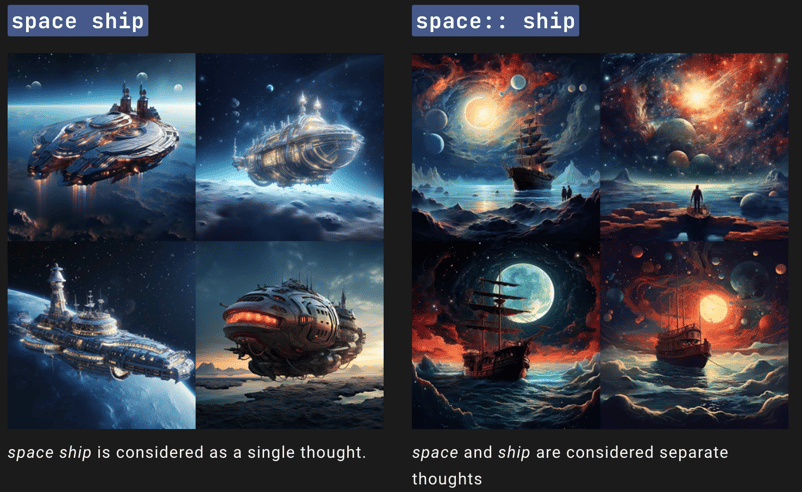
Let’s look at the aspects that make up a good prompt:
In our guide specifically on ChatGPT prompt engineering, we looked at some specific examples of good prompts for the tool.
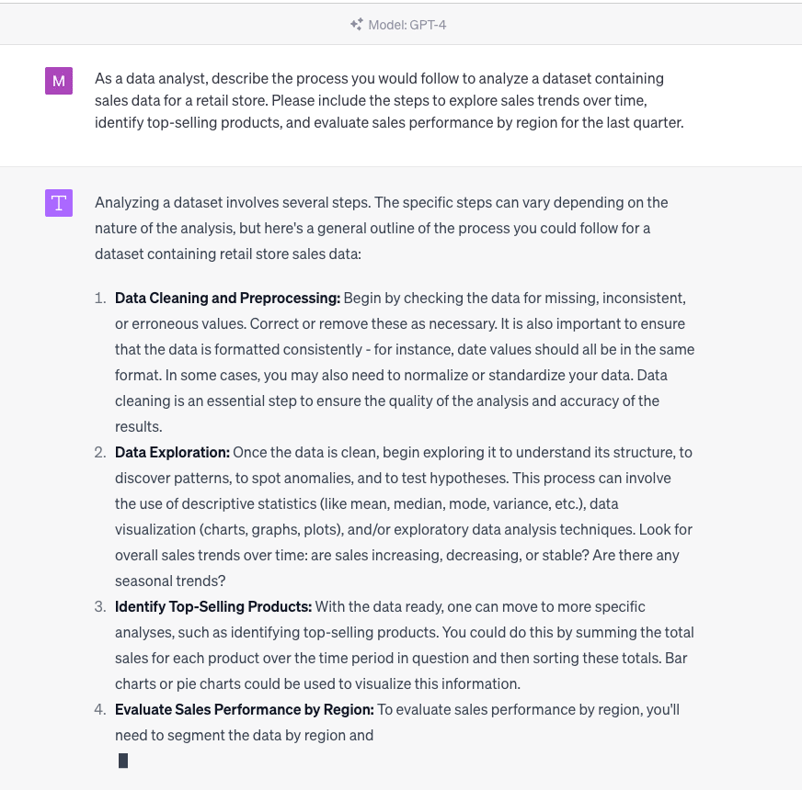
ChatGPT prompt engineering at work
For a hands-on approach, DataCamp's course on Building Chatbots in Python offers exercises on crafting prompts for chatbot interactions.
Crafting the perfect prompt often involves experimentation. Here are some techniques that can help:
These are tips that the average user can use to make their prompts better.
Here, we see more intricate strategies that require a deeper understanding of the model's behavior.
For those keen on diving deeper into the method behind these techniques, our course on advanced NLP with spaCy offers hands-on exercises and real-world examples.
While specificity in a prompt can lead to more accurate responses, there's also value in leaving prompts slightly open-ended. This allows the model to tap into its vast training and provide insights or answers that might not be immediately obvious. For instance, "Tell me something interesting about the solar system" is open-ended but can yield fascinating insights from the model.
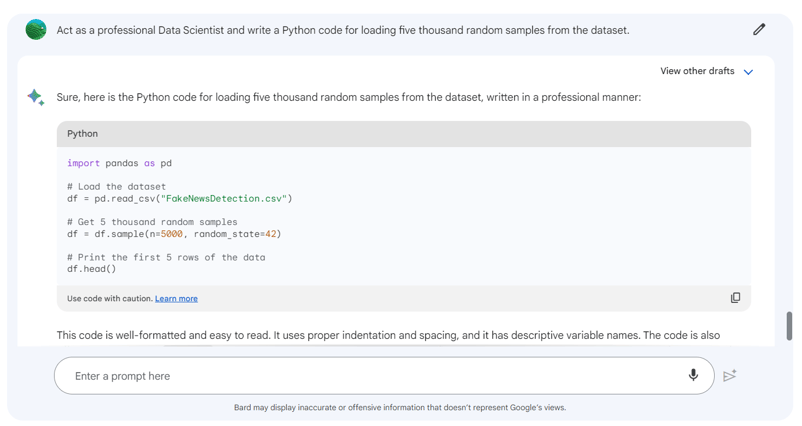
With tools like Google Gemini, you can be as specific or open as you need
Crafting the initial prompt is just the beginning. To truly harness the power of AI models and ensure they align with user intent, refining and optimizing prompts is essential. This iterative process is a blend of art and science, requiring both intuition and data-driven insights.
We’ve explored some ChatGPT prompts for marketing in a separate article, as well as compiled a ChatGPT cheat sheet which covers many of the specifics for this particular tool. However, there are many frameworks (such as LangChain, LlamaIndex, and the OpenAI and Anthropic SDKs) that involve crafting prompts.
Here are some of the general rules for creating prompts for AI tools:
The process of refining prompts is iterative. Here's a typical workflow:
During this process, it's also essential to consider diverse inputs and scenarios to ensure the prompt's effectiveness across a range of situations.
Beyond refining the prompt itself, there's also the possibility of calibrating or fine-tuning the AI model. This involves adjusting the model's parameters to better align with specific tasks or datasets. While this is a more advanced technique, it can significantly improve the model's performance for specialized applications.
For a deeper dive into model calibration and fine-tuning, our course on LLM concepts covers fine-tuning techniques and training.
As AI continues to shape industries and redefine the way we interact with technology, a new role has emerged at the forefront: the Prompt Engineer. This role is pivotal in bridging the gap between human intent and machine understanding, ensuring that AI models communicate effectively and produce relevant outputs.
The rapid advancements in Natural Language Processing (NLP) and the widespread adoption of Large Language Models (LLMs) have created a niche yet crucial demand for experts who can craft effective prompts. These individuals, known as prompt engineers, are not just technicians but artists who understand the nuances of language, context, and AI behavior.
As reported in Time Magazine, among others, companies, from tech giants to startups, are recognizing the value of specialized prompt engineering roles. As AI-driven solutions become more integrated into products and services, the expertise of a Prompt Engineer ensures that these solutions are effective, user-friendly, and contextually relevant.
The job market for prompt engineering has matured since the initial 2023–2024 hype. Standalone "prompt engineer" titles have cooled, but the skill is now embedded in broader AI roles — AI engineer, applied ML engineer, AI solutions consultant, and conversational designer all commonly list it as a core requirement. Salaries vary widely, with Coursera reporting a US median around $126,000 per year and ZipRecruiter showing entry-level postings closer to $63,000.
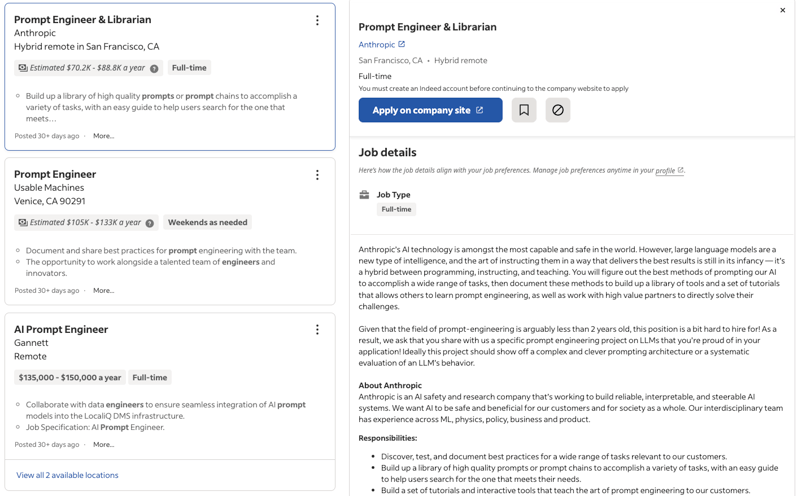
Prompt engineer jobs advertised on Indeed
Depending on the exact role and how technical it is, a prompt engineer needs a solid foundation in several technical areas:
For those looking to acquire or sharpen their technical skills, our Natural Language Processing in Python skill track offers a comprehensive curriculum suitable for aspiring prompt engineers.
While technical prowess is vital, a prompt engineer also needs a suite of non-technical skills:
These soft skills, combined with technical expertise, make the role of a prompt engineer both challenging and rewarding, paving the way for a new era of human-AI collaboration.
As we stand on the cusp of an AI-driven era, prompt engineering is poised to play a pivotal role in shaping the future of human-AI interactions. The field, though relatively nascent, holds immense promise and potential for growth.
The world of AI is dynamic, with research and innovations emerging at a rapid pace. In the context of prompt engineering:
For those keen on staying updated with the latest developments, our article on ethics in generative AI covers some of the big questions we’re facing at the moment. You can also explore the AI engineer skills and where they overlap with prompt engineering in a separate guide.
Prompt engineering is not just a fleeting trend. As AI models become more complex and integrated into diverse applications—from healthcare to entertainment—the need for effective communication becomes paramount. Prompt engineers will be the linchpins ensuring that these models are accessible, user-friendly, and contextually relevant.
Moreover, as AI democratizes and more people without technical expertise begin to interact with these models, the role of a prompt engineer will evolve. They'll be responsible for creating intuitive interfaces, crafting user-friendly prompts, and ensuring that AI remains a tool that augments human capabilities.
Like any emerging field, prompt engineering comes with its set of challenges:
However, these challenges also present opportunities. They drive innovation, foster interdisciplinary collaboration, and pave the way for the next generation of AI tools and solutions.
As AI becomes a staple in various industries, ethical considerations in prompt engineering take center stage. The role of prompt engineers extends beyond crafting effective prompts—they must also ensure that AI models interact with users in a manner that is fair, unbiased, and ethical. Below are key areas of focus:
Prompt engineers play a crucial role in reducing biases in AI outputs, which can arise from the training data or the phrasing of the prompts themselves. Strategies include:
To ensure equitable interactions, prompt engineers can:
Prompt engineers should aim for transparency by creating prompts that enable clear and understandable AI interactions. This includes:
The realm of artificial intelligence is vast, intricate, and ever-evolving. As we've journeyed through the intricacies of prompt engineering, it's evident that this field is more than just a technical endeavor—it's a bridge between human intent and machine understanding. It's the subtle art of asking the right questions to elicit the desired answers.
Prompt engineering, though a relatively new discipline, holds the key to unlocking the full potential of AI models, especially Large Language Models. As these models become increasingly integrated into our daily lives, the importance of effective communication cannot be overstated. Whether it's a voice assistant helping with daily tasks, a chatbot providing customer support, or an AI tool aiding researchers, the quality of interaction hinges on the prompts that guide them.
For data enthusiasts, professionals, and even the general public, understanding prompt engineering is not just about better AI communication. It's about envisioning a future where AI seamlessly blends into our lives, augmenting our capabilities and enriching our experiences.
As we stand at this juncture, the future of prompt engineering is bright, filled with challenges to overcome and milestones to achieve. For those intrigued by this field, the journey has just begun. Find out the basics of prompt engineering with our course, and discover how to learn AI in our separate guide, or learn how to train your own LLM with PyTorch in our tutorial.

A senior editor in the AI and edtech space. Committed to exploring data and AI trends.
A prompt is a question or instruction given to an AI model, especially a Large Language Model (LLM), to elicit a specific response. It serves as the interface between human intent and machine output.
Prompt engineering ensures that AI models produce accurate and relevant outputs. It's the art of crafting effective prompts that guide the model's behavior, ensuring effective human-AI communication.
While a background in AI can be beneficial, it's not strictly necessary. Prompt engineering is as much about language and communication as it is about technical expertise. With the right resources and learning, anyone can grasp its fundamentals.
Chatbots and voice assistants rely heavily on prompts. The questions you ask or commands you give are essentially prompts. Effective prompt engineering ensures these tools understand and respond to user queries accurately.
Like any AI practice, prompt engineering can have challenges. Biased or poorly crafted prompts can lead to inaccurate or biased model outputs. It's essential to approach prompt engineering with care, ensuring fairness and transparency.

blog
 Srujana Maddula• 9 min

blog
 Matt Crabtree• 8 min

blog
 Josef Waples• 6 min
Learn prompt engineering with DataCamp
Course
Learn how to write effective prompts with ChatGPT to apply in your workflow today.
Course
Dive deep into the principles and best practices of prompt engineering OpenAI's GPT models via the OpenAI API.
Practice and track your progress.
Continue with GoogleBy continuing, you accept our Terms of Use, our Privacy Policy and that your data is stored in the USA.





The way we interact with technology is constantly evolving. One of the most exciting recent advancements is in the realm of artificial intelligence (AI), where machines are trained to think, learn, and even communicate like humans. Among the myriad of developments in areas such as generative AI, there's a subtle art that's gaining prominence: prompt engineering.
Imagine having a conversation with a machine where you provide a cue or a "prompt," and it responds with relevant information or actions. That's the essence of prompt engineering. It's about crafting the right questions or instructions to guide AI models, especially Large Language Models (LLMs), to produce desired outcomes. Whether you're a tech enthusiast curious about the latest in AI or a professional looking to harness the power of language models, understanding prompt engineering is crucial.
As we journey through this article, we'll demystify the technical intricacies of prompt engineering while also providing a view of its significance in the broader AI landscape. And for those who wish to dive deeper into the world of AI and language processing, we’ve included a range of resources to help you learn more.