Course
Practical AI with Google Gemini and NotebookLM
2 hr
9.7K
The throughline across nearly every announcement on the first day of the Google I/O 2026 conference was the same: agents. Not chatbots, not assistants, but persistent, task-executing agents that run in the background and integrate across Google's full product stack. CEO Sundar Pichai framed it explicitly as the "agentic Gemini era," and the announcements backed that framing up.
Google also responded to Anthropic's Claude Max and OpenAI's ChatGPT Pro subscriptions by introducing a new Google AI Ultra tier at I/O, which covers the same price of $100/month and gates access to some of the agentic features covered below.
In this article, I'll walk you through the announcements that matter most for AI practitioners and developers. I'll focus on updates that are either available now or expected soon.
Gemini 3.5 Flash is the headline model release from I/O 2026. It outperforms Gemini 3.1 Pro on agentic and coding benchmarks, while Google claims it runs 4x faster on output tokens per second than other frontier models. While we cannot confirm that yet, this is definitely a bold claim.
Benchmark-wise, the performance jump is visible, especially in MCP Atlas, CharXiV Reasoning, and Finance Agent v2, all of which Gemini 3.5 Flash leads. Overall, 3.5 Flash seems to be competitive with Claude Opus 4.7 and GPT-5.5.
|
Benchmark |
3.5 Flash |
3 Flash |
3.1 Pro |
Opus 4.7 |
GPT-5.5 |
|
Terminal-bench 2.1 |
76.2% |
58.0% |
70.3% |
66.1% |
78.2% |
|
SWE-Bench Pro |
55.1% |
49.6% |
54.2% |
64.3% |
58.6% |
|
MCP Atlas |
83.6% |
62.0% |
78.2% |
79.1% |
75.3% |
|
OSWorld |
78.4% |
65.1% |
76.2% |
78.0% |
78.7% |
|
Finance Agent v2 |
57.9% |
42.6% |
43.0% |
51.5% |
51.8% |
|
CharXiv Reasoning |
84.2% |
80.3% |
83.3% |
82.1% |
84.1% |
|
Humanity's Last Exam |
40.2% |
33.7% |
44.4% |
46.9% |
41.4% |
|
ARC-AGI-2 |
72.1% |
33.6% |
77.1% |
75.8% |
84.6% |
The cost angle is worth noting here. Google claims that enterprises processing around 1 trillion tokens per day could save over $1 billion annually by shifting 80% of workloads from other frontier models to 3.5 Flash. That's a direct pitch at OpenAI and Anthropic's enterprise customers. Gemini 3.5 Flash is available today across the Gemini API, Google AI Studio, and the Gemini app. Gemini 3.5 Pro is already in internal use and expected next month.
For more detail, I recommend reading our Gemini 3.5 Flash article, where we cover the new model in more depth.
Gemini Omni is Google's new natively multimodal generative media model, capable of taking any combination of text, images, audio, and video as input and producing video output. The first model in the family, Gemini Omni Flash, is available today in the Gemini app, Google Flow, and YouTube Shorts.
The key architectural point is that Omni collapses what was previously a split stack (Veo for video, Imagen for images, separate audio systems) into a single model. That means more coherent edits and fewer pipeline artifacts when working across modalities. Google hasn't published numeric benchmarks for Omni alongside the launch, so independent evaluation is still pending. API access for developers and enterprise customers is coming in the weeks following I/O.
We've tested it and written it up in full in our Gemini Omni article. The first video generation results were hit-and-miss (at least given the high standards tools like Seedance 2.0 have raised), but a more powerful Gemini Omni Pro is expected to drop soon.
Antigravity is Google's agent-first development platform, and the 2.0 release at I/O is a significant expansion. Previously positioned as a coding environment, it's now a full platform for developing, deploying, and managing cohorts of autonomous AI agents. The centerpiece is a new standalone desktop application that acts as a central hub for agent orchestration, letting you run multiple agents in parallel on different tasks simultaneously.
The ecosystem now has four distinct surfaces for developers:
There are a couple of very useful new features for the core agent, too. The biggest one: it can now spawn modular subagents on the fly, each running in parallel with workspace isolation and inheriting the parent's tool configurations and permissions. Long-running operations run asynchronously, so they no longer block the agent loop.
Similar to Claude Code Hooks, JSON Hooks let users attach custom shell scripts at key stages of execution (before/after tool calls, model calls, or at stopping conditions) for logging, argument customization, or injecting instructions. Scheduled Tasks let you set cron-based prompts for periodic agent runs like daily PR digests or hourly deployment checks, with results appearing in the sidebar for seamless handoff to human-in-the-loop interaction.
On the management side, Antigravity introduces "projects" as an organizational primitive that scopes settings, resources, and permissions per agent group, rather than requiring the broadest global permissions for everything. The revamped side panel supports grouping conversations by project, status, or recency, with native Git worktree support built in. This project-based layout is comparable to Cursor's multi-window workspace management and Codex's task queue, but with tighter per-project permission scoping.
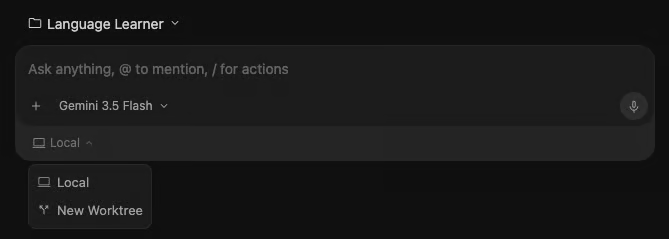
Voice input via Gemini Audio models and new slash commands (/goal for autonomous runs, /grill-me for pre-task clarification, /schedule for cron prompts, /browser for opt-in browser use) round out the UX.
Antigravity 2.0 is available to users starting today. The Google AI Ultra plan ($100/month) includes a 5x higher usage limit in Antigravity compared to the Google AI Pro plan.
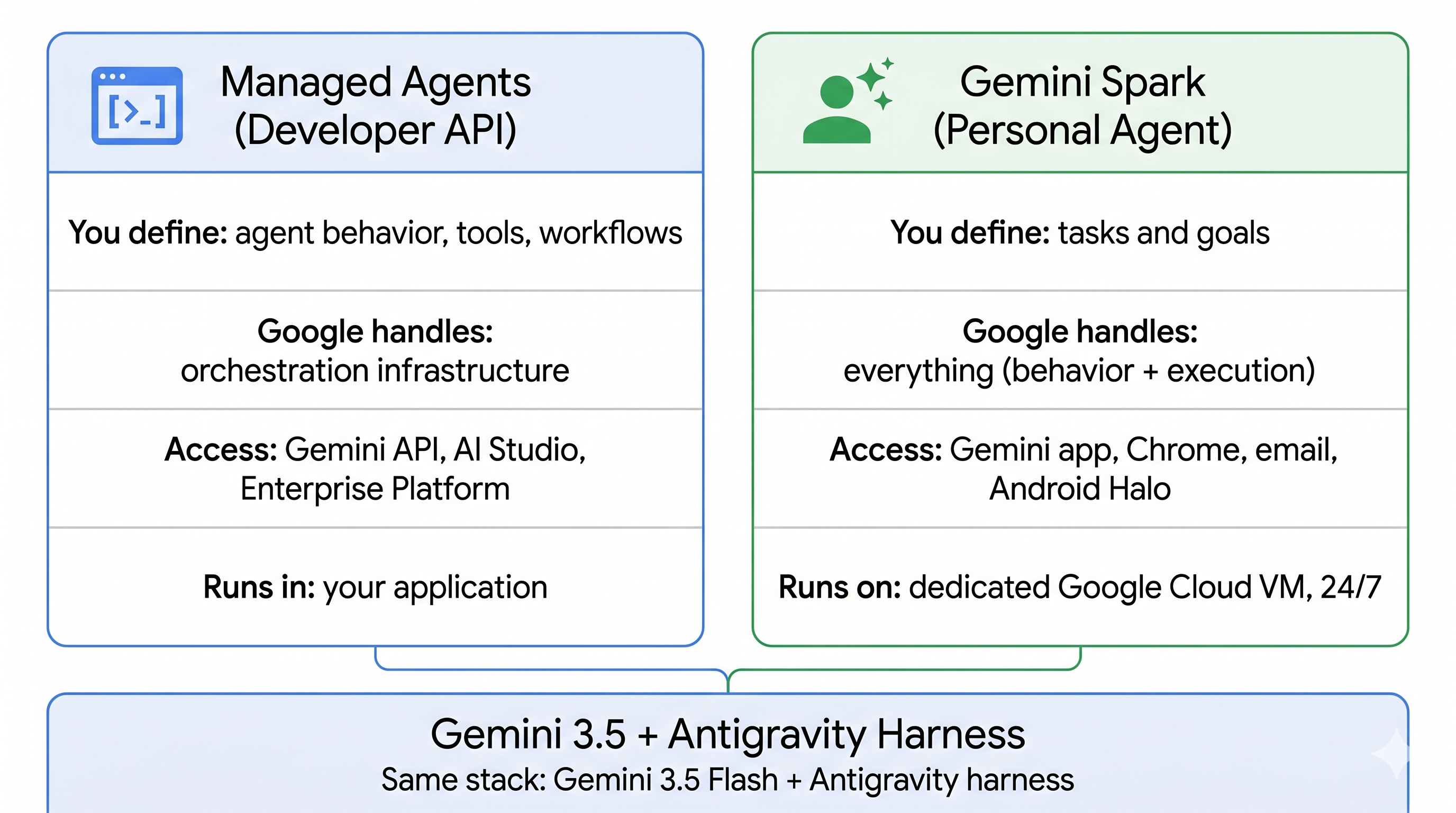
Alongside Antigravity 2.0, Google announced Managed Agents in the Gemini API, which brings agentic capabilities directly into the API layer for developers who want to build agent-powered applications without managing the orchestration infrastructure themselves. This is the API-level complement to the Antigravity desktop experience.
The practical implication for developers is that you can now define agent behaviors, tool integrations, and multi-step workflows through the Gemini API and have Google's infrastructure handle the execution. This has the potential to be a true game-changer for teams building production applications that need long-horizon task execution without spinning up and managing their own agent harness. Access is available through Google AI Studio, and enterprise customers can reach it via the Gemini Enterprise Agent Platform.
One honest caveat: early developer feedback from I/O coverage notes that documentation for complex agent flows and error-handling is still sparse. Rate limits and quota management are also flagged as friction points. These are both issues that will likely become less problematic as time goes on, but they are worth knowing before you commit to building on this stack.
Gemini Spark (not to be confused with Meta's most recent LLM, Muse Spark) is Google's new personal AI agent, and it's the most consumer-facing of the agentic announcements. It runs 24/7 on dedicated virtual machines in Google Cloud, meaning it doesn't require your laptop to be open to keep working. Spark is powered by Gemini 3.5 and the Antigravity harness, which gives it the ability to handle long-horizon tasks in the background.
The feature set at launch includes:
The comparison to OpenAI's agent ecosystem and Anthropic's tool-use capabilities is worth making directly. Spark's differentiator is the 24/7 persistent execution on Google Cloud infrastructure, combined with deep integration into Google's own productivity suite. If your work already lives in Google Workspace, that's a meaningful advantage. If it doesn't, the value proposition is less obvious.
Privacy is the legitimate concern here. An agent that continuously monitors your inbox, calendar, and documents raises real questions about data residency and compliance in regulated industries. One question I was asking myself was, for example, "What happens to agent memory when an employee leaves?" Google hasn't provided detailed answers to those questions yet.
Spark is rolling out to trusted testers this week, with a Beta for Google AI Ultra subscribers ($100/month) in the US the following week. We're covering it in more detail in our Gemini Spark article.
AI Mode in Search was introduced at the last I/O. Fast forward one year, and it has surpassed one billion monthly active users. Now, Google is pushing further with two new agentic capabilities.
The first is information agents in Search: personalized background agents you configure to monitor topics and surface relevant information at the right moment. These are rolling out this summer, starting with Google AI Pro and Ultra subscribers.
The second is generative UI in Search, powered by Gemini 3.5 Flash and Antigravity. Search will now build custom layouts, interactive visuals, and even persistent dashboards or mini-apps for complex, long-running queries. The generative UI capabilities are coming to all users for free this summer. The persistent dashboard and custom app features will be available first for Pro and Ultra subscribers in the US.
This is a real concern for publishers and SEO professionals (as the introductions of AI Overview and AI Mode were already). When AI-generated answers fully resolve a user's query directly in Search, there's no reason to click through to the source site. We've already seen this play out: both AI Overviews and the initial rollout of AI Mode led to significant traffic drops across the industry. Google still hasn't introduced a clear way to share revenue or guarantee traffic to the publishers whose content feeds these answers.
Google Flow, which debuted at I/O 2025 as an AI filmmaking tool, has taken a major step forward with three key updates:
Taken together, these updates position Flow as more than a creative assistant. It's becoming a platform for building creative workflows, with a mobile app now in beta on Android and coming soon to iOS.
SynthID, Google's invisible AI watermarking system, has now watermarked over 100 billion images and videos and 60,000 years of audio assets since its launch three years ago. The I/O announcement that matters most here isn't the scale, it's the partners: OpenAI, Kakao, and Eleven Labs are adopting SynthID alongside Nvidia, which signed on last year.
The cross-industry adoption is what makes this meaningful. A watermarking standard only works if it's widespread enough that "not watermarked" becomes a useful signal. Google is also expanding Content Credentials verification (the C2PA standard) to Search and Chrome, which will show users whether content originated from AI or a camera and whether it was edited with generative tools. The combination of SynthID and C2PA gives provenance two independent layers, which is the right approach given how easily either can be stripped individually.
Several other announcements from I/O are worth a quick note:
Google I/O 2026 was a bet on agents as the primary direction for AI, with Gemini 3.5 Flash and Antigravity 2.0 as the infrastructure underneath nearly everything else announced. The things you can use right now are Gemini 3.5 Flash (via the Gemini API and AI Studio), the new Flow agent, Gemini Omni Flash, and the Antigravity 2.0 desktop app. Gemini Spark, Search agents, and the generative UI features in Search are rolling out over the summer, mostly gated behind the new $100/month AI Ultra tier (at least initially).
For me, the Antigravity upgrade was the most interesting release, because it operates on two levels simultaneously: as a standalone developer app, it competes directly with Codex and Claude Code; as a platform, its underlying ADK and Managed Agents API challenge orchestration frameworks like LangChain, AutoGen, and OpenAI's Agents SDK. The Gemini integration and Google Cloud deployment layer are the differentiators (and the lock-in risk) on both fronts.
Learn About Google's AI Ecosystem
Course
Track
Track
blog
Matt Crabtree
8 min
blog
Alex Olteanu
8 min
blog
Josef Waples
7 min
blog
Tom Farnschläder
11 min
blog
Matt Crabtree
13 min
Tutorial
Tim Lu
6 min