

{count, plural, one {Lernpfad} other {Lernpfade}}
KI für Softwareentwicklung
{hours} Std.
Anthropic hat Claude Opus 4.7 veröffentlicht, die neueste Iteration seiner Flaggschiff-Modellstufe. Der große Fortschritt: mehr Autonomie. Anthropic positioniert es als das Modell, dem du die härtesten, langlaufenden Coding- und Agentenaufgaben ohne enge Beaufsichtigung anvertrauen kannst.
Mit diesem Release wird auch klar, dass es über Opus 4.7 hinaus noch Luft nach oben gibt. Anthropics internes Mythos Preview erzielt auf mehreren Benchmarks höhere Werte, wird aber vorerst zurückgehalten, während Anthropic Cybersicherheits-Schutzmaßnahmen testet. Für alle, die nicht intern bei Anthropic forschen, ist Opus 4.7 aktuell die Spitze des öffentlich Verfügbaren.
In diesem Artikel gehen wir durch, was in Opus 4.7 tatsächlich neu ist, schauen in die Benchmarks und teilen Hands-on-Tests, die du selbst ausprobieren kannst. Lies auch unsere Guides zu jüngst veröffentlichten Konkurrenzmodellen wie Metas Muse Spark, OpenAI's GPT-5.5 und Googles Gemini 3.1.
Update: Am 28. Mai 2026 hat Anthropic das Nachfolgemodell veröffentlicht. Alle Infos dazu findest du in unserem Claude Opus 4.8 Guide.
Claude Opus 4.7 ist Anthropics neuestes Flaggschiff-Sprachmodell und steht innerhalb der Claude-Familie über Sonnet und Haiku. Es folgt auf Claude Opus 4.6 und ist für die anspruchsvollsten Aufgaben gedacht, etwa komplexe agentische Workflows und mehrstufiges Reasoning, das über lange Sitzungen hinweg konsistent bleiben muss.
Im Vergleich zu Opus 4.6 konzentriert sich das 4.7-Release auf drei Bereiche:
Anthropics internes Mythos Preview, das wir oben erwähnt haben und zu dem wir auch ein FAQ haben, führt auf mehreren Benchmarks, ist aber nicht breit verfügbar. Opus 4.7 ist im Kern ein verwandtes Modell, das gezielt mit reduzierten Cybersicherheitsfähigkeiten trainiert wurde.
Anthropic berichtet, dass mehrere Fähigkeitsbereiche in Opus 4.7 spürbar verbessert wurden.
Opus 4.7 hält sich enger an Anweisungen als frühere Modelle. Das hilft natürlich überall dort, wo Zuverlässigkeit zählt, kann aber auch unbeabsichtigte Folgen haben: Anthropic rät, Prompts und Harnesses neu abzustimmen, weil Anweisungen, die frühere Modelle übergangen oder freier interpretiert haben, nun wörtlich genommen werden.
Die Vision für hohe Auflösung wurde verbessert und unterstützt nun Bilder bis 3,75 Megapixel – mehr als das Dreifache früherer Modelle. Davon profitieren insbesondere Computer-Use-Agenten und Datenextraktions-Workflows, die auf Lesbarkeit und Genauigkeit bis hinunter auf Pixelebene angewiesen sind.
Opus 4.7 ist besser beim dateisystembasierten Gedächtnis, also bei Mustern, in denen das Modell während der Arbeit Notizen in Dateien schreibt und sie bei späteren Läufen wieder einliest.
Claude Code ist dafür der naheliegende Anwendungsfall: eine CLAUDE.md Datei im Projektstamm, die Claude zu Sitzungsbeginn liest, bei Entscheidungen aktualisiert und später wieder nutzt.
„Besser“ heißt hier: besseres Urteilsvermögen, was sich lohnt zu notieren, und zuverlässigeres Erinnern in späteren Turns. Anthropic sagt, dadurch benötigen neue Aufgaben „weniger Kontext im Vorfeld“ – was du zu schätzen weißt, wenn du, wie wir, dem Modell schon zum fünften Mal deine Projektkonventionen erklärt hast.
Kurz gesagt: Wenn du Opus 4.7 für mehrsitzige Arbeit nutzt, lass es Notizen führen. Das klappt spürbar besser als bei Opus 4.6 – und schon 4.6 hat ziemlich ordentliche Notizen gemacht.
Anthropic teilt mit, dass Claude Opus 4.7 in diesen Bereichen deutlich zugelegt hat.
Wir haben eigene Tests erstellt, um diese Aussagen zu prüfen.
Um das Befolgen von Anweisungen zu testen, haben wir folgenden detaillierten Prompt genutzt, der Opus 4.7 stresst. Er enthält 12 klare Vorgaben, die wir am Ende überprüfen können.
You are writing a short briefing document for a new employee at a mid-sized accounting firm. Follow every instruction below.
Write a briefing about the firm's approach to client onboarding. The briefing must meet all of the following requirements:

The briefing must be exactly 4 paragraphs long.
-The second paragraph must begin with the word "Historically".
-Each paragraph must contain between 3 and 5 sentences. No paragraph may have fewer than 3 or more than 5.
-Do not use the words "streamline", "leverage", "robust", or "synergy" anywhere in the document.
-Include exactly two direct quotes from fictional senior partners. Attribute each quote to a named partner. Do not include any other quoted material.
-One of the partners quoted must have a surname that starts with the letter M.
-End the document with a single-sentence closing line on its own, separated from the fourth paragraph by a blank line. This closing line does not count toward the 4-paragraph requirement.
-The closing line must be a question.
-Use British English spelling throughout (e.g., "organisation", "colour", "realise").
-Do not use any bullet points, numbered lists, or headings.
-Mention a specific fictional client name exactly once, and italicise it using markdown asterisks.
-The total word count of the briefing, including the closing line, must be between 280 and 320 words. Do not include any preamble, explanation, or commentary before or after the briefing. Output only the briefing itself.
Und hier ist das Ergebnis:
Welcome to Harding & Whitcombe, where client onboarding is treated as the foundation of every successful long-term engagement. Our approach centres on understanding the organisation behind the numbers before any technical work begins, which means the first two weeks are devoted almost entirely to listening. New clients are assigned a dedicated onboarding lead who coordinates introductions across tax, audit, and advisory teams. This structure ensures that every colleague touching the account shares a consistent understanding of the client's priorities and sensitivities.

Historically, the firm operated a more transactional model, with onboarding handled piecemeal by whichever partner had signed the engagement letter. That changed in 2014, when senior leadership recognised that our competitors were winning work on relationships rather than fees alone. As Helena Marchbanks, our managing partner, often reminds new hires, "A client who feels understood in week one rarely questions the invoice in month six." The revised approach has measurably improved retention and referral rates across every service line.

In practical terms, you will be expected to attend the initial discovery meeting for any client you support, even in a purely observational capacity. You should familiarise yourself with the client's sector, recent filings, and any public commentary from their leadership before that first conversation. When we onboarded Thornbury Mills Ltd last spring, the junior associate who had read three years of their annual reports was the one who spotted the inventory anomaly that shaped our entire advisory brief. Preparation of that depth is the standard we expect, not the exception.

You will also notice that we emphasise candour from the outset, particularly around scope and realistic timelines. "We would rather lose a pitch than promise something we cannot deliver," says Rupert Castellane, head of our advisory practice, and that philosophy colours every onboarding conversation. Take the time to ask questions, observe the senior partners in action, and recognise that trust accumulates slowly but pays compounding dividends.

Are you ready to meet your first client?
Jetzt zur Bewertung. Hier ist unser Raster:
|
# |
Vorgabe |
Prüfmethode |
|
1 |
Genau 4 Absätze (plus Schlusszeile) |
Absatzumbrüche zählen |
|
2 |
Absatz 2 beginnt mit „Historically“ |
Erstes Wort prüfen |
|
3 |
Jeder Absatz hat 3–5 Sätze |
Sätze pro Absatz zählen |
|
4 |
Keine verbotenen Wörter |
Strg+F je Begriff |
|
5 |
Genau 2 Zitate, beide mit Namensnennung, kein weiteres Zitatmaterial |
Anzahl Anführungszeichen |
|
6 |
Ein Partnername mit Nachname beginnend mit M |
Attributionen prüfen |
|
7 |
Schlusszeile durch Leerzeile getrennt |
Visuelle Prüfung |
|
8 |
Schlusszeile ist eine Frage |
Endet mit „?“ |
|
9 |
Britische Rechtschreibung |
Strg+F nach „organization“, „color“, „realize“ etc. |
|
10 |
Keine Aufzählungen, Nummernlisten, Überschriften |
Visuelle Prüfung |
|
11 |
Fiktiver Kunde einmal genannt, kursiv |
Strg+F nach Sternchen |
|
12 |
Wortzahl 280–320 |
In Wortzähler einfügen |
Wir ersparen dir die Detailarbeit. Das Modell hat 11/12 erreicht.
Es war bis zum Schluss perfekt unterwegs, ist dann aber ganz leicht über die Wortzahl geraten (325 Wörter bei einem Limit von 320).
Wir haben denselben Test auf Claude Sonnet 4.6 angewandt, das ebenfalls 11/12 Vorgaben korrekt erfüllte – und zwar mit demselben Fehler (Wortzahl). Opus 4.7 sehen wir dennoch vorne, denn Sonnet 4.6 lag deutlich drüber (400 Wörter).
Für den zweiten Test haben wir Opus 4.7 ein schwer lesbares Bild gegeben:
You are analysing a degraded image that may be blurry, low-resolution,
or otherwise difficult to read. Your job is to extract as much accurate
information as possible.

Complete all of the following tasks. Do not include any preamble,
explanation, or commentary. Output only the requested deliverable.

1. Describe what type of document or visualisation this appears to be
   (e.g. bar chart, dashboard, table, report page). State your confidence
   as High, Medium, or Low.

2. List every number you can make out, however partial. For each one,
   state what you believe it refers to and your confidence (High, Medium,
   or Low). If a number is ambiguous between two readings (e.g. could be
   138 or 188), state both possibilities.

3. List every piece of text you can make out — titles, labels, legends,
   footnotes — quoted as precisely as possible. Where a word or character
   is unclear, use [?] to mark the uncertain character, e.g. "Re[?]enue".

4. Describe the layout: how many distinct sections or panels are visible,
   and what does each appear to contain?

5. State what you believe the overall subject or story of the image is,
   in one sentence of no more than 25 words. Flag if your confidence is
   Low.

6. List anything you attempted to read but could not make out at all.
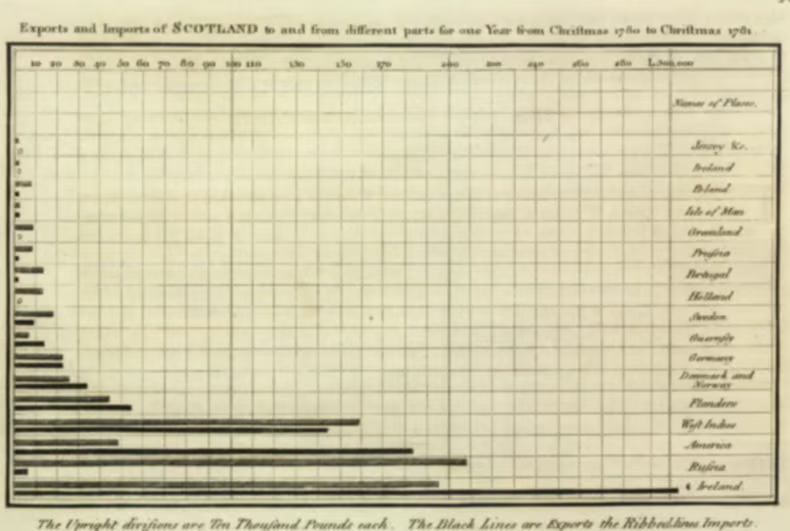
Zusammen mit diesen Anweisungen haben wir Opus 4.7 einen degradierten Screenshot von Playfairs Handelsdiagramm Schottlands (1786) gegeben, entnommen aus unserem Artikel zu Data Visualization Examples.
Wir konnten die Ausgabe validieren, da wir eine höher aufgelöste Version auf Wikipedia hatten. Das ist das Bild, das Opus 4.7 gesehen hat:
So hat Opus 4.7 es gelesen:
Type: Horizontal bar chart, antique engraving. Confidence: High.

Numbers: X-axis ticks: 10, 20, 30…110, 130, 150, 170, 200, 220, 240, 260, 280, L.300,000 (High, but 130/220 uncertain).

Years "1780" and "1781" in title (High). "Ten Thousand Pounds" per division (High).

Title: "Exports and Imports of SCOTLAND to and from different parts for one Year from Christmas 1780 to Christmas 1781"

Header: "Names of Places"

Places: Jersey &c., Ireland, [?]oland, Isle of Man, Gr[oe]nland, Prussia, Portugal, Holland, Sweden, Guernsey, Germany, Denmark and Norway, Flanders, West Indies, America, Russia, Ireland (duplicate?)

Footnote: "The Upright divisions are Ten Thousand Pounds each. The Black Lines are Exports the Ribbed lines Imports."

Layout: Single panel — title, plot area with ~16 paired bars, right-hand place-name column, footnote below.

Subject: A 1780–81 trade chart showing Scotland's exports and imports by partner. Confidence: High.

Couldn't read: Top-right corner mark; exact bar values; first letter of "[?]oland"; whether bottom "Ireland" is a duplicate.
Wir wussten, dass dieser Test knifflig sein könnte, da die x‑Achse in Playfairs Chart tatsächlich mitten drin die Zählweise wechselt (alle 10 bis 110, dann ungerade Zehner 130/150/170, dann gerade 200/220/240/260/280). Opus 4.7 hat die Achse trotzdem beim ersten Versuch korrekt gelesen – obwohl sie ungewohnt ist.
Eine Sache fanden wir dennoch witzig: Ungewissheit zu zeigen ist gut, aber „[?]oland“ hätte man hier durchaus sicher als „Poland“ lesen können, und „Gr[oe]nland“ als „Greenland“. Auch ohne offizielles Raster vergeben wir fairerweise 9/10.
Opus 4.7 wurde über 14 Benchmarks in den Bereichen Coding, Reasoning, Tool-Einsatz, Computer-Use und visuelles Reasoning evaluiert. Die Tabelle unten zeigt den vollständigen Vergleich mit Opus 4.6, GPT 5.4, Gemini 3.1 Pro und dem noch unveröffentlichten Mythos Preview.
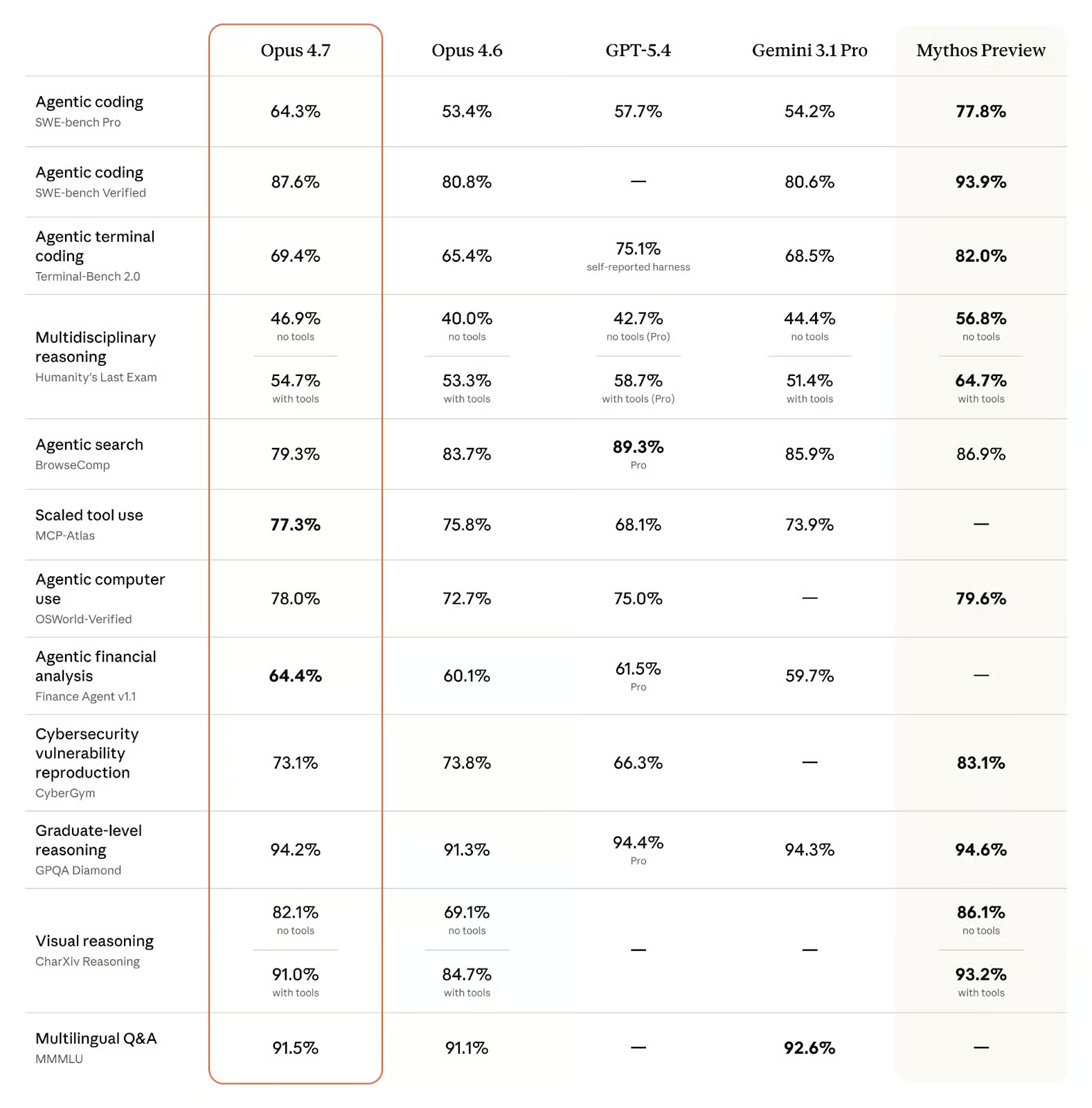
Auf SWE-bench Pro erzielt Opus 4.7 64,3% und liegt damit vor GPT-5.4 mit 57,7%, Gemini 3.1 Pro mit 54,2% und Opus 4.6 mit 53,4%. Auf SWE-bench Verified erreicht Opus 4.7 87,6% gegenüber 80,6% bei Gemini 3.1 Pro und 80,8% bei Opus 4.6. Für GPT-5.4 liegt in diesem Vergleich kein Wert auf SWE-bench Verified vor.
SWE-bench testet die Fähigkeit eines Modells, reale GitHub-Issues in Open-Source-Python-Repositories zu lösen. Pro ist die schwierigere Variante mit komplexeren Issues. Der Zuwachs um 10,9 Punkte gegenüber Opus 4.6 auf SWE-bench Pro ist (in Prozentpunkten) die größte Verbesserung dieses Releases und positioniert Opus 4.7 hier klar vor beiden großen Wettbewerbern.
Nur Anthropics internes Mythos Preview liegt mit 77,8% (SWE-bench Pro) und 93,9% (SWE-bench Verified) darüber – es gibt also weiterhin Spielraum über Opus 4.7. Da Mythos jedoch nicht breit verfügbar ist, ist Opus 4.7 für die Produktion aktuell das obere Ende.
Die Ergebnisse beim Terminal-Bench 2.0, dem Standard-Benchmark für agentisches Coding im Terminal, sind ebenfalls interessant. Opus 4.7 verbessert sich leicht gegenüber seinem Vorgänger (69,4% vs. 65,4%) und überholt Gemini 3.1 Pro (68,5%).
Allerdings kann es hier nicht mit GPT-5.4 (75,1%) mithalten – auch wenn der selbst gemeldete Vorbehalt zu GPT-5.4s Wert bei Vergleichen bedacht werden sollte. Für Anthropic dürfte es dennoch etwas enttäuschend sein, dass das neueste (veröffentlichte) Flaggschiff einen für agentische Softwareentwicklung zentralen Benchmark nicht anführt.
Humanity's Last Exam ist eine Sammlung anspruchsvoller Fragen auf Master-Niveau in Naturwissenschaften, Mathematik und Geisteswissenschaften – bewusst schwer für aktuelle Frontier-Modelle. Opus 4.7 führt die Variante ohne Tools an, die reines Reasoning ohne externe Recherche testet. In der mit-Tools-Variante liegt GPT-5.4 (58,7%) klar vor Opus 4.7 (54,7%).
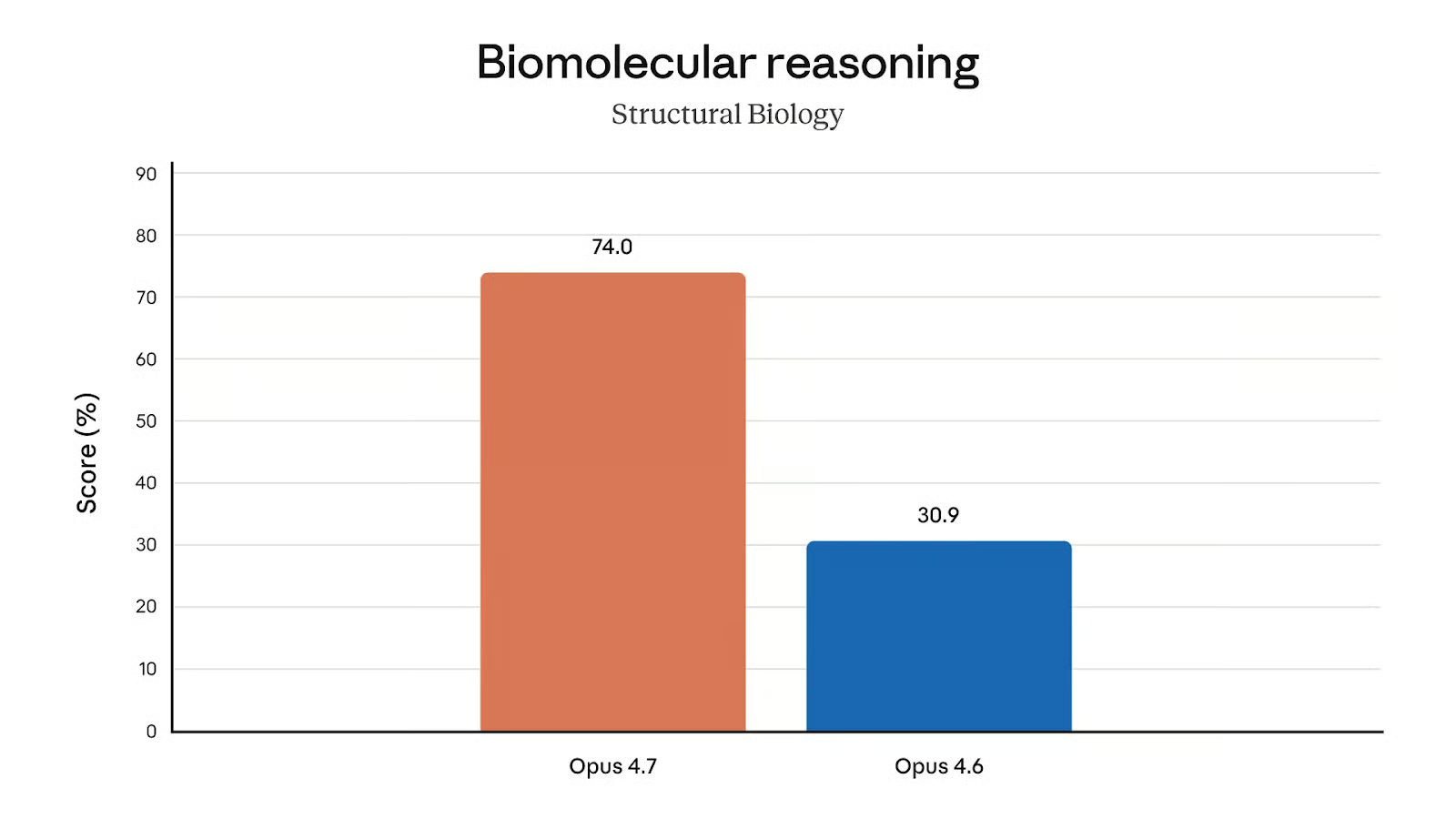
Graduate-Level-Reasoning wird üblicherweise mit GPQA-Diamond gemessen, der inzwischen ziemlich gesättigt ist: Wie bei allen aktuellen Frontier-Modellen liegen alle vier verglichenen Modelle über 90% und sind faktisch gleichauf.
Spannender ist ein Benchmark mit Fokus auf Biologie, einem der GPQA-Diamond-Fächer. Zwar fehlt der direkte Vergleich zu den Wettbewerbern, aber der Sprung von Opus 4.6 (30,9%) auf Opus 4.7 (74,0%) ist definitiv bemerkenswert!
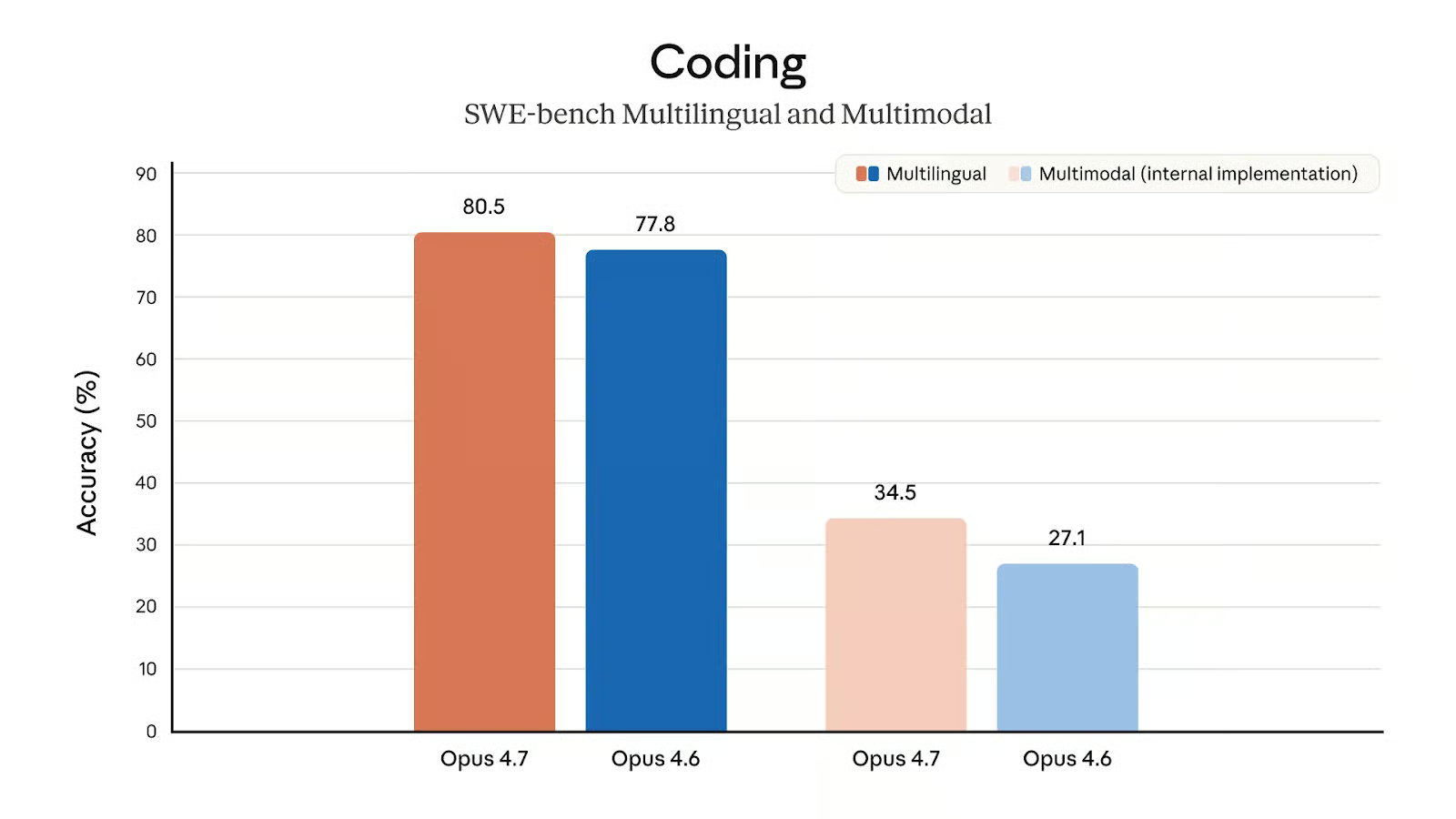
Die Ergebnisse im CharXiv-Benchmark, der visuelles Reasoning zu wissenschaftlichen Charts und Abbildungen misst, spiegeln wider, dass dies ein zentraler Fokus in der Entwicklung von Opus 4.7 war.
Die 13 Punkte Zuwachs ohne Tools sind der größte relative Gewinn dieses Releases. Ohne Wettbewerbswerte ist schwer zu sagen, wo Opus 4.7 hier im Feld steht, aber der Fortschritt gegenüber Opus 4.6 ist erheblich.
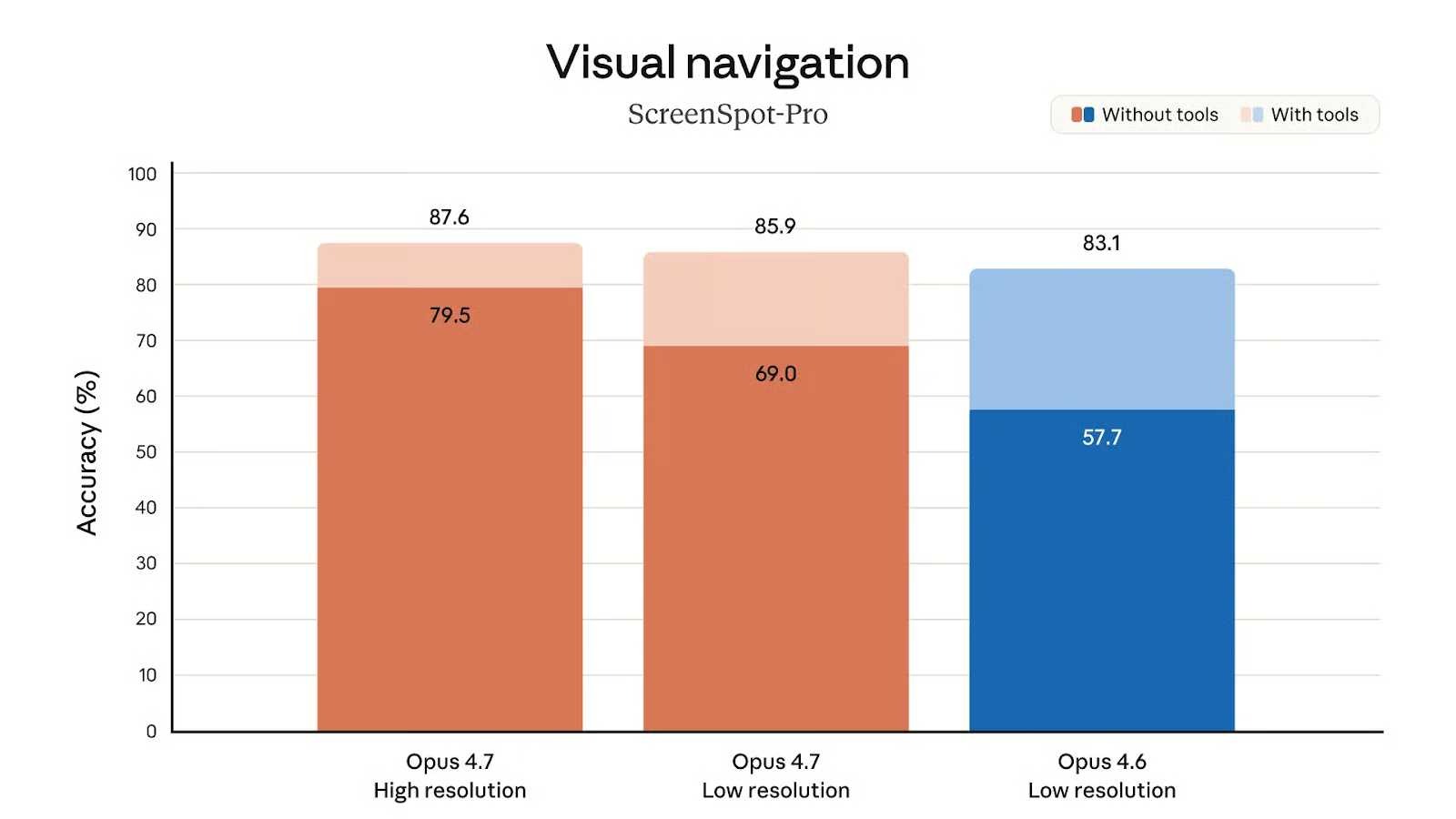
Die Unterstützung höher aufgelöster Bilder ist vermutlich ein Grund für das bessere visuelle Reasoning. Das Diagramm der Screenspot-Pro-Werte bei verschiedenen Auflösungen zeigt, wie stark Opus 4.7 bei höherer Auflösung zulegt – besonders ohne Tool-Einsatz (79,5% vs. 69,0%).
MCP-Atlas misst Leistung über komplexe, multi-tool Workflows. Opus 4.7 erreicht hier 77,3% – den höchsten Wert aller Modelle im Vergleich. Minimal darüber liegt nur Muse Spark mit 78,3%.
OSWorld testet, wie gut ein Modell Aufgaben über die Steuerung einer Computeroberfläche löst – Klicken, Tippen, App-Navigation. Opus 4.7 erzielt 78,0%, nach 72,7% bei Opus 4.6. GPT-5.4 erreicht 75,0%, Gemini 3.1 Pro hat hierzu keinen veröffentlichten Wert. Mythos Preview liegt mit 79,6% knapp darüber.
Hier glänzt Opus 4.7 eindeutig: Es führt sowohl MCP-Atlas als auch OSWorld-Verified mit spürbarem Abstand vor den Flaggschiffen von Google und OpenAI – stark für alle, die produktive Agentensysteme mit Tool-Orchestrierung und Computer-Use-Agenten bauen.
Die Finanzanalyse-Fähigkeiten verdienen eine Erwähnung: Opus 4.7 führt die Finance Agent v1.1 Leaderboard an (64,4%) und liegt deutlich vor GPT-5.4 (61,5%) und Gemini 3.1 Pro (59,7%).
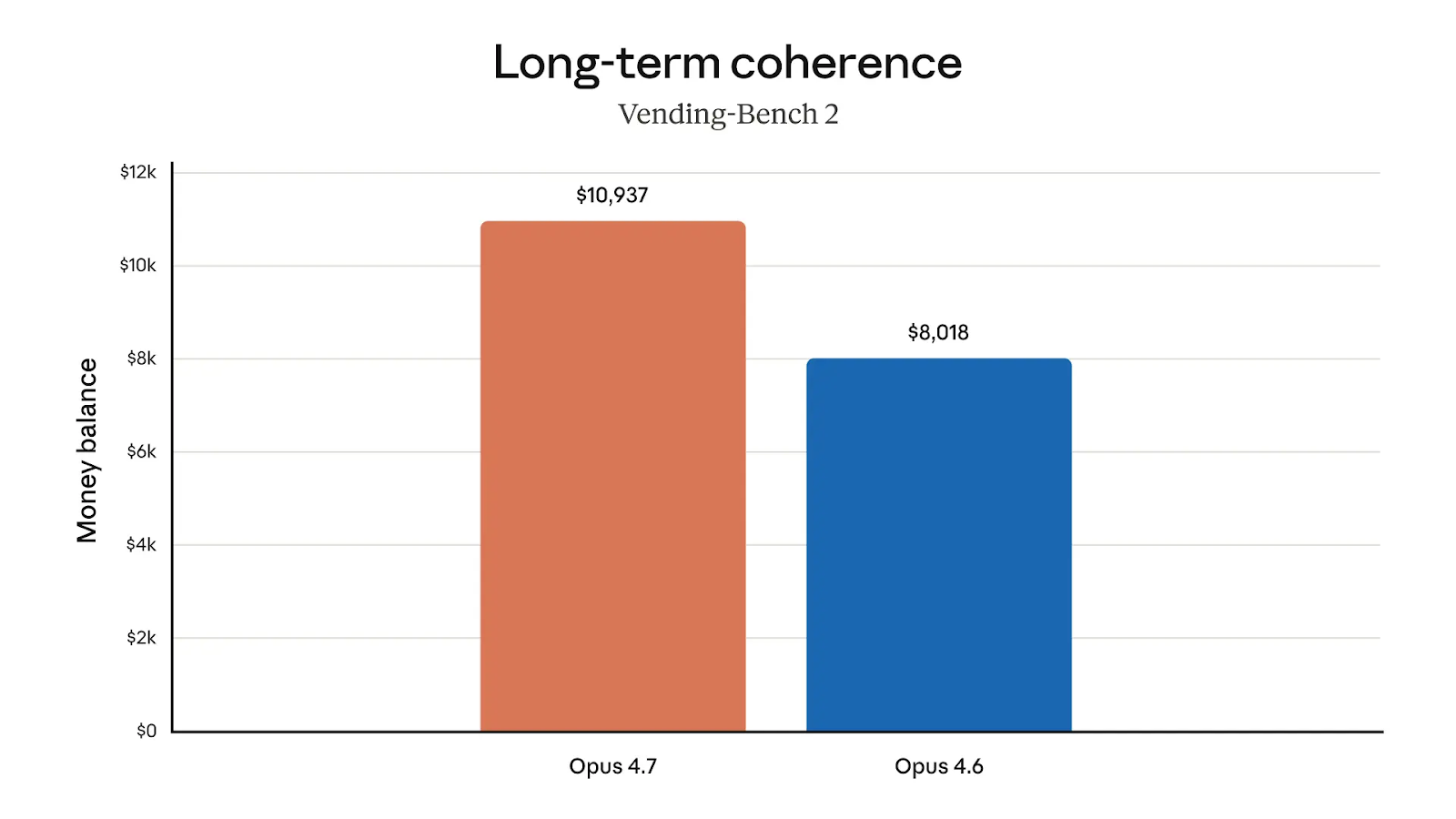
Im praxisorientierteren Vending-Bench 2 zeigt sich: Opus 4.7 geht auch besser mit Geld um. Im Schnitt endete das Modell mit 10.937 $, gegenüber 8.018 $ bei Opus 4.6.
Anthropic lässt uns nicht warten. Opus 4.7 ist jetzt verfügbar
In allen Claude-Produkten
Über die Claude API (claude-opus-4-7)
Vertex AI und
Microsoft Foundry
Gerade jetzt denkt man schnell an Inflation. Zum Glück bleibt der Preis wie bei Opus 4.6: 5 $ pro Million Input-Tokens und 25 $ pro Million Output-Tokens. (Zwischen Opus 4.6 und 4.7 gab es also keine Preiserhöhung.)
Allgemein zur Erinnerung, falls du Opus in Claude.ai nutzt: Jede Nachricht enthält die gesamte Unterhaltung bis dahin (deine neue Frage + der bisherige Verlauf) plus die Antwort des Modells. All das wird in Tokens gemessen. Dein Tarif, welcher auch immer, hat ein Tokenbudget, das sich rollierend erneuert.
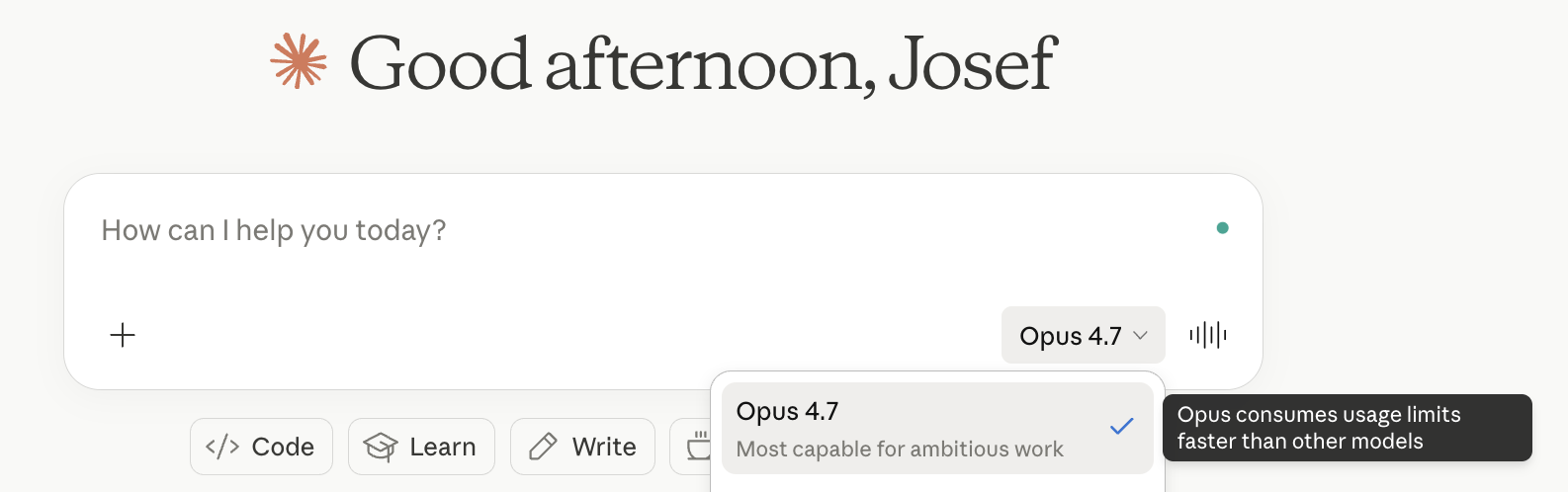
Unterschiedliche Modelle belasten dieses Budget unterschiedlich. Opus ist am teuersten, weil es am leistungsfähigsten ist. Als grobe veröffentlichte Relation: Opus kostet pro Token etwa das Fünffache von Sonnet.
Anthropic hat parallel zum Modell selbst mehrere Updates ausgeliefert, die du kennen solltest – vor allem, wenn du Claude Code nutzt oder auf der API aufbaust.
Eine neue xhigh („extra high“) Effort-Stufe liegt nun zwischen high und max. Damit kannst du die Balance zwischen Reasoning-Tiefe und Latenz feiner steuern. In Claude Code wurde die Standardstufe über alle Pläne hinweg auf xhigh angehoben. Anthropic empfiehlt, bei Coding- und agentischen Aufgaben mit high oder xhigh zu starten.
Claude Code hat den neuen Slash-Befehl /ultrareview erhalten. Er führt einen dedizierten Review-Durchlauf über deine Änderungen aus und markiert Bugs oder Designprobleme, die auch einem sorgfältigen menschlichen Reviewer auffallen würden. Pro- und Max-User bekommen drei kostenlose Ultrareviews zum Ausprobieren.
Max-User erhalten Zugriff auf den Auto Mode, eine Berechtigungsstufe, bei der Claude Entscheidungen in deinem Namen trifft. Das ist der Mittelweg zwischen dem Bestätigen jedes Schritts und dem völligen Überspringen von Berechtigungen.
Task-Budgets sind jetzt als Public Beta in der Claude API verfügbar. Entwickler können damit den Tokenverbrauch von Claude über einen Run deckeln – besonders nützlich bei längeren Agent-Workflows, bei denen sich das Modell sein Budget einteilen soll, statt es schnell zu verbrauchen.
Wir haben die Benchmarks genau betrachtet – inklusive der dort enthaltenen Vergleiche. Auf hoher Flughöhe vergleichen wir Opus 4.7 direkt mit GPT-5.4.
Die Quintessenz: Opus 4.7 ist auf Autonomie über lange Horizonte optimiert. GPT-5.4 ist ein einheitliches Allzweckmodell mit breiterem Tool-Support und günstigeren Preisen für kurze Kontexte.
| Claude Opus 4.7 | GPT-5.4 | |
|---|---|---|
| Am besten bei | Lange Coding-Runs, Desktop-Computer-Use, dichte Vision |
Browser-Recherche, Kurzkontext-Aufgaben, Steuerung während der Antwort |
| SWE-bench Pro | 64,3% | 57,7% |
| BrowseComp | 79,3% | 89,3% |
| Pricing | Flatrate über 1M Kontext | Günstiger unter 272K, gesamte Session wird darüber neu bepreist |
| Kontextfenster | ~1M Tokens | ~1M Tokens |
Den vollständigen Vergleich mit OpenAIs Nachfolgemodell GPT-5.5 findest du in unserem Blogpost Claude Opus 4.7 vs. GPT-5.5.
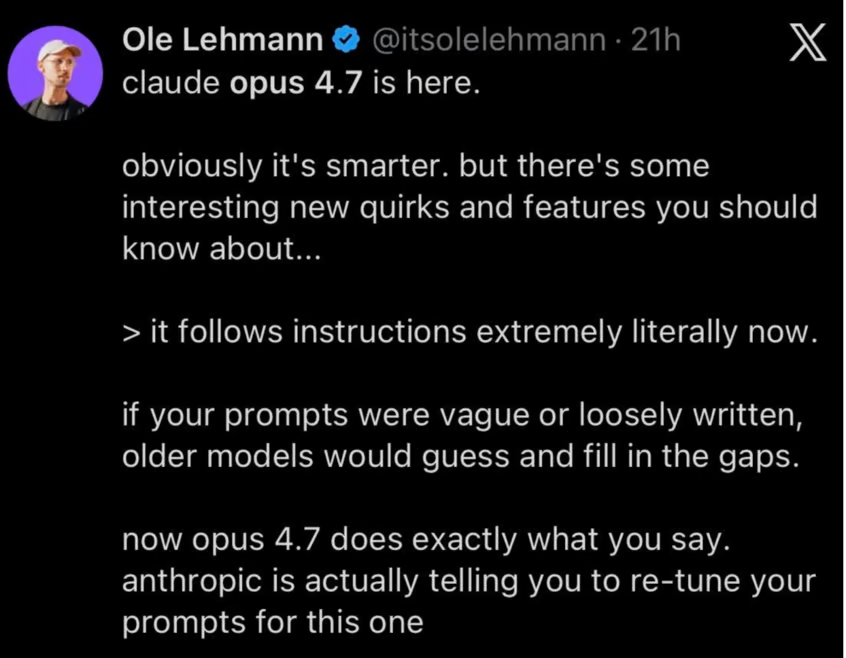
Einige Nutzer berichten, dass ihre Pipelines aus dem Tritt geraten, weil Opus 4.7 Anweisungen wörtlicher nimmt als zuvor. Anthropic hatte auf die Notwendigkeit hingewiesen, Prompts neu abzustimmen.
Andere machten sich Sorgen um den Tokenverbrauch. Im Zuge des Releases hat Anthropic die Ratenlimits für alle Nutzer angehoben, um den höheren Verbrauch auszugleichen, aber ob das wirklich reicht, ist noch unklar.
Claude Opus 4.7 ist derzeit das leistungsfähigste Modell, das die meisten Menschen tatsächlich nutzen können. Alle Verbesserungen zielen in dieselbe Richtung: länger laufende, weniger beaufsichtigte Agentenarbeit – mit stärkerem Coding, schärferer Vision und besserem Sitzungs-übergreifendem Gedächtnis als Fundament.
Spannend an diesem Release ist der Mythos-Rahmen: Opus 4.7 ist ein cyber-begrenztes Testfahrzeug auf dem Weg zu einem breiteren Mythos-Release. Das heißt, es gibt nun klar eine Decke darüber, die du nicht erreichen kannst – aber die mit 4.7 ausgelieferten Schutzmechanismen sind zugleich ein Vorgeschmack darauf, wie Anthropic künftige Frontier-Releases absichern will.
Lerne mit DataCamp
{count, plural, one {Lernpfad} other {Lernpfade}}
{count, plural, one {Kurs} other {Kurse}}
{count, plural, one {Kurs} other {Kurse}}
{count, plural, one {Blog} other {Blogs}}
Hesam Sheikh Hassani
15 Min.
{count, plural, one {Blog} other {Blogs}}
{count, plural, one {Blog} other {Blogs}}
Nathaniel Taylor-Leach
8 Min.
{count, plural, one {Blog} other {Blogs}}
Zoumana Keita
15 Min.
{count, plural, one {Blog} other {Blogs}}
Nathaniel Taylor-Leach
{count, plural, one {Tutorial} other {Tutorials}}
Kurtis Pykes
15 Min.


