Course
Developing AI Systems with the OpenAI API
3 hr
22.8K
TypeSafe came out of stealth on 15 September 2026 with Jev, a model it calls a System One model: you send it program state and typed questions, and it returns decisions with calibrated probabilities instead of text. Twelve days earlier, OpenAI shipped GPT-6 Astra, which it describes as its most intelligent and aligned model, built for computer use, coding, and professional work end to end.
In this article, I'll compare Jev and GPT-6 Astra across output reliability, decision accuracy, speed, agentic scope, and pricing, and then say which calls in a software pipeline belong to which model.
Jev is a hosted decision model that TypeSafe AI released in early access in September 2026, the first of what it calls System One models.
Its selling point is that it gives up text generation: you define the answer space in advance as Choice, Score, or Noul (yes/no) questions, and it returns typed values with calibrated probabilities that software can branch on directly. Our Jev guide covers the launch and TypeSafe's evaluation claims.
GPT-6 Astra is OpenAI's frontier flagship, released on 3 September 2026 as the successor to GPT-5.6 Sol.
Its positioning is autonomous execution: OpenAI calls it the world's best computer-use model and its most aligned one, trained to fill out forms, update a CRM, build and QA a website, and produce documents that follow your templates. Our GPT-6 Astra guide covers the launch; our GPT-6 Astra API tutorial builds a release-check agent with async tools.
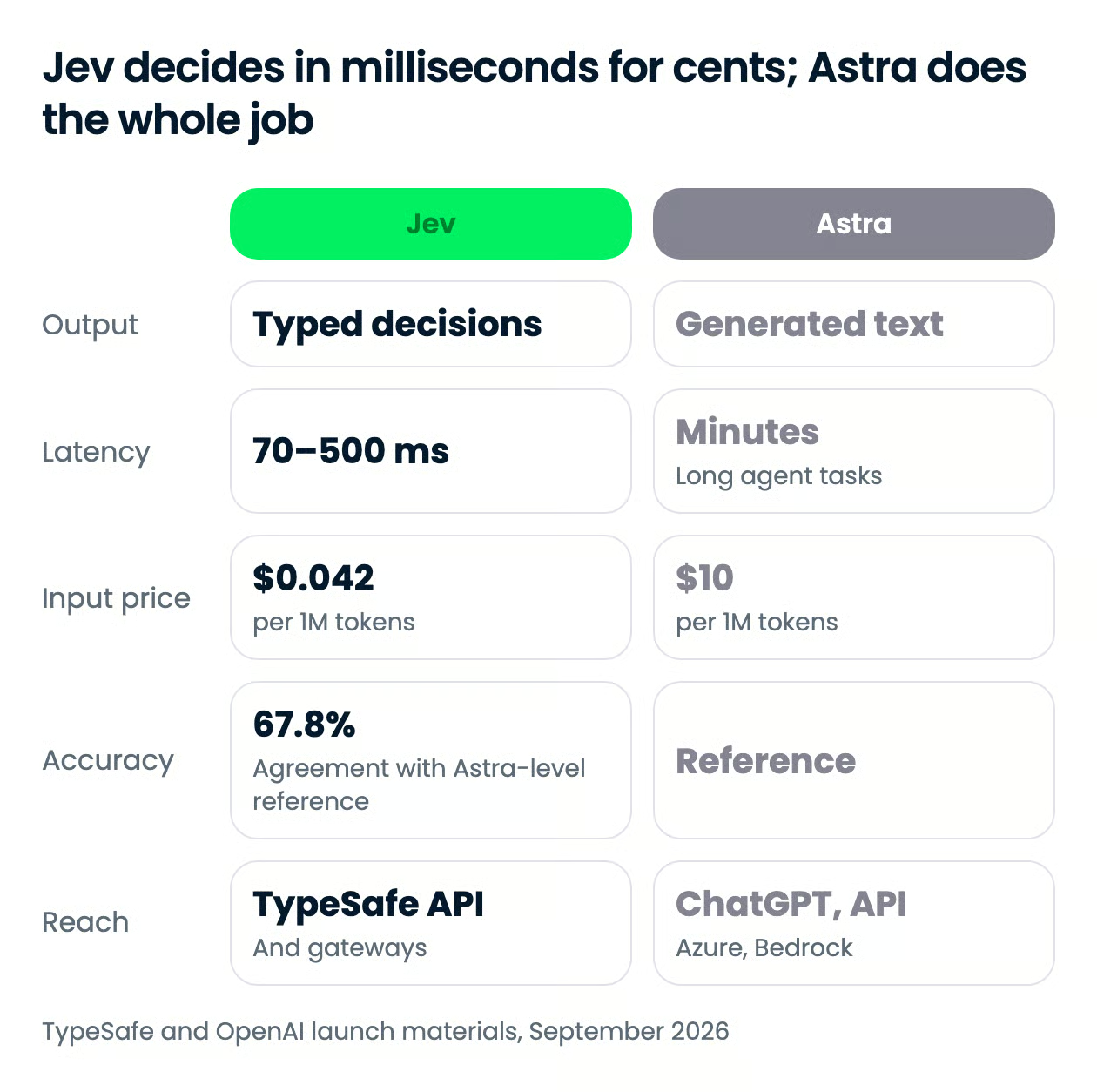
The two models sit at opposite ends of one trade: Jev buys speed, price, and type safety by refusing to generate text, and Astra buys breadth and depth by generating everything. Most of the rows below follow from that single design choice.
| Feature | Jev | GPT-6 Astra |
|---|---|---|
| Output | Typed decisions (Choice, Score, Noul) with probabilities; no text | Generated text; structured outputs and function calling supported |
| Type or schema errors | 0% by construction | Possible; 4.2% on OpenAI's internal hallucination benchmark |
| Input | Text, JSON objects, arrays; no images | Text and images |
| Context window | Not stated in TypeSafe's docs; 32,000 tokens on the OpenRouter and Vercel AI Gateway listings | 1,050,000 tokens; 128,000 max output |
| End-to-end latency | 70 to 500 ms per call (vendor-reported) | Minutes on agent tasks; about 40 minutes per OSWorld 2.0 task |
| Decision accuracy | 67.8% agreement with an Astra + Fable 5.1 reference on TypeSafe's 4-workflow eval | Is the reference; 96.0% GPQA Diamond, 97.6% FrontierMath Tier 4 |
| Agents and tools | None; a decision inside your code | Computer use, hosted shell, web search, code interpreter; 72.6% OSWorld 2.0 |
| Confidence | Calibrated probability on every answer, plus a derived confidence score | Not exposed as a field |
| Price per 1M tokens | $0.042 input; output free | $10 input; $50 output |
| Availability | Early access via TypeSafe API, OpenRouter, Vercel AI Gateway | ChatGPT paid tiers, OpenAI API, Azure, AWS Bedrock, GitHub Copilot, OpenRouter |
Jev cannot produce an invalid value, and Astra can. That single fact is why the two end up in different layers of a system rather than in the same slot.
A Jev request is a block of state plus a map of typed questions:
The answer space is fixed before inference, so schema matching is guaranteed; TypeSafe puts its structured-output and tool-call error rate at 0% and calls the figure non-empirical.
Astra represents a classic LLM and returns text. While it supports structured outputs and function calling, and cuts Sol's error rate to about a third on OpenAI's internal hallucination benchmark, the output still has to be parsed and validated. TypeSafe's chart puts Frontier LLM's structured-output error between 0.58% and 45.5%; Astra's own figure is not published, so I would not assume it sits at the low end.
The cost of Jev's guarantee is that you get no rationale, only a probability: fine for a routing layer, not for a compliance reviewer, so plan to escalate low-confidence cases to a model that can write.
Two caveats on the reliability numbers:
For output that must parse on the first try, Jev's contract wins; for anything a person reads, only Astra can answer.
Astra is more accurate. On TypeSafe's four production workflows (incident response, agent-trace observability, invoice processing, customer service), Jev agrees with the average of Astra and Claude Fable 5.1 67.8% of the time, tied with GPT-5.6 Terra and 5 to 6 points behind GPT-5.6 Sol and Claude Opus 5.
Astra is the reference there, so it has no agreement score of its own. On its own benchmarks, it saturates FrontierMath Tier 4, GPQA Diamond, and ARC-AGI-3, though the last depends on a stateful harness. Jev does not reason across turns, plan, or explain, and grading it on agreement with LLMs rather than ground truth, as TypeSafe does, risks inheriting the reference models' biases.
If peak accuracy on a low-volume decision is what you need, the LLM still wins.
Jev answers in 70 to 500 milliseconds end-to-end, by TypeSafe's measurements, compared to 3 to 329 seconds for frontier LLMs on the same kind of query. It samples all answers in parallel rather than one token at a time and accepts up to 255 options per Choice.
Astra is fast for what it is: about 47% less time per OSWorld 2.0 task than Sol, and Fast mode delivers up to 2x the speed at 2x the price. Those tasks still take tens of minutes. A TypeSafe engineer's Doom bot runs 10 queries a second for about $7 an hour, a budget no frontier LLM can meet.
For a decision request path with a 100 ms budget, Jev is the only candidate here.
Astra does everything Jev does not:
Jev takes text, JSON, or arrays of text, not images, and calls no tools. It is the fuzzy if-statement inside a workflow your code owns: classify, route, score, extract, or verify another model's output, including jailbreak detection on LLM prompts.
Astra wins this dimension outright because Jev is not entered in it.
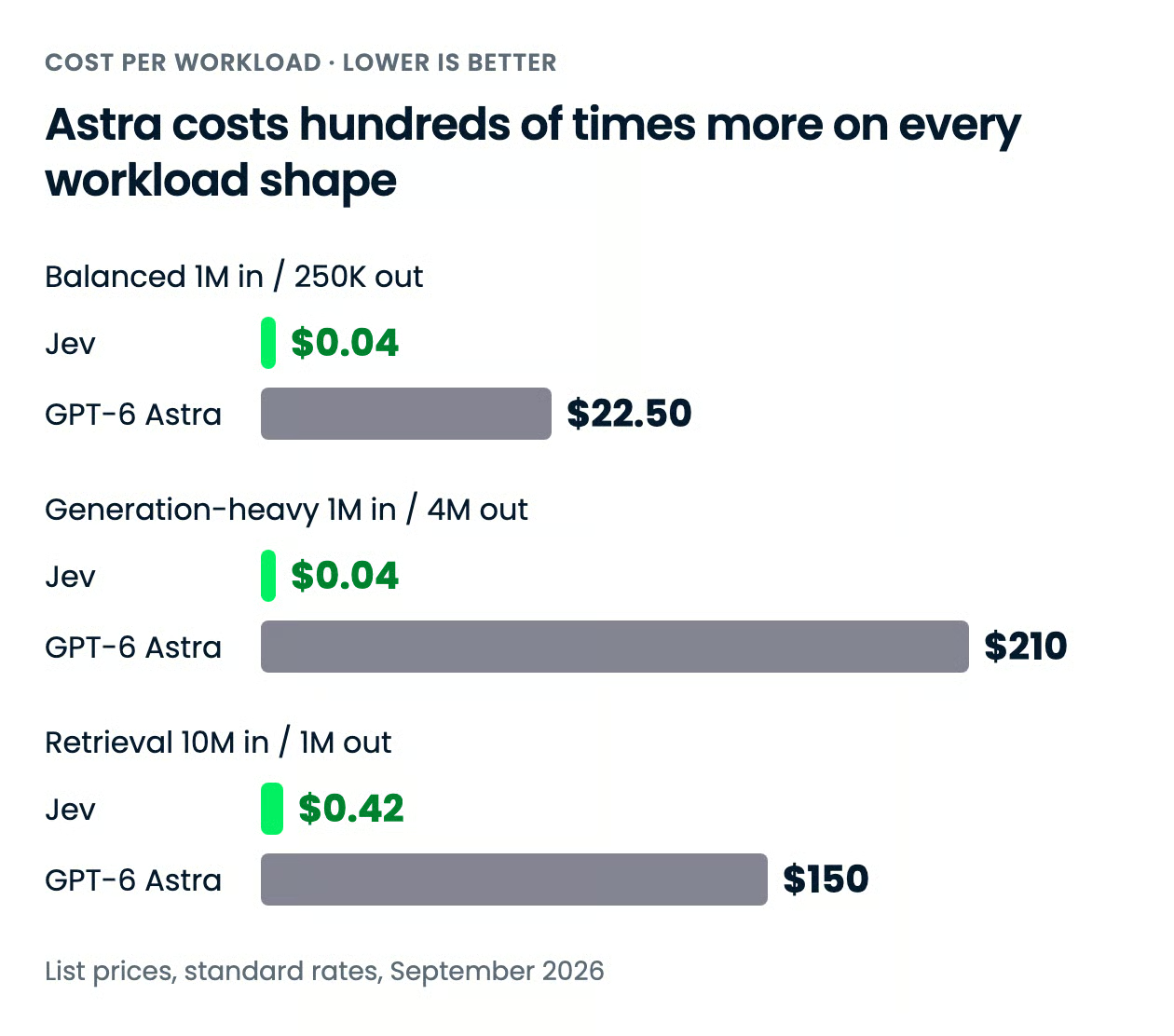
Astra costs several hundred times more than Jev on any workload shape, and the gap widens the more output the task produces, because Jev does not bill output at all.
| Rate | Jev | GPT-6 Astra |
|---|---|---|
| Input, per 1M tokens | $0.042 | $10.00 |
| Output, per 1M tokens | Free | $50.00 |
| Cached input read, per 1M tokens | Not published | $1.00 |
| Cache write, per 1M tokens | Not published | $12.50 |
| Batch discount | Not published | 50% (Batch and Flex) |
| Long-context surcharge | Not published | 2x input and cache, 1.5x output, above 272K input tokens |
| Fast mode | Not applicable | 2x the applicable rates |
| Consumer tier | Not applicable; API only | ChatGPT Plus, Pro, Business, Enterprise (Astra Pro on Pro and above) |
The shape of the difference matters as much as the size. Astra's output rate is 5x its input rate, and its reasoning tokens bill as output, so thinking-heavy or verbose work is where its bill grows fastest. Jev bills only input, and a typical answer is a few dozen output tokens, so its cost is a function of how much state you send and nothing else.
TypeSafe is candid that it cannot prove the pricing is not subsidized, and expects it to fall rather than rise.
| Workload | Jev | GPT-6 Astra | Difference |
|---|---|---|---|
| Balanced assistant: 1M in / 250K out | $0.04 | $22.50 | $22.46, Jev 99.8% cheaper |
| Generation-heavy: 1M in / 4M out | $0.04 | $210 | $209.96, Jev 99.98% cheaper |
| Retrieval, sub-threshold: 10M in / 1M out | $0.42 | $150 | $149.58, Jev 99.7% cheaper |
The formula is (volume ÷ 1M) × rate, summed across input and output, at standard rates. The generation-heavy row is the outlier because Jev's output is free, though it is also the least realistic row for Jev: the model never emits 4M output tokens, so read it as what the output premium alone does to Astra. The retrieval row is the one that matches how Jev is actually used, lots of state in and a handful of probabilities out, and it is still 357x apart.
There is no over-threshold retrieval row because TypeSafe's docs state no long-context surcharge, and the context window the routers list for Jev sits far below Astra's threshold, so Astra's 2x input and 1.5x output multipliers have nothing to be compared against. Neither vendor has published token counts for a shared workload, and Jev's tokenizer is not documented, so treat these totals as a rate comparison rather than a bill.
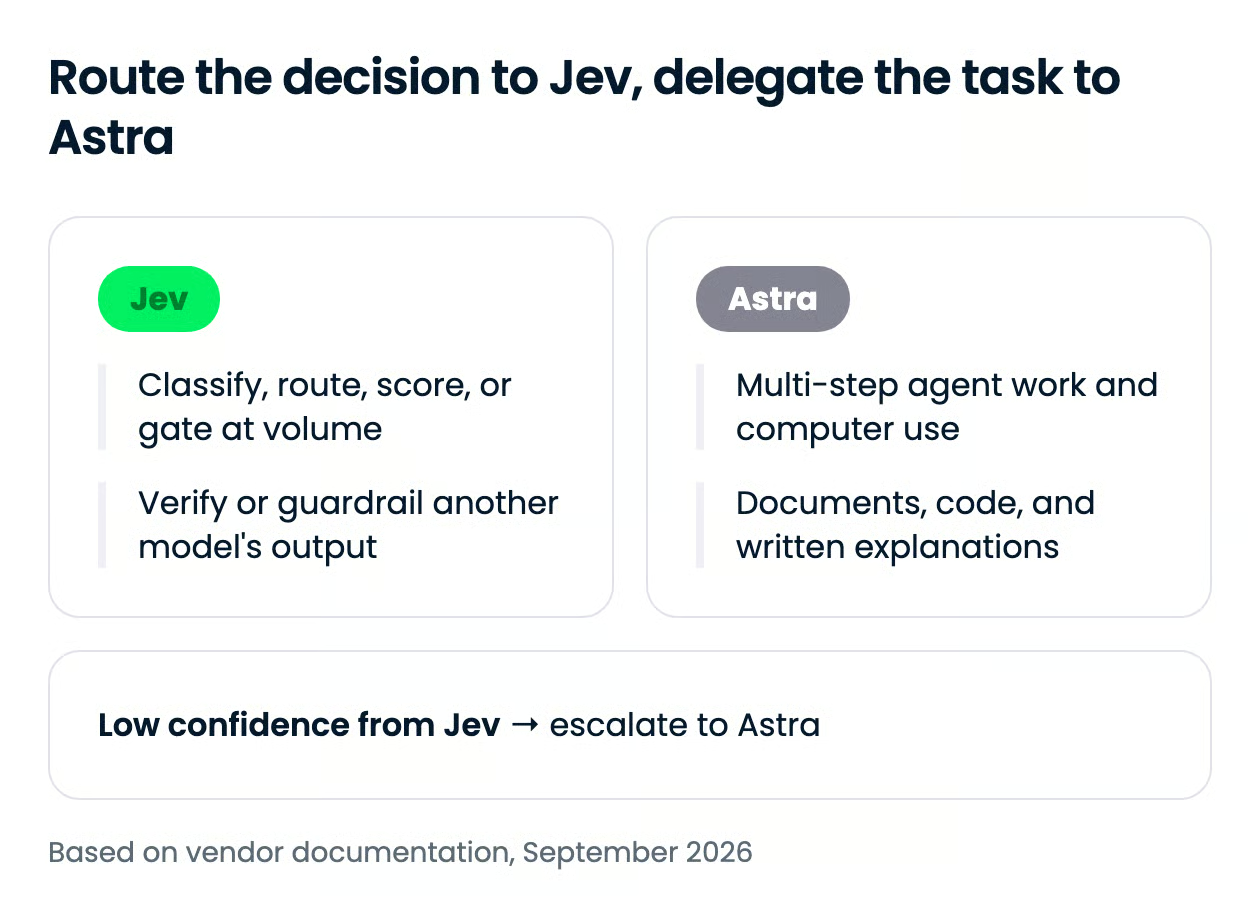
The fork is not accurate or priced on its own, but rather whether the step ends in a decision or in an artifact. A decision belongs to Jev; anything someone will read, run, or open belongs to Astra.
Reach is the most lopsided dimension in this article: Astra is everywhere OpenAI models usually are, and Jev is a waitlist-gated API whose only routes without an invite are the OpenRouter and Vercel AI Gateway listings.
| Surface | Jev | GPT-6 Astra |
|---|---|---|
| Consumer app | None; developer console only | ChatGPT Plus, Pro, Business, and Enterprise; off by default for Enterprise workspaces at launch |
| First-party API | TypeSafe API, early access via waitlist only; no self-serve signup | OpenAI API (Responses and Chat Completions), rolling out over the days after launch |
| Cloud platforms | None | Microsoft Azure AI Foundry, AWS Bedrock (us.openai.gpt-6-astra) |
| Coding agents | Not applicable; produces no text or tool calls | Codex, GitHub Copilot; not listed in the Cursor docs as of 21 September 2026 |
| Third-party routers | OpenRouter (typesafe/jev-1.13, via a dedicated systemone endpoint), Vercel AI Gateway (typesafe-ai/jev) |
OpenRouter (openai/gpt-6-astra) |
| API model ID | jev-latest (alias for jev-1.13.0) |
gpt-6-astra |
The model IDs are jev-latest, which TypeSafe's SDKs default to and which currently resolves to jev-1.13.0, and gpt-6-astra. TypeSafe recommends pinning the versioned ID if you have tuned confidence thresholds, because the alias moves when a new release ships. Jev's rate limits are 250,000 tokens per second and 1,200 requests per minute, and TypeSafe says both can change without notice while it scales.
These are not a one-string swap. Astra takes a prompt and returns text through the Responses API; Jev takes state and a map of typed questions through a single endpoint and returns probabilities. The two blocks below put the same returns request to each model, so you can see the difference in shape.
from openai import OpenAI

client = OpenAI()
response = client.responses.create(
    model="gpt-6-astra",
    input="A bike-shop customer writes: 'The frame arrived scratched, I want this "
          "sorted before my race on Sunday.' Resolve as refund, replacement, or repair.",
)
print(response.output_text)  # free text you still have to parse
import requests
response = requests.post(
"https://api.typesafe.ai/v1/systemone",
headers={"Authorization": "Bearer YOUR_TYPESAFE_KEY"},
json={
"model": "jev-latest",
"state": "The frame arrived scratched, I want this sorted before my race on Sunday.",
"questions": {
"resolution": {
"type": "choice",
"instructions": "How should the shop resolve this return?",
"criteria": {"refund": "Customer wants money back",
"replacement": "Same item, undamaged, shipped fast",
"repair": "Cosmetic fix is acceptable"},
}
},
},
)
answer = response.json()["answers"]["resolution"]
print(answer["choice"], answer["confidence"]) # typed option plus 0-1 confidenceFor the full Astra setup, including async tools and mid-turn steering, follow our GPT-6 Astra API tutorial; for structured JSON from OpenAI models, see our structured outputs tutorial.
If the step ends in a decision your code acts on, use Jev; if it ends in something a person reads or runs, use GPT-6 Astra. The architecture this launch suggests is both at once: Jev as the cheap, calibrated router in front, Astra as the specialist it escalates to when confidence drops.
What I find most telling is that TypeSafe grades Jev against Astra's answers. OpenAI is making a statement that the frontier is autonomous execution; TypeSafe is betting that most of what software asks a model is a bounded question in disguise. The open question for Jev is whether an independent benchmark confirms the parity and whether the pricing survives the subsidy.
To build the decision layer either model sits in, I recommend our Developing AI Systems with the OpenAI API course and our AI Agent Fundamentals track.
Learn AI Engineering With DataCamp!
Course
Track
Course
blog
Tom Farnschläder
15 min
blog
Matt Crabtree
12 min
blog
Derrick Mwiti
8 min
blog
Matt Crabtree
10 min
blog
Tom Farnschläder
11 min
blog
Tom Farnschläder
11 min