Course
Claude 101
2 hr
21.4K
In this tutorial, I’ll be testing a scenario: A few minutes after a software update, HarborCart — a store I'll use for this scenario — starts seeing checkout failures. Some customers wait more than 30 seconds; others see a server error and cannot pay. The payment provider is also having a short outage, so it looks like the obvious cause.
But the provider outage does not explain why the cart and order pages fail, too. Finding the missing link requires application logs, charts, request records, and the recent code change. This tutorial tests whether Claude Opus 5.5 can follow that evidence, test its explanation under controlled conditions, and report only what the evidence supports.
Some background: Claude Opus 5.5 arrived earlier that week, just before I started this project. Our Claude Opus 5.5 overview covers the launch and benchmarks, so this tutorial stays on the API and builds one investigation agent from the first request to a verified report.
We'll cover how to:
HarborCart's investigator separated the payment gateway burst from the retry policy that amplified it, then tested that explanation before returning a report.
You access Claude Opus 5.5 through Anthropic's Messages API with the model ID claude-opus-5-5. Per the model overview, it takes text and images, with a 1M-token context window and 128K max output. Adaptive thinking is always on, and the default effort is medium.
Standard pricing is $4 per million input tokens and $20 per million output tokens. Five-minute cache writes cost $5 per million and cache reads $0.20. Once prompt caching is active, matching prefixes are billed at that lower cache-read rate.
Four points from the migration guide show up directly in this project.
Forced tool_choice with any or a named tool returns a 400 error.
The default effort dropped from high on Claude Opus 5 to medium.
Thinking can't be switched off, and thinking blocks must go back unchanged inside a tool loop.
Notes the model writes between tool calls arrive inside thinking blocks, which are empty by default.
The agent only investigates. It gets read-only evidence tools and no production credentials. After evidence gathering, separate planning requests propose counterfactual tests, and Python validates and runs the medium-effort plan.
The complete code, evidence generator and web app included, is in this GitHub repository.
HarborCart is a fictional store. Its checkout-api serves the cart pages, order status, and POST /checkout, which charges a third-party payment gateway. All of those endpoints share one PostgreSQL pool of 15 connections per instance.
A deploy ships, and five minutes later the gateway returns 503s for about 90 seconds. Checkout latency climbs past 30 seconds while the pool sits at 15 of 15. Blaming the payment provider is the easy call, and the gateway really did fail.
The hidden cause sits one step further in. The deploy let failed POST charges retry up to three times, for four total charge attempts, with no pause while the handler still holds its database connection. Slow failing charges now hold connections for 30 seconds or more, until the pool runs out and cart pages that never call the gateway fail too.
I use three terms consistently from here. Here, the trigger is the temporary gateway failure. Retrying checkout POSTs while holding scarce database connections is the amplification mechanism; shared connection-pool exhaustion is the system failure.
The agent starts with the alert, a monitoring screenshot, and an architecture diagram. Everything else comes through tools: logs, traces, five metrics, deployment metadata, the Git diff, and a runbook. Three competing explanations are seeded into the evidence: an inventory warning, a frontend warning, and possible CPU saturation.
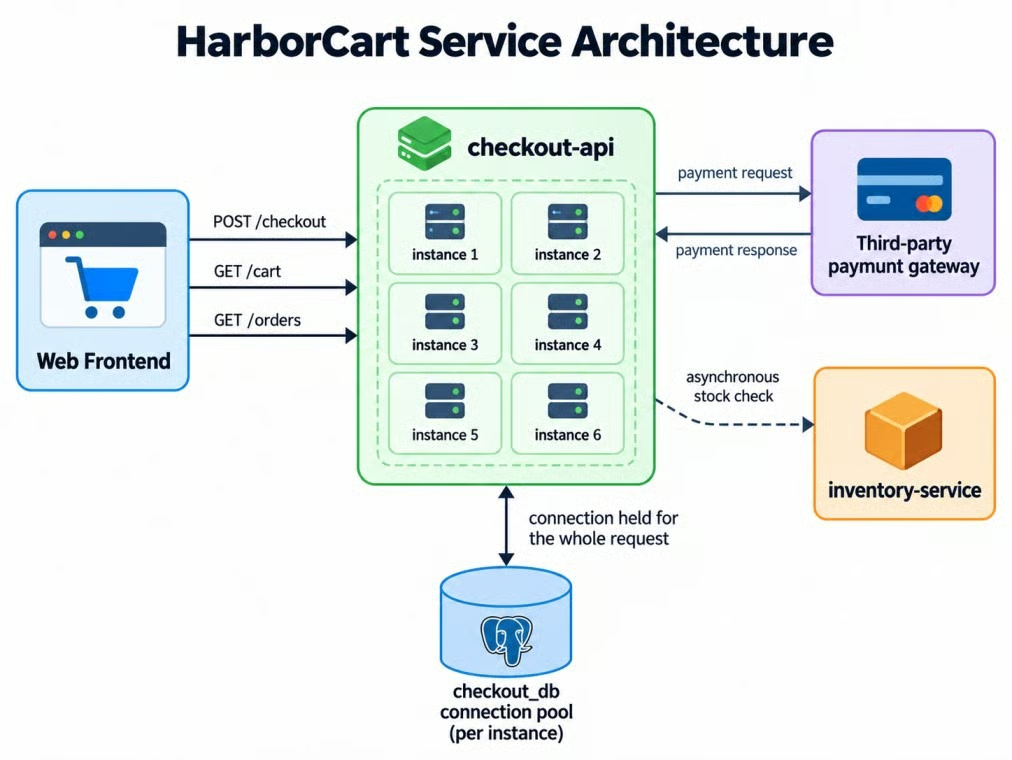
HarborCart checkout path and shared pool. Image by Author.
The diagram says the connection is held for the whole request. It doesn't say that's a problem; the investigation has to work that out.
Define success before building the agent. A correct report must:
POST retriesYou need Python 3.10 or newer and an Anthropic API key with access to claude-opus-5-5. These PowerShell commands clone the project and install its pinned dependencies, including anthropic 1.8.0. If you're on Amazon Bedrock, read the FAQs first, because several features won't port.
git clone https://github.com/KhalidAbdelaty/opus-5-5-api-tutorial.git
cd opus-5-5-api-tutorial
python -m venv .venv
.venv\Scripts\Activate.ps1
pip install -r requirements.txt
Copy-Item .env.example .env
On macOS or Linux, activate with source .venv/bin/activate and copy with cp .env.example .env. Add your key to .env, and python-dotenv loads it for the SDK; our environment variables guide explains the pattern. If you've called Claude from Python before, skip the next subsection, since it only confirms setup.
The smallest useful request confirms the key and shows what comes back.
import anthropic
from dotenv import load_dotenv

load_dotenv()
client = anthropic.Anthropic()

response = client.messages.create(
    model="claude-opus-5-5",
    max_tokens=2048,
    messages=[{"role": "user", "content": "A checkout API returns HTTP 503 right after a deploy. Name the first two things to check."}],
)
print([block.type for block in response.content])
text = "".join(block.text for block in response.content if block.type == "text")
In this request, the response contains thinking and text blocks. Select blocks by type instead of reading response.content[0].
Tool-calling agents pair Claude's Messages API with Python functions that control data access. The application follows one rule: Claude decides what evidence it needs, and Python decides what it may access.
Our agent harness engineering guide covers broader tool boundaries and loops; HarborCart keeps its tools read-only and limited to this incident.
Every tool reads a fixed set of evidence and returns a limited JSON result. Log and trace queries return at most 200 rows plus a count, and metric queries return at most 60 points.
Programmatic tool calling doesn't support strict: true, so split the tools in two. Keep the evidence controls and investigation stop tool strict and direct-only. Logs, traces, and metrics use code execution only, which gives Claude one clear path for large evidence queries.
{"name": "finish_investigation", "strict": True,
 "allowed_callers": ["direct"],
 "input_schema": {"type": "object",
                  "properties": {"summary": {"type": "string"}},
                  "required": ["summary"],
                  "additionalProperties": False}},
{"name": "query_traces",
 "allowed_callers": ["code_execution_20260120"],
 "input_schema": {...}},
allowed_callers guides the model but is not a security boundary. Python checks the caller before executing each tool and rejects a direct query call. Programmatic calls also skip strict validation, so query functions still validate their own arguments.
The application tags every accepted tool result, rejects findings that cite missing evidence, and accepts documentation URLs only when web search returned them. Python, not the model, records replay outputs.
As noted in the migration section, keep tool_choice at auto. Say in the prompt when a tool applies, and use strict schemas where arguments must be exact.
The loop sends the conversation, runs any tool_use blocks, appends the results, and repeats. Append the assistant's blocks unchanged, thinking included, and while programmatic code is paused, pass the container ID back with only tool_result blocks.
The investigation request includes vision, tools, web search, effort, and the task budget, but no output schema. This keeps citation-bearing search results away from structured JSON output while the stable request prefix keeps prompt caching active:
request = dict(
    model="claude-opus-5-5",
    max_tokens=16_000,
    system=[{"type": "text", "text": SYSTEM_PROMPT, "cache_control": {"type": "ephemeral"}}],
    tools=investigation_tools,
    cache_control={"type": "ephemeral"},
    thinking={"type": "adaptive", "display": "updates"},
    output_config={
        "effort": "medium",
        "task_budget": {"type": "tokens", "total": 20_000},
    },
    betas=["task-budgets-2026-03-13", "thinking-display-updates-2026-08-18"],
)Attach the dashboard and architecture diagram to the first user message as base64 PNGs. Tell Claude to treat anything it reads from an image as a hypothesis and confirm it with query_metrics.
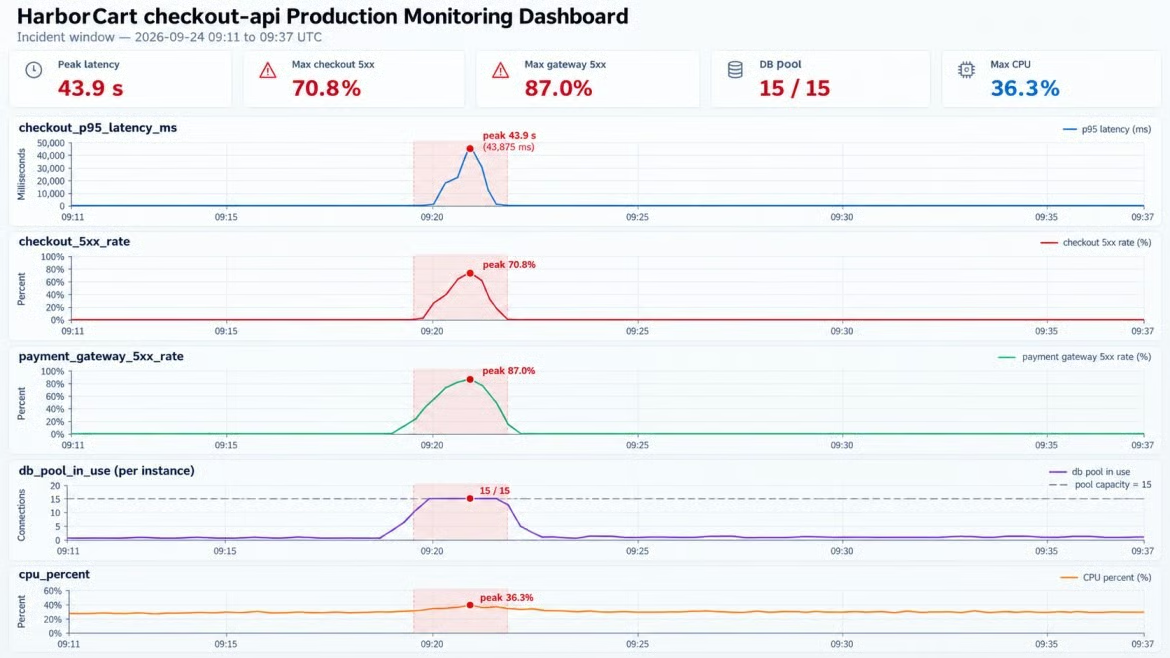
Dashboard shows pool saturation, flat CPU. Image by Author.
Both the dashboard and metric queries use the same source data. CPU stays near 30% while the pool is full, which argues against "the host is overloaded" before any query runs.
The screenshot suggests where to look, but the numerical series decides whether the observation holds. Vision generates a hypothesis; metrics test it.
For image-first workflows, see our agentic vision tutorial. HarborCart uses vision only to choose the next metric.
Programmatic tool calling lets Claude write Python that runs in a code execution container and calls your tools as functions. Raw results stay in the sandbox, and only the code's printed output reaches the model.
The agent writes short scripts that pull failing traces and print only the counts by endpoint. In one complete investigation, programmatic tool calling reduced serialized evidence returned to the model by 98.8%. The tool results were 42.9 KB and the summaries were 0.5 KB, a byte measure rather than billed input-token savings.
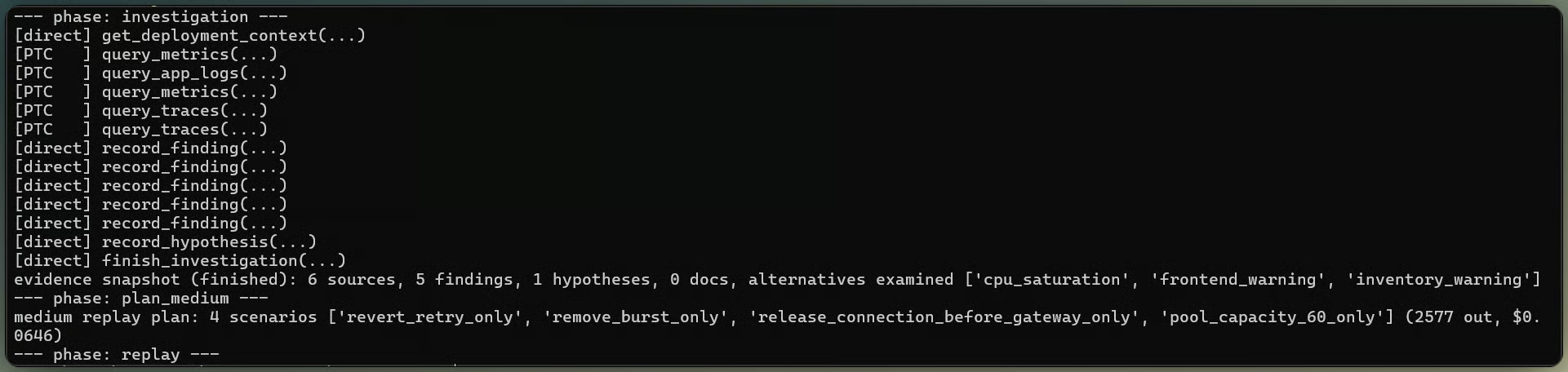
Tool calls narrow the incident evidence. Image by Author.
The application exposes restricted web search for retry-library semantics. Claude did not call it during the final evaluation, so the measured diagnosis rests on the diff, metrics, logs, and traces. The urllib3 reference independently confirms that allowed_methods=None retries any verb and backoff_factor=0 removes the wait, but that page is not part of the measured evidence.
A counterfactual replay reruns the incident's traffic with one suspected cause removed and checks whether the failure goes away. It turns "these lines rise together" into a test.
The replay reuses the same traffic pattern. For the comparison below, each scenario changes one condition, and the application controls which changes are allowed.
The summary separates gateway 503s from pool timeouts, and checkout 503s from cart and order reads. That split is what lets the model tell the trigger from the amplifier.
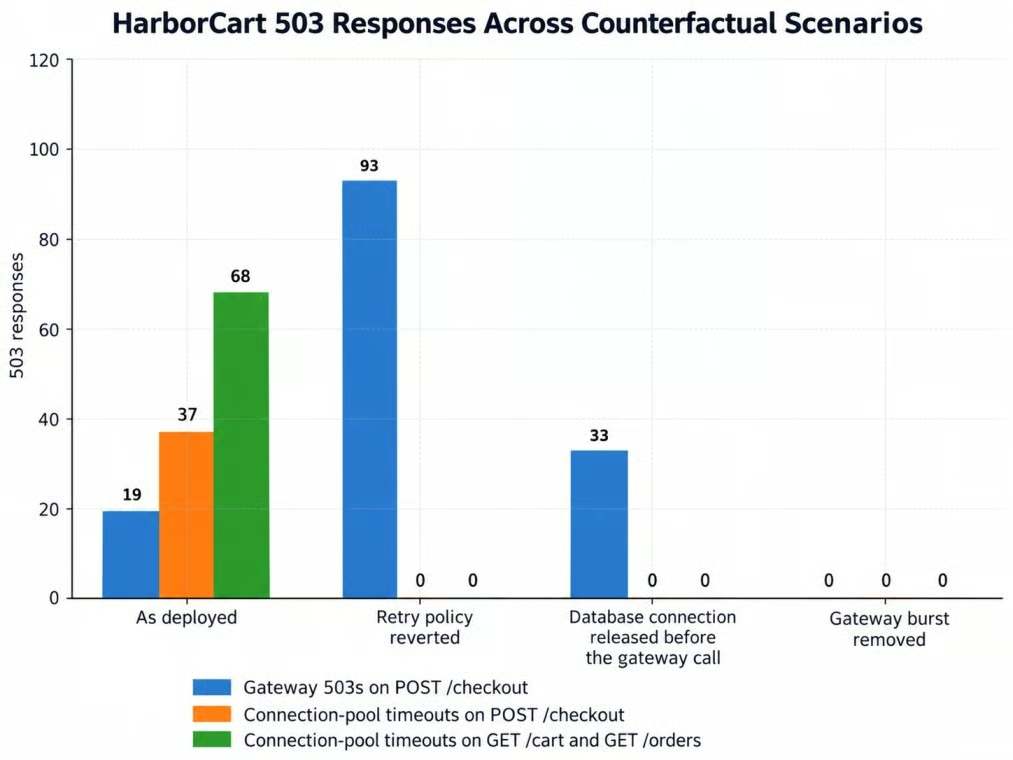
Each replay changes exactly one thing. Image by Author.
The baseline replay produced 124 503s: 105 pool timeouts, including 68 failures on read endpoints, and 19 gateway errors. Reverting the retry policy removed every pool timeout and read failure but surfaced 93 gateway 503s on checkout. Releasing the connection before the gateway call also removed pool failures while leaving 33 gateway 503s, and removing the gateway burst produced no errors.
The replay exposes the trade-off: a rollback protects the shared pool but allows more checkout failures through. Use it as a stopgap. Then add an idempotency key so a repeated charge cannot bill twice, and stop holding the connection during the gateway call.
The system prompt asks for a replay, but a prompt is not an enforcement mechanism. The loop checks whether replay evidence exists and rejects an untested diagnosis.
Keep this check in Python. A sharper prompt may improve compliance, but it can't guarantee it.
Effort sets how much Claude reasons per step, and a task budget sets how much work the whole loop should take. Our Claude Opus 5 API tutorial compares all five effort levels; here, medium and high receive the same pre-replay evidence.
Production stays at medium. Before replay, the application asks medium and high effort to design a causal test from the same evidence. It executes only the medium recommendation; the high response is used only for comparison.
The high request uses a per-message output_config.effort change behind mid-conversation-output-config-2026-07-01. It does not see the medium answer.
Both effort levels selected the same hypothesis and the same three core replay scenarios. High used 2,631 output tokens on average versus 2,307 at medium, and cost about 11% more without changing the causal test.
Choose a task budget from observed use rather than guessing. HarborCart's largest unbounded investigation consumed 13,322 counted tokens, including model output and tool-result text Claude saw. Adding a 25% margin gives 16,653, below Anthropic's 20,000-token minimum, so the configured budget is 20,000.
Keep turns and elapsed time as application limits. The experiment runner stopped starting new work after recorded spend reached $2.50. This is not a hard cap because a request already in progress can finish above it.
The final answer uses structured outputs. Its flat schema covers the verdict, cause, rejected hypotheses, evidence, and fix. Cost and latency stay out because the application measures them.
Web search citations and output_config.format cannot share a request: citations need interleaved content blocks, while the schema requires JSON. HarborCart therefore investigates without an output schema. It stores findings tied to their sources and the replay results, then sends only that verified evidence to a second request with no tools or web search.
import json

report_response = client.messages.create(
    model="claude-opus-5-5",
    max_tokens=16_000,
    system=report_instructions,
    messages=[{"role": "user", "content": json.dumps(verified_evidence)}],
    output_config={
        "effort": "medium",
        "format": {"type": "json_schema", "schema": report_schema},
    },
)
The second request needs only the verified evidence, so preserving the full investigation cache is unnecessary.
Allow "inconclusive" in the verdict field. A report should not be forced into a verified diagnosis when the replay contradicts its explanation.
The schema validates the report's shape, while the replay validates the diagnosis. A refusal also returns HTTP 200 with stop_reason: "refusal" and may not match your schema, so check the stop reason before parsing.
All three final reports found the core causal mechanism and ruled out the three alternative explanations. Two met all eight checks; the third scored 6/8 because it omitted the explicit POST-retry configuration change and did not cite the deployment diff. That is why offline scoring stays separate from schema validation: valid JSON and the right diagnosis can still produce an incomplete report.
The reports also identify a second risk: retrying a charge can bill a customer twice. RFC 9110 does not define POST as inherently idempotent and advises against automatic retries unless the client knows the operation is safe to repeat. An idempotency key supported by the payment provider is one common way to make those retries safer.
Our Streamlit tutorial covers the interface setup. HarborCart's interface shows investigation events, the medium and high replay plans, replay results, the final report, and cost. For status between tool calls, the Claude Opus 5.5 prompting guide describes display: "updates"; the app also renders tool events when an update block is empty.
Learn with DataCamp
Course
Course
Course
blog
Josef Waples
10 min
Tutorial
Khalid Abdelaty
15 min
Tutorial
François Aubry
8 min
Tutorial
Abid Ali Awan
8 min
Tutorial
Abid Ali Awan
8 min
Tutorial
Khalid Abdelaty
13 min