
The main findings:
- Both wrote a genuine shader. Each page computes the whole scene in a GLSL fragment shader, with p5.js only hosting the canvas and passing in mouse and time.
- Fable 5.2 built depth; Astra built a picture. Fable's waves, rocks, and lighthouse read as 3D, with the look of a somewhat older PlayStation game, in a good way. Astra's scene is clearly recognizable, but very flat, and its lighthouse looks like an oversimplified paint drawing.
- Only Fable 5.2's beam respects the scene. When Fable's beam swings behind an element, that element stays dark. Astra's beam responds to the mouse, but less precisely.
- Fable 5.2 committed to the storm. It has heavy rain, strong waves, and lightning in the background. Astra has convincing rain and generally good waves, but no lightning, a calm sea, odd-looking rocks, and waves near the shore that look like they are evaporating.
I scored both on whether the page looks like the described scene, the quality of the shader work, how well the beam follows the cursor, and whether the effect is a real fragment shader. Both got full marks on that last axis; the rows where they differ:
| Measure | Claude Fable 5.2 (high) | GPT-6 Astra (high) |
|---|---|---|
| Cost of this run (USD) | $4.91 | $1.75 |
| Output tokens (incl. reasoning) | 95,683 | 22,934 |
| Aesthetic match (primary discriminator) | 5 | 3 |
| Shader competence | 5 | 4 |
| Cursor interactivity | 5 | 4 |
| Rubric score (mean of four axes) | 5.0 | 3.7 |
The cost row is the surprise. Fable 5.2 is cheaper per token, but it spent about four times as many output tokens on this task, so its run cost almost three times as much as Astra's.
Claude Fable 5.2 wins this test clearly, and the gap lands exactly where Unity's quote said it would: a scene with real depth and a light that behaves like light. Fable's scene looks like a game; Astra's looks like a simplified illustration of one.
This is one run of one task at one effort setting, and a different test from the physics simulation Astra won against Fable 5.1, so it says more about 3D scene building than about the two models overall.
When to Choose Claude Fable 5.2 vs GPT-6 Astra
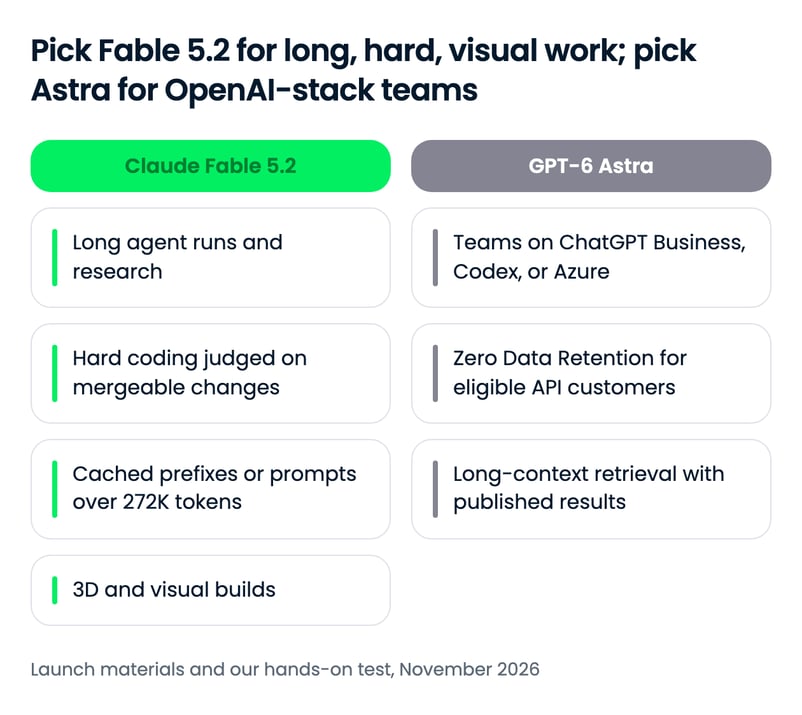
For most technical work, Fable 5.2 is the stronger and cheaper pick per token. The case for GPT-6 Astra rests on where your team already works and on the claims OpenAI has published that Anthropic hasn't answered.
Choose Claude Fable 5.2 if...
- Your agents run for hours. Fable 5.2's leads are widest on multi-step projects like the Remote Labor Index, and Anthropic's Lean formalization of Fermat's Last Theorem shows it carrying a very long job to the end.
- You need code that gets merged. It leads both of Anthropic's coding benchmarks, and Anthropic says it beats Astra's best FrontierCode score even at high effort.
- Your prompts are cached or very long. Cached reads cost a fifth of Astra's rate, and there is no surcharge above 272K tokens.
- You're building 3D scenes, games, or visual tools. In my shader test, it produced the only scene with real depth and lighting that respects the geometry.
Choose GPT-6 Astra if...
- Your team already works in ChatGPT Business or Enterprise, Codex, or Azure. Astra is included in those subscriptions, and Pro, Business, and Enterprise plans also get GPT-6 Astra Pro.
- You need Zero Data Retention. Astra supports it for eligible API customers, while Fable 5.2 requires 30-day retention unless you set up Enterprise Frontier Safeguards.
- Your work depends on retrieval across a million-token prompt. OpenAI has published long-context retrieval results for Astra; Anthropic hasn't for Fable 5.2.
- You run many short builds on a budget. In my test, Astra spent far fewer tokens and finished for about a third of Fable's cost, with a weaker but usable result.
How to Get Started With Claude Fable 5.2 and GPT-6 Astra
Both models are on their vendor's API, the three big clouds, GitHub Copilot, and OpenRouter.
| Surface | Claude Fable 5.2 | GPT-6 Astra |
|---|---|---|
| Consumer app | Claude apps, eligible paid plans (including Pro and Team) | ChatGPT Plus, Pro, Business, Enterprise (off by default for Enterprise workspaces) |
| First-party API | Claude Platform | OpenAI API |
| Cloud platforms | AWS (Claude Platform on AWS, Amazon Bedrock), Google Cloud, Microsoft Azure | Microsoft Azure, Amazon Bedrock, Google Cloud |
| Coding agents | Claude Code, GitHub Copilot | Codex, GitHub Copilot |
| Third-party routers | OpenRouter | OpenRouter |
| API model ID | claude-fable-5-2 | gpt-6-astra |
The model IDs are claude-fable-5-2 on the Claude Platform and gpt-6-astra on the OpenAI API.
Making your first API call
The quickest way to try both is OpenRouter, where switching models is a one-string change in an OpenAI-compatible client.
import os
from openai import OpenAI
client = OpenAI(base_url="https://openrouter.ai/api/v1", api_key=os.environ["OPENROUTER_API_KEY"])
response = client.chat.completions.create(
model="anthropic/claude-fable-5.2", # swap for "openai/gpt-6-astra"
messages=[{"role": "user", "content": "Review this migration plan for risks..."}],
)
print(response.choices[0].message.content)For the native SDKs, our GPT-6 Astra API tutorial builds a full agent, and our Fable 5.2 guide covers effort levels and fast mode.
Final Thoughts
Claude Fable 5.2 is the better model for most demanding technical work right now: it leads GPT-6 Astra on every benchmark the two share, costs less per token, and won my hands-on test clearly. The caveat is that Anthropic wrote every one of those head-to-head numbers, and OpenAI's strongest claims on math, abstract reasoning, and million-token retrieval still have no Fable 5.2 answer.
What I find most interesting is the cost row from my test. Fable 5.2 is cheaper per token and still ran far more expensive, because it thought and wrote so much more. If you move workloads over, measure cost per task, not per token.
If you're keen to build with either model, I recommend our Introduction to Claude Models course and our Working with the OpenAI API course.
FAQs
Is Claude Fable 5.2 better than GPT-6 Astra?
On the benchmarks that score both models, yes. Anthropic's launch table puts Claude Fable 5.2 ahead of GPT-6 Astra on every shared row, including coding, computer use, and long-horizon knowledge work, and Fable 5.2 also won our hands-on shader test. OpenAI hasn't published its own comparison against Fable 5.2, and Astra's math, abstract reasoning, and long-context retrieval results have no Fable 5.2 counterpart yet.
How much do Claude Fable 5.2 and GPT-6 Astra cost?
Claude Fable 5.2 costs $8 per million input tokens and $40 per million output tokens. GPT-6 Astra costs $10 and $50. Cached reads cost $0.20 per million tokens on Fable 5.2 and $1.00 on Astra, and Astra charges 2x input and 1.5x output for requests above 272K input tokens, while Fable 5.2 lists no long-context surcharge.
Which is better for coding, Claude Fable 5.2 or GPT-6 Astra?
Claude Fable 5.2 leads on both coding benchmarks Anthropic reports for the two models: 49.1% vs 42.8% on FrontierCode 2.0 and 69.9% vs 65.5% on FrontierSWE v2. Those scores come from Anthropic, not OpenAI. For teams already working in Codex or ChatGPT, GPT-6 Astra stays the more convenient choice.
What are the API model IDs for Claude Fable 5.2 and GPT-6 Astra?
Claude Fable 5.2 is claude-fable-5-2 on the Claude Platform, and GPT-6 Astra is gpt-6-astra on the OpenAI API. On OpenRouter, they are anthropic/claude-fable-5.2 and openai/gpt-6-astra.
Where can I use Claude Fable 5.2 and GPT-6 Astra?
Claude Fable 5.2 is available in the Claude apps and Claude Code on eligible paid plans, and on the Claude Platform. GPT-6 Astra is available in ChatGPT Plus, Pro, Business, and Enterprise, on the OpenAI API, and in Codex. Both are available on Microsoft Azure, Amazon Bedrock, GitHub Copilot, and Google Cloud.

Tom is a Data Science Editor at DataCamp. He writes and edits AI tutorials, compares new LLM releases, and builds AI-powered workflows. Previously, he worked in data science at Deutsche Telekom. Outside of work, he forecasts football matches with machine learning.






Anthropic released Claude Fable 5.2 on November 9, 2026, two months after OpenAI launched GPT-6 Astra as "the world's most intelligent and aligned model." Fable 5.2 comes with a price cut against Fable 5.1, and Anthropic's launch table puts it ahead of Astra on every row where both models appear. OpenAI hasn't published a comparison against Fable 5.2 that we could find, so the obvious question for anyone choosing a frontier model is whether those numbers hold up.
In this article, I'll compare Claude Fable 5.2 and GPT-6 Astra across long-horizon knowledge work, coding, computer use, safeguards, and pricing, and then run one hands-on build task against both.
To keep up with the AI and data space, I recommend subscribing to our weekly newsletter, The Median.
TL;DR
What Is Claude Fable 5.2?
Claude Fable 5.2 is Anthropic's model for its most demanding technical work, released to all users in November 2026 and built on the same underlying model as Claude Mythos 5.2, which drops Fable's cybersecurity and biology safeguards for vetted organizations.
Anthropic positions it for the most ambitious long-horizon technical work, and still recommends Claude Opus 5.5 as the default for everyday coding and knowledge tasks.
Our Claude Fable 5.2 and Mythos 5.2 guide covers the launch in full.
What Is GPT-6 Astra?
GPT-6 Astra is OpenAI's frontier flagship, launched in September 2026 as the successor to GPT-5.6 Sol.
OpenAI built its pitch around computer use and professional work, and around saturating benchmarks such as ARC-AGI-3 and FrontierMath Tier 4 that were designed to stay ahead of AI models.
Our GPT-6 Astra guide covers the launch; our GPT-6 Astra API tutorial walks through building a release check agent.
Claude Fable 5.2 vs GPT-6 Astra: Head-to-Head Comparison
Fable 5.2 leads on every benchmark that scores both models, from coding to computer use, and only chart reading comes close to a tie. The catch is the source: all of these figures come from Anthropic's launch table, because OpenAI's own table predates Fable 5.2.
Long-horizon knowledge work and research
Fable 5.2's largest lead is on open-ended, multi-step work. On the Remote Labor Index, which scores real freelance-style projects, Fable 5.2 completes 41.3% against Astra's 20.8%, roughly double.
The pattern holds across the table: the more a task looks like a long project rather than a single answer, the wider Fable 5.2's lead. Humanity's Last Exam is no surprise: OpenAI's own launch table already showed Astra trailing Claude Fable 5.1 on it.
Anthropic's own showcase points the same way. Fable 5.2 formalized the proof of Fermat's Last Theorem in Lean in 30 hours with about 1,000 agents, a project an earlier internal research model needed 11 days for.
Two caveats before you treat this as settled:
Fable 5.2 is the stronger model for long, ambiguous research and analysis projects, and the margins are large enough that a harness difference alone is unlikely to close them.
Coding and agentic workflows
Fable 5.2 leads both coding benchmarks Anthropic reports, though by less than on knowledge work. On FrontierCode 2.0, which asks whether open-source maintainers would merge a model's changes, Fable 5.2 reaches 49.1% at xhigh effort against Astra's 42.8%.
Anthropic adds that Fable 5.2 at high effort beats Astra's best FrontierCode score at about the same cost per task. OpenAI's own coding table uses older benchmark versions and compares Astra against Fable 5.1, so there is no OpenAI-side check yet. Fable 5.2 is the better coding model on the evidence available.
Computer use, vision, and robotics
Fable 5.2 leads on computer use and robotics, while chart reading is close to a tie. Robotics is the outlier: on RoboDojo Sim, a simulated two-arm robot, Fable 5.2 scores 64.9% against Astra's 29.8%.
OpenAI called Astra "the world's best computer use model," but it made that claim against Claude Fable 5.1 and Claude Opus 5 on OSWorld 2.0. On Anthropic's newer version, Fable 5.2 takes the lead.
Math, abstract reasoning, and long context: Astra's unanswered claims
Astra's strongest launch results sit on benchmarks Anthropic didn't report for Fable 5.2, so there is no head-to-head here, only claims on one side. The clearest is long-context retrieval: Astra scores 96.3% on OpenAI's MRCR v2 8-needle test in the 512K to 1M token band.
OpenAI also reports near-saturated scores on FrontierMath Tier 4 and ARC-AGI-3, though our GPT-6 Astra guide notes that the ARC-AGI-3 figure depends on a stateful harness that plain API calls don't get. If your work hinges on retrieval across a million-token prompt, Astra is the only one of the two with published evidence.
Safeguards and data retention
Both models block offensive cybersecurity work by default, and they differ more on data retention than on refusals. Fable 5.2's classifiers block penetration testing, exploit generation, and most research-level biology, though Anthropic says it produces fewer unnecessary blocks than Fable 5.1; vetted organizations can apply for Claude Mythos 5.2 instead.
OpenAI rates Astra at the Critical cybersecurity threshold of its Preparedness Framework and gates exploit creation behind its Daybreak program. Astra supports Zero Data Retention for eligible API customers, while Fable 5.2 requires 30-day retention for safety monitoring unless an enterprise uses Anthropic's Enterprise Frontier Safeguards. For regulated teams that already rely on zero retention, Astra is the easier fit.
Pricing: what you actually pay
Fable 5.2 is cheaper than GPT-6 Astra on every rate both vendors publish, and the gap is not uniform. Astra costs 1.25x as much for input, output, and cache writes, but 5x as much for cached reads, and only Astra adds a long-context surcharge.
On a plain balanced workload the difference is modest. It becomes a deciding factor once prompts are cached or run past 272K tokens.
Token rates side by side
Both vendors list standard rates per million tokens, plus cache, batch, and fast-mode pricing.
The cached-read rate is the line most teams will feel, because agent loops re-send the same long prefix on every step.
What a real workload costs
Each row below is a monthly volume, priced as (volume ÷ 1M) × rate, summed across input and output.
Neither vendor has published token counts for a shared workload, so treat these totals as a rate comparison rather than a bill. My hands-on run below is a reminder of why: there, the cheaper model per token was the more expensive run.
How Claude Fable 5.2 and GPT-6 Astra Performed
Benchmarks from one vendor's launch post only go so far, so I ran one build task against both models with an identical prompt and identical tooling.
The task: a single HTML page with a full-window animated GLSL fragment shader of a lighthouse on a rocky coast during a night storm, with rolling waves breaking on the rocks, slanted rain, and low clouds lit from beneath. The lighthouse beam had to follow the mouse and light up the waves, rain, and clouds it sweeps across. p5.js could only host the canvas, run the loop, and pass the mouse position and time into the shader.
The full prompt:
What makes it hard:
Anthropic's launch post quotes Unity's Sam Zhang saying Fable 5.2's clearest gains are in "building higher-quality 3D scenes from scratch," so this is a direct test of that claim. It's also a rematch of sorts: in our GPT-6 Astra vs Claude Fable 5.1 comparison, Astra won a physics simulation test against the previous Fable.
Both models ran in OpenCode with a pinned tool surface (file read and edit only), at
highreasoning effort, one attempt each, in a fresh session, with the prompt delivered byte-for-byte.Here are my screen recordings of both pages, moving the mouse across the scene. Fable goes first: