
Track
डेवलपर्स के लिए एसोसिएट AI इंजीनियर
26 घंटा
Google's Gemini 3.8 Live is a native speech-to-speech model built specifically for real-time streaming and interactive audio applications. Gemini 3.8 Live processes multimodal inputs directly over a persistent WebSocket connection.
This bidirectional streaming capability allows developers to create full-duplex conversational agents that can listen and speak simultaneously, supporting features like natural user interruptions and real-time audio transcription.
For application development, Gemini 3.8 Live introduces asynchronous tool calling and background reasoning, allowing agents to execute external function calls or retrieve data while maintaining active dialogue with the user.
For a comprehensive overview of its features, benchmarks, and pricing, refer to our Gemini 3.8 Live guide.
Before diving into the code, let's understand how a real-time voice assistant works under the hood.
In standard Python scripts, code runs line by line: function A finishes, then function B runs. But in a live voice conversation, waiting doesn't work:
To achieve this without freezing, we use Python's asyncio to run 4 lightweight background tasks ("workers") that communicate using two asyncio.Queue buffers (think of them as conveyor belts):
input_queue):audio_recorder(): Continuously listens to the microphone and drops audio slices onto the belt.
send_audio_loop(): Takes audio slices from the belt and streams them over to Gemini.
audio_queue):receive_loop(): Listens to Gemini. When text arrives, it prints it. When speech arrives, it drops the audio chunks onto the belt.
audio_player(): Takes audio chunks from the belt and plays them through the speakers or headphones.
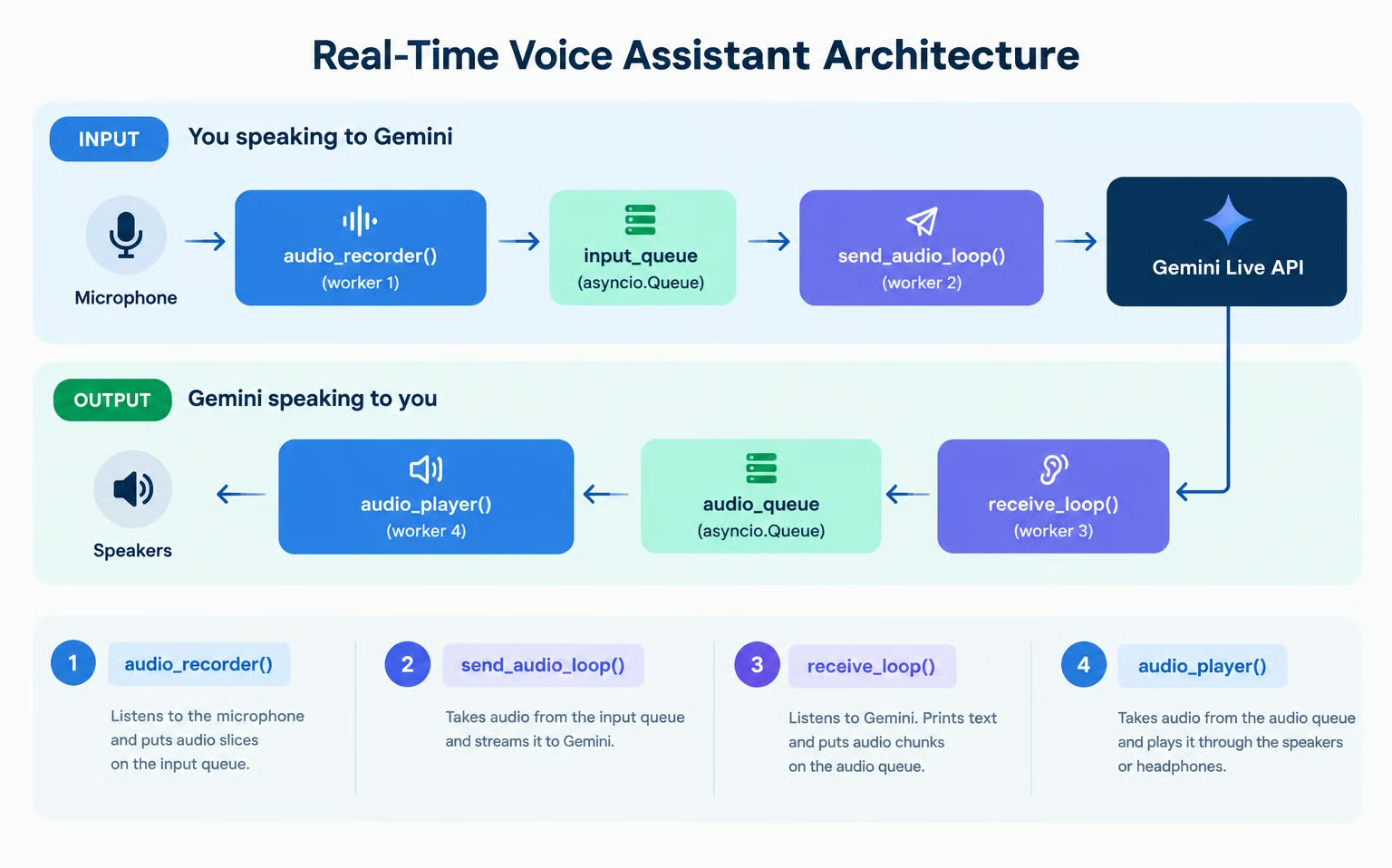
Because each worker only focuses on its own small job, all four can run concurrently on Python's event loop without stepping on each other.
The full code used in this tutorial is available in this GitHub repo.
To use the Gemini API, we need to create and set up an API key so that our code can communicate with the API.
The simplest way to do this is:
Visit Google’s AI Studio API key page and log in.
Click the Create API key button in the top-right corner.
Copy the API key into a file named .env in the same folder where the Python code will be, with the following format:
GEMINI_API_KEY=replace_with_api_keyNote that using the API usually incurs costs. The free tier covers limited access to both Gemini 3.8 Live models, but free-tier data is used to improve Google's products. For production use or higher rate limits, we need to ensure we have a payment method configured on Google’s AI Studio billing page.
These steps were designed to run in a local Jupyter notebook, with each code snippet corresponding to a notebook code cell. Because we require microphone and speaker access, it won't work out of the box on an online notebook like Google Colab.
First, we ensure the required packages are installed:
pip install google-genai sounddevice python-dotenvHere’s a breakdown of what these packages do:
google-genai: The official Google package used to interact with Gemini models.
sounddevice: Used to handle audio hardware, recording from the microphone, and playing back through speakers.
python-dotenv: Utility package to load our Gemini API key from a .env file.
Now we can load environment variables, verify the API key, and initialize the genai.Client.
import asyncio
import os
import sys
from dotenv import load_dotenv
from google import genai
from google.genai import types
import sounddevice as sd

# Load environment variables from .env file
load_dotenv()

api_key = os.getenv("GEMINI_API_KEY")
if not api_key:
    raise ValueError("GEMINI_API_KEY not found. Please set it in your .env file or environment.")

# Initialize the Gemini Client
client = genai.Client(api_key=api_key)
print("Gemini Client initialized successfully!")Let's start by understanding the core Gemini Live connection lifecycle by sending a single text turn and receiving streaming speech and transcription. We’ll send a text prompt and receive the text and audio response. However, we won’t play the audio yet. For now, let's just focus on collecting the audio chunks.
The Gemini Live API uses a persistent WebSocket connection accessed via client.aio.live.connect(). To configure speech output and real-time transcription, we supply a config dictionary:
# Session configuration
config = {
    "response_modalities": ["AUDIO"],
    "output_audio_transcription": {},
}response_modalities: Use the value ["AUDIO"] to tell Gemini to respond with speech audio.
output_audio_transcription: The value {} tells Gemini to simultaneously stream the text transcript of what it is saying.
We can now test sending a text prompt using session.send_client_content() and stream the incoming text transcription.
print("Connecting to Gemini 3.8 Live API...")
async with client.aio.live.connect(model="gemini-3.8-live", config=config) as session:
    print("Connected! Sending text prompt...")

    await session.send_client_content(
        turns={"role": "user", "parts": [{"text": "Hello! In one short sentence, introduce yourself."}]},
        turn_complete=True,
    )

    print("\n[Gemini Transcription]: ", end="", flush=True)
    audio_chunks_received = 0
    total_audio_bytes = 0

    async for response in session.receive():
        server_content = response.server_content
        if server_content:
            # 1. Print real-time transcription as tokens arrive
            if server_content.output_transcription:
                print(server_content.output_transcription.text, end="", flush=True)

            # 2. Inspect audio chunks
            if server_content.model_turn:
                for part in server_content.model_turn.parts:
                    if part.inline_data and part.inline_data.data:
                        audio_chunks_received += 1
                        total_audio_bytes += len(part.inline_data.data)

    print(f"\n\nReceived {audio_chunks_received} audio chunks ({total_audio_bytes:,} bytes total).")
When running this code, we should see something like:
Connecting to Gemini 3.8 Live API...
Connected! Sending text prompt...

[Gemini Transcription]: Hello, I am your helpful AI assistant designed to assist you with various tasks and answer your questions.

Received 22 audio chunks (304,800 bytes total).
The code captured the audio chunks, but we didn’t have an audio player set up, so we couldn’t hear it. Let’s learn how to define the audio player next.
In Step 2, we received thousands of bytes of audio data, but we did not hear anything. If we write directly to the audio hardware inside the receive loop, any network delay will cause audio stutters, and any audio playback delay will block network reception.
To prevent audio playback from blocking the network receiver, we implement our first worker: audio_player().
You don't need to worry about low-level audio implementation details. We advise you to treat them as black boxes.
OUTPUT_SAMPLE_RATE = 24000
CHANNELS = 1

async def audio_player(audio_queue: asyncio.Queue):
    """Plays raw 24kHz audio chunks from audio_queue through the speakers."""
    loop = asyncio.get_running_loop()
    with sd.RawOutputStream(
        samplerate=OUTPUT_SAMPLE_RATE, channels=CHANNELS, dtype="int16"
    ) as stream:
        while True:
            chunk = await audio_queue.get()
            if chunk is None:  # Sentinel value signaling end of stream
                audio_queue.task_done()
                break
            await loop.run_in_executor(None, stream.write, chunk)
            audio_queue.task_done()

print("Audio player defined!")
To test it, we connect the audio_player() to our request. This time, we’ll hear Gemini speak out loud in real time while observing the streamed transcription:
audio_queue = asyncio.Queue()
player_task = asyncio.create_task(audio_player(audio_queue))

prompt_text = "Hello! In one short sentence, introduce yourself."
print(f"[User]: {prompt_text}")

async with client.aio.live.connect(model="gemini-3.8-live", config=config) as session:
    await session.send_client_content(
        turns={"role": "user", "parts": [{"text": prompt_text}]},
        turn_complete=True,
    )

    print("[Gemini]: ", end="", flush=True)
    async for response in session.receive():
        server_content = response.server_content
        if server_content:
            if server_content.output_transcription:
                print(server_content.output_transcription.text, end="", flush=True)

            if server_content.model_turn:
                for part in server_content.model_turn.parts:
                    if part.inline_data and part.inline_data.data:
                        await audio_queue.put(part.inline_data.data)

print()
# Signal the player to shut down and await completion
await audio_queue.put(None)
await player_task
print("Playback complete!")
By running this snippet, we can now hear Gemini’s response.
To speak with Gemini in real time, we need to continuously capture our voice from the microphone.
Our second worker is audio_recorder(). It listens to your microphone in the background, slices the incoming speech into small chunks, and places them onto input_queue. We set the sample rate to 16 kHz, the standard speech format Gemini expects.
INPUT_SAMPLE_RATE = 16000  # Gemini Live expects 16kHz audio input
CHUNK_SIZE = 1024          # Number of samples per audio chunk

async def audio_recorder(input_queue: asyncio.Queue, stop_event: asyncio.Event):
    """Captures microphone input and puts raw audio chunks into the input queue."""
    loop = asyncio.get_running_loop()

    def record_loop():
        with sd.RawInputStream(
            samplerate=INPUT_SAMPLE_RATE,
            channels=CHANNELS,
            dtype="int16",
            blocksize=CHUNK_SIZE,
        ) as stream:
            while not stop_event.is_set():
                data, _ = stream.read(CHUNK_SIZE)
                loop.call_soon_threadsafe(input_queue.put_nowait, bytes(data))

    await asyncio.to_thread(record_loop)

print("Audio recorder defined!")In Step 2, we used send_client_content() to send a turn with static text. For continuous voice streaming, the Live API provides session.send_realtime_input().
Our third worker is send_audio_loop(). It watches input_queue and, as soon as an audio chunk from the microphone arrives, it forwards it to Gemini over the open WebSocket.
Notice that we don't have to manually tell Gemini when we start or stop speaking: Gemini uses its built-in Voice Activity Detection (VAD) to automatically detect when you begin and finish talking.
async def send_audio_loop(session, input_queue: asyncio.Queue, stop_event: asyncio.Event):
    """Continuously streams microphone chunks from input_queue to Gemini."""
    while not stop_event.is_set():
        try:
            chunk = await asyncio.wait_for(input_queue.get(), timeout=0.1)
            await session.send_realtime_input(
                audio=types.Blob(data=chunk, mime_type=f"audio/pcm;rate={INPUT_SAMPLE_RATE}")
            )
            input_queue.task_done()
        except asyncio.TimeoutError:
            continue

print("send_audio_loop defined!")
Just as we tested audio playback with a text prompt in Step 3, we can now test our microphone streaming end-to-end with a single spoken question.
When we run the cell below, we speak a question aloud into our microphone (for example: "What is the capital of France?"). Gemini will process our voice directly and respond with synthesized speech and real-time transcription:
audio_queue = asyncio.Queue()
input_queue = asyncio.Queue()
stop_event = asyncio.Event()

player_task = asyncio.create_task(audio_player(audio_queue))

print("Connecting to Gemini Live API...")
async with client.aio.live.connect(model="gemini-3.8-live", config=config) as session:
    print("Connected! Speak a question into your microphone (e.g. 'What is the capital of France?')...")
    recorder_task = asyncio.create_task(audio_recorder(input_queue, stop_event))
    sender_task = asyncio.create_task(send_audio_loop(session, input_queue, stop_event))

    print("\n[Gemini]: ", end="", flush=True)
    async for response in session.receive():
        server_content = response.server_content
        if server_content:
            # 1. As soon as Gemini starts replying, mute the microphone
            # so speaker audio cannot loop back into the mic and interrupt Gemini
            if not stop_event.is_set() and (server_content.output_transcription or server_content.model_turn):
                stop_event.set()

            # 2. Print transcription text as it streams
            if server_content.output_transcription:
                print(server_content.output_transcription.text, end="", flush=True)

            # 3. Queue audio parts for playback
            if server_content.model_turn:
                for part in server_content.model_turn.parts:
                    if part.inline_data and part.inline_data.data:
                        await audio_queue.put(part.inline_data.data)

            # 4. Turn complete
            if server_content.turn_complete:
                break

    # Clean up mic tasks cleanly
    stop_event.set()
    recorder_task.cancel()
    sender_task.cancel()
    await asyncio.gather(recorder_task, sender_task, return_exceptions=True)

# 5. Wait for playback queue to drain, then allow the soundcard buffer to finish playing
await audio_queue.join()
await asyncio.sleep(0.8)  # Prevents clipping the final syllables
await audio_queue.put(None)
await player_task

print("\nSingle-turn voice test complete!")Notice what happened in the test above: we asked a question using our microphone, and Gemini understood our voice directly and replied out loud. However, if we try to ask a follow-up question, the session has already ended.
To overcome that, we need to address two crucial aspects of building a real-world voice assistant: multi-turn persistence and interruption.
In the google-genai SDK, session.receive() is an async generator for one turn. When Gemini finishes speaking its answer, session.receive() finishes. Without wrapping it in an outer loop, the assistant terminates after the first response.
To support continuous multi-turn conversations, we wrap session.receive() in an outer while not stop_event.is_set(): loop:
while not stop_event.is_set():
    async for response in session.receive():
...Gemini 3.8 Live has native voice activity detection and barge-in support. If Gemini is speaking and you begin talking, Gemini immediately stops generating audio and sends a message flag: server_content.interrupted == True.
Even though Gemini stops sending new audio, our local audio_queue might still hold a few audio chunks waiting to be played by the speakers. If we do not clear this queue, the speakers will continue playing the previous answer.
Therefore, as soon as server_content.interrupted is received, we flush the queue so playback stops instantly:
if server_content.interrupted:
    print("\n[Interrupted!]")
    while not audio_queue.empty():
        audio_queue.get_nowait()
audio_queue.task_done()Here is our fourth and final worker: receive_loop(). It combines multi-turn persistence, real-time transcription, and instant interruption:
async def receive_loop(session, audio_queue: asyncio.Queue, stop_event: asyncio.Event):
    """Receives transcription and audio output from Gemini across multiple turns."""
    first_chunk_received = False
    try:
        while not stop_event.is_set():
            async for response in session.receive():
                if stop_event.is_set():
                    break

                server_content = response.server_content
                if server_content:
                    # 1. Handle user interruption (barge-in)
                    if server_content.interrupted:
                        print("\n[Interrupted!]")
                        # Flush remaining unplayed audio so speakers go silent immediately
                        while not audio_queue.empty():
                            try:
                                audio_queue.get_nowait()
                                audio_queue.task_done()
                            except asyncio.QueueEmpty:
                                break
                        first_chunk_received = False
                        print("\n[Listening... Speak now]")

                    # 2. Print real-time transcription
                    if server_content.output_transcription:
                        if not first_chunk_received:
                            print("\n[Gemini]: ", end="", flush=True)
                            first_chunk_received = True
                        print(server_content.output_transcription.text, end="", flush=True)

                    # 3. Enqueue synthesized audio for playback
                    if server_content.model_turn:
                        for part in server_content.model_turn.parts:
                            if part.inline_data and part.inline_data.data:
                                await audio_queue.put(part.inline_data.data)

                    # 4. Interaction complete: wait for audio to finish playing before prompt
                    # In Gemini 3.8, interaction_status tracks when the overall exchange is finished
                    is_done = False
                    if server_content.interaction_status is not None:
                        is_done = str(server_content.interaction_status).endswith("IDLE") or server_content.interaction_status == "IDLE"
                    elif server_content.turn_complete:
                        is_done = True

                    if is_done:
                        print()
                        await audio_queue.join()
                        first_chunk_received = False
                        print("\n[Listening... Speak now]")
    except asyncio.CancelledError:
        pass
    except Exception as e:
        print(f"\n[Receive Error]: {e}", file=sys.stderr)
        stop_event.set()

print("receive_loop defined!")We now orchestrate our four concurrent workers in run_voice_assistant:
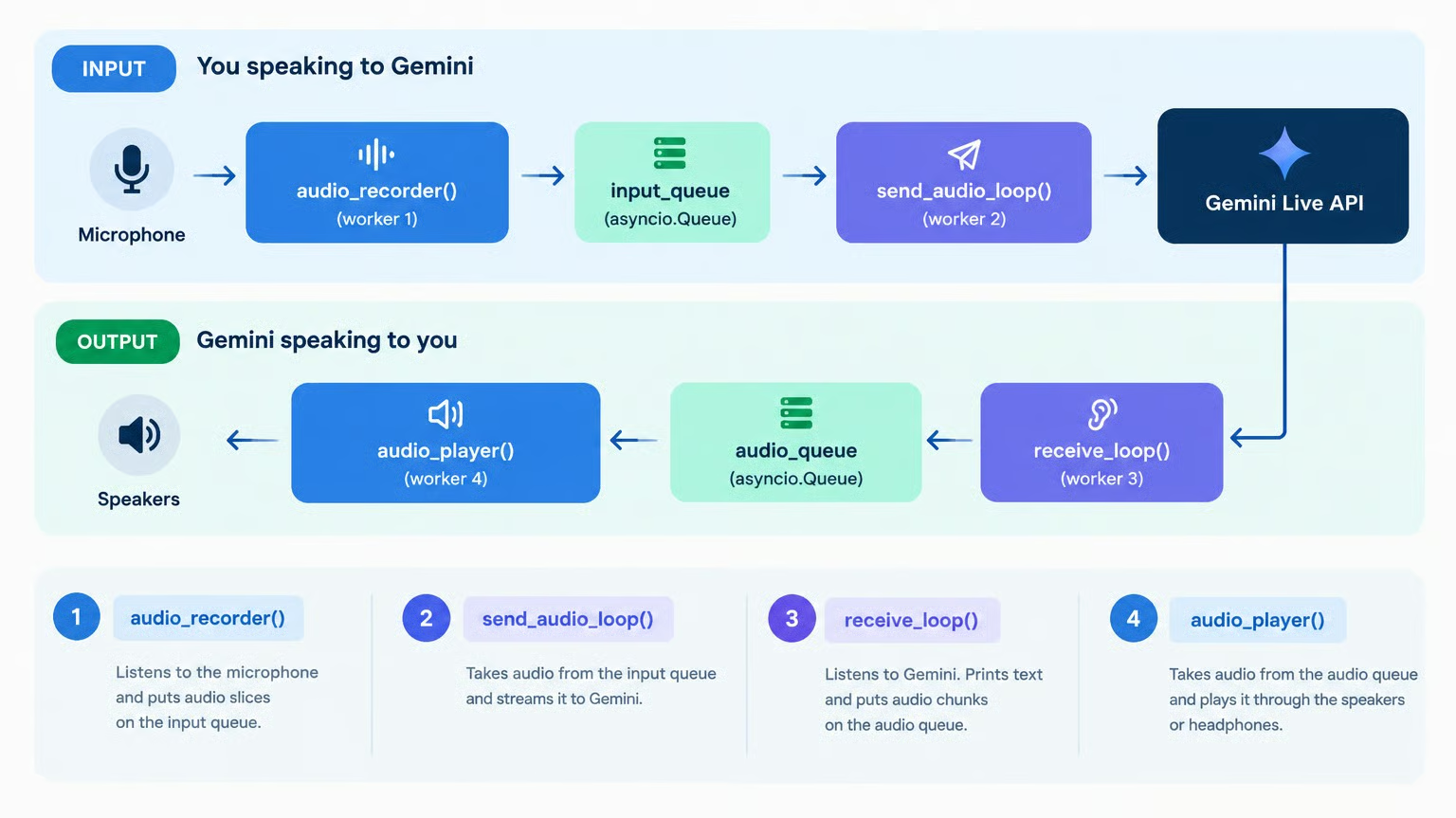
audio_player(): Consumes from the audio_queue and writes to speakers.
audio_recorder(): Reads from the microphone and pushes audio into the input_queue.
send_audio_loop(): Consumes from the input_queue and streams to Gemini using session.send_realtime_input().
receive_loop(): Consumes Gemini’s output using session.receive(), prints transcription and pushes audio to audio_queue for playback.
async def run_voice_assistant():
    """Runs the full-duplex interactive voice assistant."""
    audio_queue: asyncio.Queue[bytes | None] = asyncio.Queue()
    input_queue: asyncio.Queue[bytes] = asyncio.Queue()
    stop_event = asyncio.Event()

    player_task = asyncio.create_task(audio_player(audio_queue))

    print("Connecting to Gemini Live API...")
    async with client.aio.live.connect(model="gemini-3.8-live", config=config) as session:
        print("[Listening... Speak now]")

        recorder_task = asyncio.create_task(audio_recorder(input_queue, stop_event))
        sender_task = asyncio.create_task(send_audio_loop(session, input_queue, stop_event))
        receiver_task = asyncio.create_task(receive_loop(session, audio_queue, stop_event))

        try:
            while not stop_event.is_set():
                await asyncio.sleep(0.5)
        except (asyncio.CancelledError, KeyboardInterrupt):
            print("\nStopping voice assistant...")
        finally:
            stop_event.set()
            recorder_task.cancel()
            sender_task.cancel()
            receiver_task.cancel()
            await asyncio.gather(recorder_task, sender_task, receiver_task, return_exceptions=True)

    # Terminate player
    await audio_queue.put(None)
    await player_task
    print("\nSession finished cleanly.")

print("run_voice_assistant is ready to run!")Here’s how to run the voice assistant in your notebook:
await run_voice_assistant()Notes:
Gemini 3.8 Live comes in two versions:
Standard (gemini-3.8-live): Optimized for ultra-low latency direct speech-to-speech conversations. When calling tools, it waits silently for the tool's response before answering.
Extended Thinking (gemini-3.8-live-extended-thinking): Features background reasoning and parallel conversational fillers. It can speak natural updates (e.g. *"Let me look that up for you..."*) while executing tools in the background.
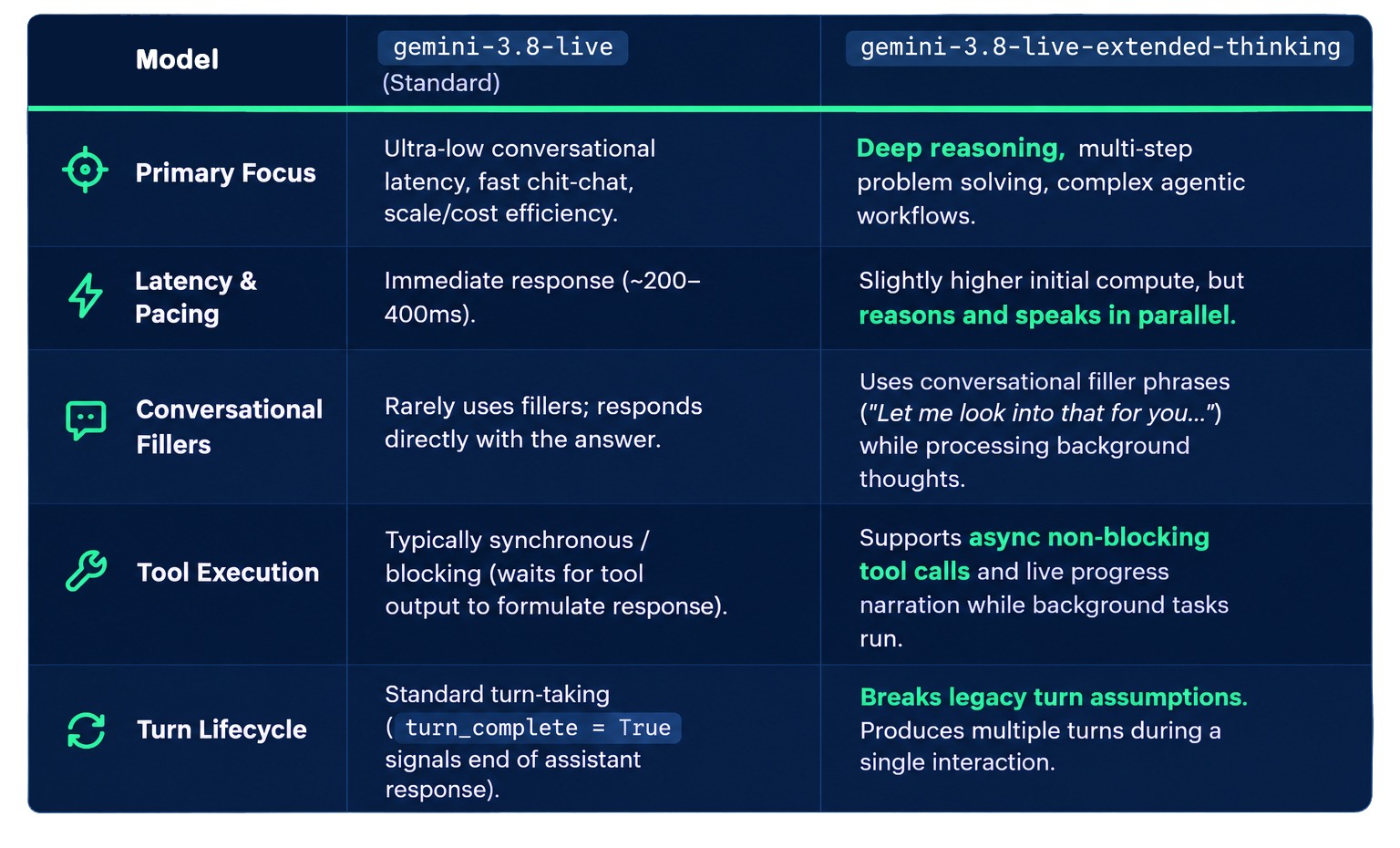
Here’s a breakdown of the differences between the two:
If you’re unsure which of the two versions to use, this is my decision framework. When building conversational agents:
Use gemini-3.8-live for direct question-answering and fast voice commands where minimizing latency is the top priority.
Use gemini-3.8-live-extended-thinking for rich conversational assistants and agents that perform multi-step reasoning, external data retrieval, or API calls while maintaining an active, natural dialogue with the user.
One of the strengths of the extended-thinking version of the model is that it can reason and execute tools in the background while maintaining a conversation.
Before we dive into the code, let’s see this in action. I equipped the base model with a tool to check the weather. Here’s a video of me asking the weather in New York; notice how the model stays silent while it’s computing the answer:
Learn AI With DataCamp!
Track
course
course
tutorial
Aryan Irani
11 मि॰
tutorial
François Aubry
12 मि॰
tutorial
Khalid Abdelaty
15 मि॰
tutorial
Abid Ali Awan
11 मि॰
tutorial
Bexruz (Bex) Tuychiev
12 मि॰
tutorial
Khalid Abdelaty
15 मि॰