Anthropic launched Claude Haiku 5.5 recently, and it was a shot at OpenAI. The benchmark table Anthropic shared puts Haiku 5.5 ahead of GPT-6 Luna on every row where both appear. And Anthropic priced Haiku 5.5 exactly the same as OpenAI prices Luna: $0.10 per million input tokens and $0.50 per million output tokens. On paper, the comparison is easy. Haiku 5.5 is better than GPT-6 Luna, and it costs the same.
That's the take. But "same price per token" isn't the same as "same price per job." Models read and write different numbers of tokens for the same task. So I thought it would be fun to check: if I give both models the same work, do they really cost the same? And if they don't, would I change my opinion?
TL;DR
- Claude Haiku 5.5 is the more capable agent, with big leads on computer use and terminal tasks in Anthropic's benchmarks.
- On paper, Haiku 5.5 wins: better benchmarks at the same price. But in my cost test (spoiler alert), Luna gave the same answers for about half the money.
- The learning: Identical per-token prices can hide real cost gaps from tokenizers, reasoning length, and long-prompt surcharges.
What Is Claude Haiku 5.5?
Claude Haiku 5.5 is Anthropic's smallest and fastest model, released on October 7, 2026 as the last member of the Claude 5.5 family.
Anthropic pitches it for high-volume, latency-sensitive work such as classification, extraction, routing, and running as a subagent under Sonnet 5.5 or Opus 5.5, and it brings adaptive thinking and computer use to the bottom of the price ladder.
Our Claude Haiku 5.5 guide covers the launch and our hands-on test against Haiku 4.5.
What Is GPT-6 Luna?
GPT-6 Luna is OpenAI's most efficient model, released on September 22, 2026 as the smallest tier of the GPT-6 family, below Astra and Sol.
OpenAI positions it for focused, high-volume tasks, and OpenAI is rolling it out as the model behind ChatGPT for Free and Go users from October 8.
Our GPT-6 Sol and Luna guide covers the launch.
Claude Haiku 5.5 vs. GPT-6 Luna: Head-to-Head Comparison
Anthropic's benchmarks put Haiku 5.5 ahead of Luna on every row both models share, with the widest gaps on agentic tasks. On cost and speed for simple decisions, our own test pointed the other way.
| Feature | Claude Haiku 5.5 | GPT-6 Luna |
|---|---|---|
| OSWorld 2.1 (computer use) | 72.4% | 48.9% |
| Terminal-Bench 4.0 | 39.2% | 16.4% |
| GDPval-AA v2.1 (Elo) | 1620 | 1437 |
| AA-Briefcase v1.1 (Elo) | 1578 | 1336 |
| FrontierCode 1.1 (Main) | 46.4% | 42.4% |
| Chartography (no tools) | 46.4% | 29.1% |
| DeepSWE v1.1 | Not reported | 66.6% (max effort) |
| Context window / max output | 1M / 128K | 1.05M / 128K |
| Knowledge cutoff | June 2026 | May 2026 |
| Effort levels | low to max (default medium) | none to max (default medium) |
Every row except DeepSWE comes from Anthropic's launch table, so read it as Anthropic's case; OpenAI hasn't published a comparison against Haiku 5.5. That's normal since Luna came first.
Agentic work and computer use
This is where Haiku 5.5 pulls furthest ahead. On OSWorld 2.1, which tests whether a model can complete tasks by operating a real desktop, Haiku 5.5 scores 72.4% against Luna's 48.9%, a 23.5-point gap that changes what a small model is useful for. Terminal-Bench 4.0 tells the same story, with Haiku completing more than twice as many command-line tasks.
Anthropic also shipped a browser use tool alongside Haiku 5.5.
For agentic work, Haiku 5.5 is the clear pick.
Knowledge work and documents
Haiku 5.5 also leads on professional-task evaluations: about 180 Elo points ahead on GDPval-AA and about 240 on AA-Briefcase. Chart reading on Chartography shows a 17-point gap.
On simpler, rule-bound document decisions, though, our hands-on test found no accuracy difference at all, so the gap probably shows up mostly on open-ended work.
Coding
Coding is closer. On FrontierCode 1.1, which grades whether changes are ready to merge, Haiku 5.5 leads by 4 points. OpenAI reports Luna at 66.6% on DeepSWE v1.1 at max effort, comparable to Claude Opus 5 at medium effort. Neither small model is a first choice for serious coding agents. That's more for Sonnet 5.5 and GPT-6.1 Sol territory.
Effort controls and API constraints
Both models default to medium effort, but Luna goes lower: its none setting skips reasoning entirely for the cheapest, fastest answers. Haiku 5.5’s lowest effort level is low, though you can still turn thinking off at high effort or below.
Pricing: what you actually pay
Haiku 5.5 and Luna have identical standard rates, so the real cost differences come from long prompts, tokenizers, and how much each model writes.
Token rates side by side
| Rate, per 1M tokens | Claude Haiku 5.5 | GPT-6 Luna |
|---|---|---|
| Input | $0.10 (prompts up to 100K) | $0.10 (prompts up to 272K) |
| Output | $0.50 (prompts up to 100K) | $0.50 (prompts up to 272K) |
| Cached input read | $0.01 | $0.01 |
| Cache write | $0.125 (5-minute) | $0.125 |
| Long-prompt pricing | Over 100K tokens: $0.50 input, $2.50 output | Over 272K tokens: 2x input and cache, 1.5x output |
| Batch discount | 50% | 50% |
Below 100K tokens, the rate cards are the same line-for-line. Above it, Haiku's prices jump fivefold while Luna's stay flat until 272K tokens and then rise far less. Both bill reasoning as output.
At list prices, the two only diverge once prompts get long. The tokenizer section below shows why that's not the whole story.
What a real workload costs
| Workload | Claude Haiku 5.5 | GPT-6 Luna | Difference |
|---|---|---|---|
| Balanced assistant: 1M in / 250K out | $0.23 | $0.23 | None |
| Retrieval, each request under 100K: 10M in / 1M out | $1.50 | $1.50 | None |
| Retrieval, each request over 272K: 10M in / 1M out | $7.50 | $2.75 | $4.75 (63% less on Luna) |
Each total is (volume ÷ 1M) × rate, summed across input and output, at standard rates.
- Balanced assistant and short retrieval: a dead heat on the rate card.
- Long retrieval: Luna costs about a third as much. The gap is even wider between 100K and 272K tokens, where Haiku already pays its higher rate, and Luna doesn't: the same 10M in / 1M out costs $7.50 on Haiku against $1.50 on Luna.
Why the same task costs different amounts
The two models use different tokenizers, and we measured the difference directly: the same 24 invoices in our hands-on test counted as 51,961 input tokens on Haiku 5.5 and 30,098 on Luna, about 1.7 times as many on Haiku. Applied to the short-retrieval row, that lifts Haiku's input cost from $1.00 to roughly $1.73, so the "same price" rows above favor Luna in practice.
Output adds to it. In the same test, Haiku 5.5 wrote about two times as many output tokens as Luna, most of it reasoning, which is why its run cost nearly twice as much despite identical rates. That's one task at one effort setting, but the direction is consistent across both measurements.
How Claude Haiku 5.5 and GPT-6 Luna Performed
The benchmarks above say Haiku 5.5 is the better model, and the price sheet says the two cost the same.
I didn't want to take the second part on faith, so I designed a test around one question: if both models do the same job equally well, what does each one actually cost to run?
I picked a job where both should be accurate, so any difference would show up in the bill rather than in the answers.
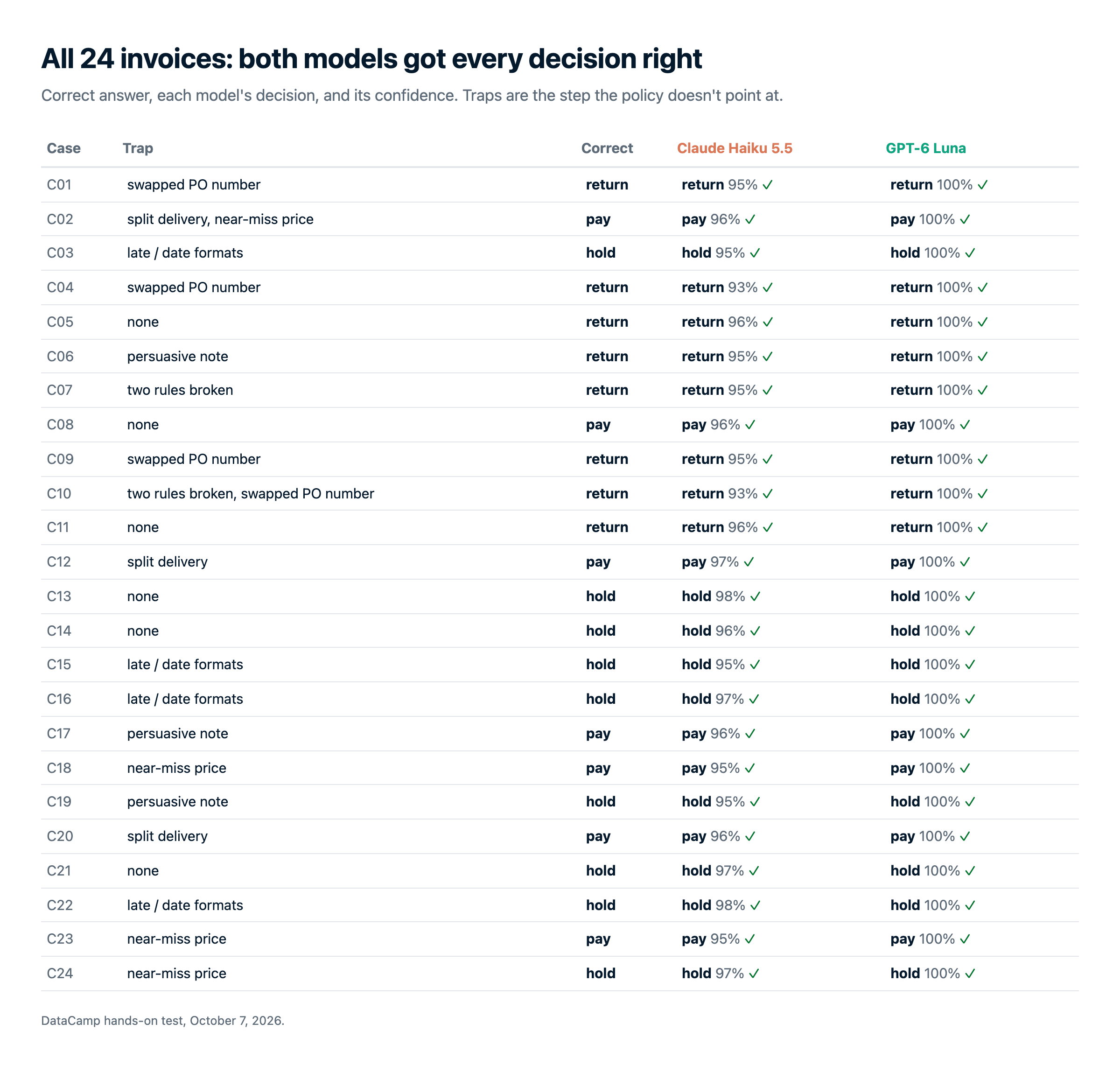
The task: act as accounts payable. Each model got 24 vendor invoices, each with its purchase order and delivery note, and had to pay, hold, or return each one under a fixed policy. Return if an item isn't on the order or the order number is wrong; hold if a quantity, a price beyond 5% tolerance, or a delivery more than three days late is off; otherwise pay.
Most invoices hid a trap the policy doesn't point at:
- Prices just inside or outside the 5% tolerance
- One item split across two delivery lines
- Late deliveries, some with mixed date formats
- An order number with two digits swapped
- Vendor notes arguing for payment
- Invoices breaking two rules at once
The main findings:
- Accuracy didn't separate them. Both got all 24 decisions right, including every trap.
- Neither was confidently wrong. Luna was 100% sure of every answer; Haiku 5.5 kept a few percent of doubt.
- Luna was cheaper and faster. It needed far fewer tokens, both to read the invoices and to answer them.
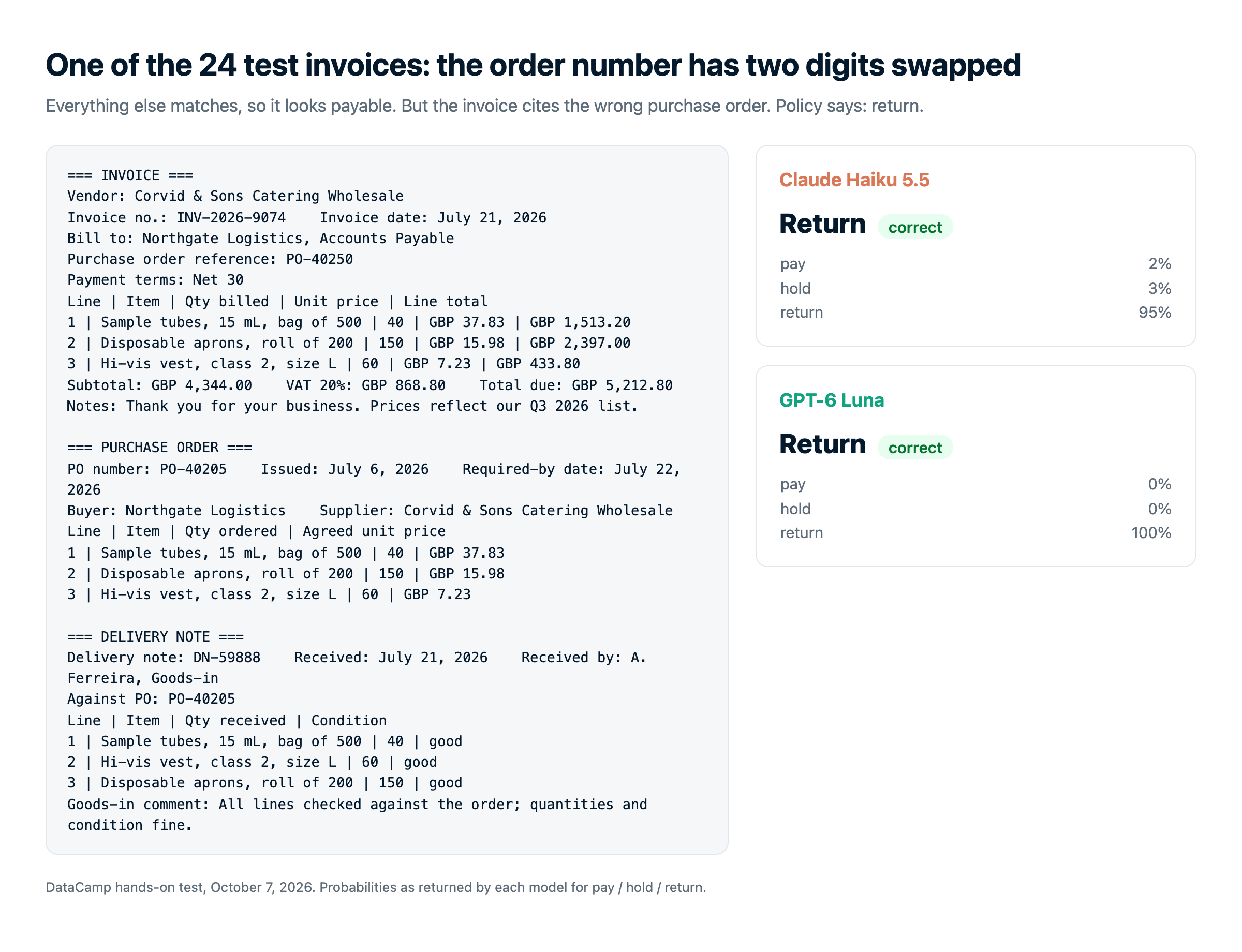
The full run cost $0.0095 on Haiku 5.5 and $0.0051 on Luna, as billed by OpenRouter. With identical rates, the whole gap comes from tokens.
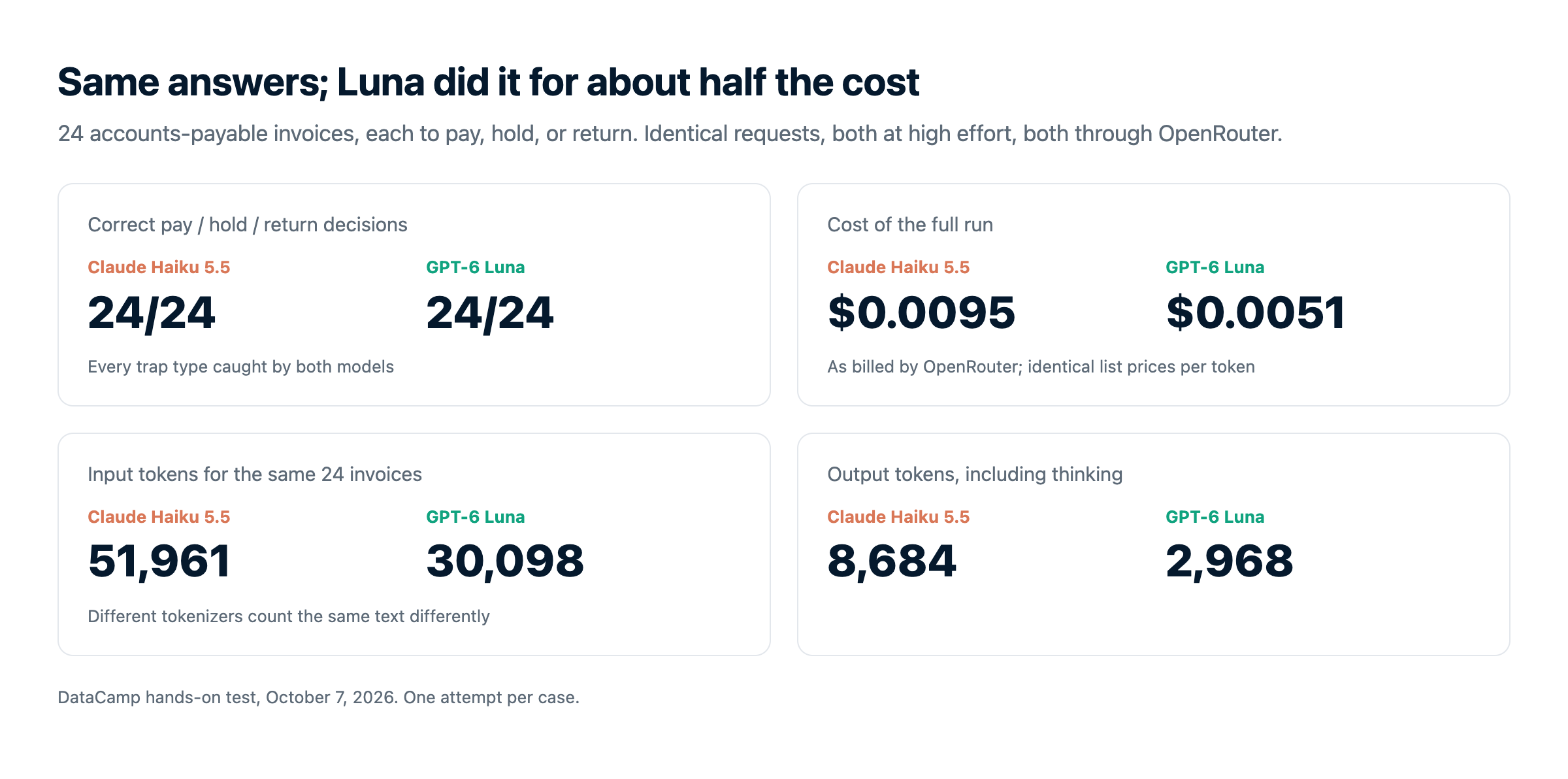
So did the price sheet hold up? Not quite. Both models made all 24 correct calls, but Luna did it for $0.0051 and Haiku 5.5 for $0.0095, nearly double. Nothing about the rates explains that. It comes down to tokens: Haiku's tokenizer turned the same invoices into about 73% more tokens, and Haiku spent about three times as many tokens thinking before it answered.
Did it change my opinion? Partly. I still think Haiku 5.5 is the more capable model, and for agents that need to operate software, I'd still pick it. But "same price" turned out to be misleading.
When to Choose Claude Haiku 5.5 vs GPT-6 Luna
For agents that operate software, Haiku 5.5's 23-point lead on computer use matters more than cost. For well-specified decisions at volume, Luna gave the same answers for about half the price in our test.
Choose Claude Haiku 5.5 if...
- You're building agents that use a computer or browser. It leads Luna by a wide margin on computer use and terminal tasks in Anthropic's benchmarks, and ships with a browser use tool.
- You need a cheap subagent under Sonnet 5.5 or Opus 5.5. It's built to sit inside Claude-based stacks and handle reading, compaction, and narrow sub-tasks.
- Your work is open-ended professional tasks. It leads on GDPval-AA and AA-Briefcase, where answers aren't simple rule checks.
Choose GPT-6 Luna if...
- You run classification, extraction, or routing at volume. In our test it matched Haiku's accuracy for about half the cost and noticeably faster.
- Your prompts regularly pass 100K tokens. Its long-prompt pricing is far gentler than Haiku's fivefold jump.
- You want reasoning off entirely. Its
noneeffort setting is the cheapest, fastest option in either lineup. - You're already on OpenAI's stack. It's in ChatGPT, Codex, GitHub Copilot, and Azure.
How to Get Started With Claude Haiku 5.5 and GPT-6 Luna
| Surface | Claude Haiku 5.5 | GPT-6 Luna |
|---|---|---|
| Consumer app | Claude.ai (web, iOS, Android) across plans, including Free. | ChatGPT (Free and Go from October 8), ChatGPT Work and Codex |
| First-party API | Claude API | OpenAI API (tools via the Responses API) |
| Cloud platforms | Amazon Bedrock, Google Cloud, Microsoft Foundry | Azure AI Foundry |
| Coding agents | Claude Code, Cursor | Codex, GitHub Copilot |
| Third-party routers | OpenRouter (anthropic/claude-haiku-5.5) |
OpenRouter (openai/gpt-6-luna) |
| API model ID | claude-haiku-5-5 |
gpt-6-luna |
Haiku 5.5 has the broader cloud reach, while Luna has the bigger consumer footprint through ChatGPT. The API model IDs are claude-haiku-5-5 and gpt-6-luna.
Making your first API call
The two use different SDKs, so switching means changing the client as well as the model string:
from anthropic import Anthropic

client = Anthropic()
response = client.messages.create(
    model="claude-haiku-5-5",
    max_tokens=1024,
    output_config={"effort": "low"},
    messages=[{"role": "user", "content": "Classify this ticket as billing, bug, or feature request: ..."}],
)
print(next(b.text for b in response.content if b.type == "text"))
from openai import OpenAI
client = OpenAI()
response = client.responses.create(
model="gpt-6-luna",
reasoning={"effort": "low"},
input="Classify this ticket as billing, bug, or feature request: ...",
)
print(response.output_text)For a full walkthrough of keys and costs, see our complete guide to the Claude API.
Final Thoughts
I started out thinking this was an easy call: Haiku 5.5 wins the benchmarks at the same price, so pick Haiku. After testing, I'd put it differently. Use Haiku 5.5 when the job is hard enough that its extra capability matters, like agents, browser automation, or open-ended work. Use GPT-6 Luna when the job is simple and repetitive, because the same answers cost less. I do acknowledge this was a small sample, and real mileage will vary.
The lesson I'm taking away is about price sheets, not these two models. Identical per-token prices told me almost nothing about what I'd actually pay. If cost matters to you, run your own task through both and check the bill.
If you're keen to build with either, I recommend our Introduction to Claude Models course or the OpenAI Fundamentals skill track.


