Course
Working with the OpenAI API
3 hr
173.9K
The attention to Anthropic's new model lasted only for about an hour in the race for more efficient and affordable frontier models.
Their Claude Opus 5.5 is the first model in its Claude 5.5 family, pitched as Fable 5.1-level performance at a lower running cost than Opus 5.
OpenAI answered very quickly, publishing GPT-6 Sol as the mid-tier of the GPT-6 family, trained with the same methods as the flagship GPT-6 Astra and launched at half the API price of its predecessor, GPT-5.6 Sol.
In this article, I'll compare GPT-6 Sol and Claude Opus 5.5 across many performance categories, guardrails, and pricing, and I'll include one hands-on build test I ran on both.
GPT-6 Sol is OpenAI's mid-tier GPT-6 model, released on September 22, 2026, alongside GPT-6 Luna and positioned below the flagship GPT-6 Astra.
Its selling point is Astra's training recipe at half of GPT-5.6 Sol's API price, with prompt caching that survives mid-conversation changes to reasoning effort or tools.
Our GPT-6 Sol and Luna guide covers the launch, and our GPT-6 Astra API tutorial walks through the family's async tools and steering.
Claude Opus 5.5 is Anthropic's first Claude 5.5 model, released on September 22, 2026, as the company's new leading model for long-running agentic coding and knowledge work.
Its selling point is Fable-class results at Opus prices: Anthropic says it matches Claude Fable 5.1 on most work, and it ships with Fable-class cybersecurity and biology safeguards.
Our Opus 5.5 guide covers the launch, and our Claude Opus 5 API tutorial covers the previous generation's API.
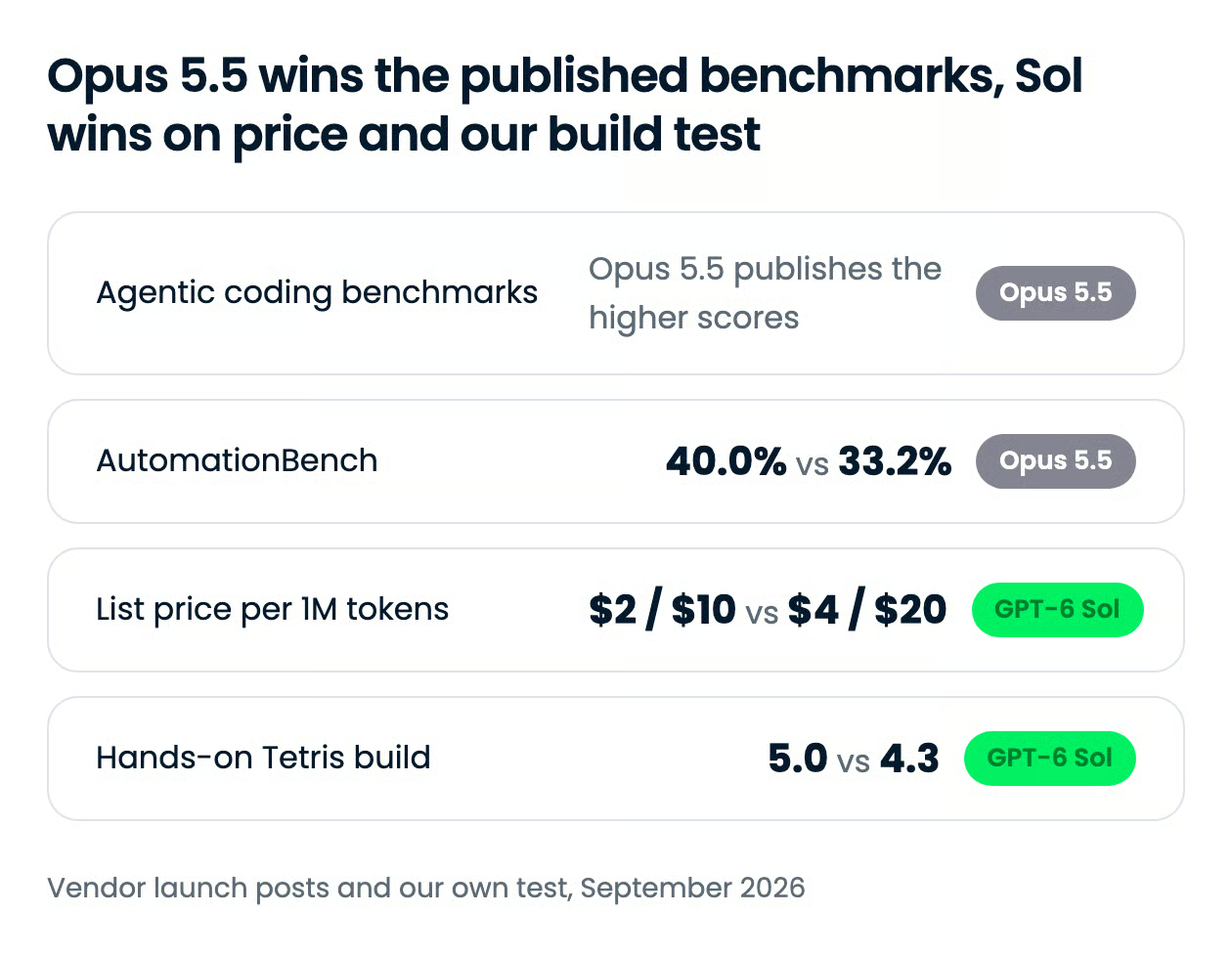
Because of the narrow release timings, no vendor put the other's new model in its launch table, so the two models overlap on only two benchmarks, and Opus 5.5 leads both. Sol's case rests on price and on how it held up in our own test.
| Feature | GPT-6 Sol | Claude Opus 5.5 |
|---|---|---|
| Agentic coding benchmarks | DeepSWE v1.1 68.8% at max effort; "matches Claude Fable 5.1" on FrontierCode, no number published | Terminal-Bench 4.0 66.4%, FrontierCode v1.1 54.4%, CursorBench 4.0 57.8% |
| AutomationBench (shared) | 33.2% at xhigh effort, $0.27 per task | 40.0% (Zapier's run, no fallback models) |
| OSWorld 2.0, partial score (shared) | 60.5% on the offline set at xhigh effort | 81.8% |
| Knowledge work | About half the factual mistakes of GPT-5.6 Sol on OpenAI's internal evaluation | GDPval-AA v2.1 1846 Elo, ahead of GPT-6 Astra and GPT-5.6 Sol |
| Context window / max output | 1.05M tokens / 128K | 1M tokens / 128K |
| List price per 1M tokens | $2 input / $10 output | $4 input / $20 output |
| Guardrails | Effort from none to max; fewer misleading claims about its coding work than GPT-5.6 Sol |
Thinking cannot be switched off; most cybersecurity tasks rerouted to Opus 4.8 |
| Our hands-on Tetris build (mean of three axes) | 5.0 | 4.3 |
Opus 5.5 publishes the stronger agentic-coding numbers, and Sol's post does not directly contest them. Anthropic reports Opus 5.5 on Terminal-Bench 4.0, FrontierCode, and CursorBench; OpenAI reports Sol on DeepSWE and describes its FrontierCode result only as matching Claude Fable 5.1 at xhigh effort. Anthropic puts Fable 5.1 at 50.3% on FrontierCode against 54.4% for Opus 5.5, so if both claims hold, Sol sits about four points behind Opus 5.5 on the one coding benchmark both vendors mention.
| Benchmark | GPT-6 Sol | Claude Opus 5.5 | Notes |
|---|---|---|---|
| Terminal-Bench 4.0 | Not published | 66.4% (xhigh) | Anthropic-run; GPT-6 Astra 57.9% and GPT-5.6 Sol 37.3% as reported by OpenAI |
| FrontierCode v1.1 Main | Not published; "matches Claude Fable 5.1 xhigh" | 54.4% | Anthropic scores Fable 5.1 at 50.3%; graded on mergeability, not just correctness |
| CursorBench 4.0 | Not published | 57.8% | Anthropic-run; GPT-5.6 Sol 41.7% |
| DeepSWE v1.1 | 68.8% (max) | Not published | OpenAI-run; Claude Fable 5's best score is 69.9% at xhigh |
Both vendors lean on long-horizon anecdotes rather than shared scores. Anthropic's internal HAProxy rewrite from C to Rust had Opus 5.5 finish in 9.5 hours against 12 for Fable 5.1 at 51% lower cost. OpenAI's argument is cost per task: Sol lands within about a point of Fable 5's DeepSWE score at roughly 80% lower cost.
Two reasons to take these tables with salt:
On paper, Opus 5.5 is the stronger coding model; our single build test below is where that gap failed to show.
Opus 5.5 leads both benchmarks the two models share, and the AutomationBench gap is the cleanest number in this article: 40.0% for Opus 5.5 against 33.2% for Sol on Zapier's test of agents working across 47 business tools.
Sol's counter is the bill: OpenAI frames Sol as beating Claude Opus 5 at 9% of Opus 5's cost per task, though that comparison is with the previous Opus, not this one.
| Benchmark | GPT-6 Sol | Claude Opus 5.5 | Notes |
|---|---|---|---|
| AutomationBench | 33.2% (xhigh), $0.27 per task | 40.0% | Opus 5.5 figure from Zapier's early-access run with no fallback models; Sol figure from OpenAI |
| OSWorld 2.0 (partial) | 60.5% (offline set, xhigh) | 81.8% | Different subsets and effort settings; OpenAI says Astra remains its best computer-use model |
| Agents' Last Exam | 56.4% (max) | Not published | OpenAI says this beats Claude Opus 5's best score at 60% lower cost per task |
Opus 5.5 is the stronger agent on score; Sol is the one you can afford to run on every ticket.
Opus 5.5 holds the only cross-vendor number here: 1846 Elo on GDPval-AA v2.1, ahead of the GPT-6 Astra and GPT-5.6 Sol scores in Anthropic's table; Sol itself is not listed. In Anthropic's report-writing test, where any invented figure fails the run, 16 of 18 Opus 5.5 reports passed, and neither Fable 5.1 nor Opus 5 passed once.
Sol's evidence is against its own predecessor: on OpenAI's internal factuality set, Sol makes about half as many mistakes as GPT-5.6 Sol. Artificial Analysis's AA-Omniscience test agrees, with a catch: Sol's hallucination rate fell from 92% to 60% while it answered only 83% of questions against its predecessor's 99%.
Both are more careful than their predecessors; only Opus 5.5 has shown it against a rival.
Sol is the less constrained API, and Opus 5.5 is the more supervised one.
Opus 5.5 cannot run with thinking switched off, rejects forced tool use, and binds thinking blocks to the model and conversation that produced them, so edited context fails with a 400 error on accounts created after August 31, 2026. Most cybersecurity tasks are rerouted to Opus 4.8 outside its Cyber Verification Program, and biology work needs its Life Sciences Verification Program.
Sol's ladder runs from none to max, effort can change mid-conversation without breaking the cache, and OpenAI reports fewer misleading claims about its coding work than GPT-5.6 Sol.
The trade is deliberate: Opus 5.5 attempted to cross containment boundaries around 85% less often than Opus 5, which matters for unattended agents.
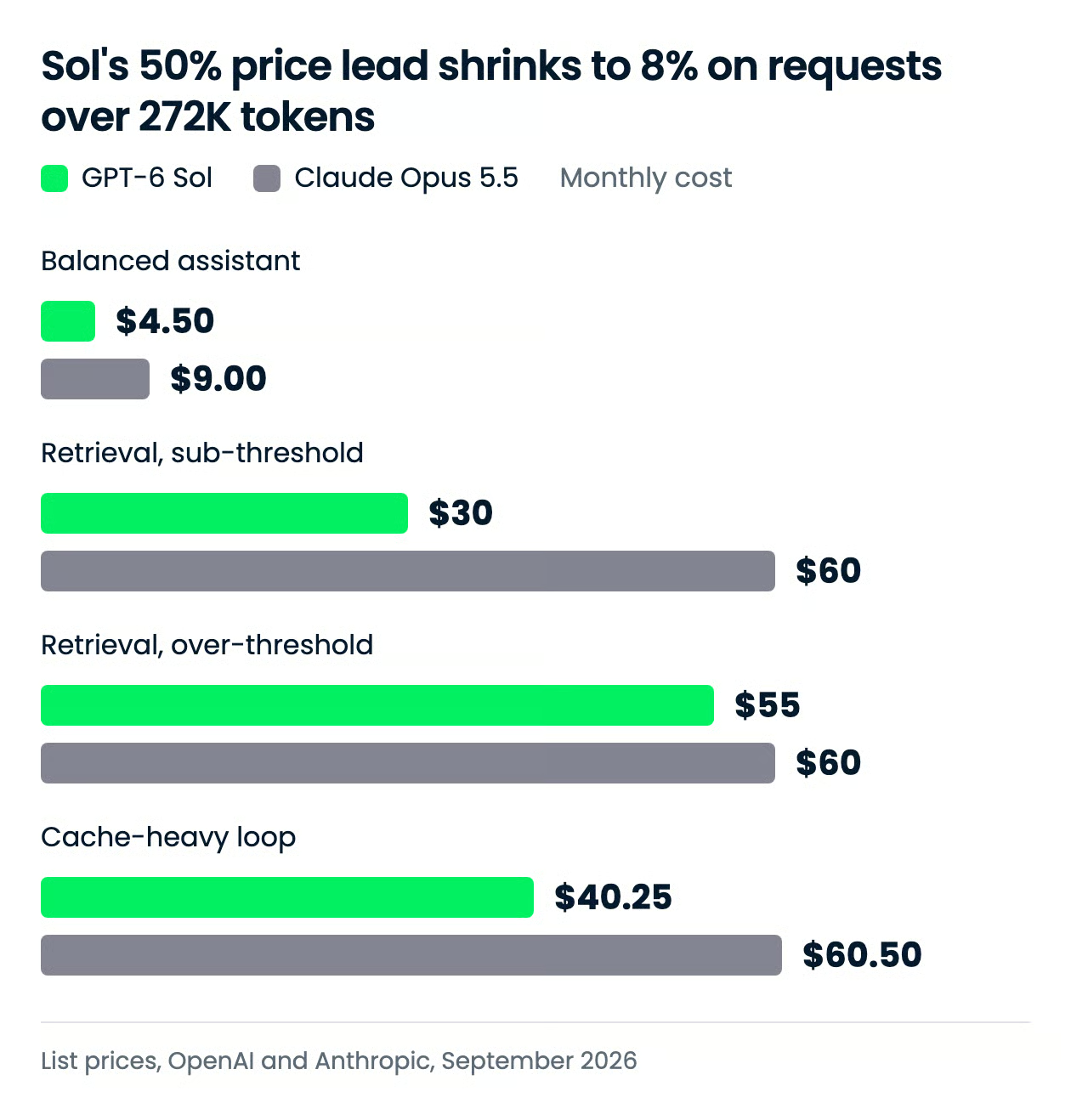
Opus 5.5 costs exactly twice Sol on the headline rates, but the two mechanisms that agents actually pay for break the pattern: cache reads cost the same, and Sol adds a surcharge above 272K tokens that Anthropic does not.
| Rate | GPT-6 Sol | Claude Opus 5.5 |
|---|---|---|
| Input, per 1M tokens | $2.00 | $4.00 |
| Output, per 1M tokens | $10.00 | $20.00 |
| Cached input read, per 1M tokens | $0.20 | $0.20 |
| Cache write, per 1M tokens | $2.50 | $5.00 (5-minute) or $8.00 (1-hour) |
| Batch discount | 50% (Batch and Flex) | 50% |
| Long-context pricing | Above 272K input tokens: 2x input and cache rates, 1.5x output, for the whole request | Full 1M window at standard rates |
| Fast mode | 2x the applicable rates | $8.00 input / $40.00 output, up to 2.5x speed |
| Consumer plans | ChatGPT Work and Codex on Plus, Pro, Business, Enterprise, and Edu | Claude apps; limits raised on Pro, Max, Team, and Enterprise at launch |
The premium is flat across input, output, and cache writes, so it hurts every workload shape equally until caching or long context enters the picture. Cached reads are the exception, and Anthropic says they make up most of the cost of agentic and coding work. Neither vendor publishes a separate rate for reasoning tokens, so budget them at the output rate.
| Workload | GPT-6 Sol | Claude Opus 5.5 | Difference |
|---|---|---|---|
| Balanced assistant: 1M in / 250K out | $4.50 | $9.00 | $4.50 (50%) |
| Retrieval, sub-threshold: 10M in / 1M out, requests under 272K | $30 | $60 | $30 (50%) |
| Retrieval, over-threshold: 10M in / 1M out, requests over 272K | $55 | $60 | $5 (8%) |
| Cache-heavy loop: 100K prefix written once, 1,000 cached reads, 5K fresh in / 1K out per request | $40.25 | $60.50 | $20.25 (33%) |
The over-threshold row is the headline: once every request crosses the threshold, Sol's surcharge lifts its bill to within 8% of Opus 5.5, so a long-context retrieval pipeline gets almost no discount for picking Sol. The cache-heavy loop narrows the gap to 33% for a different reason: the 1,000 cached reads cost the same on both models, and only the fresh tokens carry the 2x premium.
The two models use different tokenizers, and neither vendor has published token counts for a shared workload, so treat these totals as a rate comparison rather than a bill. Anthropic does say Opus 5.5 uses fewer tokens per task than Opus 5, though not how it compares with Sol.
Benchmarks from two vendors that never tested each other's model only go so far, so I ran one build task against both with an identical prompt and identical tooling.
I asked both to build a single-file Tetris clone on a 12×24 board with one twist: gravity flips every 20 seconds. Two things the prompt demands make it hard: after a flip, pieces have to fall toward the ceiling and lock onto a second stack there, with full rows clearing on either stack, and cells already locked must never move.
Both models ran inside OpenCode with an identical pinned tool surface: file reading, searching, and editing only, no shell and no network. Both ran at high reasoning effort, one attempt each, no retries, and the prompt was delivered byte-for-byte to a fresh session.
One asymmetry to keep in mind: high sits two rungs below the ceiling on both ladders, but Sol's ladder has an extra none rung at the bottom, so high is its fourth of six settings and Opus 5.5's third of five.
This was the prompt:
Build a single-file HTML page (inline CSS and JS, canvas, no build step, no external dependencies, no network) that is a playable Tetris clone with one twist: gravity flips every 20 seconds. It needs:
- a 12×24 board, the seven tetrominoes, rotation, left/right movement, soft drop, hard drop, line clears, a score, and a game-over state, controlled with the arrow keys and the space bar;
- the twist: every 20 seconds the direction of gravity flips between down and up. Pieces then fall toward the ceiling, land on the stack that has formed there, and full rows clear on either stack. Pieces already locked in place never move when gravity flips;
- a visible gravity indicator (an arrow showing the current direction) and a countdown to the next flip, both always on screen;
- a fixed starting position: the board loads with the same flat four-row stack already locked on the floor (a few gaps, no complete rows), so the flip has a stack to leave behind;
- a fixed seed for the piece sequence, so two loads produce the same game;
- autoplay on load: with no key pressed, a simple built-in player plays at the normal starting speed of about one row per second, sliding each piece without rotating into the column where the stack it is falling toward is currently lowest (the leftmost such column on a tie) and letting it fall — never a hard drop — so pieces are seen falling the moment the page opens. Any key press hands control to the keyboard for the rest of the game;
- the whole board, indicator and countdown fit in one viewport of about 1440×900 without scrolling.

Ship it as one working file named `index.html`. Do not install packages. Do not open, screenshot, or headless-render the page (no Playwright, Puppeteer, or Chrome). Do not ask me clarifying questions — make reasonable assumptions and note them briefly in a comment at the top of the file.
I recorded the cost and graded both on the following three rubrics, with scores from 1 to 5:
Sol took 6 turns and 9 tool calls: it listed, searched, and read the empty workspace before writing a 22 KB index.html, then patched it once more. What came out has its own branding, "Fall / Rise, a game of shifting ground", with a gravity panel that recolours from amber to teal at the flip, a countdown to the next inversion, and a rule card in the margin.
It does what it should and it works smoothly and stably: the floor stack stays put at the flip, pieces rise and lock on the ceiling, rows clear on both stacks, and the soft drop feels responsive, which made it the more fun of the two to play.
It also added a level counter that nobody asked for, and I'd call that a wash rather than a credit: levels rise slowly enough that they make no difference until far deeper into a game than either of these builds will realistically be played. Where Opus loses is feel rather than logic: the layout is plainer than Sol's and the soft drop is less smooth, so it drops a point on visual quality and one on completeness.
| Measure | GPT-6 Sol | Claude Opus 5.5 |
|---|---|---|
| Turns | 6 | 3 |
| Tool calls | 9 | 2 |
| Cost | $0.26 | $0.87 |
| Total tokens | 120,226 | 107,958 |
| Reasoning tokens | 8,123 | 22,551 |
| Runnability | pass | pass |
| Flip mechanics | 5 | 5 |
| Game completeness | 5 | 4 |
| Visual quality and feel | 5 | 4 |
| Rubric score (mean of three axes) | 5 | 4.3 |
GPT-6 Sol wins this test, but narrowly, and not on the hard part. Both got the gravity flip right, so the margin came down to craft, and Sol's responsiveness and visual polish gives it an edge over Opus.
What separates them more sharply is what the runs cost. Opus 5.5 spent $0.87 against Sol's $0.26, more than three times as much, and it did that on fewer total tokens: 108k against 120k. The difference is reasoning: Opus thought roughly three times as hard per turn, reached a correct build in half the turns, and stopped. Sol iterated in the file instead, cheaply, and came out slightly ahead on feel.
This is a single run of one task at one effort setting, and it probes game-loop logic in one file, not the long-horizon repository work both vendors benchmark. The cost figures are one data point each, not an average.
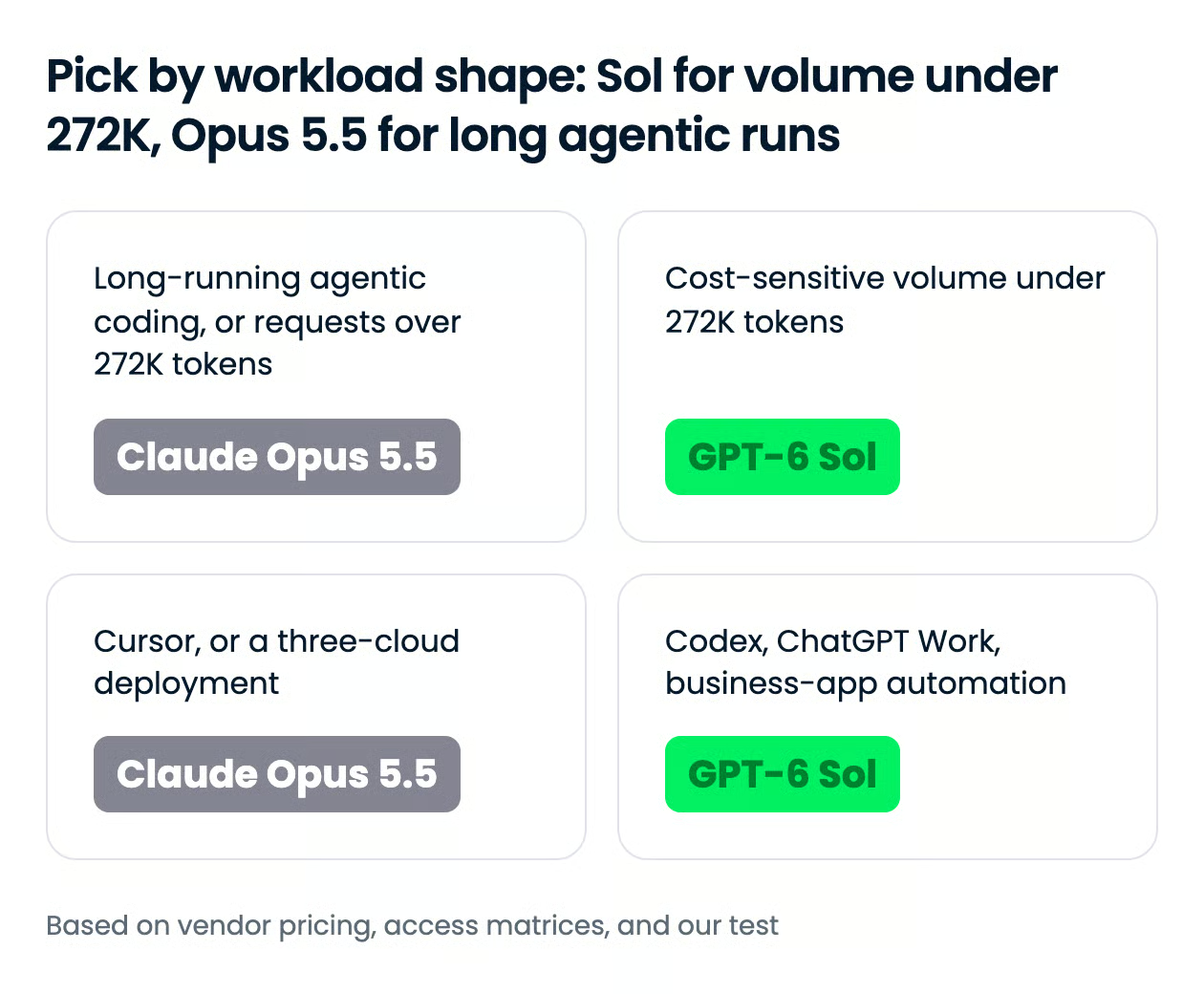
The fork is request size and workload shape rather than raw capability: below 272K tokens per request, Sol's discount is real; above it, or on cache-heavy loops, the two bills converge, and Opus 5.5's published lead on agentic work is what you are paying for.
none setting and cache-safe effort changes let an agent run cheap follow-ups and escalate only the hard steps.| Surface | GPT-6 Sol | Claude Opus 5.5 |
|---|---|---|
| Consumer app | ChatGPT Work and Codex on Plus, Pro, Business, Enterprise, and Edu plans; not yet in ChatGPT's Chat | Claude apps; usage limits raised on Pro, Max, Team, and Enterprise plans at launch |
| First-party API | Yes, OpenAI API (Responses API recommended) | Yes, Claude API |
| Cloud platforms | Azure AI Foundry, AWS Bedrock | AWS Bedrock, Google Cloud Vertex AI, Microsoft Foundry |
| Coding agents | Codex, GitHub Copilot | Claude Code, Cursor, GitHub Copilot |
| Third-party routers | OpenRouter, Vercel AI Gateway | OpenRouter, Vercel AI Gateway |
| API model ID | gpt-6-sol |
claude-opus-5-5 |
Opus 5.5 launched on all three major clouds and in Cursor on day one, while Sol is on two clouds and absent from Cursor's model list. On the APIs, the strings are gpt-6-sol and claude-opus-5-5.
Each model ships inside its vendor's own agent, Codex for Sol and Claude Code for Opus 5.5, and both are selectable in GitHub Copilot. If you want one harness for both, a router-backed agent such as OpenCode reaches them through OpenRouter as openai/gpt-6-sol and anthropic/claude-opus-5.5, which is how our test ran them under identical tooling.
Direct API calls use different SDKs, so the swap is a client and a model string rather than a single line:
from openai import OpenAI

client = OpenAI()
response = client.responses.create(
    model="gpt-6-sol",
    reasoning={"effort": "high"},
    input="Refactor this module and explain what you changed.",
)
print(response.output_text)
from anthropic import Anthropic
client = Anthropic()
response = client.messages.create(
model="claude-opus-5-5",
max_tokens=4096,
messages=[{"role": "user", "content": "Refactor this module and explain what you changed."}],
)
print(response.content[0].text)For the full agent setups, our Codex CLI tutorial and our Claude Code tutorial cover installation and workflows, and our Codex vs Claude Code comparison weighs the two harnesses themselves.
If your workload is long, agentic coding, or your requests run past the long-context threshold, use Claude Opus 5.5: it publishes the stronger agentic numbers, and its pricing does not punish big requests. If you run volume under that threshold, live in Codex or ChatGPT Work, or automate business apps on a budget, use GPT-6 Sol and bank the difference.
What I find most interesting is that neither vendor was able to put the other's new model in its table, and the one place we could compare them ourselves, a self-contained build, the cheaper model came out ahead on polish.
If you're keen to build with either model, I recommend our Working with the OpenAI API and our Introduction to Claude Models courses.
Learn AI With DataCamp!
Course
Course
Track
blog
Tom Farnschläder
14 min
blog
Tom Farnschläder
11 min
blog
Derrick Mwiti
9 min
blog
Tom Farnschläder
15 min
blog
Tom Farnschläder
11 min
blog
Tom Farnschläder
15 min