Course
Understanding Artificial Intelligence
2 hr
421.1K
Traditional reinforcement learning doesn't really work when your environment gets too big to track by hand. The reason is because every state needs its own entry in a table, and every action from every state needs its own value.
For example, a game screen produces millions of pixel combinations, which just don't fit into a table you can loop through. The agent needs to guess the value of a state it's never seen, based on states that look similar.
Deep reinforcement learning fixes this by swapping the table for a neural network that estimates the value of a state or the best action to take, even for situations it's never encountered directly. This is what lets agents master Go and fly simulated drones, both of which are tasks that would blow up any classic RL algorithm.
In this article, I'll walk you through the core concepts of deep RL, the major algorithm families like DQN and PPO, and where they show up in the real world.
If you're new to reinforcement learning, enroll in our Reinforcement Learning in Python track to dial in the fundamentals in a weekend.
Deep reinforcement learning is reinforcement learning with a neural network standing in for the lookup table.
Reinforcement learning already gives you the basic loop in which an agent tries an action, watches what happens, and adjusts based on the reward. Deep learning adds a network that can turn raw input into something the agent can act on. When combined, the agent learns which actions work best straight from raw data, without anyone hand-coding what each state means.
Imagine you're training an agent to play a game like Breakout. The agent doesn't get a clean list of "ball position" or "paddle position" - it gets raw pixels from the screen. A tabular method would need a separate row for every possible pixel combination, and that number is unmanageable. A neural network looks at the pixels directly and outputs which action to take, or how good each action looks, without ever having seen that exact screen before.
In short, tabular methods memorize, and networks generalize.
That's what makes deep RL work in environments too large or too messy for a table to handle.
Every deep RL system runs the same loop, no matter which algorithm sits underneath it.
Here's how it goes:
The diagram below shows this loop in motion:
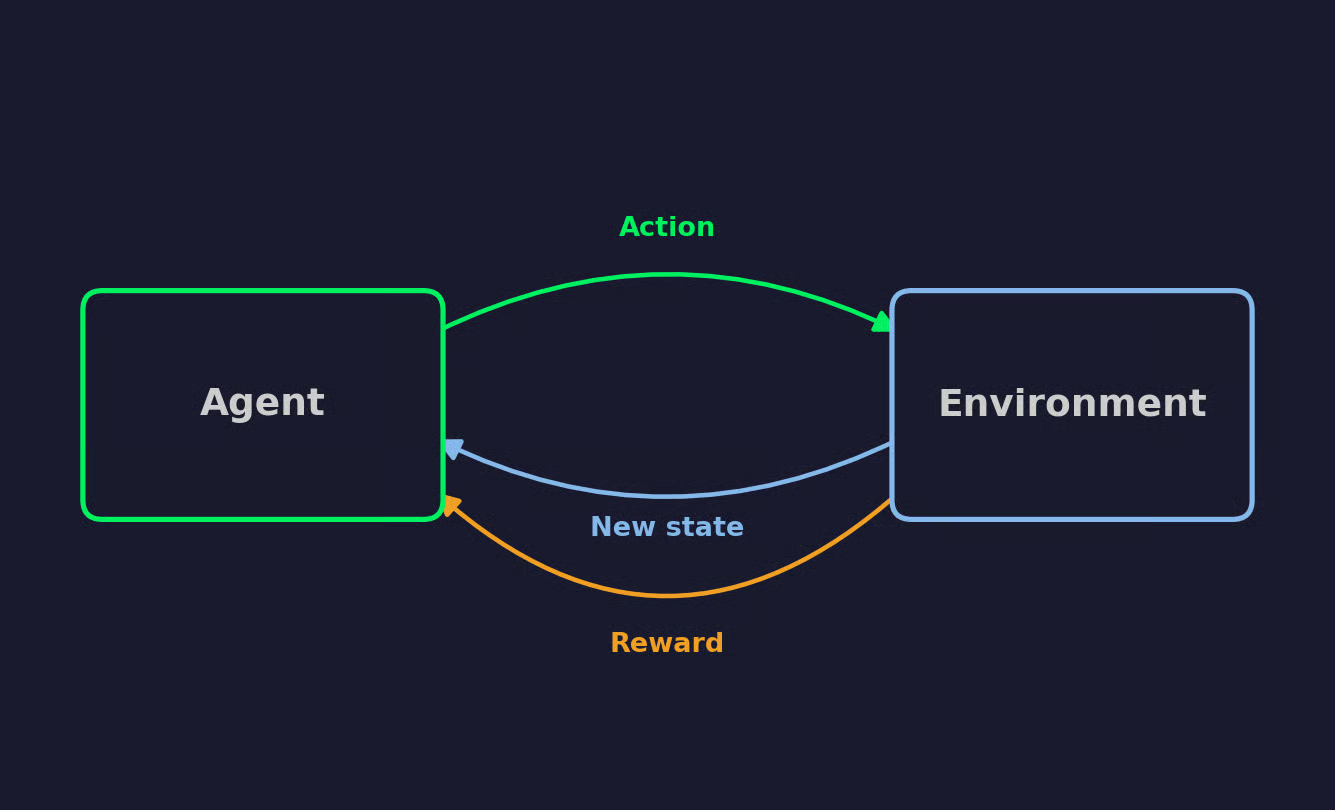
Reinforcement learning loop
If you repeat this loop enough times, the agent's behavior will shift toward whatever actions keep maximizing the reward.
Every deep RL algorithm builds on the same seven ideas. You should get comfortable with these, and the rest of the article will make a lot more sense.
Imagine a robot vacuum learning to clean a room. I'll use that example through every term below.
The agent is the decision maker - the robot vacuum, in our example. The environment is everything it interacts with, such as the room, the furniture, the dirt, the walls it can bump into.
The agent doesn't control the environment, but it chooses actions, and the environment decides what happens next.
The state describes the full condition of the environment at a given moment, such as the exact position of every dirt patch and the vacuum's location. Real agents rarely get access to that with certainty.
Instead, they act on an observation, whatever the agent can actually see, like a camera feed or a set of proximity sensors.
In simple environments, the observation and the state are basically the same thing. In more complex ones, the agent works with partial information and has to fill in the gaps.
Actions are the moves available to the agent at any given moment. For the vacuum, that could mean moving forward, turning left, turning right, or activating the suction.
Actions can be discrete, in which the agent picks from a fixed list, or continuous, in which the agent picks a value along a range, like a steering angle. This distinction matters a lot once you get to the different algorithm families later in the article.
A reward is the numeric feedback the agent gets after taking an action. If the vacuum cleans a new patch of floor, it might get a reward of +1. But when it bumps into a wall, it might get -1.
The agent's whole goal is to maximize the total reward it collects over time, not just the reward from the next single action.
A policy is the agent's strategy for mapping states, or observations, to actions. It's the rulebook the agent follows to decide what to do next.
A policy can be deterministic, always picking the same action for a given state, or stochastic, picking actions based on a probability distribution. Deep RL algorithms often use a neural network to represent this policy.
A value function estimates how much future reward the agent can expect to collect from a given state, if it keeps following its current policy.
A Q-value function does the same thing for a state-action pair. It estimates the future reward from taking a specific action in a specific state, then following the policy afterward.
This is the kind of function a neural network is good at approximating. It's the same idea I covered when I swapped out the lookup table earlier in the article.
An episode is one full run of the agent through the environment, from the starting state to some ending condition. For the vacuum, that could mean the room's fully clean or the battery dies.
Once an episode ends, the environment resets, and a new one begins.
An agent that only repeats what already worked will never find something better.
Imagine the vacuum again. It stumbles onto a path that cleans a decent chunk of the room, and it keeps running that same path every time. It never checks the corner behind the couch. That's the trade-off at the center of reinforcement learning:
One common way to balance the two is epsilon-greedy exploration. At each step, the agent picks a random action with probability epsilon, a small number like 0.1, and otherwise picks whatever action it currently believes is best. Many algorithms decay epsilon over time, in which the agent explores heavily early on, then leans harder on exploitation once it's learned enough to trust its own judgment.
There's no fixed epsilon that works for every environment.
Too much exploration wastes time on actions that keep failing. Too little exploration means the agent settles for a decent strategy while a better one is right next to it, undiscovered. Getting this balance right only gets harder as the environment grows more complex, especially when a bad early action doesn't reveal its true cost until many steps later.
Every deep RL algorithm falls into one of three families, based on what it actually learns: a value function, a policy, or both at once.
DQN takes the Q-value function from earlier in this article and swaps the lookup table for a neural network. The network takes a state as input and outputs a Q-value for every possible action, learned the same way a standard neural network learns anything else.
Training that network directly is not recommended. Consecutive experiences are correlated, in which the network overfits to whatever it just saw, and the target it's after changes every time the network updates.
DQN fixes both problems:
DQN mattered because it was the first algorithm to learn control policies directly from raw pixels across a wide range of Atari games, using the same architecture and hyperparameters for each one. When DeepMind published it in 2015, it proved deep learning and reinforcement learning could actually work together at scale, without hand-built features for every game.
Instead of learning a value function and picking actions based on it, policy gradient methods learn the policy. The network takes a state and outputs action probabilities, and the agent samples an action from that distribution.
This approach fits continuous or stochastic actions.
A value-based method needs to check every possible action to find the best one, which breaks down the moment the action space becomes continuous - you can't loop through an infinite range of steering angles. A policy gradient method just samples from the distribution, no matter how many actions exist.
REINFORCE is the foundational algorithm here. It runs a full episode, then increases the probability of actions that led to high total reward and decreases the probability of actions that led to low total reward. The catch is that it only updates after the episode ends, and it relies on the full return, which makes its updates noisy and inconsistent from one episode to the next.
Actor-critic methods fix REINFORCE's noise problem by adding a second network.
The actor is the policy - it picks actions the same way a policy gradient method would. The critic is a value function that judges each action right after it happens, instead of waiting for the episode to finish.
This is the value-based and policy-based approaches working together. The actor still learns a policy, but it updates based on the critic's judgment of each action, not the delayed, noisy return REINFORCE depends on.
A2C and A3C are the standard examples. A2C runs a couple of environment copies in parallel and updates the actor and critic together once each batch finishes. A3C runs those copies asynchronously, in which each one updates the shared network on its own schedule instead of waiting for the others.
Policy gradient updates can go wrong if you let them get too large. A large enough update can ruin a policy that was working just fine, and there's no way to undo it once it happens.
PPO limits the size of every update to avoid that. Here's the clipped objective it optimizes:

Proximal policy optimization
r_t(θ) is the ratio between the new policy's probability of an action and the old policy's probability of that same action. Â_t is the advantage, or how much better that action turned out compared to the critic's baseline expectation. The clip() function keeps the ratio inside a narrow band around 1, so the policy can't shift too far in a single step. The min() then picks the more conservative of the two estimates, so an unusually large advantage estimate can't push the update further than the clip allows.
OpenAI introduced PPO in 2017, and it became a default choice almost instantly. It's easier to implement and tune than the trust-region methods that came before it, and it holds up across a wide set of environments without much per-task adjustment.
DDPG and Soft Actor-Critic (SAC) both target continuous-control problems, like robotic joint angles or steering values, where the agent needs to output a specific number instead of picking from a distribution.
DDPG is an actor-critic method whose actor outputs a single deterministic action rather than a distribution, and it borrows experience replay and target networks from DQN.
SAC builds on that same idea but adds an entropy term that rewards the policy for staying somewhat random, which keeps the agent exploring longer and tends to make training more stable than DDPG's.
Value-based methods, like DQN, learn a Q-value function and pick whatever action that function rates highest. This works well for discrete action spaces and gets good sample efficiency out of experience replay, but it doesn't extend to continuous actions without extra work.
Policy-based methods like REINFORCE learn the policy directly, sampling actions from a probability distribution. That's what makes them work with continuous and stochastic actions, but plain policy gradient updates are noisy and need fresh data for every update.
Actor-critic methods, including A2C/A3C, PPO, DDPG, and SAC, combine both ideas. The critic's fast feedback stabilizes the actor's updates, which is why most of the algorithms used in practice today fall into this category.
Here's a more visual comparison:
| What's learned | How actions are selected | Discrete vs. continuous | Stability | Sample efficiency | Representative algorithms | |
|---|---|---|---|---|---|---|
| Value-based | Q-value function | Highest-rated action | Discrete | Needs target networks and replay to stay stable | Good, thanks to experience replay | DQN |
| Policy-based | Policy | Sampled from the policy's distribution | Both, best with continuous | Noisy, high-variance updates | Poor, needs new data for every update | REINFORCE |
| Actor-critic | Policy and value function | Sampled from the actor, guided by the critic | Both | More stable than pure policy-based methods | Better than pure policy-based methods | A2C/A3C, PPO, DDPG, SAC |
Deep reinforcement learning methods compared
Supervised learning gets a labeled answer for every example. Deep RL has to figure out what worked from a reward signal that shows up late, gets combined up with the actions before it, and sometimes doesn't show up in any useful way at all.
Deep RL agents often need millions of environment steps before they learn anything useful, especially compared to how little data a supervised model needs to get similar accuracy on a fixed dataset.
The reason is because the agent has to generate its own training data by acting, and most of those actions early on are close to random. A supervised model gets to reuse the same labeled dataset over and over. An RL agent has to keep exploring an environment it barely understands, one step at a time.
RL training is often unstable.
Part of the problem is that value functions bootstrap off their own estimates, in which today's Q-value target depends on yesterday's Q-value guess. If that guess is off, the error compounds instead of correcting itself. On top of that, the agent's policy keeps changing as it learns, so the data it collects keeps shifting too.
In other words, the network is chasing a moving target on two fronts at once.
Some environments only hand out a reward at the very end, like a win or loss signal after a long game. The agent has to work backward from that single number and figure out which of the dozens of actions it took actually mattered.
This is called the credit assignment problem, and it gets worse the longer the delay between an action and its consequence.
Reward design sounds easy until you try it.
Here's a famous example. An OpenAI-trained boat-racing agent was rewarded for hitting checkpoints, so it found a lagoon with respawning power-ups and looped through it forever, racking up score without ever finishing the race. The reward function did exactly what it was told - the agent just wasn't told what "winning" actually meant. This difference between what you reward and what you actually want is called reward hacking, and it shows up in some form in almost every reward function you write.
The same algorithm, run with a different random seed, can produce different results.
Published results are hard to reproduce without the exact codebase, hyperparameters, and seeds the original researchers used. Small implementation details, like how observations get normalized or how the replay buffer gets initialized, can shift performance more than the choice of algorithm does.
A simulator lets an agent fail over and over, as many times as it takes. The real world doesn't work that way.
For example, a self-driving policy that explores a bad action on a highway puts people at risk. Simulators never capture the real world perfectly, as edge cases the simulator never modeled all show up the moment the policy leaves the lab. A policy that looks great in simulation can fail in ways nobody predicted once it meets a real environment, which is why deploying deep RL outside of games and simulators takes a lot more caution than the benchmark numbers suggest.
I'll now highlight the differences between deep reinforcement learning and more traditional approaches.
Supervised learning trains on labeled examples, where every input already has a correct answer. Deep RL never gets that - it only gets a reward after acting, and it has to figure out on its own which actions led to that reward.
Imitation learning trains a policy to copy an expert's demonstrations, without ever using a reward signal. Deep RL discovers behavior through trial and error instead.
Imitation learning gets a policy up and running fast, but it's capped by how good the demonstrations are, and it struggles the moment the agent gets in a situation the expert never showed it. Deep RL can, in theory, exceed the performance of any teacher, but it needs a lot more interaction and a reward function that actually points toward the behavior you want.
Evolutionary algorithms optimize a policy by mutating a population of candidates and keeping whichever ones perform best, with no gradient computation at all. Deep RL computes gradients from the reward signal and updates a single policy.
Evolutionary methods parallelize well, since every candidate in the population can run independently. But they typically need far more total environment interactions than gradient-based deep RL to reach the same level of performance.
Deep RL punishes shortcuts more than most other fields. With that in mind, here are some best practices to keep in mind for your next project:
Deep reinforcement learning takes the trial-and-error loop at the core of RL and combines it with a neural network that can handle states no lookup table ever could.
Every algorithm in this article falls into one of three families. Value-based methods, like DQN, learn a Q-value function and choose whatever action rates highest. Policy-based methods, like REINFORCE, learn a policy directly. Actor-critic methods, including PPO, combine both, and that combination is what most algorithms use today.
Just keep in mind that none of this is free.
Training stability, sample efficiency, reward design, and reproducibility all get harder the moment you move from a table to a network. If you want to go deeper, Q-learning and reinforcement learning cover the foundations this article builds on, and DQN and PPO are good next stops for the algorithms themselves.
Learn with DataCamp
Course
Course
Track
blog
Hesam Sheikh Hassani
5 min
blog
Javier Canales Luna
10 min
blog
Javier Canales Luna
8 min
blog
Ryan Ong
12 min
Tutorial
Bexruz (Bex) Tuychiev
14 min
Tutorial
Arun Nanda
15 min