Course
Spoken Language Processing in Python
4 hr
9.3K
Streaming speech-to-text has turned into a crowded leaderboard. OpenAI, Google, ElevenLabs, Meta, and Deepgram all ship real-time transcription models, and Artificial Analysis now ranks dozens of them on a single word error rate index. SpaceXAI's newest model, Grok Voice Transcribe 2.0, now took the top spot on that index.
In this article, I'll cover everything new with Grok Voice Transcribe 2.0, looking at the new features, exploring the public and internal benchmarks, and working through pricing and API access. You can also see our guides to the Grok Voice Think Fast 2.0 API and the GPT Live Transcribe API.
Grok Voice Transcribe 2.0 is SpaceXAI's second-generation speech-to-text model, and the one xAI now calls its best transcription model. It is built on the audio foundation model behind Grok Voice, which SpaceXAI says already handles tens of thousands of customer-support calls a day, transcribes millions of hours of video narration, and runs the Grok assistant in Tesla vehicles.
What changed from 1.0 is the training, not the API. SpaceXAI trained 2.0 on live, noisy, multilingual audio recorded across varied environments, then refined it with post-training aimed at the hardest real-world conditions:
The headline claim is that 2.0 is twice as accurate as 1.0 across xAI's real-world evaluations, with pricing unchanged from the first generation. I'll press on that claim in the benchmarks section, because the public leaderboard tells a more modest story than the internal sets do.
The feature list is the same one 1.0 shipped with, which is the point: xAI put the whole upgrade into accuracy and left the API surface alone.
You can send a recorded file or a URL to the batch endpoint, or stream raw audio over a WebSocket and get transcript events back while the speaker is still talking. Both paths run the same model, so a transcript of a call recording and a transcript of the live call should read the same.
Batch accepts files up to 500 MB in 12 audio formats, including WAV, MP3, FLAC, and MP4 containers plus raw PCM and the G.711 telephony codecs. Streaming can emit partial transcripts about every 500 ms and tags each result as either a locked chunk or a finished utterance, so a captioning UI can show text early and replace it later.
Every word comes back with a start and end time, and turning on diarization adds a speaker label to each word at no extra cost. For call-center audio with the agent on one channel and the customer on another, multichannel mode transcribes up to 8 channels independently, which sidesteps diarization altogether.
The response is one JSON object with the full text, the detected language as a BCP-47 code, the audio duration, and the word array. There is no separate timestamps call to make.
You can pass up to 100 key terms per request, each up to 50 characters, to bias the model toward product names, drug names, or whatever your domain says out loud that a dictionary does not contain. Text formatting writes numbers, dates, currencies, phone numbers, and email addresses in their written form when you set the language parameter, which SpaceXAI supports for 25 languages.
Filler words such as "um" and "uh" are stripped by default. That is the right default for transcripts people read and the wrong one for conversation analytics, so the flag is there if you want the fillers back.
Smart turn detection lets a voice agent wait for the end of a thought instead of jumping in at every pause. You set a confidence threshold between 0 and 1, and the model only marks the utterance as finished when it is that confident that the speaker is done; SpaceXAI suggests 0.5 for balanced use and 0.7 when people dictate numbers or addresses.
A companion timeout forces the turn to end after a fixed silence, so a caller who walks away does not hang the session. Without smart turn, the default endpointing fires after 400 ms of silence, which is fine for short commands and painful for anyone reading out a phone number.
The model detects the language automatically and handles language switches within a single recording in one pass, with no language hint required. SpaceXAI calls multilingual accuracy the largest improvement over 1.0, and the short-phrase numbers in the next section back that up.
One caveat: the language parameter still matters for formatting. Set it when you want written-form numbers and currencies, and leave it off when the audio mixes languages and you would rather have the raw words.
Grok Voice Transcribe 2.0 leads the public streaming leaderboard on accuracy and beats 1.0 on every internal set SpaceXAI reports, but the size of the gain depends heavily on which audio you look at.
On Artificial Analysis's streaming speech-to-text index, Grok Voice Transcribe 2.0 posts a word error rate (WER) of 2.7%, the lowest of the 34 streaming models listed as of 21 September 2026. Meta's Muse Voice Transcribe is next at 3.1%, ElevenLabs Scribe v2 Realtime sits at 3.6%, and Grok Voice Transcribe 1.0 trails at 3.9%. SpaceXAI's announcement counted 32 models on the same leaderboard at launch.
What WER measures: WER is the share of words the model gets wrong, so lower is better.
What the speech-to-text index measures: Artificial Analysis's index averages the WER across 3 test sets (AA-AgentTalk, VoxPopuli, and Earnings-22). Grok 2.0's widest lead is on VoxPopuli, where its 1.4% WER is less than half of 1.0's 3.1%.
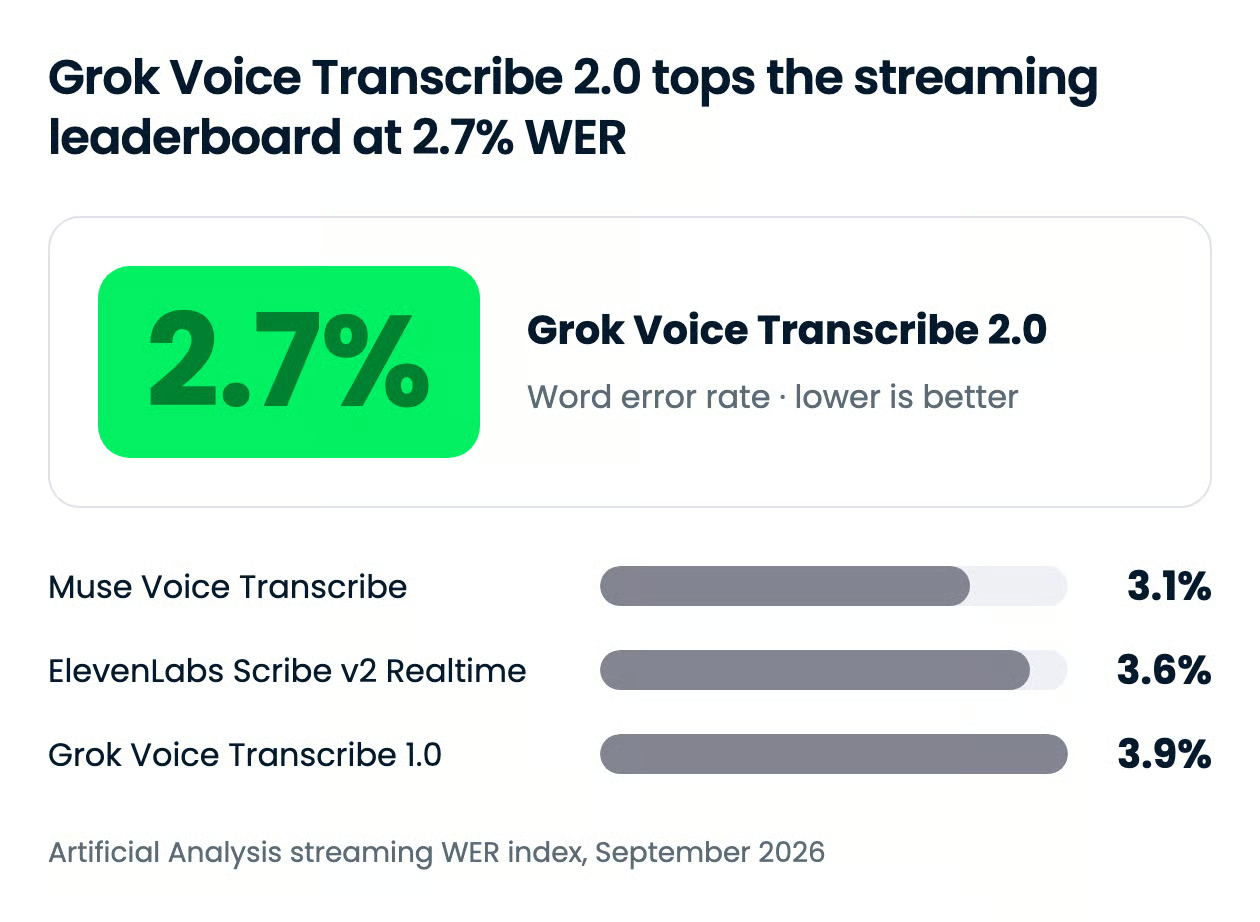
The gap to 1.0 on this index is 31%, not the 2x the announcement leads with. That larger claim comes from SpaceXAI's own production sets, which I cover next. The same leaderboard also records how long each model takes to commit a final transcript, and here the picture flips.
| Model | WER index (final transcript) | Time to final transcript |
|---|---|---|
| Grok Voice Transcribe 2.0 | 2.7% | 0.49 s |
| Muse Voice Transcribe (Meta) | 3.1% | 0.16 s |
| ElevenLabs Scribe v2 Realtime | 3.6% | 0.14 s |
| Grok Voice Transcribe 1.0 | 3.9% | 0.37 s |
| Deepgram Flux | 7.4% | 0.02 s |
Latency is the cost. Grok 2.0 takes 0.49 s to return a final transcript, versus 0.37 s for 1.0 and 0.14 s for Scribe v2 Realtime. For captions that's invisible. For a voice agent that has to answer on every turn, the extra tenths of a second add up.
SpaceXAI measures WER on four internal sets drawn from production traffic:
Grok Voice Transcribe 2.0 improves on 1.0 across all four, and on telephony SpaceXAI says it leads every model it tested.
The one number SpaceXAI publishes from these sets is the short-phrase result: WER drops from 20.6% with 1.0 to 6.8% with 2.0. Short in-car commands give the model almost no context to identify the language, which is exactly where 1.0 struggled, and a 3x improvement there is the strongest evidence behind the "twice as accurate" claim.
The rest of the internal charts, including the multilingual comparison against ElevenLabs Scribe v2 and Deepgram Nova-3, ship as bars without labelled values. I would treat "leads every model we tested" on telephony as a vendor claim until someone reproduces it on their own call audio.
Grok Voice Transcribe 2.0 costs $0.10 per hour of audio for batch transcription and $0.20 per hour for streaming, identical to Grok Voice Transcribe 1.0. Diarization, word timestamps, and key term biasing are included in those rates rather than billed as add-ons.
| Mode | Price | Included |
|---|---|---|
| Batch (file or URL) | $0.10 per hour of audio | Diarization, timestamps, key terms, formatting |
| Streaming (WebSocket) | $0.20 per hour of audio | Diarization, timestamps, key terms, formatting, smart turn |
Those rates are among the lowest on the streaming leaderboard. Artificial Analysis lists Grok 2.0 at $3.33 per 1,000 minutes, next to $3.00 for Meta's Muse Voice Transcribe and $6.50 for both ElevenLabs Scribe v2 Realtime and Deepgram Flux. Among the four most accurate models on the index, only Muse is cheaper, and Muse scores lower on accuracy.
The model is generally available in the SpaceXAI API, with no waitlist or region restriction mentioned in the announcement or the docs. There is no consumer plan to pick, because this is an API product, and neither the announcement nor the docs mention a free tier for speech-to-text.
The default is in transition. SpaceXAI says 2.0 will soon become the default in the Speech-to-Text API and that 1.0 will be deprecated in the coming weeks. Until then, the model ID should be set explicitly.
The model ID is grok-voice-transcribe-2.0, passed as a form field on the REST endpoint or as a query parameter on the WebSocket endpoint. To stay on the old model through the deprecation window, pin grok-voice-transcribe-1.0.
It runs on two surfaces: the SpaceXAI API, with batch at https://api.x.ai/v1/stt and streaming at wss://api.x.ai/v1/stt, and the SpaceXAI console, which has a live speech-to-text playground. It is not in OpenRouter's catalog as of 21 September 2026.
Here is the smallest batch call that returns a diarized transcript:
import os
import requests

response = requests.post(
    "https://api.x.ai/v1/stt",
    headers={"Authorization": f"Bearer {os.environ['XAI_API_KEY']}"},
    data=[("model", "grok-voice-transcribe-2.0"), ("diarize", "true")],
    files={"file": open("standup.wav", "rb")},
)
print(response.json()["text"])
For voice agents built on xAI's WebSocket voice APIs, see our Grok Voice Think Fast 2.0 API tutorial, which covers the speech-to-speech model, and our Grok Voice Agent API guide. If you call Grok's text models from the same codebase, our Grok 4.6 API tutorial covers keys and tool calling.
Grok Voice Transcribe 2.0 is the cheapest way to get the most accurate streaming transcript on the public leaderboard, and that combination is rare. xAI is making a statement that its voice stack is meant to compete with OpenAI, Google, and ElevenLabs, not only its text models.
I would switch if my audio is phone-quality, multilingual, or full of spoken numbers, which is where 2.0 pulls away from 1.0 and from most rivals. I would hold off on a latency-sensitive voice agent until SpaceXAI closes the gap to Scribe v2 on time to the final transcript.
If you want to build transcription pipelines yourself, I recommend our Spoken Language Processing in Python course, which goes from raw audio files to transcribed and classified phone calls.
Learn AI With DataCamp!
Course
Track
Course
blog
Khalid Abdelaty
13 min
blog
Tom Farnschläder
13 min
blog
Josef Waples
9 min
blog
Khalid Abdelaty
13 min
blog
Alex Olteanu
8 min
Tutorial
Khalid Abdelaty
15 min