
The main findings:
- Both built the scene correctly on the first try. Each shipped a real GLSL fragment shader with time and mouse uniforms, animated smoothly, and drew a kelp forest you recognize at a glance. Neither needed a nudge.
- GPT-6.2 Sol's scene looks more realistic. Opus 5.5's version reads a bit more cartoon-like, which cost it a point on how closely the scene matched the brief.
- Each model got a different half of the torch right. Sol's torch feels like a 3D cone of light reaching into the scene, while Opus 5.5's moves more along a flat 2D angle. But Opus 5.5's kelp bends away from the torch clearly and responsively, and Sol's bend-away is weaker.
Here is Opus 5.5's version, where the strands near the cursor visibly give way:
I scored both on how closely the scene matched the brief, shader quality, cursor interactivity, and whether the effect was a real shader. Shader quality and technique were full marks for both; the rows where they differ:
| Measure | GPT-6.2 Sol (high) | Claude Opus 5.5 (high) |
|---|---|---|
| Cost of this run (USD) | $0.21 | $1.20 |
| Output tokens (incl. reasoning) | 16,476 | 44,996 |
| Aesthetic match (primary discriminator) | 5 | 4 |
| Rubric score (mean of four axes) | 4.8 | 4.5 |
GPT-6.2 Sol wins this test narrowly, on realism, which fits OpenAI's claim about better-looking 3D frontends. Sol got the light right and Opus 5.5 got the push right, and Sol did it for about a sixth of the cost.
This is one run of one task at one effort setting. Both models cleared the technique bar easily, so what separated them was taste, which a single run can only hint at.
When to Choose GPT-6.2 Sol vs Claude Opus 5.5
The choice comes down to the kind of work, the length of your prompts, and where you deploy.
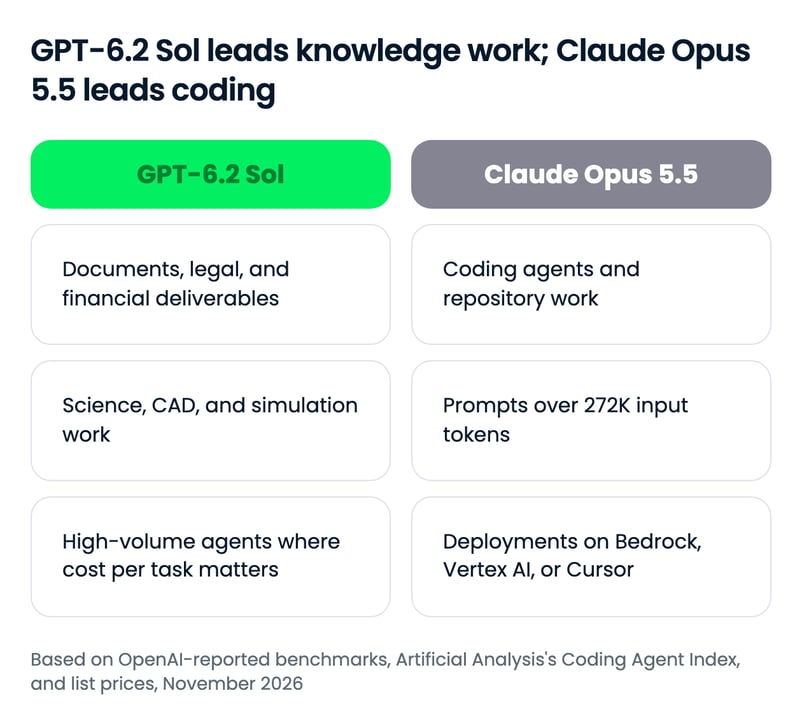
GPT-6.2 Sol should be your default, and Opus 5.5 a model you pick for a reason. The one number that can reverse the cost case is the 272K-token threshold, above which Sol's surcharge brings it close to Opus 5.5's price.
Choose GPT-6.2 Sol if...
- You produce professional deliverables. Sol leads on GDPval v2 and more than doubles Opus 5.5 on Harvey's legal benchmark, so documents, memos, and legal drafts are its home ground.
- You run scientific, CAD, or simulation work. It now leads Terminal-Bench-Science and BenchCAD, two benchmarks where GPT-6.1 Sol trailed Opus 5.5.
- You run agents at high volume. Its cost per task is a fraction of Opus 5.5's on every chart OpenAI published, and on several of OpenAI's charts it scores close to its max at high effort.
- You work in Codex, GitHub Copilot, or Azure AI Foundry. GPT-6.2 Sol is already listed on all three.
Choose Claude Opus 5.5 if...
- Coding agents are your main workload. Opus 5.5 leads Artificial Analysis's independent Coding Agent Index by 8 points, and Anthropic's Terminal-Bench 4.0 and CursorBench results have no GPT-6.2 Sol counterpart yet.
- Your prompts routinely pass 272K tokens. Opus 5.5 has no long-context surcharge, so whole-codebase prompts cost about the same on both.
- You deploy through Bedrock, Vertex AI, or Cursor. Opus 5.5 is listed on all three; GPT-6.2 Sol is not in the Cursor docs, and we found no Bedrock or Vertex AI listing for it in our sources.
How to Get Started With GPT-6.2 Sol and Claude Opus 5.5
Access is almost identical, except that GPT-6.2 Sol is not available in Cursor, since OpenAI decided to pull their models from the platform.
| Surface | GPT-6.2 Sol | Claude Opus 5.5 |
|---|---|---|
| Consumer app | ChatGPT Work (Plus, Pro, Enterprise, Edu) | Claude apps |
| First-party API | OpenAI API | Claude API |
| Cloud platforms | Amazon Bedrock, Google Vertex AI, Azure AI Foundry | Amazon Bedrock, Google Vertex AI, Azure AI Foundry |
| Coding agents | Codex, GitHub Copilot | Claude Code, Cursor, GitHub Copilot |
| Third-party routers | OpenRouter | OpenRouter |
| API model ID | gpt-6.2-sol | claude-opus-5-5 |
The API model IDs are gpt-6.2-sol and claude-opus-5-5; on OpenRouter they are openai/gpt-6.2-sol and anthropic/claude-opus-5.5.
Making your first API call
The quickest way to try both is OpenRouter, where switching models is a one-string change:
import os
from openai import OpenAI
client = OpenAI(base_url="https://openrouter.ai/api/v1", api_key=os.environ["OPENROUTER_API_KEY"])
response = client.chat.completions.create(
model="openai/gpt-6.2-sol", # swap for "anthropic/claude-opus-5.5"
messages=[{"role": "user", "content": "Summarize this incident report in five bullet points."}],
)
print(response.choices[0].message.content)For a full build, our Opus 5.5 API tutorial walks through an agent project from start to finish.
Final Thoughts
GPT-6.2 Sol should be the default pick over Claude Opus 5.5. It beats Opus 5.5 on about half of the benchmarks they share and comes close on the rest for a fraction of the cost per task, which leaves Opus 5.5 the pick for coding agents, very long prompts, and Bedrock, Vertex AI, or Cursor deployments.
What I find most interesting is that Sol's price never changed: OpenAI won this round on output tokens. Keep in mind that Opus 5.5 has been out for almost two months, which feels like light-years at the current pace, so I expect Anthropic's next release to compete with Sol on quality and efficiency.
If you're building on either model, I recommend our OpenAI Fundamentals skill track or our Introduction to Claude Models course.
FAQs
Is GPT-6.2 Sol better than Claude Opus 5.5?
On most benchmarks the two share in OpenAI's launch charts, yes. GPT-6.2 Sol beats Opus 5.5 at max effort on Agents' Last Exam, Terminal-Bench-Science, GDPval v2, Harvey LAB-AA, and BenchCAD, for far less per task. Opus 5.5 keeps a clear lead in agentic coding: it scores 58 to Sol's 50 on Artificial Analysis's independent Coding Agent Index.
How much cheaper is GPT-6.2 Sol than Claude Opus 5.5?
GPT-6.2 Sol's API rates are half of Opus 5.5's: $2 vs $4 per million input tokens and $10 vs $20 per million output tokens. Per finished task the gap is wider, because Sol uses fewer output tokens. On prompts over 272K input tokens, Sol's surcharge brings the two close to the same price.
What changed between GPT-6.1 Sol and GPT-6.2 Sol?
GPT-6.2 Sol keeps GPT-6.1 Sol's API prices but scores higher on most of OpenAI's benchmarks while using fewer output tokens. The biggest jumps against Claude Opus 5.5 are on Terminal-Bench-Science, where Sol went from trailing to leading, and AutomationBench, where Opus 5.5's lead shrank to about one point.
Where can I use GPT-6.2 Sol and Claude Opus 5.5?
GPT-6.2 Sol is in ChatGPT Work and Codex for Plus, Pro, Enterprise, and Edu users, and the OpenAI API. Claude Opus 5.5 is in the Claude apps, Claude Code, the Claude API, and Cursor. Both are available on Amazon Bedrock, Google Vertex AI, Azure AI Foundry, GitHub Copilot, and OpenRouter.
What are the API model IDs for GPT-6.2 Sol and Claude Opus 5.5?
The OpenAI API model ID is gpt-6.2-sol, and the Claude API model ID is claude-opus-5-5. On OpenRouter, the two models are openai/gpt-6.2-sol and anthropic/claude-opus-5.5, so you can switch between them by changing a single string in the same client code.

Tom is a Data Science Editor at DataCamp. He writes and edits AI tutorials, compares new LLM releases, and builds AI-powered workflows. Previously, he worked in data science at Deutsche Telekom. Outside of work, he forecasts football matches with machine learning.









OpenAI has released GPT-6.2 Sol, the everyday tier of its GPT-6.2 family, at exactly the same API prices as GPT-6.1 Sol. When we compared GPT-6.1 Sol with Claude Opus 5.5, the split was clear: Sol for cost per task, Opus 5.5 for the highest success rate on hard agent runs at max effort. OpenAI's launch charts for GPT-6.2 Sol put that second half in doubt, and they include Opus 5.5 at max effort on almost every one.
In this article, I'll compare GPT-6.2 Sol and Claude Opus 5.5 across professional work and science, coding, business automation, and pricing, and then run both on the same hands-on shader build.
If you want a firmer grasp of how GPT models work and how to prompt them well before reading the comparison, I recommend the Intermediate ChatGPT course, which covers the architecture behind GPT models and advanced prompt writing. To keep up with the AI and data space, I recommend subscribing to our weekly newsletter, The Median.
TL;DR
What Is GPT-6.2 Sol?
GPT-6.2 Sol is OpenAI's efficient, mid-tier reasoning model, released in November 2026 alongside GPT-6.2 Astra.
OpenAI calls it its go-to model for everyday work, and its selling point is efficiency: better results than GPT-6.1 Sol on demanding tasks with fewer output tokens, at unchanged prices.
Our GPT-6.2 Astra and Sol guide covers the launch, with the full benchmark set and two hands-on tests.
What Is Claude Opus 5.5?
Claude Opus 5.5 is Anthropic's model for long-running agentic coding and knowledge work, released on September 22, 2026, as the first model in the Claude 5.5 family.
Anthropic positions it at the level of Claude Fable 5.1 on most work while costing 40% less to run than Opus 5, and its thinking can no longer be switched off.
Our Claude Opus 5.5 guide covers the launch; our Opus 5.5 API tutorial builds an AI incident investigator with it.
GPT-6.2 Sol vs Claude Opus 5.5: Head-to-Head Comparison
GPT-6.2 Sol now leads Claude Opus 5.5 on most shared benchmarks, and Opus 5.5 keeps narrow leads on coding and automation.
In our GPT-6.1 Sol vs Opus 5.5 comparison, Opus 5.5 led most of the max-effort results. With GPT-6.2 Sol, OpenAI's charts show Sol ahead on 5 of the 9 benchmarks both models appear on, level on 1, and less than 2 points behind on the other 3. Coding is the exception: on Artificial Analysis's independent Coding Agent Index, Opus 5.5 leads by 8 points.
Professional work and science
This is where the 6.1 verdict flips. GPT-6.1 Sol trailed Opus 5.5 on Terminal-Bench-Science 0.1, which tests scientific work in a terminal, by 6 points at max effort. GPT-6.2 Sol now leads it, 68.0% to 63.3%, for less than a tenth of the cost per task.
The rest of OpenAI's professional-work charts point the same way:
Agents' Last Exam, OpenAI's test of long-horizon professional workflows, is close to a tie at max effort. The more telling point on that chart is effort: Sol at high effort already sits above Opus 5.5 at max, for about $0.69 per task.
For documents, legal work, CAD, and scientific analysis, GPT-6.2 Sol is now the stronger model on the evidence available, not just the cheaper one.
Coding
Coding is where Opus 5.5 still clearly leads, and the independent numbers put the gap well above what OpenAI's chart shows. On Artificial Analysis's Coding Agent Index, which combines FrontierCode, Terminal-Bench 4.1, and SWE-Atlas-QnA, Opus 5.5 in Claude Code scores 58 at max effort, against 50 for GPT-6.2 Sol in Codex at its best setting, xhigh.
GPT-6.2 Sol actually scores lower on that index than GPT-6.1 Sol did. Artificial Analysis traces the drop to SWE-Atlas-QnA, where the new model is more likely to omit key facts from its answers.
OpenAI's own FrontierCode 2.0 chart shows a gap of under 2 points at max effort. Opus 5.5 costs about ten times as much per task at max effort on the coding index (about $12.60 against about $1.15), but for repository work where the result has to be right, it is the stronger model.
Business workflow automation
AutomationBench, Zapier's test of agents running multistep workflows across business apps, was the headline of the 6.1 comparison: Opus 5.5 led by 6 points at max effort. With GPT-6.2 Sol, the gap is down to 1.4 points.
Sol also flattens early. It scores about the same from medium effort upward, while Opus 5.5 climbs steadily and only overtakes Sol at max, where each task costs about five times as much. For a support bot or a sales-ops agent running thousands of workflows, Sol is now the obvious pick; Opus 5.5 only makes sense where a failed run costs more than the price gap.
General reasoning
Opus 5.5 keeps a small lead on the Artificial Analysis Intelligence Index, a composite of 9 evaluations across knowledge work, coding, and science. At xhigh effort, Opus 5.5 scores level with Sol at max, for about six times the cost per task. They tie on the Vals Science Index, so general reasoning is close to parity with a slight Anthropic tilt.
Pricing: what you actually pay
GPT-6.2 Sol is half the price of Opus 5.5 per token and far cheaper per finished task.
GPT-6.2 Sol keeps GPT-6.1 Sol's rates, so the token-price gap is the same as before. The cost-per-task gap is not, because Sol now needs fewer output tokens to finish the same work. Our own single shader run, covered below, points the same way, with Opus being almost 6x as expensive as Sol ($0.21 against $1.20).
Token rates side by side
GPT-6.2 Sol costs exactly half of Opus 5.5 on every standard rate, until a prompt passes 272K input tokens:
Both models bill reasoning tokens as output, and Opus 5.5's thinking can't be switched off, so its output rate is the one that matters most.
What a real workload costs
Each total is (volume ÷ 1M) × rate, summed across input and output, at standard rates.
Why the same task costs different amounts
The two models use different tokenizers, but the bigger difference is how many output tokens each spends. OpenAI's GDPval v2 chart puts Opus 5.5 at 191,241 output tokens per task at max effort against GPT-6.2 Sol's 33,428, and at 61,121 against 12,420 at high effort.
Those are OpenAI's own measurements, but they compare the two subjects directly. If Opus 5.5 needed about 3 times Sol's output tokens on the balanced assistant workload, as it did in our own test, its monthly bill would be $19.00 against Sol's $4.50.
That is why the cost-per-task gaps in the summary table run far wider than the 2x token-price gap.
How GPT-6.2 Sol and Claude Opus 5.5 Performed
Every number so far comes from OpenAI's charts, so I ran one build task against both models with an identical prompt and identical tooling.
The task: a single HTML page with a full-window, animated GLSL fragment shader of an underwater kelp forest at dusk, hosted by p5.js loaded from a CDN.
The hard part is that the scene has several elements, and the cursor has to change all of them:
It probes OpenAI's claim that GPT-6.2 builds frontends that look and work better, including 3D scenes. Both models ran in OpenCode with a pinned tool surface (file read and edit only), at high reasoning effort, with one attempt each in a fresh session and the prompt delivered byte-for-byte.
Here is what GPT-6.2 Sol built: