Sari la conținutul principal

Completează detaliile pentru a debloca webinarul

Continuând, acceptați Termenii și condițiile de utilizare, Politica de confidențialitate și faptul că datele dvs. sunt stocate în SUA.

Share this webinar

Close your data and AI skills gap

We're the only platform uniquely engineered to advance data and AI skills across your entire organization. Let's explore a tailored program.

Book an Enterprise Demo
Upskilling a small team?Get started today
Artificial Intelligence

AI and the Workforce: How Will AI Reshape Data and Technology Roles?

August 2025
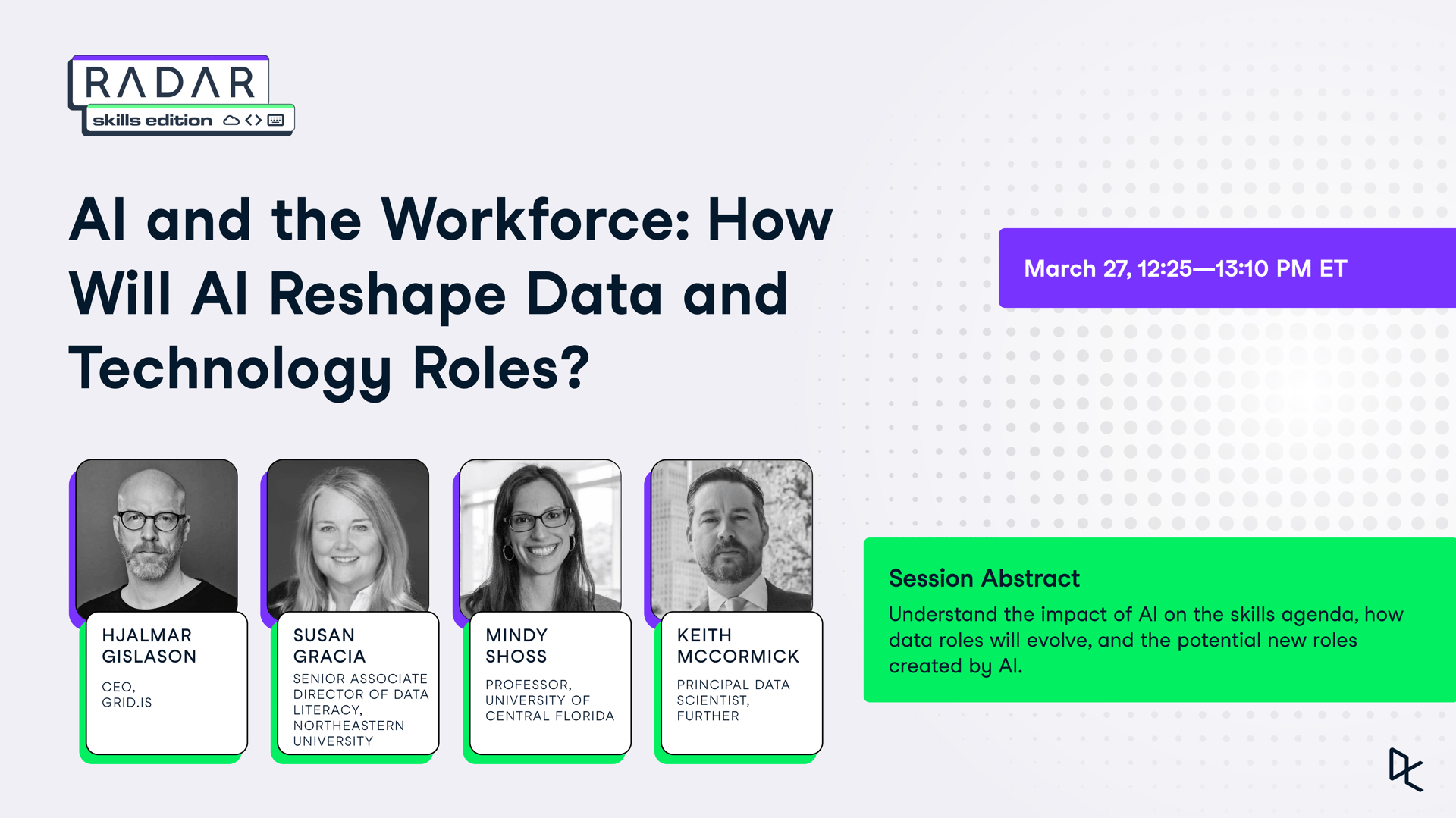
Webinar Preview

Your Presenter(s)

Fotografie portret Susan Gracia

Susan Gracia

Senior Associate Director of Data Literacy at Northeastern University

Susan Gracia, Sr. Associate Director of Data Literacy at Northeastern University, leads the creation and execution of a university-wide data literacy program. In this role, she develops data literacy learning opportunities, assessments, learning paths, and certifications, while also providing instruction and fostering data community. She is a former faculty member at Northeastern University and Rhode Island College and serves as a visiting professor at the Pontificia Universidad Católica del Perú. Her leadership experience includes Director of Assessment roles at Rhode Island College and Simmons College. As Lead Instructor - Corporate Data at Pragmatic Institute, and instructor at Data Literacy, Inc. she taught data literacy and business-driven analysis to business leaders and data teams. She has developed data literacy and strategy courses for ESME Learning Solutions and Dataquest.

Fotografie portret Hjalmar Gislason

Hjalmar Gislason

Founder and CEO of GRID

Hjalmar Gislason is the founder and CEO of GRID, with their main product being a smart spreadsheet with an interactive data visualization layer and integrated AI assistance. Hjalmar previously served as VP of Product Management at Qlik. He was the founder and CEO of DataMarket, founded in 2008 and sold to Qlik in 2014. A career data nerd and entrepreneur, GRID is Hjalmar’s fifth software startup as a founder.

Fotografie portret Mindy Shoss

Mindy Shoss

Professor at University of Central Florida

Mindy's research focuses on occupational health psychology and the future of work, including as job insecurity and precarious work, the integration of artificial intelligence and robotics in the workplace, worker well-being, and adaptation to change. She has authored more than 100 research articles and book chapters. Mindy was named a Fellow of the Society for Industrial and Organizational Psychology (SIOP), a Fellow of the Global Labour Organization (GLO), and an Honorary Professor at Australian Catholic University. She was the 2021 recipient of the Gwendolyn Puryear Keita Award for Social Justice and the Welfare of Working People. Additionally, Mindy serves as Associate Editor of the Journal of Occupational Health Psychology and sits on the American Psychological Association (APA)’s Future of Work Advisory Committee and National Institute for Occupational Safety and Health (NIOSH)’s Healthy Work Design and Well-Being Cross-Sector Council.

Fotografie portret Keith McCormick

Keith McCormick

Principal Data Scientist at Further

Keith is a consultant, creator, keynote speaker, workshop leader, and author. As Principal Data Scientist at Pandata, he is responsible for AI Evangelism and Thought Leadership, Solution Discovery and Design, Business Development. Keith has run a machine learning consultancy business since 1996. He's the author of several data science books, including SPSS Statistics for Dummies, the Handbook of Statistical Analysis: AI and Machine Learning Applications, and the SPSS Modeler Cookbook. Keith also teaches predictive analytics at University of California, Irvine. Previously, he was Executive Data Scientist in Residence at Pandata (acquired by Further), and Chief Data Science Advisor at CloudFactory.

Summary

AI's transformative potential is reshaping data and technology roles, presenting both challenges and opportunities for professionals in the field. The advent of AI, particularly generative AI (Gen AI), is redefining how tasks are performed, creating new roles and responsibilities, and requiring teams to adapt swiftly to changing demands. While AI is already assisting with routine tasks, the integration of AI into creative processes and decision-making is also on the horizon. As organizations adapt to this shift, the need for AI literacy and continuous upskilling is essential. The conversation emphasized that AI is not replacing jobs but altering them, necessitating a blend of technical, human, and domain-specific skills. The panelists emphasized the importance of embracing AI's capabilities while exercising caution around its limitations, such as the potential for AI "hallucinations" or inaccuracies. As AI becomes an integral part of workflows, the ability to communicate and collaborate across domains will be important. The future of work, particularly in data and technology roles, is poised for significant evolution, with AI as a central driver of change.

Key Takeaways:

  • AI is fundamentally changing data and technology roles, requiring new skills and approaches.
  • Generative AI is opening up creative possibilities and altering traditional workflows.
  • AI literacy and continuous learning are essential for future-proofing careers.
  • Data teams may shift towards more supportive and educational roles within organizations.
  • The importance of domain knowledge and human skills remains critical in an AI-driven world.

In-Depth Analysis

The Impact of AI on Data and Technology Roles

AI is revolutionizing data and technology roles by automating routine tasks and creating opportunities for more strategic involvement. As highlighted by Keith McCormick, data teams are increasingly tasked with integrating AI into their workflows, which often begins with a desire to "do something" with Gen AI. This shift is not solely about automation but about enhancing capabilities, enabling teams to tackle more complex problems. However, AI's integration requires a careful balance of technical expertise and human insight. The ability to communicate effectively with non-technical stakeholders and understand the broader business context is becoming crucial. As AI tools become more accessible, data professionals must adapt by developing skills that connect technology and business needs, ensuring they remain relevant in this evolving environment.

AI Literacy and Continuous Learning

Susan Gracia emphasized the need for AI literacy as a core component of data literacy. As AI becomes embedded in everyday tools, understanding its functionalities and limitations is essential. Northeastern University's educational model, focusing on human, data, and technological literacies, aims to prepare individuals for an AI-driven world. This approach highlights the importance of integrating AI skills with human-centric capabilities like critical thinking and ethics. The panelists agreed that continuous learning is vital; professionals must stay abreast of AI advancements to leverage them effectively. This lifelong learning mindset ensures that individuals can adapt to the rapid technological changes and maintain their competitive edge in the workforce.

Balancing Technical and Human Skills

The integration of AI into the workplace does not diminish the value of human skills; rather, it amplifies the need for them. Mindy Shoss highlighted that while AI can automate tasks, human judgment, creativity, and domain expertise remain irreplaceable. The ability to interpret AI outputs, validate results, and apply them within the appropriate context is important. As AI tools democratize data access, the role of data professionals may shift towards guiding and supporting non-specialists in using these tools effectively. This shift requires data teams to enhance their communication skills, enabling them to educate and collaborate with colleagues across various domains.

The Future of Work in an AI-Driven World

As AI continues to evolve, its impact on the workforce will be profound. The panelists concurred that AI is not eliminating jobs but transforming them. The key to thriving in this new environment is to embrace the changes and utilize AI's potential responsibly. Hjalmar Gislason noted that AI's ability to handle creative tasks challenges the notion that creativity is solely a human domain. As organizations explore AI's possibilities, the focus will be on integrating AI smoothly with traditional tools and methods. This integration will enable businesses to leverage AI's strengths while mitigating its limitations, ultimately driving innovation and efficiency across industries.


Înrudite

webinar

Data Science and Business Intelligence in 2025: How will AI Transform the Data Team?

Three guests explore the impact of LLMs and GenAI on analytics and data functions in 2025, how they will lower the barrier to entry for working with data, the skills data teams need to develop, and a lot more.

webinar

Learning in the Age of AI: How Will AI Reshape the L&D Function in 2025?

Three industry experts discuss how AI is reshaping the L&D function, how to best drive AI literacy for the wider organization, and how learning teams can future proof their workflows for 2025 and beyond.

webinar

The State of Data & AI Literacy in 2025

Explore the latest trends shaping how organizations are building data and AI skills across their workforce.

webinar

AI In The Enterprise: Developing AI Talent

Damien Herrick, Ita Petrika-Lindroos, and Thomas Bodenski discuss strategies for developing AI talent. Learn which AI skills and roles are in demand, how to attract the right talent, and how to build AI literacy across your organization.

webinar

AI Literacy at Scale: Building a Future-Ready Workforce

Industry experts explore strategies for scaling AI literacy across diverse teams, bridging the gap between technical expertise and business understanding.

webinar

The Hottest AI Skills in 2025

Explore the most in-demand AI skills of 2025. You’ll learn which technical and practical skills are leading the job market, how hiring flows are evolving for AI roles, and what qualities hiring managers prioritize when building their AI teams.