Track
Associate AI Engineer for Developers
29 hr
Practice and track your progress.
Continue with GoogleMoonshot AI released Kimi K3.1 Pro in October 2026 with an unusually specific claim: on Terminal-Bench 4.0, its new open-weight model lands within a point of Claude Opus 5.5, the flagship Anthropic shipped on September 22. It does that at half Anthropic's per-token price, and Moonshot promises downloadable weights by November 4.
In this article, I'll compare Kimi K3.1 Pro and Claude Opus 5.5 across agentic coding, reasoning, tool-heavy agent work, safety controls, and what each one actually costs to run.
If you're interested in new model releases, also make sure to read our guides on Google's newest flagships, Gemini 4 Carbon and Genie 4. To keep up to date with the latest AI news, I also recommend subscribing to our weekly newsletter, The Median.
Kimi K3.1 Pro is Moonshot AI's flagship model, released in October 2026 as a post-trained version of Kimi K3 with open weights promised by November 4.
Its selling point is reinforcement learning at scale: Moonshot ran joint RL across hundreds of downstream domains, which shows most in long-horizon coding, financial research, and 3D creation.
Our Kimi K3.1 Pro guide covers the launch in full.
Claude Opus 5.5 is Anthropic's closed flagship and the first model in the Claude 5.5 family, released on September 22, 2026.
Anthropic pitches it as Claude Fable 5.1-level performance on most work at a lower price than Opus 5, with the best scores it has measured on its automated alignment audit.
Our Claude Opus 5.5 guide covers the launch; our Opus 5.5 API tutorial walks through building an AI incident investigator.
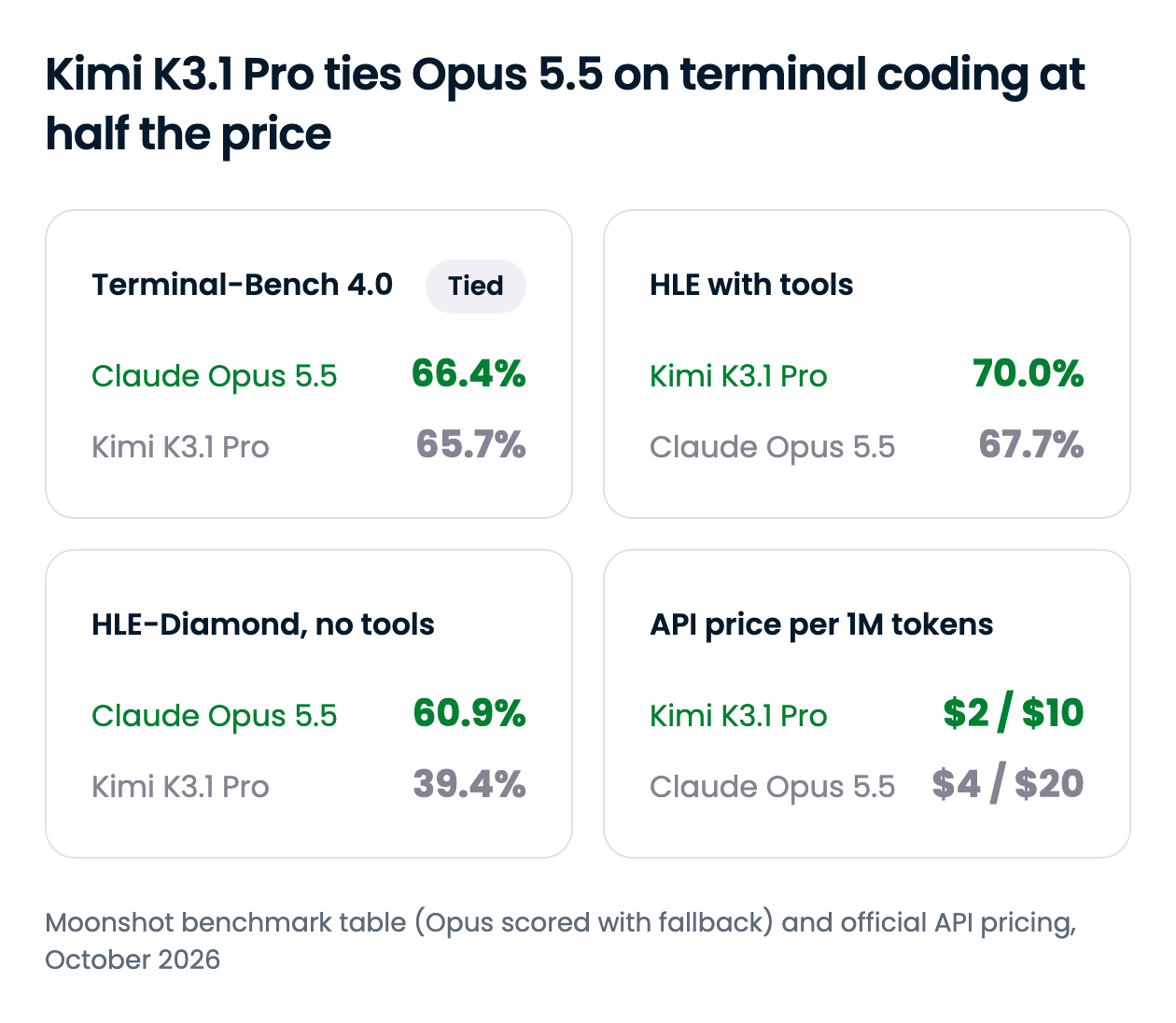
Kimi K3.1 Pro wins on price and on agent work that leans on tools; Opus 5.5 wins whenever the model has to reason without help or work out an under-specified problem. The summary below covers every dimension, and the sections after it go into the ones where the gap changes a decision.
| Feature | Kimi K3.1 Pro | Claude Opus 5.5 |
|---|---|---|
| Developer | Moonshot AI | Anthropic |
| Released | October 2026 | September 22, 2026 |
| Weights | Open weights due by November 4, 2026 (license not yet announced) | Closed |
| Context window | 1M tokens | 1M tokens |
| Max output | Up to 1,048,576 tokens (131,072 by default) | 128K tokens (300K on the Batch API, beta) |
| Terminal-Bench 4.0 | 65.7% | 66.4% |
| Long-horizon coding (SWE-Marathon v1.1) | 51.7% | 46.3% |
| Closed-book reasoning (HLE-Diamond) | 39.4% | 60.9% |
| Tool-assisted reasoning (HLE with tools) | 70.0% | 67.7% |
| Offensive cyber (ExploitBench) | 74.7 | 91.0 |
| API price | Half of Opus 5.5 on input and output | Baseline |
| Where you can run it | Kimi API, Kimi apps, OpenRouter | Claude API, Claude apps, AWS, Google Cloud, Azure, major coding agents |
One caveat applies to every score in this section. The head-to-head numbers come from Moonshot's own benchmark table, which marks each Opus 5.5 result "with fallback": Anthropic's safeguards hand some cyber and biology tasks to other Claude models (Opus 4.8 and Opus 5, respectively), which likely drags those scores down.
The two models are effectively level on Terminal-Bench 4.0, and that headline hides a real split underneath. Kimi K3.1 Pro leads the long-horizon rows, while Opus 5.5 leads, by a wide margin, wherever the task is open-ended.
The biggest gap is ProgramBench, which asks a model to rebuild a program from its binary and spec. Opus 5.5 gets 65.0% of tasks to at least 95% of tests passing, while Kimi K3.1 Pro manages 31.5%, less than half.
| Benchmark | Kimi K3.1 Pro | Claude Opus 5.5 | Notes |
|---|---|---|---|
| Terminal-Bench 4.0 | 65.7% | 66.4% | Kimi run in the Claude Code harness; Opus at xhigh effort per Anthropic |
| SWE-Marathon v1.1 | 51.7% | 46.3% | Multi-hour engineering tasks |
| DeepSWE v1.1 | 75.5% | 74.2% | Each lab's own setup, so treat as a tie |
| Kimi Code Bench 3.0 Long-horizon | 61.2% | 58.5% | Moonshot internal benchmark |
| ProgramBench (binary score) | 31.5% | 65.0% | Share of tasks scoring at least 95% |
| Terminal-Bench Science 0.1 | 38.1% | 63.3% | Anthropic's own table reports 58.7% for Opus |
| PostTrainBench v1.2 | 36.5% | 43.8% | Kimi run on H20 GPUs instead of H100s |
| BenchCAD with tools | 92.7% | 96.2% | 3D reconstruction through CAD code |
The pattern is consistent. Give Kimi K3.1 Pro a well-defined engineering task and a lot of time, and it keeps going: Moonshot's showcase run had it fix 36 errors in a human walking simulator's shoulder-muscle calculations across 167 missions. Anthropic's equivalent story is a C-to-Rust translation of HAProxy that passed nearly all of HAProxy's own regression tests.
Where the spec is thin, Opus pulls ahead. ProgramBench, scientific research workflows, and post-training experiments all require working out what the task even is, and that's where Kimi's long-run stamina stops paying off.
For long, well-specified coding agents, Kimi K3.1 Pro is a real alternative; for reverse-engineering, research code, and fuzzy tickets, Opus 5.5 is the safer pick.
Take the tools away and Opus 5.5 leads clearly. The widest gap is HLE-Diamond, the 1,000-question hardest subset of Humanity's Last Exam, where Opus scores 60.9% to Kimi's 39.4%.
| Benchmark | Kimi K3.1 Pro | Claude Opus 5.5 | Notes |
|---|---|---|---|
| HLE-Full | 51.1% | 59.8% | 2,500 questions, no tools |
| HLE-Diamond | 39.4% | 60.9% | Hardest 1,000 questions |
| GPQA-Diamond | 94.2% | 93.9% | Near saturation; a tie |
| MMMU-Pro | 84.1% | 87.7% | Image and text questions |
| Kimi Hallu Bench (lower is better) | 5.4% | 6.8% | Moonshot internal; claim-level hallucination rate |
They tie on GPQA-Diamond, which is too close to its ceiling to separate anyone. Kimi's lower hallucination rate comes from Moonshot's own stress test, so I'd treat it rather as a sign the factual-accuracy work landed than as a head-to-head verdict. For closed-book reasoning, Opus 5.5 is the stronger model.
Hand both models tools and the reasoning result flips. On Humanity's Last Exam with tools, Kimi K3.1 Pro scores 70.0% against Opus's 67.7%, and it leads most of Moonshot's research and document rows.
| Benchmark | Kimi K3.1 Pro | Claude Opus 5.5 | Notes |
|---|---|---|---|
| HLE-Full with tools | 70.0% | 67.7% | Same questions, tools allowed |
| BrowseComp | 92.1% | 90.8% | Hard-to-find web information |
| OfficeQA Pro v2 | 64.4 | 62.2 | Numerical analysis across financial PDFs |
| Frontier Finance | 58.6 | 56.7 | Investment workflows, screening to profitability |
| AutomationBench-AA | 73.3 | 69.5 | Artificial Analysis version, not Zapier's |
| OSWorld V2.1 | 79.6% | 81.8% | Operating a desktop computer |
| APEX-Agents | 67.2 | 73.5 | Mercor leaderboard |
| AA-Briefcase v1.1 (Elo) | 1678 | 1803 | Artificial Analysis |
Kimi's wins are small but consistent on search and finance documents. Opus keeps the edge on computer use and on the third-party agent leaderboards, so Kimi K3.1 Pro is the better research agent and Opus 5.5 the better desktop and general office agent.
Both models read the same size context, and both always think: neither Moonshot nor Anthropic lets you switch reasoning off. The defaults differ, though. Kimi K3.1 Pro runs at max effort unless you set low or high, while Opus 5.5 defaults to medium, so an untuned Kimi call spends more reasoning per request.
The output ceiling is the bigger practical gap. Kimi K3.1 Pro can return a full context window's worth of output in one call, roughly eight times Opus 5.5's ceiling outside the Batch API. Agent builders migrating to Opus should also know that forced tool use now returns a 400 error.
Both labs throttle offensive cyber ability, in opposite ways. Moonshot removed cyber-related data from mid-training and RL for the open-weight release, which cut its internal exploit benchmark from 90.5% to 81.0%. Anthropic keeps the capability in Opus 5.5 and re-routes most cybersecurity requests to Opus 4.8 at serving time.
On ExploitBench, Opus scores 91.0 to Kimi's 74.7, and Moonshot says outright that K3.1 Pro stays behind frontier proprietary models on cyber by design. The trade-off is control: once the weights ship, you can run Kimi on your own infrastructure, which Opus doesn't offer.
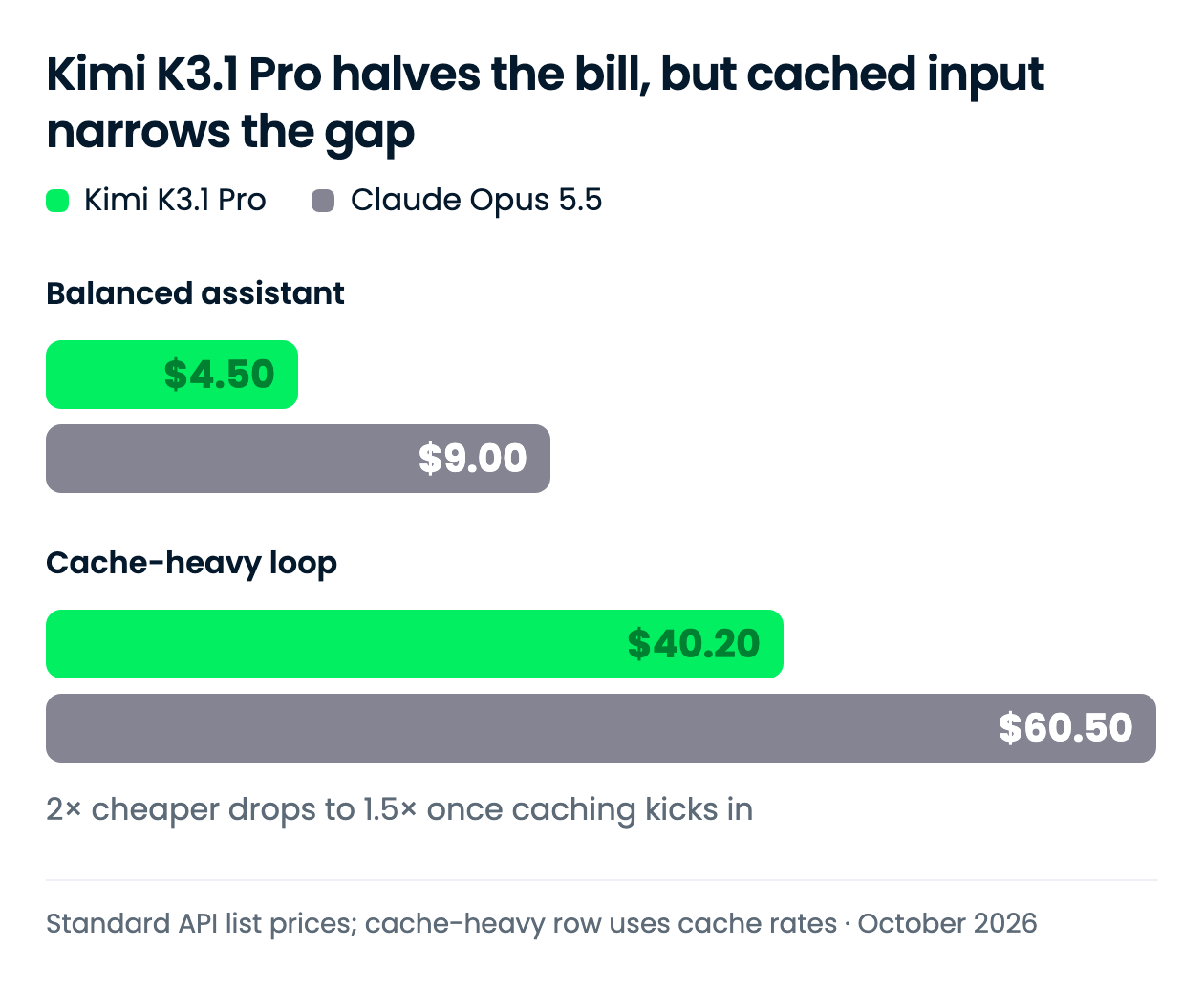
Kimi K3.1 Pro costs half as much as Opus 5.5 on fresh tokens. The saving shrinks when a workload runs on cached context, because both vendors charge the same for a cache read.
All rates are per 1M tokens, from Moonshot's and Anthropic's official pricing pages.
| Rate | Kimi K3.1 Pro | Claude Opus 5.5 |
|---|---|---|
| Input, per 1M tokens | $2.00 | $4.00 |
| Output, per 1M tokens | $10.00 | $20.00 |
| Cached input read, per 1M tokens | $0.20 | $0.20 |
| Cache write, 5-minute TTL | $2.00 | $5.00 |
| Cache write, 1-hour TTL | $4.00 | $8.00 |
| Faster variant | K3.1 Pro Highspeed, 2–3x speed: $4.00 / $20.00 | Fast mode, up to 2.5x speed: $8.00 / $40.00 |
The multiple is not uniform: 0.5x on input, output, and 1-hour cache writes, 0.4x on 5-minute cache writes, and 1.0x on cache reads. Neither vendor adds a long-context surcharge.
Two quirks fall out of the table. Kimi's Highspeed variant costs exactly what standard Opus costs. Anthropic's Batch API halves Opus to $2 and $10, matching Kimi's standard rate, while Moonshot's pricing page lists no batch discount.
I picked two monthly workload shapes: a balanced assistant as the scale anchor, and a cache-heavy agent loop, because cache pricing is where the two price lists diverge.
| Workload | Kimi K3.1 Pro | Claude Opus 5.5 | Difference |
|---|---|---|---|
| Balanced assistant: 1M in / 250K out | $4.50 | $9.00 | $4.50 (Kimi 50% cheaper) |
| Cache-heavy loop: 100K prefix written once, 1,000 cached reads, plus 5K fresh in / 1K out per request | $40.20 | $60.50 | $20.30 (Kimi 34% cheaper) |
Each total is (volume ÷ 1M) × rate, summed across input, output, and cache lines; the cache-heavy row uses the 5-minute cache write. The balanced row is simply the 2x rate gap.
The cache-heavy row is the one to plan around. The 100M cached tokens cost $20 on either model, so only the fresh tokens and the cache write carry Kimi's discount, and the saving drops to about a third. Anthropic says cache reads make up the majority of agentic coding costs, so long-running agents will land closer to this row than to the first.
The two models use different tokenizers, and neither vendor has published token counts for a shared workload, so treat these totals as a rate comparison rather than a bill.
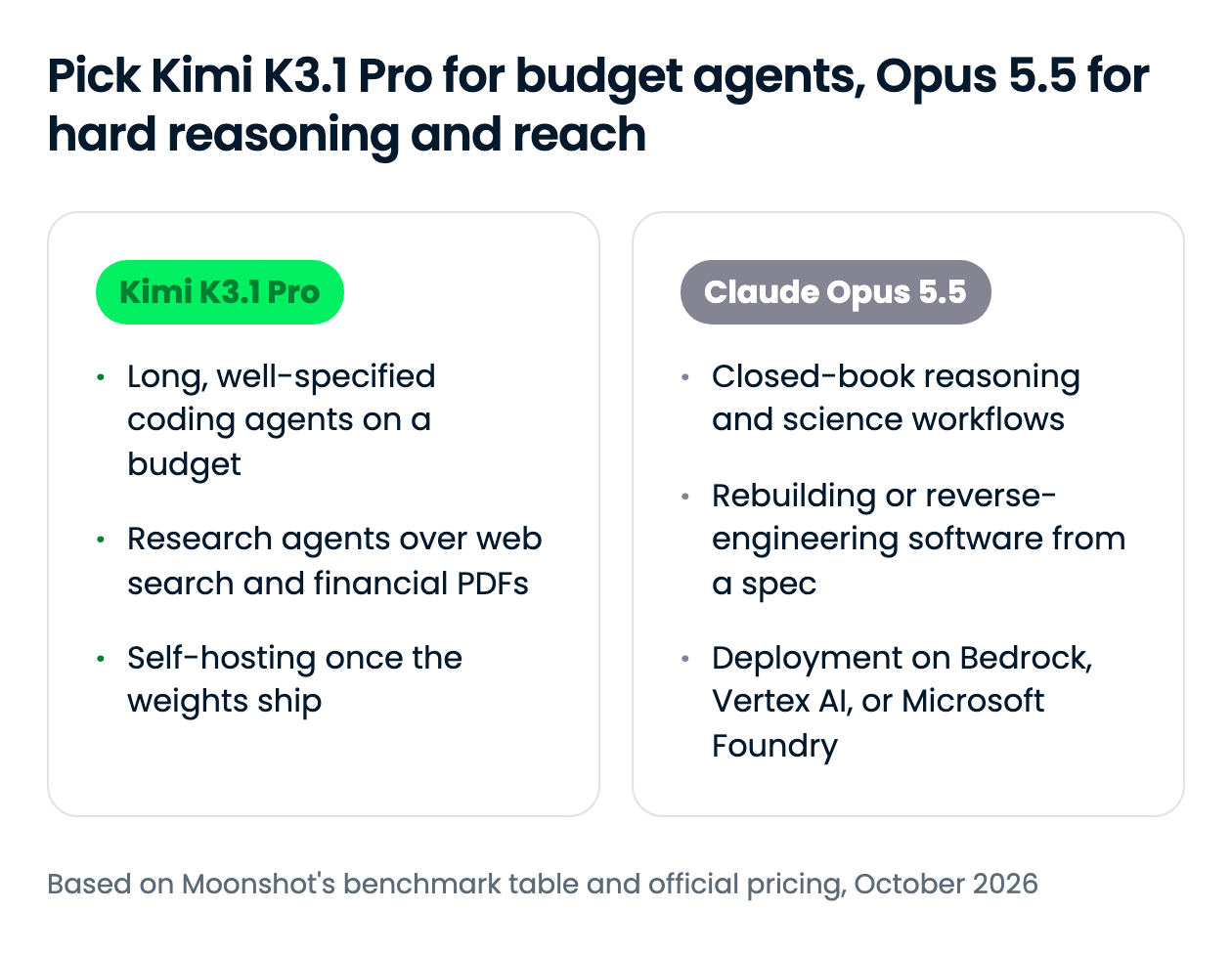
The fork is price against breadth: Kimi K3.1 Pro halves the per-token rate, and Opus 5.5 covers the reasoning cases Kimi trails on and the cloud platforms Kimi isn't confirmed on. If your agent runs mostly on cached context, the saving is closer to a third than a half.
You can call both models today through their own APIs or through OpenRouter, and Opus 5.5 also runs on Amazon Bedrock, Vertex AI, and Microsoft Foundry.
| Surface | Kimi K3.1 Pro | Claude Opus 5.5 |
|---|---|---|
| Consumer app | Kimi.com, Kimi mobile apps, Kimi Work desktop app | Claude apps (Pro, Max, Team, Enterprise) |
| First-party API | Kimi API (OpenAI-compatible) | Claude API |
| Cloud platforms | Not yet available on Azure AI Foundry or Amazon Bedrock as of 29 Oct 2026 | Amazon Bedrock, Vertex AI, Microsoft Foundry |
| Coding agents | Kimi Code (not yet available in GitHub Copilot and Cursor as of 29 Oct 2026) | Claude Code, Cursor, GitHub Copilot |
| Third-party routers | OpenRouter | OpenRouter |
| Open weights | Due by November 4, 2026 | No |
| API model ID | kimi-k3.1-pro |
claude-opus-5-5 |
The reach gap is the deciding factor for many teams: Opus 5.5 is on every major cloud and in the mainstream coding agents, while Kimi K3.1 Pro is confirmed only on Moonshot's own surfaces and OpenRouter until the weights arrive. On the first-party APIs the model IDs are kimi-k3.1-pro and claude-opus-5-5; on OpenRouter they are moonshotai/kimi-k3.1-pro and anthropic/claude-opus-5.5.
OpenRouter's OpenAI-compatible endpoint makes the two models a one-string swap, which is the easiest way to A/B them on your own prompts.
from openai import OpenAI

client = OpenAI(base_url="https://openrouter.ai/api/v1", api_key="YOUR_OPENROUTER_KEY")
response = client.chat.completions.create(
    model="moonshotai/kimi-k3.1-pro",  # swap for "anthropic/claude-opus-5.5"
    messages=[{"role": "user", "content": "Find the race condition in this worker pool..."}],
)
print(response.choices[0].message.content)
Our Opus 5.5 API tutorial goes deeper on the Claude side, and our explainer on OpenCode shows how to plug either model into an open-source coding agent.
Kimi K3.1 Pro matches Claude Opus 5.5 on terminal coding and beats it on long, tool-heavy agent runs, at a significant discount. If your agents run long, well-defined tasks with tools, use Kimi; if they reason without help, chase vague specs, or have to live on AWS, Google Cloud, or Azure, use Opus.
What I find most interesting is how differently the two labs handle the same risk: Moonshot cuts cyber capability out of the weights before publishing them, and Anthropic keeps it in the model and gates it at serving time. I'd test Kimi through OpenRouter and revisit self-hosting once the weights and license land in November.
If you're keen to build with models like these, I recommend checking out our Associate AI Engineer for Developers track.
Learn AI With DataCamp!
Track
Course
Practice and track your progress.
Continue with Googleblog
Tom Farnschläder
11 min
blog
Derrick Mwiti
10 min
blog
Matt Crabtree
14 min
blog
Tom Farnschläder
15 min
blog
Tom Farnschläder
11 min
blog
Josef Waples
10 min