Track
Developing Large Language Models
19 hr
Imagine two students sitting the same exam. The first student spends three weeks studying only one module, while the second has already practiced on millions of different exams and simply gets a sheet of worked examples on the day.
For most of machine learning’s past, tabular models have been the first student. Every new dataset meant cleaning columns, engineering features, training XGBoost or LightGBM, and tuning hyperparameters for hours.
Tabular foundation models, though, are the second student: you hand them your labeled rows as examples, and they predict the rest with no training at all.
In 2026, this idea went from research papers to real products, with SAP committing more than €1 billion to Prior Labs and Google releasing its own model. So in this article, we will look at:
Don’t worry if you don’t have much deep learning experience. The code in this article uses the familiar scikit-learn interface, and if you want a quick refresher first, 8 Machine Learning Models Explained in 20 Minutes covers the basics.
pip install tabicl.A tabular foundation model is a neural network pretrained on millions of synthetic tabular datasets that learns a general strategy for predicting a target column, then applies that strategy to a new table through in-context learning, without any per-dataset training.
The big change here is when the learning happens.
With XGBoost, the learning happens on your data every time you train a new model. With a tabular foundation model, the learning happened months ago during pretraining, and your data is simply the input. There are also a few terms you will keep seeing, so let me explain them in plain language:
Now, let’s talk about how tabular foundation models compare to boosting methods and automated machine learning (AutoML):
| Tabular foundation models | Gradient-boosted trees (XGBoost, LightGBM) | AutoML (AutoGluon, H2O AutoML) | |
|---|---|---|---|
| Training time on new data | None | Seconds to minutes, plus tuning | Minutes to hours |
| Interpretability | Limited (SHAP is possible but slow) | Good (feature importance, fast SHAP) | Varies, often hard-to-read ensembles |
| Best dataset size | Hundreds to about 100K rows | Thousands to many millions of rows | Thousands to millions of rows |
| GPU needed? | Recommended past a few thousand rows | No | Usually no |
| Small, randomly split datasets | Best on current benchmarks | Strong when tuned | Strong but slow |
Before we look at how they work, though, I want to quickly compare them with the most famous, widely used models: large language models.
Large language models (LLMs) and tabular foundation models both use transformers, and both learn from examples in their input.
The difference is what they are built to read. An LLM reads a table as a long string of text, which means it has to work out from commas and spaces which numbers belong to the same column.
There is also a meaning problem.
The value 42 could be someone’s age or a revenue figure, but nothing in the number itself tells you which. A tabular foundation model is trained to treat each column as its own variable and each row as one example, so it focuses on how the columns relate to each other.
I like to think of it this way: an LLM is great at talking about your data, and a tabular foundation model is built to do the math on it.
The two can also work together, which is exactly how H2O.ai positions its tabH2O model: as the prediction tool an AI agent calls when it needs a number from a spreadsheet.
Tabular data was hard for deep learning because tables have no shared structure that a neural network can learn once and reuse. A pixel is a pixel in every photo. A column called score in a financial dataset and a column called score in a football dataset have nothing in common.
A well-known 2022 paper by Léo Grinsztajn, Edouard Oyallon, and Gaël Varoquaux, Why do tree-based models still outperform deep learning on tabular data?, tested this on 45 datasets and found that tree-based models, especially gradient boosting, still beat deep learning on medium-sized tables of around 10,000 rows. The reasons they found are:
Two more practical problems make this worse. A single table can mix numbers, categories, rankings, and missing values, and most business tables only have hundreds or thousands of rows, which is far too little for a neural network trained from scratch.
I would argue that small datasets are the most important problem. A neural network trained from zero on 800 rows has nothing to fall back on, whereas a tree does not need any prior knowledge to work.
This is exactly what pretraining fixed. A tabular foundation model has already practiced on millions of small, messy, made-up tables before it ever sees yours, so it is not starting from zero.
A tabular foundation model takes your labeled training rows and your unlabeled test rows together as one input and predicts the missing labels in a single forward pass. Its weights never change, just like an LLM answering a question after you give it a few examples in the prompt.
This also changes what the familiar scikit-learn methods mean.
When you call .fit() on TabICL, the TabICL documentation explains that it loads the pretrained checkpoint, preprocesses your data, and stores it. The real work happens during .predict().
The .fit() name stays so that the model slots into your existing scikit-learn code.
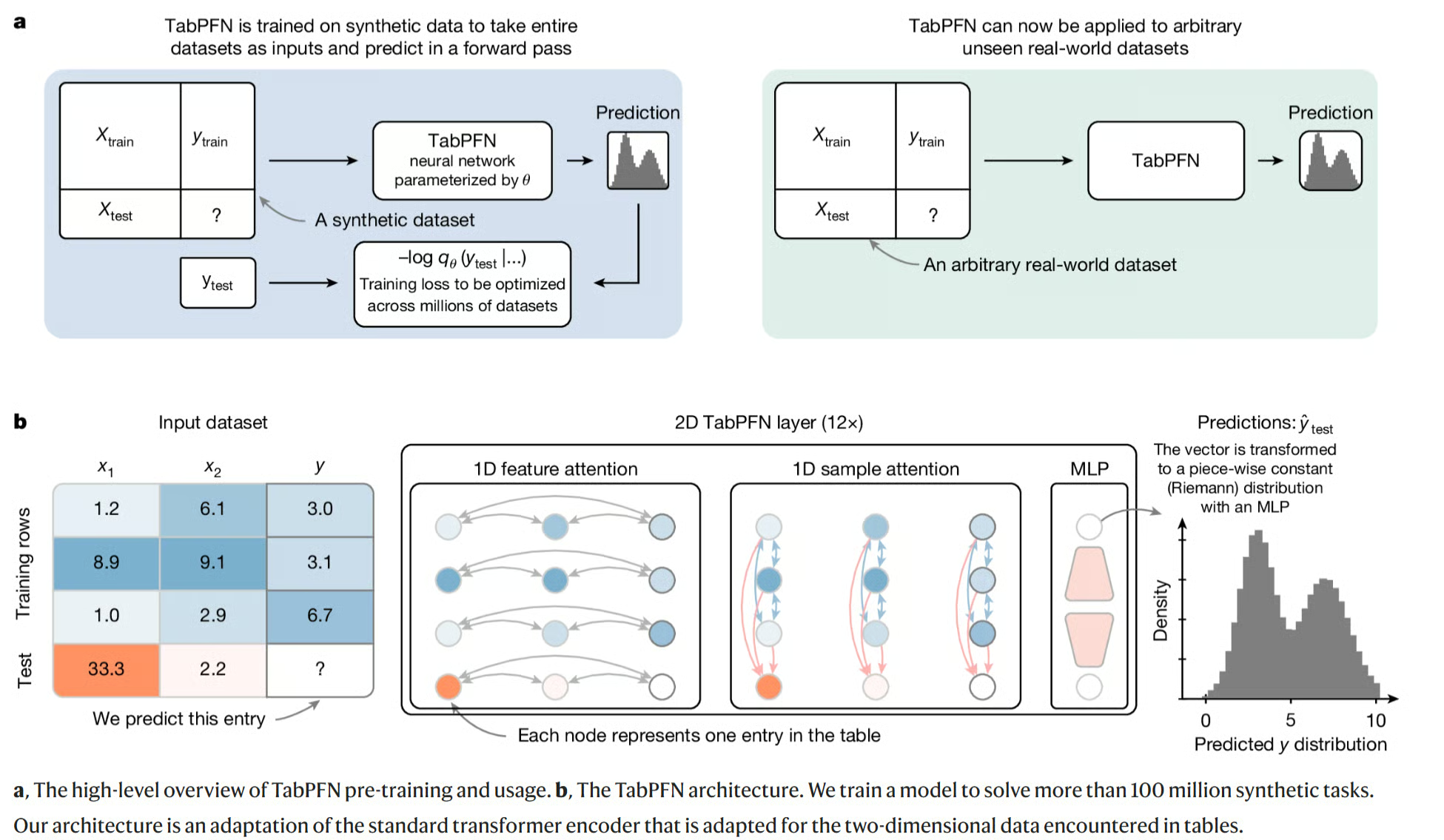
Figure 1: TabPFN is pretrained on millions of synthetic datasets, then predicts on a real table in one forward pass. The bottom panel shows how it attends across features and samples. Source: Hollmann et al., “Accurate predictions on small data with a tabular foundation model”, Nature (2025).
Synthetic pretraining means training the model on made-up tables instead of real ones, produced by a data generator that works like a generative model.
Think of a pilot training in a flight simulator. The pilot practices thousands of fake flights with different weather, airports, and faults, so that the first real flight does not feel new.
TabPFN works in a similar way.
Its creators wrote a generator that invents random “cause and effect” rules between columns (for example, column A affects column B, which affects the target), then produces rows from those rules.
During pretraining, the target column is hidden, the model tries to predict it, and this repeats millions of times with different rules, noise levels, and table sizes.
The important thing is that the model never learns facts about any real topic. It learns general skills such as spotting which columns matter, dealing with outliers, and knowing when to be unsure.
In fact, the TabICLv2 paper credits its new synthetic data generator as a key reason for its better performance.
You do not need to understand every detail of the architectures, but it does help to know that there are two main designs:
Note that both families are trained on synthetic data, so “prior-fitted network” describes how they are trained rather than a separate type of model.
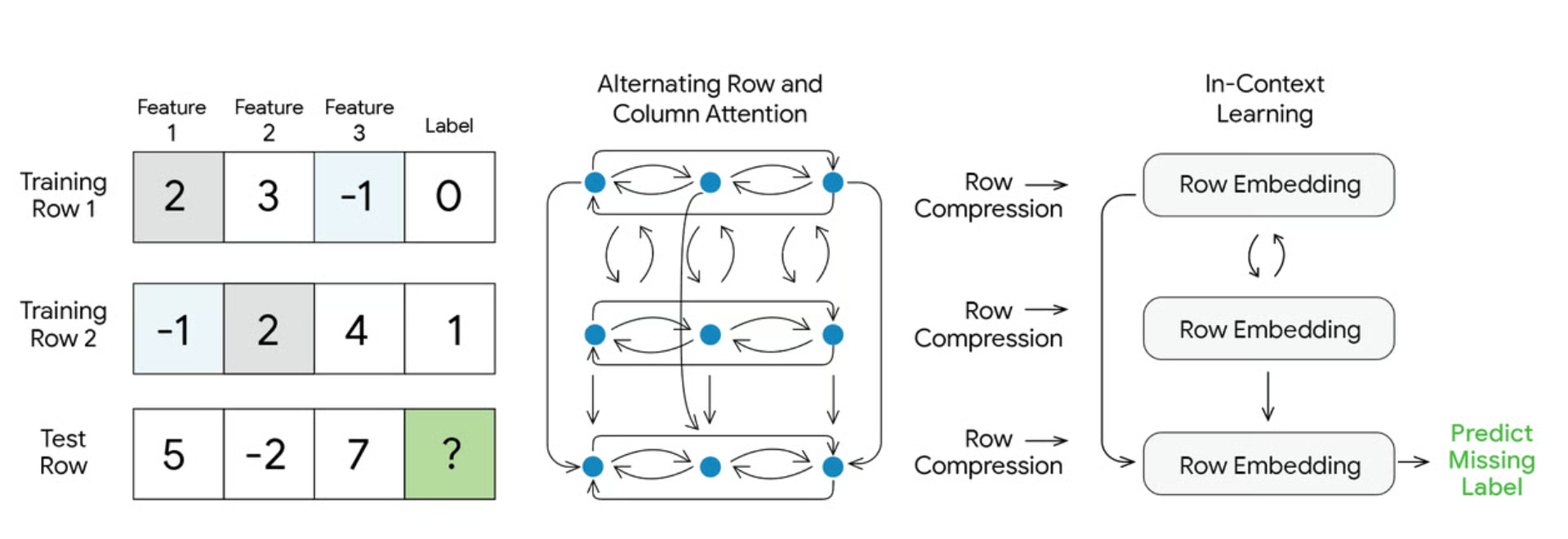
Figure 2: TabFM mixes both designs: TabPFN-style attention over rows and columns, then TabICL-style row compression, then in-context learning for the missing label. Source: Google Research, “Introducing TabFM: A zero-shot foundation model for tabular data” (2026).
There is a trade-off here that catches a lot of people out.
XGBoost spends time training once, then predicts almost instantly.
A tabular foundation model skips training, but it has to read all of your training rows every time it predicts.
Think of a chef who does no prep work before service but has to reread the whole recipe book for every order.
For a small book, that is fine, but as your dataset grows, predictions get slower. Both TabICL and TabPFN can cache their “reading” of the training data to speed up repeated predictions, but the first pass still costs time.
The key tabular foundation models in 2026 are TabPFN, TabICLv2, Google’s TabFM, Fundamental’s NEXUS, and H2O.ai’s tabH2O. What I find interesting is how fast the business side moved: five months took this area from academic papers to major deals. Here is a brief timeline:
Now let’s walk through each one, starting with the model that started it all.
TabPFN is the model that created this category. TabPFN-2 was published in Nature in January 2025 and beat tuned tree-based models on datasets of up to 10,000 rows.
Since then, Prior Labs has released new versions quickly. TabPFN-3 arrived in May 2026 and handles up to 1 million rows (and up to 200 features). It also added a Thinking mode (through its paid API) that spends extra time at the fitting stage to make better predictions.
The latest version, TabPFN-3.5, came out in September 2026, and its technical report claims first place on several major benchmarks, including on time-ordered and grouped data. I would treat those as the company’s own numbers until others confirm them.
One more thing is the license. TabPFN-2 can be used commercially as long as you credit Prior Labs, but versions 2.5 to 3.5 are non-commercial. That means you can experiment with them for free, but using them in a real product requires a paid license.
TabICLv2 is the best fully open tabular foundation model right now. It was built at Inria, released in February 2026, and accepted at ICML 2026.
The headline result from the TabICLv2 paper is that, without any tuning, it beat RealTabPFN-2.5, the previous best model, even though that model had been tuned, ensembled, and fine-tuned on real data.
According to its GitHub repository, it also beats heavily tuned XGBoost, CatBoost, and LightGBM on around 80% of datasets in the TabArena benchmark.
It is also fast, handling 50,000 rows with 100 features in under 10 seconds on an H100 GPU, which is around 10 times faster than TabPFN-2.5.
It works best between 300 and 100,000 rows and can stretch to around 500,000 rows with some loss in accuracy.
In my opinion, this is the one most readers should start with.
You install it with pip install tabicl, it works like any scikit-learn model, and its permissive license lets you use it commercially without signing up for anything. The leaderboard changes fast, though, and TabPFN-3.5’s report now ranks itself ahead of TabICLv2.
TabFM is Google Research’s tabular foundation model, released on June 30, 2026. What makes it different is where you can use it: it is built into BigQuery, Google’s cloud data warehouse, so you can get predictions with plain SQL.
-- Use past customers (with known churn) to predict churn for new customers
-- AI.PREDICT is in preview, so check the BigQuery docs for the latest syntax
SELECT *
FROM AI.PREDICT(
  TABLE my_dataset.customers_history,
  TABLE my_dataset.customers_new,
  label_col => 'churned'
);
This is great for people who know SQL but not Python.
However, the BigQuery documentation currently limits you to 20 feature columns and 10 classes, and Google plans to add token-based pricing on top of standard BigQuery charges from October 30, 2026. The model weights on Hugging Face are non-commercial, so commercial use goes through BigQuery.
NEXUS is a closed, business-only model from Fundamental, a San Francisco startup founded by former DeepMind researchers. It launched in February 2026 with $255M in funding, and the company calls it a Large Tabular Model (LTM).
Businesses buy and run NEXUS through AWS, and Fundamental says Fortune 100 companies already use it for demand forecasting, pricing, and customer churn. However, there are no public weights or benchmark results you can check yourself, so I would treat it as an enterprise option.
tabH2O is H2O.ai’s model, and its whole idea is simple: send your data, get predictions back.
It cleans up missing values and categories for you and can run on a company’s own servers, which matters for banks and hospitals that cannot send data to the cloud.
What I like is that the tabH2O paper does not oversell it. It beat tuned CatBoost and LightGBM on the TALENT benchmark, but still ranked behind TabICLv2.
| Model | Creator | Open weights? | Max scale | License | Best for |
|---|---|---|---|---|---|
| TabPFN-2 | Prior Labs | Yes | 10K rows | Commercial with attribution | Commercial use of a proven older model |
| TabPFN-3 / 3.5 | Prior Labs (SAP) | Yes, after accepting a license | Up to 1M rows | Non-commercial, paid API for business | Top accuracy and research |
| TabICLv2 | Inria | Yes | Best up to 100K rows | Permissive open source | Your default starting point |
| TabFM | Google Research | Yes | 20 features in BigQuery | Non-commercial weights | SQL users on BigQuery |
| NEXUS | Fundamental | No | Not disclosed | Proprietary | Large companies on AWS |
| tabH2O | H2O.ai | No | Not disclosed | Commercial API | Teams with no ML setup, AI agents |
You use a tabular foundation model in Python exactly like any other scikit-learn model.
The best way to see what it offers is to put it head to head with XGBoost, so let’s do that on scikit-learn’s built-in breast cancer dataset.
First, we install the packages:
pip install tabicl xgboost scikit-learnThen we run both models on the same split:
from sklearn.datasets import load_breast_cancer
from sklearn.metrics import accuracy_score
from sklearn.model_selection import train_test_split
from tabicl import TabICLClassifier
from xgboost import XGBClassifier

# Load a small tabular dataset as a pandas DataFrame
X, y = load_breast_cancer(return_X_y=True, as_frame=True)
X_train, X_test, y_train, y_test = train_test_split(
    X, y, test_size=0.2, stratify=y, random_state=42
)

# Tabular foundation model: fit() just stores the training rows
tfm = TabICLClassifier()
tfm.fit(X_train, y_train)
tfm_preds = tfm.predict(X_test)

# XGBoost baseline with reasonable, untuned settings
xgb = XGBClassifier(n_estimators=300, learning_rate=0.05, max_depth=4)
xgb.fit(X_train, y_train)
xgb_preds = xgb.predict(X_test)

print(f"TabICL accuracy:  {accuracy_score(y_test, tfm_preds):.3f}")
print(f"XGBoost accuracy: {accuracy_score(y_test, xgb_preds):.3f}")
This small dataset runs fine on a normal laptop CPU.
Both models will score very highly on something this clean, so please do not judge them on one split. The real test will be your own messy data.
If you want to try TabPFN instead, run pip install tabpfn, and then it is only a two-line change:
from tabpfn import TabPFNClassifier

tfm = TabPFNClassifier()  # The first run asks you to accept the license
tfm.fit(X_train, y_train)
tfm_preds = tfm.predict(X_test)
One important thing before you compare models on real data.
If your data has dates, split it by time instead of randomly. Otherwise, the model gets to peek at the future, and as you will see in the next section, that is exactly where tabular foundation models look better than they really are.
Tabular foundation models work well when your dataset is small to medium and the test rows look like the training rows. They struggle with time-ordered data, grouped data, very large tables, and strict explainability needs.
That “test rows look like training rows” idea has a name, IID (independent and identically distributed), and it is the single most important thing to check about your data.
Let’s start with where they work well:
Now for the limitations, which I think matter more if you plan to use these in a real project.
The BeyondArena benchmark, released in June 2026, tested 11 models on 142 datasets, including ones split by time (predicting the future from the past) and by group (predicting for a new hospital or country).
It found tabular foundation models do best on small and medium IID data, while tree-based and other deep learning models still lead on time-ordered, grouped, large, and very wide data. Since most business data (sales, fraud, churn) is ordered in time, this limitation shows up in most real projects.
TabPFN-3.5, released after BeyondArena, specifically claims to close this gap on time-ordered and grouped data. That is promising, but it has not yet been independently tested.
You can get SHAP values from both TabICL and TabPFN, but it takes much longer than SHAP on a tree model, and there are no tree splits to inspect. In areas like credit scoring, where regulators need to understand the model, this is a real problem.
Anything past a few thousand rows really wants a GPU, and predictions get slower as your training data grows. A trained XGBoost model on a CPU will win on speed every time.
TabPFN-2 is commercial with credit, newer TabPFN versions are non-commercial, TabFM weights are non-commercial, and TabICLv2 is permissive.
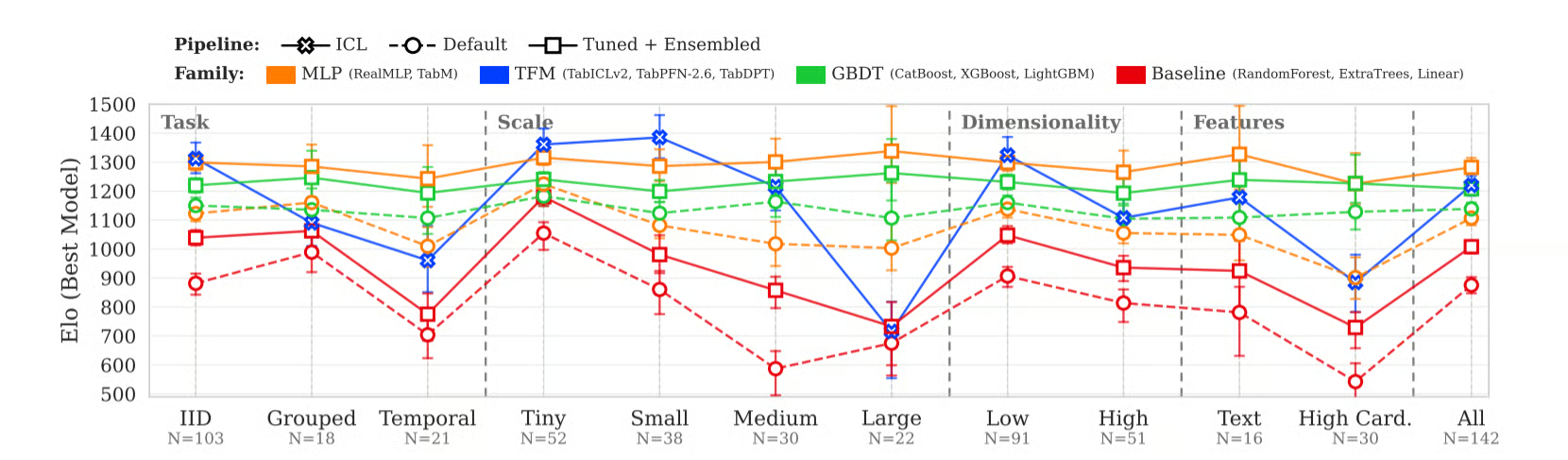
Figure 3: Elo by model family (higher is better). Tabular foundation models lead on small IID data but drop on temporal and large datasets, where trees and MLPs hold up better. Blue is the best of TabICLv2, TabPFN-2.6, and TabDPT, not the newest TabPFN versions. Source: Purucker et al., “Beyond IID: How General Are Tabular Foundation Models, Really?” (2026), CC BY 4.0.
Hopefully, you will agree with me that tabular foundation models have raised the bar for how good a quick, no-effort baseline can be, but tree-based models are still the better choice in plenty of real situations.
You should use a tabular foundation model when your dataset is small to medium and IID, and you do not need a fully explainable model or very fast predictions on a CPU. Here is the decision table I would use:
| Scenario | Recommended approach |
|---|---|
| Under 10K rows, IID, no explainability needs | Start with TabICLv2 or TabPFN |
| 10K to 100K rows, IID | Test TabICLv2 and XGBoost, keep the winner |
| 100K to 1M rows | Start with XGBoost or LightGBM, try TabPFN-3 as a challenger |
| Data split by time or by group | Start with tree-based models |
| Need SHAP, feature importance or auditing | Tree-based model with SHAP |
| Fast predictions without a GPU | Tree-based model |
| Quick proof of concept, no ML setup | TabICLv2, or BigQuery AI.PREDICT if your data is already there |
| AI agent that needs predictions from tables | An API like tabH2O or NEXUS |
Before picking a model, I would recommend asking these three questions:
And the last point I would like to make is this. Run a tabular foundation model first, because it only costs you a few minutes. If it cannot beat XGBoost on your data, you now know that spending time on feature engineering and tuning XGBoost is worth it.
Remember the two students from the start of this article? In 2026, the second student, the one who practiced on millions of exams, can finally beat the one who studied for weeks, at least on small and medium tables.
Tabular foundation models replace per-dataset training with pretraining, and replace fit() with learning from examples.
What surprises me most is how quickly this domain has improved. TabPFN-2 first showed in 2025 that a neural network could beat tuned trees on small tables, and TabICLv2 and TabPFN-3 have since pushed that to much larger ones.
The open problems now are time-ordered data, changing data, explainability, and licensing, which are exactly the things that decide whether a model makes it into a real product.
So my advice is to treat these models as your new starting point and pick the final tool based on your data, your limits, and where the model will run.
And if you want to master the tree-based models that still win in many real situations, check out our Machine Learning with Tree-Based Models in Python course and the Supervised Machine Learning in Python track. If you work in R, Machine Learning with Tree-Based Models in R covers the same ground.
Top DataCamp Courses
Track
Course
Track
blog
Andrea Valenzuela
10 min
blog
Javier Canales Luna
9 min
blog
Amberle McKee
8 min
Tutorial
Vaibhav Mehra
15 min
Tutorial
Tim Lu
7 min
code-along
Richie Cotton