본문으로 바로가기

세부 정보를 입력하여 웨비나에 참여하세요.

계속 진행하시면 당사의 이용약관, 개인정보처리방침 및 귀하의 데이터가 미국에 저장되는 것에 동의하시는 것입니다.

Share this webinar

Close your data and AI skills gap

We're the only platform uniquely engineered to advance data and AI skills across your entire organization. Let's explore a tailored program.

Book an Enterprise Demo
Upskilling a small team?Get started today
Artificial Intelligence

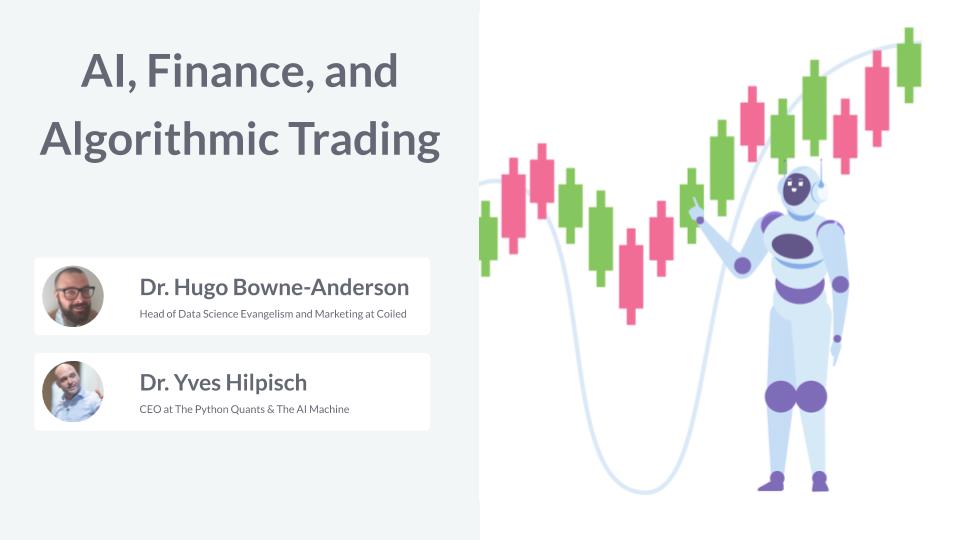
Webinar | AI, Finance, and Algorithmic Trading

November 2021
Webinar Preview

Your Presenter(s)

Hugo Bowne-Anderson 헤드샷

Hugo Bowne-Anderson

Data Scientist

Hugo is a data scientist, educator, writer and podcaster at DataCamp. His main interests are promoting data & AI literacy, helping to spread data skills through organizations and society and doing amateur stand up comedy in NYC.

Dr. Yves Hilpisch 헤드샷

Dr. Yves Hilpisch

CEO at The Python Quants & The AI Machine

Connect with Dr. Hilpisch on LinkedIn and Twitter, or view his work on YouTube and Github.

Summary

In an insightful conversation, data science and AI experts Dr. Eve Hilpisch and Dr. Hugo Bowne-Anderson discussed the significant impact of AI and machine learning in finance. They brought into focus the changing role of data scientists in financial markets and the growing dependence on AI-enhanced algorithmic trading. The dialogue examined the technical challenges and opportunities Python and other technologies present in creating effective trading algorithms. They also reflected on the philosophical aspects of AI's role in decision-making and market predictions, especially during unusual events like financial crises. Valuable insights were shared on combining AI with human decision-making processes, and the future of finance in an AI-driven competitive environment.

Key Takeaways:

  • AI and machine learning are transforming finance, notably in algorithmic trading.
  • Python has emerged as a mainstay in financial data science, providing powerful tools for data manipulation and analysis.
  • AI's capability to replicate human intelligence prompts philosophical and practical questions in finance.
  • Market instability presents unique challenges for training AI models using historical data.
  • Python's compatibility with other languages and its efficiency make it ideal for financial applications.

Deep Dives

AI and Machine Learning in Finance

The incorporation of AI and machine learning in finance is transforming the sector, introducing new methods for analyzing large datasets and executing trades. Dr. Eve Hilpisch emphasized the rising significance of AI, stating that "data scientists are now key players in finance." AI's capability to analyze extensive amounts of data quickly and accurately allows for the creation of advanced trading strategies that were previously unthinkable. The conversation brought to light how AI can outdo traditional methods by learning from patterns in historical data, although it faces obstacles during unexpected market events.

The Role of Python in Financial Data Science

Python has emerged as an essential tool for financial data scientists, owing to its flexibility and a wide range of libraries. As Dr. Hilpisch noted, "Pandas was finally the package that brought me into the Python ecosystem." Python's data manipulation capabilities make it ideal for managing the large datasets typical in finance. Its compatibility with other programming languages and ease of use have made it the favored choice for many financial institutions. The webinar also discussed Python's ability to work with technologies like Docker and AWS, further enhancing its usefulness in finance.

AI's Philosophical and Practical Implications

The philosophical aspects of AI in finance are deep, as AI systems start to replicate human decision-making processes. Dr. Bowne-Anderson expressed caution about anthropomorphizing AI, stating, "We need to be careful about how we think of AI's 'learning' process." The conversation explored the concept of AI as a tool that enhances human intelligence, rather than replacing it. This viewpoint aligns with the idea of "centaurs" in chess, where human and machine collaboration leads to superior outcomes.

Challenges in AI Model Training During Market Volatility

Training AI models during periods of market instability presents considerable challenges. Dr. Hilpisch discussed the limitations of using historical data to predict future market behavior, especially during "black swan" events like the COVID-19 pandemic. He highlighted the need for adaptive approaches, such as reinforcement learning, which can adjust to changing market conditions in real-time. This adaptability is essential for creating effective trading algorithms that can withstand unexpected market shifts.


관련된

webinar

Deep Learning in Finance

Get an insider’s account of deep learning in finance.

webinar

Machine Learning for Investment Finance

Discover the common use cases for machine learning in investment finance.

webinar

Scaling AI Adoption in Financial Services

Explore regulatory AI initiatives in financial services and how to overcome them

webinar

How AI Can Improve Your Data Strategy

Find out how AI, ML, and data science can inform your data strategy.

webinar

The Future of Data Science in Insurance

Expert webinar with Regional Chief Data and Analytics Officer at Allianz Benelux