Sari la conținutul principal

Completează detaliile pentru a debloca webinarul

Continuând, acceptați Termenii și condițiile de utilizare, Politica de confidențialitate și faptul că datele dvs. sunt stocate în SUA.

Share this webinar

Close your data and AI skills gap

We're the only platform uniquely engineered to advance data and AI skills across your entire organization. Let's explore a tailored program.

Book an Enterprise Demo
Upskilling a small team?Get started today
Artificial Intelligence

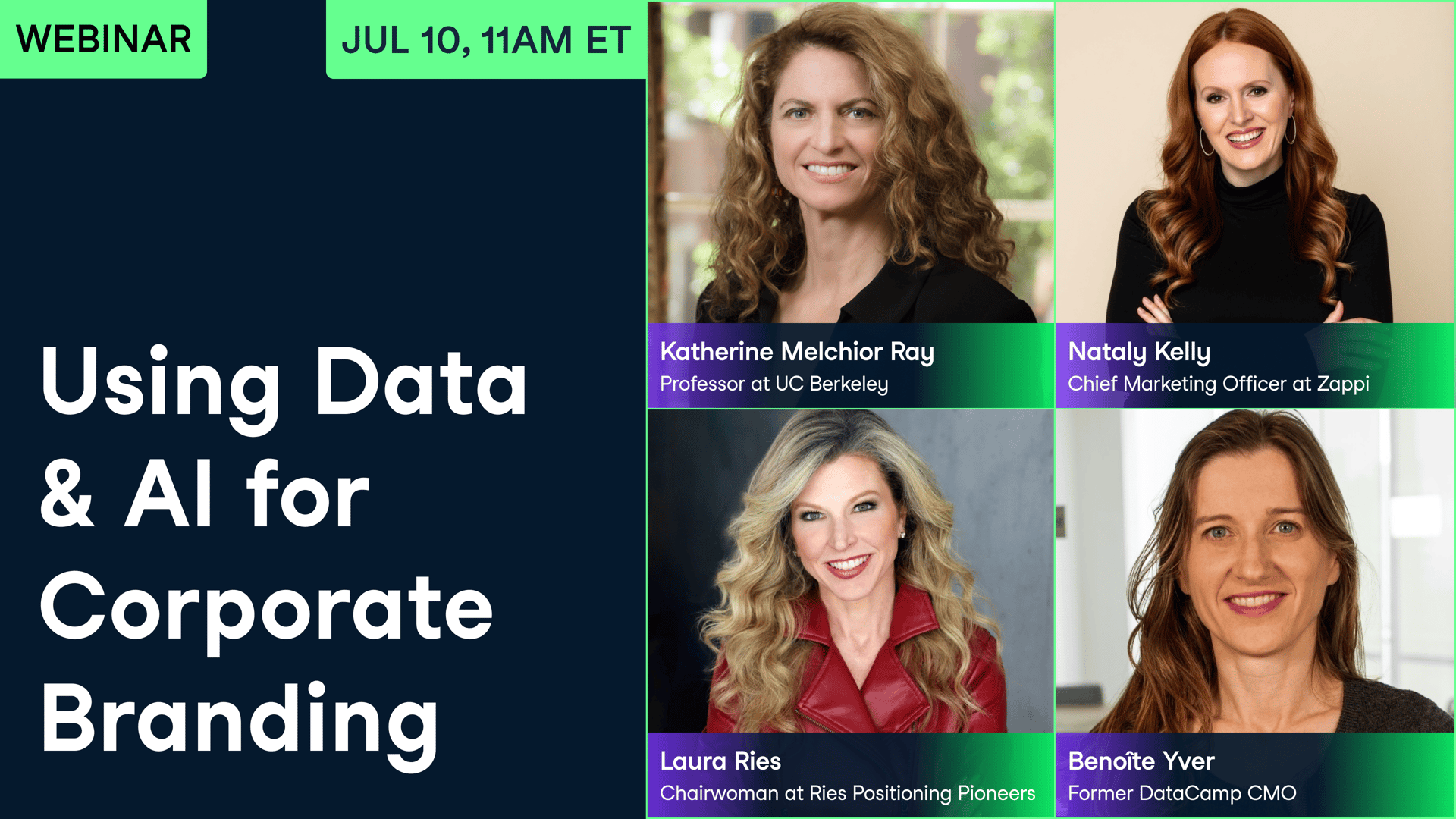
Using Data and AI for Corporate Branding

July 2025
Webinar Preview

Your Presenter(s)

Fotografie portret Katherine Melchior Ray

Katherine Melchior Ray

International Marketing & Leadership Professor at UC Berkeley Haas School of Business

Katherine is a global marketing leader who lectures at UC Berkeley, Haas School of Business and runs the GlobeAlly consultancy. Previously, she was Chief Marketing Officer at Babbel (Berlin) and at Shiseido (Tokyo) as well as a senior executive at Nike, Louis Vuitton, Gucci, and Hyatt. She is the author of "Brand Global, Adapt Local" alongside Nataly Kelly.

Fotografie portret Nataly Kelly

Nataly Kelly

Chief Marketing Officer at Zappi

Nataly has over two decades of experience as a data-centric marketing and growth executive. She heads up marketing for consumer insights platform Zappi and also runs the Born to Be Global consultancy. Previously, Nataly was Chief Growth Officer at Rebrandly and VP of Marketing at HubSpot. Alongside Katherine, she is the author of "Brand Global, Adapt Local".

Fotografie portret Laura Ries

Laura Ries

Chairwoman at Ries Positioning Pioneers

Laura has three decades experience running the RIES marketing consultancy. She's a world-expert on brand building and brand positioning, having taught the topic in over 60 countries. She is the author of seven books on branding, including the upcoming "The Strategic Enemy".

Fotografie portret Benoîte Yver

Benoîte Yver

Former DataCamp CMO

Benoîte advises technology companies on applying data to their marketing strategy. She has extensive experience of uncovering customer insights from customer data. Benoîte has been a three-time Chief Marketing Officer, at Datameer, Level AI, and DataCamp, as well as fractional CMO for a dozen startups.

Session Resources

Summary

Using data and AI for corporate branding is a session designed for marketing professionals and data practitioners interested in enhancing brand perception and reach through data-driven strategies.

A strong corporate brand simplifies selling products and services, aids in recruitment, and generally eases business operations. Achieving a global brand is challenging due to the need to resonate across diverse cultures and customer segments. Data and AI are important in understanding audiences, moving beyond intuition to informed decision-making. The session features insights from experts like Katherine Melchior Ray, Nataly Kelly, Laura Ries, and Benoîte Yver, who discuss the complex nature of branding, the role of data in brand building, and the importance of maintaining a consistent brand promise. They emphasize the need for a strategic approach to branding, considering both brand awareness and brand equity, and highlight the potential of AI in personalizing content while cautioning against losing the human touch in brand strategy.

Key Takeaways:

  • Branding is more than a logo; it represents a promise of quality and service.
  • Data and AI are essential in understanding and reaching target audiences.
  • Brand awareness and brand equity are critical components of a successful brand strategy.
  • AI can aid in content personalization but should not replace human insight.
  • Experimentation and testing are vital in refining brand messaging and strategy.

Deep Dives

The Role of Data and AI in Branding

Data and AI have transformed the area of corporate branding by providing tools to understand and engage with audiences more effectively. As Richie Cotton notes, relying solely on intuition is no longer sufficient. Data-driven insights allow brands to customize their messaging and offerings to specific customer segments, enhancing both reach and relevance. AI, in particular, offers the ability to personalize content at scale, though experts caution that it should complement, not replace, human creativity and strategic thinking. Benoîte Yver highlights the importance of using data to track brand awareness and equity, suggesting metrics like net promoter scores and customer lifetime value as proxies for brand success.

Understanding Brand Components and Perception

A brand is not just a logo but a promise of what a company delivers in terms of quality and service. Katherine Melchior Ray explains that a brand's perception is shaped by its history, culture, and marketing efforts. Laura Ries adds that the perception of a brand in the consumer's mind is crucial, often outweighing the reality of the product or service. This perception is influenced by strategic positioning and the ability to communicate a singular, focused message. The session emphasizes the need for brands to understand their unique value proposition and how it resonates with different customer segments.

Global Branding Challenges and Strategies

Building a global brand requires understanding cultural differences and adapting strategies to resonate with diverse audiences. Nataly Kelly shares insights from her experience at HubSpot, where brand perception varied significantly across regions due to differences in market maturity and pricing. The session discusses the importance of segmenting audiences and customizing messaging to local preferences while maintaining the core brand promise. Catherine Melchior Ray highlights the success of Puma in India as an example of a brand that adapted its strategy to local market needs, focusing on popular sports and cultural preferences to gain market share.

Experimentation and Measuring Brand Success

Experimentation, such as A/B testing, plays an important role in refining brand messaging and strategy. However, as Laura Ries points out, it's essential to interpret the results carefully to avoid misleading conclusions, as seen in the infamous Pepsi Challenge. The session also explores how to measure brand success, with Benoîte Yver suggesting metrics like share of search and customer lifetime value. Ultimately, the success of a brand is tied to its ability to dominate a category, as Laura Ries notes, and to maintain a strong perception in the consumer's mind, allowing for premium pricing and customer loyalty.


Înrudite

The Definitive Guide to Machine Learning for Business Leaders

Craft a 21st-century data strategy to optimize business outcomes.

webinar

Using Data and AI For GTM

GTM experts to explore how data and AI can enhance every stage of the go-to-market workflow.

webinar

Artificial Intelligence for Business Leaders

We'll answer the questions about AI that you've been too afraid to ask.

webinar

How AI Can Improve Your Data Strategy

Find out how AI, ML, and data science can inform your data strategy.

webinar

Spreading Data & AI Literacy Across Your Organization

Learn how to devise a data and AI strategy that aligns with your business strategy, and how to combine technology and training to increase the data and AI literacy across your company for business success.

webinar

Spreading Data & AI Literacy Across Your Organization

Learn how to devise a data and AI strategy that aligns with your business strategy, and how to combine technology and training to increase the data and AI literacy across your company for business success.