본문으로 바로가기

세부 정보를 입력하여 웨비나에 참여하세요.

계속 진행하시면 당사의 이용약관, 개인정보처리방침 및 귀하의 데이터가 미국에 저장되는 것에 동의하시는 것입니다.

스피커

비즈니스용

2명 이상을 교육하시나요?

팀원들이 중앙 집중식 보고, 과제, 프로젝트 등을 포함한 DataCamp 라이브러리 전체에 액세스할 수 있도록 하세요.
DataCamp for Business를 사용해 보세요.맞춤형 솔루션을 원하시면 데모를 예약하세요.

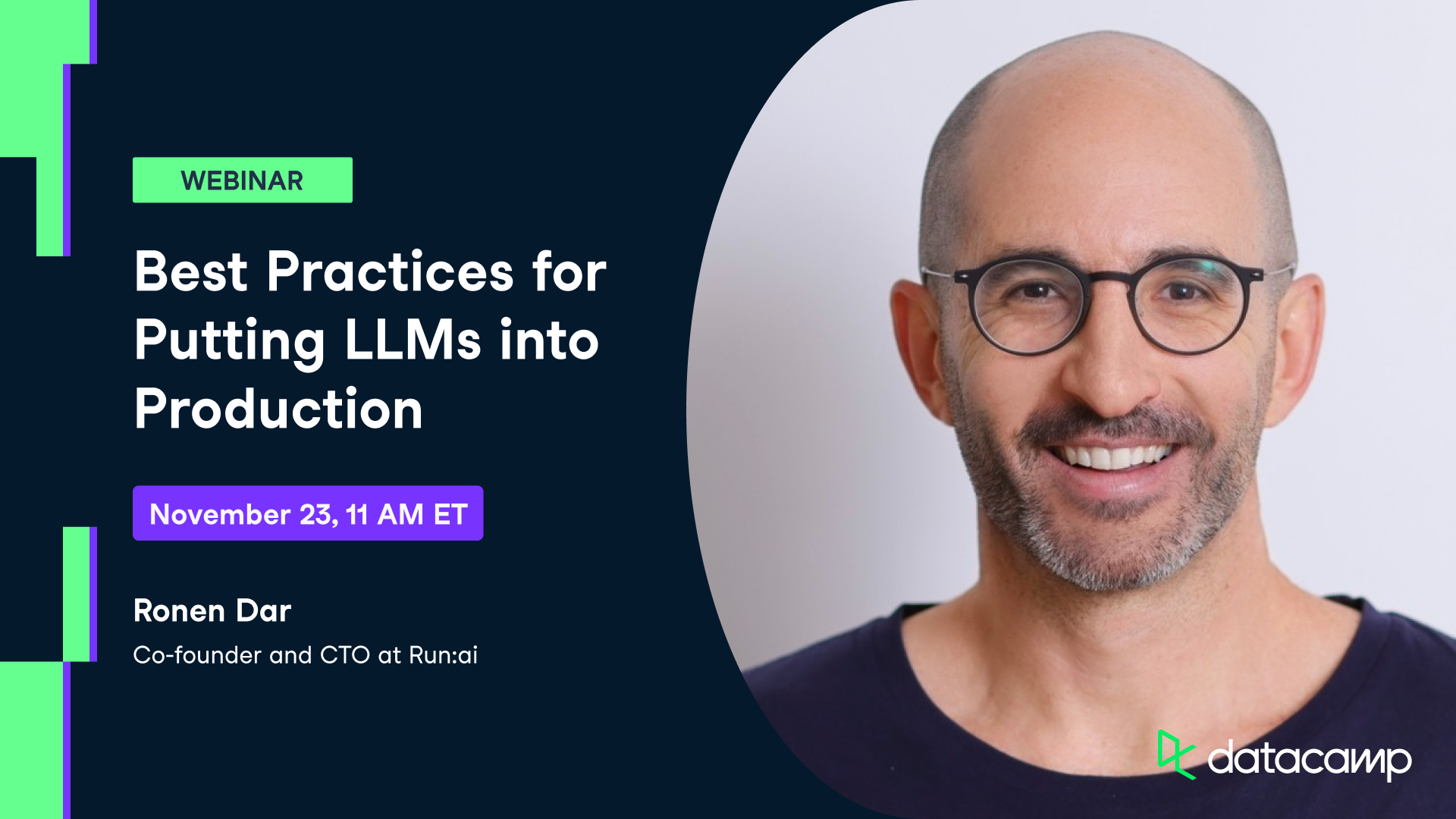
Best Practices for Putting LLMs into Production

November 2023
Webinar Preview

Summary

In the quickly progressing field of AI, launching large language models (LLMs) in production environments comes with unique difficulties and opportunities. The need for GPU resources is rapidly increasing due to the computational power required for both training and managing these models. As Richie underlined, organizations are handling infrastructure hurdles, notably the effective management of shared GPU resources on platforms like Kubernetes. Ronan Dar, CTO of Run.ai, explained the complexities of refining AI workloads, highlighting the constraints of Kubernetes in handling batch jobs and the necessity for advanced scheduling solutions. He discussed Run.ai's platform enhancements that allow smarter GPU utilization, such as fractional GPU provisioning and flexible resource allocation, to tackle these challenges. The conversation also covered the importance of balancing model size, quantization, and batching to optimize LLM deployment costs and performance. With the ongoing development of serving frameworks and the integration of technologies like retrieval-augmented generation, the field is moving towards more efficient and accessible AI applications.

Key Takeaways:

  • Effective management of GPU resources is vital for launching large language models in production.
  • Kubernetes, while useful for certain tasks, has constraints in batch scheduling and resource sharing.
  • Run.ai's platform addresses these constraints by providing advanced scheduling and GPU optimization solutions.
  • Balancing model size, quantization, and batching is necessary to control costs and boost performance.
  • Serving frameworks and retrieval-augmented generation play a significant role in optimizing LLM deployment.

Deep Dives

Challenges with Kubernetes for AI Workloads

Kubernetes, originally designed for microservic ...
더 읽어보기

es, faces difficulties when tasked with managing AI workloads, particularly batch jobs and resource allocation. As Ronan Dar highlighted, "Kubernetes was built for scheduling pods, not jobs," emphasizing the inherent problems in managing distributed workloads. The absence of flexible quotas and effective queuing mechanisms can lead to resource scarcity, where one user's demands may limit another's access. Run.ai addresses these issues by integrating a dedicated scheduler into Kubernetes environments, enabling flexible resource allocation and refining GPU utilization for shared clusters. This improvement not only alleviates the scheduling constraints but also introduces the capability for fractional GPU provisioning, a key feature for maximizing resource efficiency.

Optimizing GPU Utilization

Effective GPU utilization is a key part of cost-effective AI operations. Ronan stressed the need for smarter resource management, stating, "People are using their GPUs better, less idle GPUs, people are getting access to more GPUs." Run.ai's approach involves pooling GPU resources across clouds and on-premises environments, allowing for flexible allocation based on workload demands. This strategy reduces idle time and increases the number of concurrent workloads, thereby enhancing overall productivity. The introduction of fractional GPU provisioning further refines utilization by enabling the sharing of GPU resources, ensuring that even smaller tasks can leverage high-performance computing without the overhead of allocating entire GPUs.

Deployment and Cost Management of LLMs

The deployment of large language models is a costly venture, primarily due to their significant computational requirements. Ronan outlined several strategies for managing these costs, including selecting appropriate GPU types, implementing model quantization, and employing continuous batching techniques. Quantization, for example, reduces model size by representing weights with fewer bits, though this must be balanced against potential accuracy degradation. Continuous batching, on the other hand, enhances throughput by allowing the parallel processing of input sequences, significantly improving GPU efficiency. These strategies, coupled with the use of specialized inference GPUs and advanced serving frameworks, form a comprehensive approach to cost management in LLM deployment.

Advancements in Serving Frameworks

Serving frameworks are evolving quickly, offering new opportunities to enhance the deployment of LLMs. These frameworks, such as NVIDIA Triton and Microsoft's DeepSpeed, provide essential optimizations that improve latency and throughput, critical metrics for performance. Ronan highlighted the importance of selecting the right combination of LLM engines and servers, as these choices impact the efficiency and scalability of AI applications. The integration of features like HTTP interfaces, queuing mechanisms, and multi-model hosting capabilities further simplifies the deployment process, making it more accessible for enterprises looking to leverage LLMs in their operations.


관련된

webinar

Understanding LLM Inference: How AI Generates Words

In this session, you'll learn how large language models generate words. Our two experts from NVIDIA will present the core concepts of how LLMs work, then you'll see how large scale LLMs are developed.

webinar

Unleashing the Synergy of LLMs and Knowledge Graphs

This webinar illuminates how LLM applications can interact intelligently with structured knowledge for semantic understanding and reasoning.

webinar

Best Practices for Developing Generative AI Products

In this webinar, you'll learn about the most important business use cases for AI assistants, how to adopt and manage AI assistants, and how to ensure data privacy and security while using AI assistants.

webinar

Buy or Train? Using Large Language Models in the Enterprise

In this (mostly) non-technical webinar, Hagay talks you through the pros and cons of each approach to help you make the right decisions for safely adopting large language models in your organization.

webinar

The Future of Programming: Accelerating Coding Workflows with LLMs

Explore practical applications of LLMs in coding workflows, how to best approach integrating AI into the workflows of data teams, what the future holds for AI-assisted coding, and more.

webinar

How To 10x Your Data Team's Productivity With LLM-Assisted Coding

Gunther, the CEO at Waii.ai, explains what technology, talent, and processes you need to reap the benefits of LLL-assisted coding to increase your data teams' productivity dramatically.