Share this webinar
Close your data and AI skills gap
We're the only platform uniquely engineered to advance data and AI skills across your entire organization. Let's explore a tailored program.
Book an Enterprise DemoAgentic Commerce: What It Is, What Works, and What Changes Next
August 2026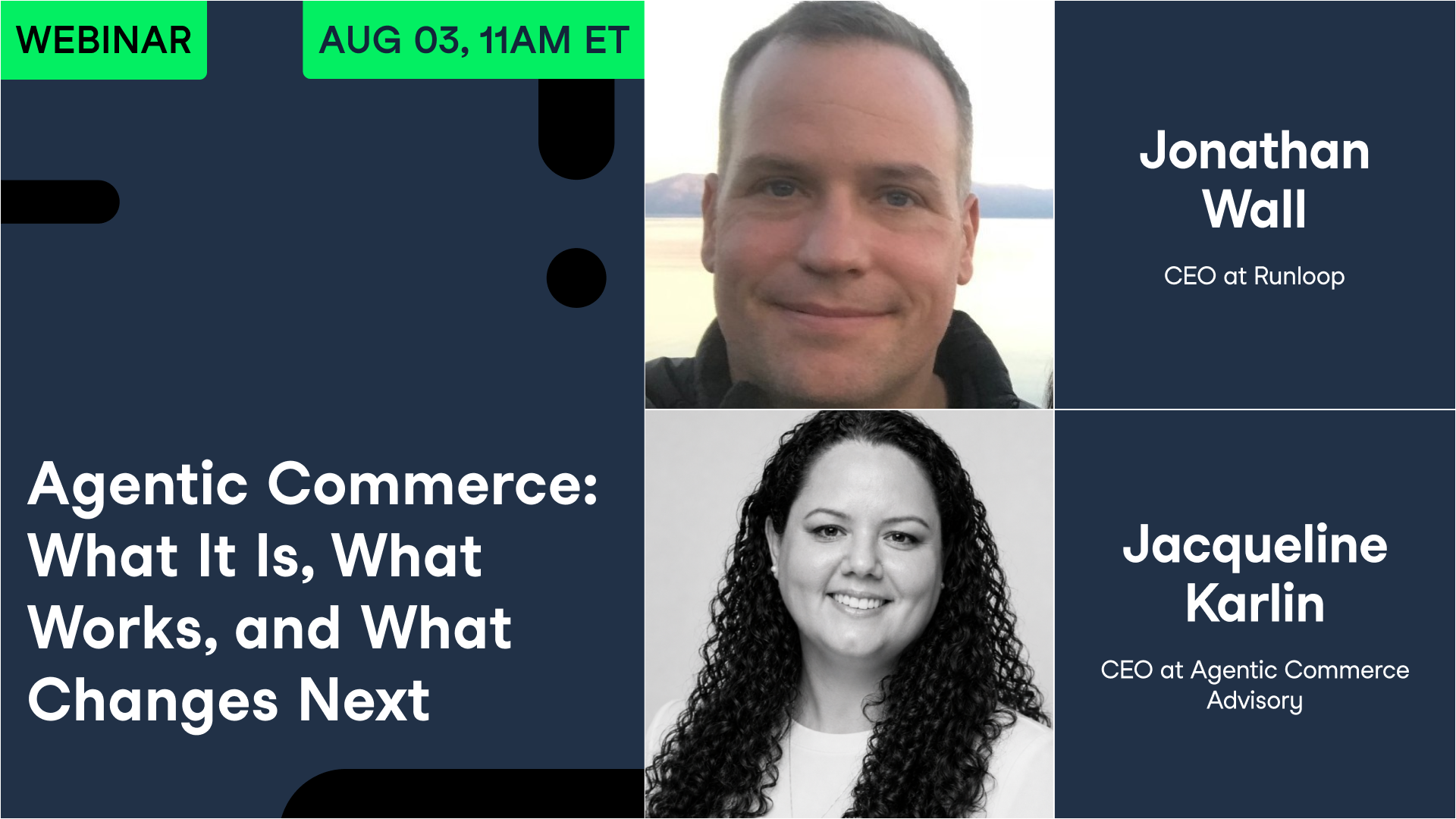
Your Presenter(s)

Jonathan Wall
CEO at Runloop

Jonathan Wall is the co-founder and CEO of Runloop, an AI infrastructure company providing enterprise-grade environments for deploying coding agents safely and at scale. A repeat founder with deep roots in fintech and developer infrastructure, he previously co-founded Google Wallet — bringing tap-to-pay technology to the US — and Index, a fintech startup acquired by Stripe, where he subsequently led product engineering. He holds an MS in Computer Engineering from the University of Rochester.

Jacqueline Karlin
CEO at Agentic Commerce Advisory

Jacqueline Karlin is the founder and CEO of Agentic Commerce Advisory, where she helps organizations navigate the transition to AI-driven commerce. Her career spans senior product leadership at PayPal, where she led AI-powered shopping personalization and checkout, as well as director-level roles at Expedia Group, WhatsApp Commerce, and Amazon, where she built voice commerce and international lending products. She holds an MBA from MIT Sloan.
Summary
Agentic commerce splits into two distinct problems that most companies haven't yet told apart.
In this session, Richie Cotton spoke with Jonathan Wall, CEO and cofounder of RunLoop, and Jacqueline Karlin, founder of Agentic Commerce Advisory, about what's actually happening as AI agents start shopping, researching, and paying on people's behalf. Wall, who previously cofounded Google Wallet and worked on payments at Stripe, splits the space into two overlapping domains: agents that help people find and buy things, and agents that pay each other for compute and resources with no human in the loop. Karlin, who led AI-powered shopping personalization at PayPal and held product roles at Expedia and Amazon, says trust is the real constraint. It shows up twice: how much authority a consumer hands to an agent, and how much a merchant is willing to hand back.
The conversation covers where agentic commerce is furthest along today (Meta's business messaging, Walmart's Sparky, Amazon's Rufus), the protocols competing to standardize it (AP2, ACP, UCP, x402), and a cost problem few merchants have priced in yet. Agents don't get tired, and that changes the economics of every transaction they touch. Both guests land on the same starting point: make your product catalog readable by agents before worrying about anything else.
Key Takeaways
- Agentic commerce covers two different things: agents that shop on a person's behalf, and agents that pay other systems for compute or resources with no human involved.
- Trust runs in two directions. Consumers have to trust an agent with a purchase, and merchants have to trust that the agent buying from them represents a real, qualified customer.
- Purchases split into a barbell. Low-consideration items like toothpaste get bought on price alone, high-consideration items like travel or a first 3D printer benefit from an agent's research, and the middle ground is still unsettled.
- At least six competing catalog schemas exist across AI shopping platforms today, so merchants have to pick one to start with rather than trying to support all of them at once.
- Agent traffic can scale far faster than paid seats or headcount would suggest. One company saw agent-driven pull requests on GitHub rise from 4 million to 275 million in about nine months.
- Making a product catalog discoverable and readable by agents matters more right now than optimizing the checkout or conversion flow.
- Merchants who don't want certain agent traffic, an industrial printer seller getting queries from home users, for instance, need a way to opt out before they burn compute budget serving buyers they can't win.
- The fastest way to learn the space is to build a small, low-stakes experiment where one person plays the buying agent and another plays the selling agent, rather than planning a year of production changes up front.
Deep Dives
Two kinds of agentic commerce, not one
Asked to define agentic commerce, Wall split it in two. "How do you enable human beings to offload the work of discovering products that they need to agents? And I think, how do you delegate them the authority to purchase stuff for you?" That's the domain most people picture: an agent researching a purchase, or told to "go find the lowest price on this specific brand." The second domain sits further under the hood, where agents pay other systems directly. "What happens when you ask an agent to accomplish a task and it wants to go out and spin up a computer or purchase materials for research that it doesn't have free access to" is, in Wall's words, "the domain of more machine to machine payments." These run on different protocols and different motivations, he said, and it isn't obvious yet which one will end up larger.
Karlin's answer centered the consumer side of that first domain. People have wanted to delegate shopping tasks to machines for a long time, she said, but "the point now is that there is actual agency, and we're building that." That shift raises the trust question fast: not just whether an agent will make a good decision, but whether a merchant is set up to serve it. Karlin described merchants who already run tight risk thresholds on their existing channels now facing "a new channel called agent storefronts," forced to decide how to reorganize their operating model to compete there. The two domains overlap in places. A shopping agent might trigger a machine-to-machine payment to check inventory or pricing. But Wall kept them separate conceptually, since the tools, protocols, and pace of adoption differ between them.
The barbell: toothpaste on one end, a 3D printer on the other
Wall used his own recent purchase to show where agent-assisted research earns its keep. Buying a 3D printer for his kids, he leaned on AI for the parts of the decision that were genuinely hard: "is this a safe thing to have in my house? Are there any fumes? What's the easiest to use? What's the most cost effective?" He applied the same logic to specialist gear like skis, where marketing language obscures which product actually performs. "I think it might be a barbell," he said of purchases generally, with heavy research at one end, pure price-shopping at the other, and the middle still unsettled.
Karlin backed this up with numbers from her time building shopping personalization. Low-consideration items historically converted at three to six percent once a shopper reached a retailer's site. High-consideration items like travel or headphones converted at one to one and a half percent, a gap she traced to the cognitive load of the decision. What's changing, in her view, is that shoppers now arrive at a merchant's site after an LLM has already done some of that reasoning for them, which raises their confidence before they buy. By the time Wall reached checkout on his printer, he said, "it was really a mechanical aspect of me just purchasing it because I read enough reviews." The conversion, in his words, was essentially 100%. Karlin's open question for merchants was blunt: "how do you compete with toothpaste in the future?" The low-consideration end is where agents are likely to compress margins hardest on pure price.
A crowded field of protocols, and the plain llm.txt fallback
Wall ran through the standards currently competing to define how agents transact: AP2, focused on giving agents a verifiable signal of user intent; ACP, built by Stripe and OpenAI around the checkout flow and payment approval; UCP, from Google and Shopify, aimed at a comprehensive product catalog; and, on the machine-to-machine side, x402 and Stripe's newer MPP protocol. "It's an exciting time," he said, "but I guess I would say we're in early innings." The technical building blocks are still being shaped alongside the UX patterns that will sit on top of them, and the two aren't tightly coupled yet.
Karlin added a practical constraint on top of the protocol race: schema fragmentation. Citing a recent Stripe report on lessons from the last three years of agentic commerce, she noted that publishing a catalog in a genuinely native way currently means dealing with six different schemas across platforms. Her advice matched Wall's approach to picking a starting point: "pick one, experiment, learn from it, and then think what you do about the others." Underneath the formal protocols, Wall pointed to a simpler fallback any merchant can ship today: an llm.txt file, a documentation tree written for agents rather than people, read the moment an agent lands on a page. RunLoop's own traffic shows how fast that shift can happen. A year ago, most visitors to its documentation were people. Today it's roughly 90% agents, and a meaningful share of new signups now come through automated onboarding via Stripe's agent-driven CLI rather than a human clicking through a form.
The cost problem nobody has priced in yet
Wall's clearest warning concerned unit economics. He pointed to GitHub's own numbers on agent-generated activity: "last September, agents opened 4,000,000 pull requests. By March of this year, it was 17,000,000. And as of right now, it is 275,000,000." That's the same $20-per-seat product generating roughly 70 times the volume in nine months, because the constraint used to be human attention and now isn't. He expects the same pattern in commerce once "always on" personal assistants, the kind OpenAI and Gemini are building toward, get pointed at shopping tasks. A human planning a trip gets tired after checking ten or twelve flight options and settles. An agent doesn't. "It's going to attempt to assemble the best possible deal," Wall said, which means far more requests hitting merchant systems for the same eventual booking. His prediction: merchants will get excited about serving a wave of agentic transactions, "and then they will say, did I lose money on this?"
Karlin extended the point into strategy. Compute costs depend on which cloud provider a business has negotiated with and how much leverage it has, and every request an agent sends triggers reasoning that costs money whether or not it converts. Her advice was for merchants to decide up front which agent traffic they actually want to serve. Take an industrial printer seller getting inbound reasoning traffic from a consumer shopping for a home printer: the mismatch needs catching early. "You really need to get to a place in your own decisioning on, I wanna participate or I don't wanna participate," Karlin said. "Otherwise, you're gonna consume a lot of your tokens and money for something that you're not the best match for." She also raised a question with no clear answer yet: what happens to advertising once agents, not people, are the ones comparing prices and bidding for the best deal.
Getting started: build something small before touching production
Both guests landed on the same advice for teams unsure where to begin. Wall described an internal exercise at RunLoop. Rather than mapping new protocols onto a production system, the team built a small, throwaway commerce site selling Pokémon cards, implemented several protocols on it, and set two agents loose to trade with each other: one instructed to favor a certain card, the other tuned to be price-sensitive. "It's a little silly and contrived," he admitted, "but for people who are sitting there looking at those protocols and they are daunting," building a closed experiment where you've played both buyer and seller gives a working sense of what the agents actually do, without a year of planning risk attached.
Karlin agreed, and used lunch delivery to show where the protocols still fall short of a full purchase, start to finish. A request like "get me three pepperoni pizzas under $40 by 7pm" can't be fully executed today, because, as she put it, the industry still lacks "a good tax resolution, a shipping cost resolution." Without that, a merchant can't guarantee the price or delivery window a customer specified. Her point wasn't that the protocols are failing. It's that most businesses will need to build past their current limits rather than assume adoption alone gets a purchase from request to delivery. On priorities, Wall was direct: "focus on making sure all of your catalog is discoverable and researchable and consumable by agents. Basically, make sure you can capture top of funnel" before spending effort on conversion or checkout optimization.
有关的
white paper
A Practical Guide to AI Agents by Snowflake
Courtesy of Snowflake, this e-book reveals how agentic AI is transforming the way we work, from automating complex workflows to accelerating decision-making at scale.webinar
The AI Agent Strategic Playbook
AI leaders and enterprise practitioners, will share how organizations are deploying AI agents today—and what executives need to know to lead those efforts effectively.webinar
AI Agents For Business: AI Agents and the Future of Work
Sanjay Srivastava, Chief Digital Officer at GENPACT, and Marianna Bonanome, Head of AI Strategy & Partnerships at SandboxAQ, discuss how AI agents are transforming business operations and workforce planning.webinar
AI Agents Unpacked: Hype, Hope, or Real ROI?
Industry leaders discuss the realities of AI agents in enterprise settings. You’ll learn about the most common agent types and architectures, the tools and skills needed to build them, and the risks and challenges that come with deployment.webinar
Making AI Work in Healthcare
Experts discuss what it really takes to deploy AI in healthcare and life sciences.webinar