CUSTOMER STORY
The Financial Conduct Authority Is Changing the Way 1000s of People Work
Upskilling a small team? Get started today
Drive measurable impact from upskilling
Request a DemoLike many large organizations, the FCA operates in a complex, fast-moving environment. Data touches almost every role, whether in regulatory supervision, policy, frontline operations, or leadership decision-making.
But formalizing a data training program at scale is harder than it sounds. Common challenges included:
- How do you get buy-in from people who don’t have “data” in their job title?
- How do you prevent training from feeling like just another obligation?
- How do you measure real impact beyond course completions?
- How do you overcome resistance to change?
“Organizations don’t change. People change,” Emily explains. “And you’re asking each individual to show up differently.”
The FCA recognized early on that if they focused only on training delivery, the program would struggle. To succeed, they needed to design for adoption.
The foundation: Build the right team before you build the program
Before launching any learning tracks, the FCA focused on governance and sponsorship. Emily emphasizes that strong data academies are built by strong delivery teams. That includes:
- An executive business sponsor to legitimize the program and connect it to frontline impact
- A senior data leader (e.g., CDO) to align training with strategic data priorities
- An L&D leader to integrate data skills into the broader capability roadmap
- A change-focused project manager to drive engagement, not just delivery
- Internal communications and branding support to break through organizational noise
“We hear so much noise every day,” Emily says. “If your program doesn’t stand out, it won’t land.” Rather than treating data training as a siloed initiative, the FCA embedded it into leadership conversations, L&D strategy, and business priorities from day one.
The approach: Designing for change, not just knowledge
One of the most important insights from the FCA’s experience: knowledge alone doesn’t drive behavior change. You can’t just put people through courses and expect transformation.
Instead, the FCA anchored their data academy in established change principles. Their approach focused on five stages:
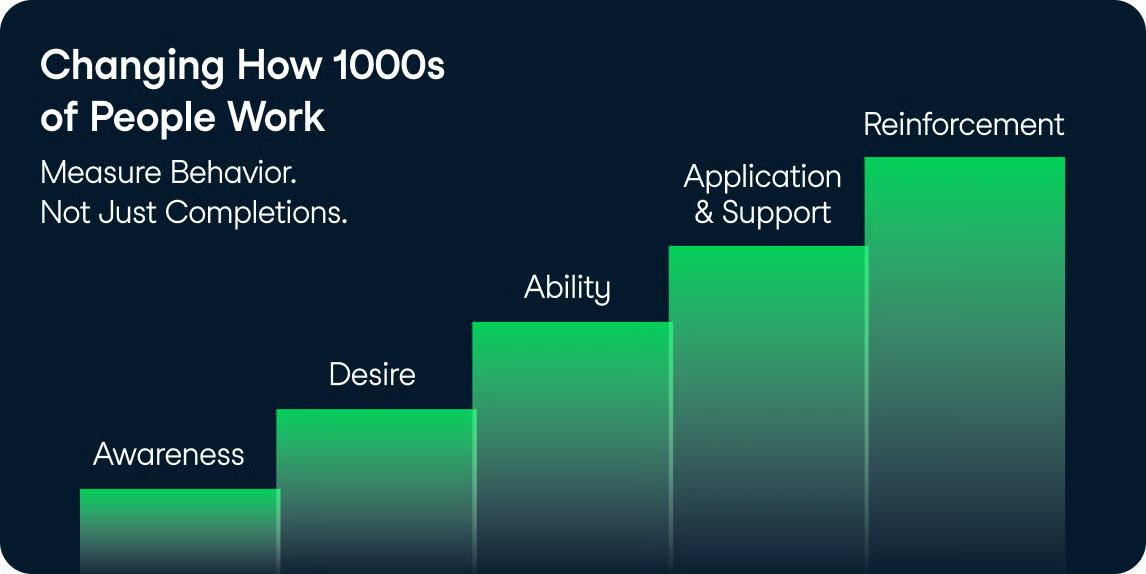
1. Awareness: Explain the “why”
Telling employees that a data program is coming isn’t enough. People need to understand why change is necessary, what’s broken in the current state, what success looks like, and perhaps most importantly, what’s in it for them.
Whether the driver was delivering better public value, working smarter, or preparing for future regulatory challenges, the FCA made sure messaging was clear, repeated, and simple. They used multiple communication channels—from leadership forums to local team conversations—to ensure the message didn’t get lost.
2. Desire: Make it personally relevant
Even when people understand the case for change, they won’t engage unless they see how it benefits them. The FCA invested time in understanding different learner personas, including:
- Leaders who needed to make more confident, data-driven decisions
- Frontline regulatory staff seeking credibility and trust with stakeholders
- Teams looking to automate manual processes
- Analysts wanting to deepen technical capability
By mapping roles to real data tasks, they could recommend relevant learning paths, whether that meant improving data visualization skills, strengthening statistical literacy, or building confidence interpreting dashboards.
Early adopters played a key role here. These “change champions” helped validate personas, test learning content, and share real-world success stories that created social proof.
3. Ability: Deliver practical, role-based learning
Once awareness and motivation were in place, learning could land effectively. The FCA ensured training was relevant to real job responsibilities, clear and jargon-free, structured in manageable segments, and supported with accessible resources.
Importantly, learning wasn’t treated as a standalone event—it was part of a broader behavioral journey.
The team was also hyper-aware that knowing how to do something isn’t the same as being able to do it in practice. To build real capability, the FCA focused on removing friction:
- Ensuring tools and infrastructure supported newly learned skills
- Encouraging managers to give time for learning and experimentation
- Providing coaching, mentoring, and drop-in sessions
- Creating safe environments to practice new techniques
From collaborative problem-solving sessions to practical exercises tied to real datasets, employees were encouraged to apply what they learned immediately. Managers were also equipped to support their teams, reinforcing that learning wasn’t “extra work,” but part of evolving how the organization operates.
4. Reinforcement: Make change stick
Many training programs lose momentum after the initial launch. The FCA proactively designed reinforcement mechanisms, including:
- Highlighting success stories and use cases
- Recognizing “data heroes”
- Sharing visible examples of business impact
- Measuring ROI and communicating results
- Creating communities of practice
They didn’t just measure course completions. They tracked behavioral indicators and business outcomes, asking: Are people using data differently? Are decisions more evidence-based? Are processes more efficient? Are we realizing measurable public value?
This shift from measuring activity to measuring impact helped sustain executive support.
The Results: A scalable model for data transformation
By combining strong governance, change management principles, and practical learning design, the FCA built more than a training program; they built a framework for transformation. Key outcomes include:
- Strong executive sponsorship and cross-functional alignment
- High engagement driven by tailored messaging and persona-based learning
- Practical application of skills tied to real regulatory work
- Reinforcement systems that sustain behavior change
- Clear measurement of ROI and business impact
Most importantly, the FCA shifted the conversation from “Do I have time for training?” to “How can this make my work better?”
“Upskilling isn’t about teaching people to code. It’s about helping them turn up differently in their role.”