Roll out Microsoft Copilot at Scale in Your Enterprise
May 2026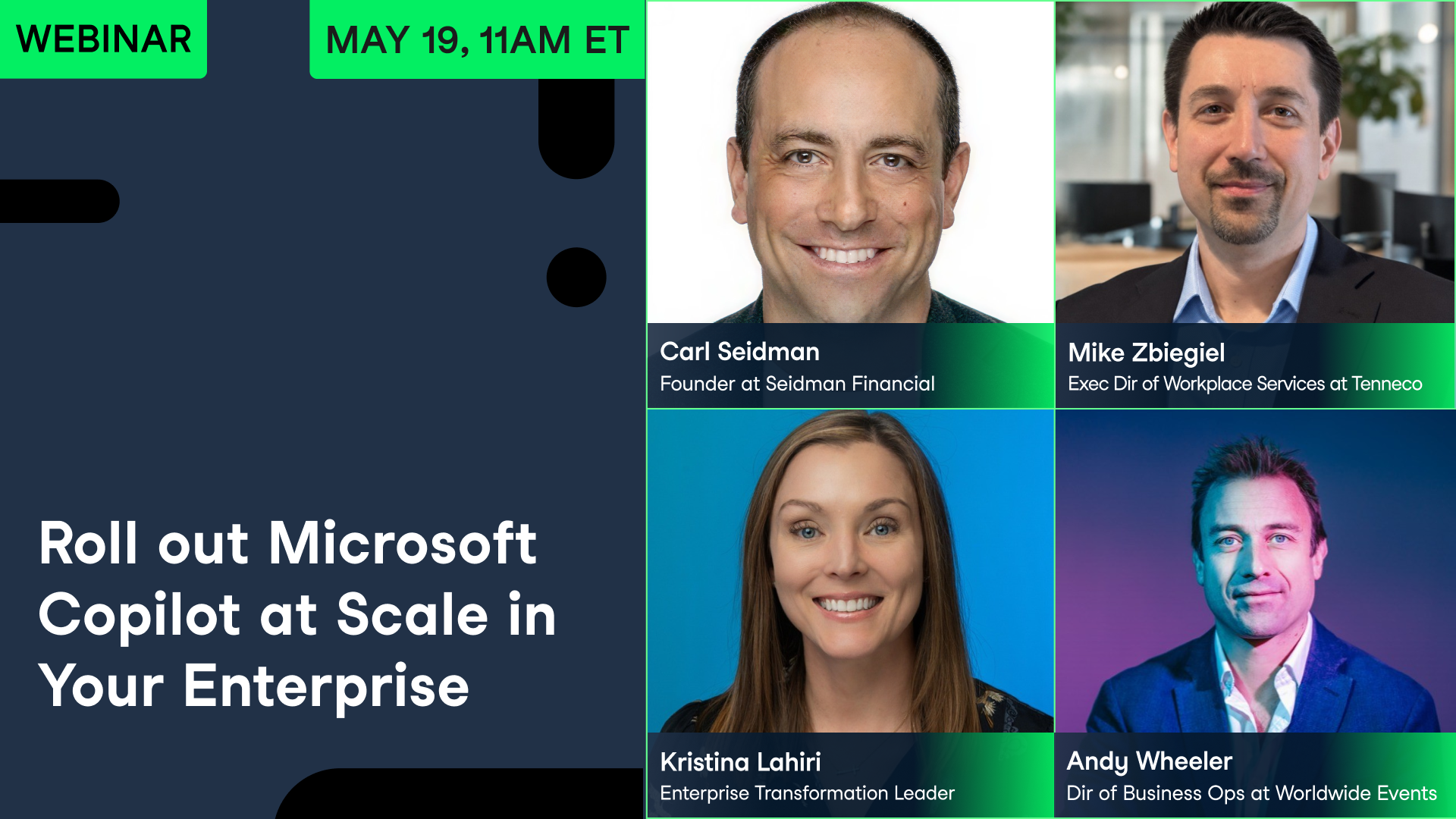
您的演示者

Carl Seidman
Founder at Seidman Financial
Carl runs the financial advisory and fractional CFO service company Seidman Financial. He is also the creator of The FP&A Mastery Signature Program for accounting and finance professionals. On top of this, Carl is an Adjunct Professor at Rice University's Jones Graduate School of Business. He's a Microsoft MVP and has taught hundreds of thousands of learners in his Excel and AI courses.

Mike Zbiegiel
Executive Director of Workplace Services at Tenneco

Mike leads Enterprise Workplace Services at Tenneco, one of the world’s leading designers, manufacturers, and marketers of automotive products for both original equipment and aftermarket customers. His work centers on delivering measurable business value by enabling people to work smarter and more efficiently through technology. He serves on the core team shaping Tenneco’s enterprise AI strategy, with a focus on applying generative and agentic AI to accelerate business processes and productivity.

Kristina Lahiri
Enterprise Transformation Leader
Kristina is an enterprise transformation leader with 18+ years driving operating model design, AI adoption, and large-scale technology programs across global organizations such as Ansys, Bayer Crop Science, and Monsanto. She has led enterprise AI initiatives including Microsoft 365 Copilot deployment, with a focus on governance and change management.

Andy Wheeler
Director of Business Operations at Worldwide Events
Andy leads operational strategy and AI-driven transformation to scale performance and modernize processes. He specializes in helping organizations adopt AI to drive measurable business impact. Andy is also a Non-Executive Director at the Sussex Chamber of Commerce and a mentor and executive coach. Previously, he held senior leadership roles in technology and events, including Managing Director at Artifax, where he led growth and product innovation.
Summary
Most Microsoft Copilot enterprise rollouts fail not because of the technology, but because organizations treat them as technology deployments.
That was the central argument in DataCamp's panel discussion "Microsoft Copilot at Scale in Your Enterprise," part of the "Put Copilot to Work" series with Microsoft. Four practitioners brought different angles to the same problem: Carl Seidman, a Microsoft MVP and Copilot and Excel trainer who works with Fortune 500 firms and CPA practices; Kristina Lahiri, an enterprise transformation leader with eighteen years of AI adoption experience at companies including Bayer Crop Science and Monsanto; Mike Zbiegiel, executive director of Workplace Services at Tenneco, one of the world's largest automotive manufacturers; and Andy Wheeler, director of business operations at Worldwide Events.
They covered the full arc of a Copilot rollout: who should own the program and why authority matters, what governance structures must exist before a single license is issued, how to run a pilot that produces measurable outcomes rather than anecdotes, how to build training that produces lasting behavior change, and what it takes to scale without adoption stalling. Licenses are easy. Changing how people work across an organization is not.
Key Takeaways
- A Microsoft Copilot enterprise rollout needs a named program owner with real authority — including the power to reject use cases, revoke licenses, and halt deployment if governance isn't ready.
- Data governance and acceptable use policies must exist before deployment begins. At Tenneco, 100 agents were built within two weeks of Copilot going live, before any policies were set.
- Every pilot needs a predefined definition of success. Without one, a pilot is just a preview with no way to evaluate what worked.
- ROI measurement is still unsolved for most organizations. Time savings tracked through staff surveys are the most common proxy, but converting that into hard financial figures remains difficult.
- Training must be role-specific. What Copilot offers a financial analyst, an HR manager, and an engineer are different problems that require different instruction.
- Champion networks within each business function outperform centralized IT-led training for driving sustained Copilot adoption.
- Copilot adoption is not a one-time initiative. Microsoft releases significant new capabilities near-weekly, and organizations need an ongoing operating model to keep pace.
- Prompt reliability requires explicit constraints. Carl Seidman built a structured instruction set that let Copilot produce a thirteen-week cash flow forecast in five to seven minutes — without those constraints, the output changes with every run.
Deep Dives
Who Should Own the Microsoft Copilot Enterprise Rollout
The first structural decision in any Copilot enterprise rollout is who owns it. The panelists agreed: placing responsibility entirely within IT is not just a tactical problem — it's a structural one.
Kristina Lahiri drew the distinction between IT enabling the platform and someone being accountable for the outcome. "The initiative needs really a named owner who's accountable for the outcome and has enough organizational clout or standing with different groups like legal, HR, security, and business that can help to have the authority to make decisions and bring the right people together." That authority has to be real and exercised, she said. The program owner needs "the authority to say no — to be able to reject use cases, to revoke a license, to slow down deployment if governance isn't ready."
At Tenneco, this structure came from the top down. A leadership conference where senior executives were already discussing AI's impact on manufacturing gave the CIO an opening. He used it to pitch Copilot to the leadership team and secured early buy-in from the CAO, CEO, and legal team before any rollout work began. As Zbiegiel put it, "if you're trying to do this bottom up, it's gonna be a struggle."
In practice, the governance council at Lahiri's former organization included the VP of enterprise applications, a privacy and legal attorney, data security, a sales operations representative, and HR. Titles vary by organization; what matters is real representation from each function with decision-making authority, not just advisory seats.
Andy Wheeler added that executive sponsorship sets the mandate but doesn't create adoption on its own. His team ran workshops, demo days, and a company-wide hackathon specifically to find curious employees before selecting early adopters and champions. The cultural engagement piece, he said, is what actually drives implementation forward — not the org chart.
Zbiegiel raised a less-discussed factor: trust. Many employees hear "AI rollout" and assume it threatens their jobs. Leaders with existing credibility are better positioned to address that fear directly. "Think about who those people are within your organization at that leadership level who've built up that level of trust in the organization that can help drive that transformation."
What a Microsoft Copilot Governance Framework Actually Requires
Governance is the most cited requirement for successful enterprise Copilot deployment and one of the least clearly defined. The panel broke it into practical components and identified specific risks that emerge when any component is skipped.
Carl Seidman started with licensing. At the time of the session, enterprise Copilot required a Microsoft 365 Business Premium, E3, or E5 license — and 500 licenses could run $15,000 to $20,000 per month. "You've gotta make sure that you know where you're going before you start rolling this out to everyone, or there's start to become a very expensive investment very quickly with a questionable ROI on the back end."
Beyond cost, Seidman flagged data access as a structural risk. Copilot, once active, can reach everything in SharePoint, OneDrive, and connected repositories. "You're probably gonna have to go back in and say, what is actually here that we're giving people access to? Is there information here that's significantly outdated that we don't want Copilot utilizing?" Acceptable use policies — defining what Copilot can be used for and what data should stay out of AI — need to be in place before employees receive access, not as a follow-up.
At Tenneco, the speed of unsanctioned activity caught Zbiegiel's team off guard: "As soon as you turn on Copilot, Copilot Studio is there, people can start developing within it. In two weeks, we had about a 100 agents get developed." Without governance structures first, agent development — and its risks — is already underway before the organization has agreed on rules.
Lahiri outlined four layers she considers essential to any Microsoft Copilot governance framework: access controls (who can have it and why), data security (what information is permitted in and out), an acceptable use policy (which use cases are approved), and a remediation process for when agents act incorrectly. That last layer is increasingly important as agentic capabilities expand. "If you've empowered an agent to send an email and it sends the wrong email, how are you gonna handle that?" Without a remediation process, agentic errors become organizational liabilities. Without governance in general, she said, "it'll turn into the Wild West."
Lahiri also flagged Power Platform as a governance gap many organizations miss. For teams moving beyond basic productivity tasks into agent development and workflow automation, Power Platform is the underlying layer — and it needs its own governance model, not an afterthought to the main Copilot policy.
Designing a Pilot That Measures Real Outcomes
The most common flaw in enterprise Copilot pilots is beginning without a definition of success. The result is a program that runs, generates anecdotes, and fails to answer what leadership will eventually ask: did this work?
Lahiri's test for pilot readiness was direct: "if you can answer what measurable value looks like, then you can have a pilot. Otherwise, it ends up just being a preview."
The most tractable success metrics, in the panel's experience, are time-based. If a sales team member spends several hours each week writing up meeting notes and Copilot cuts that to minutes, the savings can be tracked and multiplied across headcount. That freed time moves toward higher-value work — more client calls, more analysis. The business case is real even when it doesn't appear directly on a financial statement.
At Tenneco, the pilot was deliberately multidimensional. Different functions — project managers, finance teams, senior leaders — used Copilot differently and were evaluated on different outcomes. Zbiegiel's team set up cohorts that shared experiences across functions. Success fed demand: "We started with our top level leaders in the company... that led us to introduce this to the decision makers who control strategy and funding... we had to hit the pause button because we were getting so much demand coming in."
A pilot also needs a real feedback loop, not just a closing survey. Lahiri called for "people who have that courage and candor to be able to really work it, and provide feedback" throughout the pilot. Are there hallucinations? Is Copilot pulling from outdated data? Those problems should surface early, before they become production issues at scale. The feedback loop — one that "doesn't end," as Lahiri put it — is what separates a pilot from a proof of concept with a predetermined outcome.
Building Training That Changes How People Work
Generic AI literacy training doesn't produce the behavior change Microsoft Copilot adoption requires. The panel's consistent position: training has to be grounded in role-specific work and connected to the actual tasks people do every day.
Carl Seidman made the case with finance as his example. "You might have financial analysts, you might have accountants, you might have controllers, you might have FP&A directors. Not all of them need to be doing the same tasks and the same projects within Copilot for Excel. Treating them as such is probably gonna be very inefficient and ineffective."
His approach starts not with Copilot, but with the work itself. Finance professionals using Copilot for high-stakes analysis need to understand their own processes before they can identify where AI adds value — and where it introduces risk. "If you're using Copilot for financial decisions and you're not verifying that these outputs are correct, there are some major consequences." The skills required include critical thinking about AI outputs, not just prompting technique.
Prompt reliability deserves its own training emphasis. Seidman built a detailed instruction set for producing a thirteen-week cash flow forecast that allowed Copilot to complete the model in five to seven minutes. But without those constraints, the output varies on every run. "You still have to treat it sometimes like it's a child and give it some very rigid instructions." Copilot's flexibility is also a consistency problem if users haven't learned to constrain it.
At Tenneco, Microsoft Copilot adoption training ran as a nine-session series, moving from AI fundamentals through prompt engineering to building basic agents. Demonstrations triggered live Q&A, giving participants space to share their own experiments. Zbiegiel's framing for changing how employees think about the tool: "If you can get people to think in terms of this is my assistant and I can give it all that non-value-add work that I wanna get off my plate, it changes their perspective on how they approach it."
Champion networks extended the reach of formal training in ways centralized delivery couldn't. Function-specific champions translated IT-level guidance into practical use cases for HR, engineering, or finance, and handled questions before they escalated to the IT team. Seidman advocated for quarterly summits where teams share what is and isn't working — because in large organizations, a successful approach in one group may never surface elsewhere. "Without understanding how to go about prompting, how to build those sub agents, you're leaving it up to everybody and hoping for the best."
Scaling Copilot Adoption: From Pilot to Ongoing Program
The failure mode that ends more enterprise Copilot programs than any technical problem is treating the initial rollout as a project with a finish line. A pilot succeeds, early metrics are logged, leadership attention moves on — and adoption flatlines.
Lahiri named it directly: "This is not an initiative or a project as an end date. It is something that has to continue to go and grow." Microsoft releases significant new capabilities near-weekly. Features that didn't exist at the start of a pilot — expanded agentic workflows, deeper integrations, updated Copilot Studio tools — may be available or necessary within months. Governance models, training content, and champion networks all need to keep pace.
She also identified a scaling trap: if a process breaks at 500 licenses, expanding to 5,000 makes it worse. "If your process breaks at 500 licenses, then you need to fix that process before you scale." The feedback loop that worked in a pilot needs to become a formal part of the operational model before the program expands.
Zbiegiel made the case for active community as the mechanism that prevents adoption from stalling between phases: "If you don't have that within the org and across the different functions, it's going to be a struggle for people." New employees arrive without any Copilot context. Long-term users drift back toward familiar habits when there's no reinforcement. New capabilities land without explanation. A functioning community — not just an intranet page — maintains momentum through those transitions.
Managing leadership expectations honestly is part of the scaling work, not a separate conversation. Zbiegiel's advice on moving beyond personal productivity metrics to business results: "You need to speak honestly about what's possible. I think a lot of assumptions exist around how AI is a magic wand that you can wave and make things happen. It takes work. It doesn't happen overnight." Seidman drew the line between micro-level adoption (individual productivity gains) and macro-level alignment (whether the rollout serves the organization's actual strategic direction). Both require attention. Organizations most likely to see sustained returns from Copilot connect the two from the beginning.
相关内容
webinar
Introduction to Microsoft Copilot
In this session, two Microsoft experts - Angie Rudduck, a Senior Content Developer for Data & AI, and Shannon Lindsay, Senior Program Manager for Power BI - teach you how to get started using Copilot.webinar
Introduction to Microsoft Copilot
In this session, two Microsoft experts - Angie Rudduck, a Senior Content Developer for Data & AI, and Shannon Lindsay, Senior Program Manager for Power BI - teach you how to get started using Copilot.webinar
How Leaders Build AI Skills at Scale
Industry experts share how they’ve built AI training programs that scale without sacrificing relevance or engagement.webinar
Scaling Computer Vision AI in the Enterprise
Nick Lotz, Technical Marketing Engineer at Voxel 51, walks you through the end-to-end process of adopting computer vision AI in the enterprise.webinar
AI Upskilling: Lessons from the Frontlines
Experts discuss their experiences running AI upskilling programs at scale. You’ll learn how to define training personas, boost adoption and engagement, and measure the ROI of your efforts.webinar