跳至内容

填写详细信息即可解锁网络研讨会

继续操作即表示您接受我们的《使用条款》和《隐私政策》,并同意您的数据存储在美国。

Share this webinar

Close your data and AI skills gap

We're the only platform uniquely engineered to advance data and AI skills across your entire organization. Let's explore a tailored program.

Book an Enterprise Demo
Upskilling a small team?Get started today
Artificial Intelligence

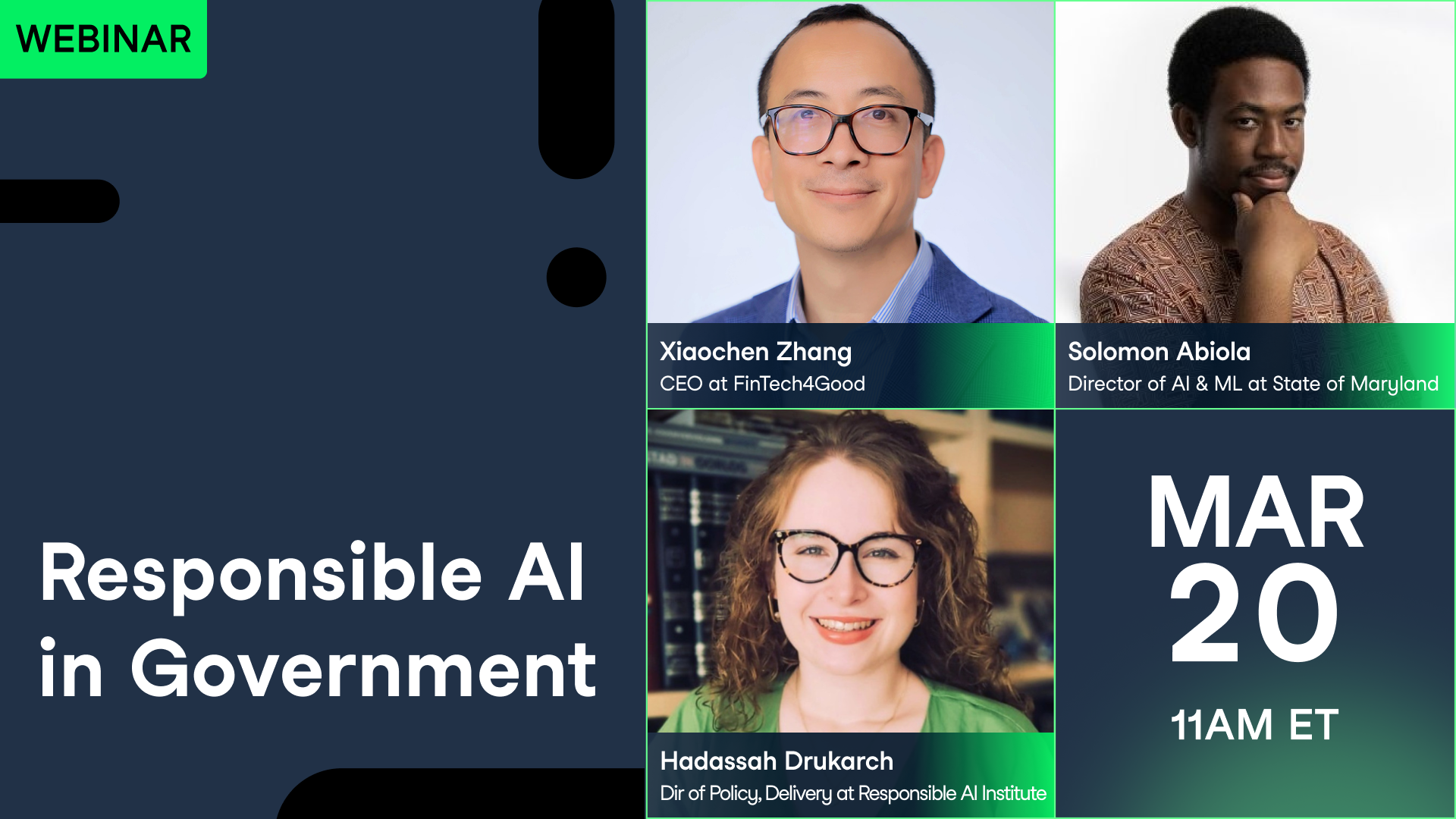
Responsible AI in Government

March 2025
Webinar Preview

Your Presenter(s)

Solomon Abiola头像

Solomon Abiola

Director of AI & ML Policy & Governance at the State of Maryland

Solomon’s career has spanned tech, academia, and consulting, with a focus on AI and policy development. At AWS, he helped release AI products to millions through initiatives like AWS Educate and the Cloud Institute—plus some cool Twitch videos if you're interested in learning more about AI. Solomon holds dual PhDs in Computer Science and Translational Biomedical Sciences. My experience also includes working in startups—one of which uses AI to track national policy. Additionally, he contributed to the development of AI-driven policies for infectious disease tracking and helped design a patent-pending wearable device during the Ebola and COVID outbreaks, in collaboration with the Nigerian government.

Xiaochen Zhang头像

Xiaochen Zhang

Former Global Head of Innovation & GTM at AWS, Chief Responsible AI Director at AI 2030, CEO at FinTech4Good

Xiaochen is a data and AI leader with 20 years of experience in financial markets and international development. As the former Global Head of Innovation & GTM at AWS, he led a team developing cutting-edge solutions in digital assets, central bank digital currency, green finance, and regulatory and supervisory technologies. As Chief Responsible AI Director at AI 2030, Xiaochen is helping raise public awareness of responsible AI issues.

Session Resources

Summary

Scaling responsible AI in government is a critical focus as various sectors explore AI's potential to improve operations, services, and citizen engagement. The conversation around responsible AI is driven by the need to maintain public trust and ensure fairness and transparency. AI adoption in government presents both opportunities and risks, requiring best practices to manage these dual aspects effectively. The discussion highlights the importance of building frameworks for responsible AI use cases, ensuring that AI systems are fair, unbiased, and transparent while also aligning with regulatory standards. The conversation further explores the nuanced differences between deploying traditional machine learning and generative AI applications, emphasizing the unique challenges each presents in terms of data management and model evaluation. As governments worldwide develop AI strategies, the role of regulations, such as the EU AI Act, becomes significant in guiding responsible AI deployment. Additionally, the need for AI literacy and workforce development is emphasized as essential to preparing government agencies and their staff for the challenges and opportunities of AI. The conversation concludes with a call to action for individuals and organizations to engage with AI technology actively, embracing its potential while remaining vigilant about its ethical and societal implications.

Key Takeaways:

  • Responsible AI in government is crucial for maintaining public trust and ensuring transparency and fairness.
  • Generative AI presents unique challenges in data management and bias that differ from traditional machine learning.
  • Regulatory frameworks, such as the EU AI Act, play a significant role in guiding responsible AI deployment in government.
  • AI literacy and workforce development are essential for preparing government agencies for AI integration.
  • Engagement with AI technology is encouraged to understand its benefits and address its challenges effectively.

Deep Dives

The Importance of Responsible AI in Government

Responsible AI in government is key as it directly impacts public trust and the efficacy of services provided to citizens. Governments hold vast amounts of sensitive data and are tasked with using AI to improve public services efficiently and ethically. "The relationship between citizens and government is crucial, and if AI solutions are not implemented responsibly, it could jeopardize public trust," remarked Xiaochen Zhang. Therefore, responsible AI practices are essential to ensure that AI systems are transparent, fair, and unbiased, thereby safeguarding citizens' rights and building trust. The discussion emphasizes that while AI offers significant opportunities for enhancing public service delivery, it is accompanied by risks that must be managed through responsible practices. This involves setting clear guidelines and frameworks for AI deployment, ensuring that all stakeholders are aware of the ethical considerations and potential biases inherent in AI systems.

Generative AI vs. Traditional Machine Learning in Government

The deployment of generative AI in government settings introduces challenges distinct from those associated with traditional machine learning. Traditional AI applications often involve controlled datasets, where data provenance and biases are more easily managed. However, generative AI, which relies on foundational models trained on vast datasets, presents new challenges in terms of data sovereignty and bias. Solomon Abiola noted, "With generative AI, you're not just using data; you're creating data." This creation aspect introduces complexities in ensuring that AI applications do not inadvertently discriminate or produce biased outcomes. Governments need to develop comprehensive frameworks for evaluating and mitigating bias in generative AI applications, emphasizing the importance of transparency and fairness in these systems.

The Role of Regulations in Responsible AI Deployment

Regulatory frameworks are vital in guiding the responsible deployment of AI in government. The EU AI Act is highlighted as a comprehensive policy framework that provides guidelines for AI use, emphasizing innovation while protecting citizens' rights. Regulations like these are essential for providing clarity and setting standards for AI deployment, ensuring that government AI systems are aligned with ethical principles and societal values. Xiaochen Zhang pointed out that regulations must balance innovation and protection, noting that overly rigid policies could stifle technological advancement. Therefore, developing flexible, yet comprehensive, regulatory frameworks is essential for encouraging responsible AI innovation within government sectors.

AI Literacy and Workforce Development in Government

As AI becomes increasingly integrated into government operations, developing AI literacy and skills among government employees is essential. The conversation emphasizes the importance of workforce development programs that equip government staff with the necessary skills to understand and manage AI technologies effectively. "AI strategy should include workforce development to ensure long-term growth and adaptability," highlighted Xiaochen Zhang. Training programs should be customized to meet the diverse needs of government employees, providing them with the tools to engage with AI technologies critically and responsibly. This approach ensures that government agencies are not only prepared to deploy AI solutions effectively but also capable of addressing the ethical and societal challenges that arise with AI integration.


有关的

webinar

What Leaders Need to Know About Implementing AI Responsibly

Richie interviews two world-renowned thought leaders on responsible AI. You'll learn about principles of responsible AI, the consequences of irresponsible AI, as well as best practices for implementing responsible AI throughout your organization.

webinar

Building Trust in AI: Scaling Responsible AI Within Your Organization

Explore actionable strategies for embedding responsible AI principles across your organization's AI initiatives.

webinar

Building Trust in AI: Scaling Responsible AI Within Your Organization

Explore actionable strategies for embedding responsible AI principles across your organization's AI initiatives.

webinar

Understanding Regulations for AI in the USA, the EU, and Around the World

In this session, two experts on AI governance explain which AI policies you need to be aware of, how governments are treating AI regulation, and how you need to deal with them.

webinar

Data Literacy for Responsible AI

The role of data literacy as the basis for scalable, trustworthy AI governance.

webinar

Empowering Government with Data & AI Literacy

Richard Davis, CDO at Ofcom, discusses how government agencies can cultivate a culture that puts data-driven decision making and the responsible use of technology at the center.