Ga naar hoofdinhoud

Vul je gegevens in om de webinar te ontgrendelen

Door verder te gaan accepteer je onze Gebruiksvoorwaarden, ons Privacybeleid en dat je gegevens worden opgeslagen in de VS.

Share this webinar

Close your data and AI skills gap

We're the only platform uniquely engineered to advance data and AI skills across your entire organization. Let's explore a tailored program.

Book an Enterprise Demo
Upskilling a small team?Get started today
Artificial Intelligence

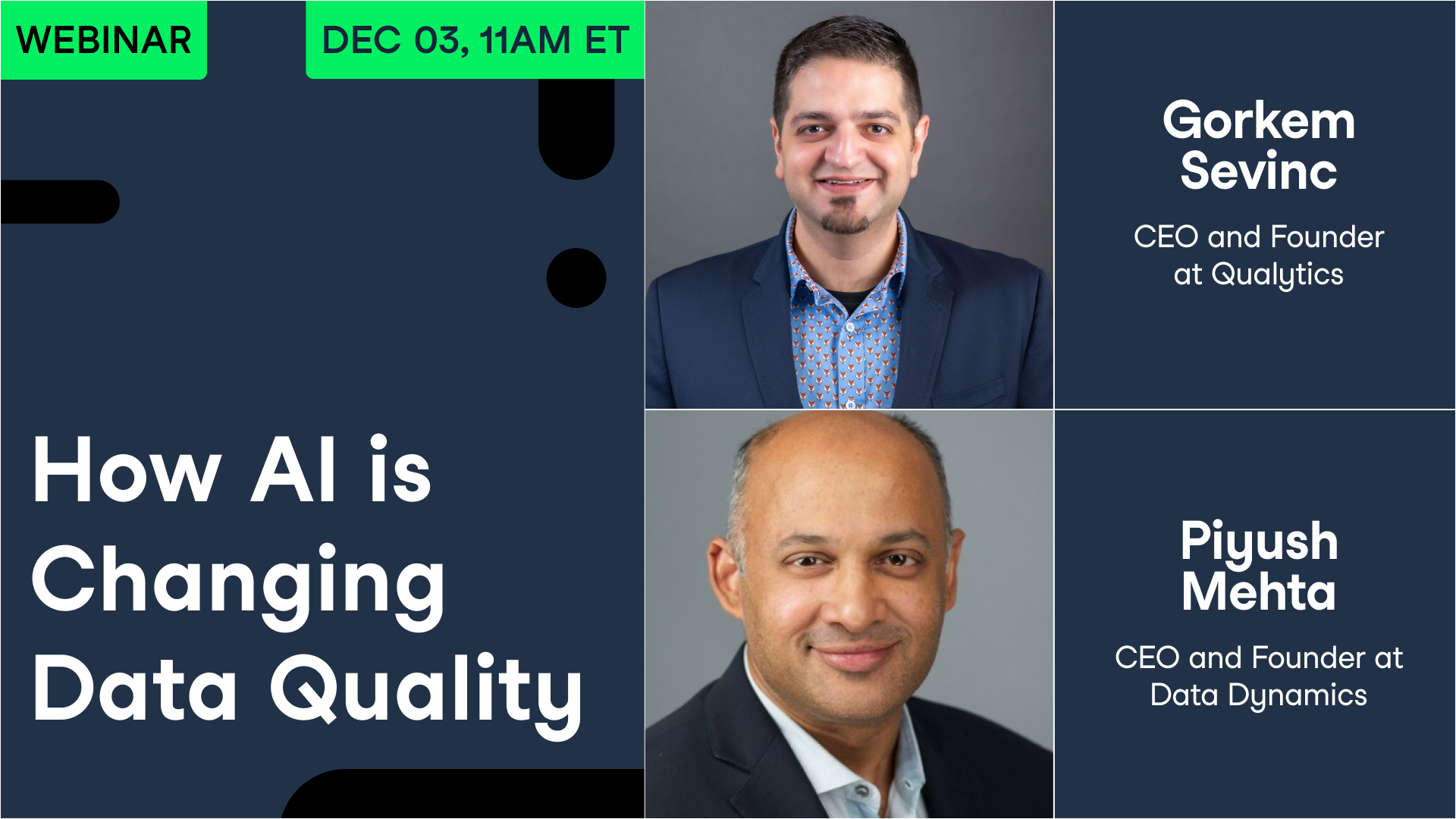
How AI is Changing Data Quality

December 2024
Webinar Preview

Your Presenter(s)

Gorkem Sevinc Headshot

Gorkem Sevinc

CEO and Founder at Qualytics

Gorkem runs the data quality platform company Qualytics. He has vast experience in building, scaling and leading teams, and architecting enterprise-level software and data infrastructures; with specific experience in artificial intelligence, machine learning, data analytics & visualization, large-Scale data operations and scalable architectures.

Previously he was Chief Architect and Co-Founder at financial services company Facet; CTO and Co-Founder at mobile health platform Scene Health; VP of Software Engineering for miDiagnostics; and Managing Director of the Johns Hopkins Medicine Technology Innovation Center.

Piyush Mehta Headshot

Piyush Mehta

CEO and Founder at Data Dynamics

Piyush, a.k.a. "The Dean of Data", runs the self-service data management software, Zubin. He has three decades of experience as a serial entrepreneur in software and technology. Always focused on addressing customer challenges with automation, his current organization supports 30% of the Fortune 100 for their data management needs. This ‘customer first’ approach has allowed him to build strong and trusted industry relationships which provide him a strong pulse of the market.

Prior to Data Dynamics, Piyush was CEO at SANpulse Technologies and CEO at Integration International.


Summary

Data quality is an essential aspect for any organization striving to make informed decisions through data-driven insights. Poor data quality can lead to unreliable analyses, undermining trust in data-driven decisions and wasting resources. The discussion explores why data quality remains a persistent issue and how leveraging modern technologies such as AI and ML can address these challenges. Key industry leaders, including Joakim Sevinc from Inge and Piyush Mehta from Data Dynamics, bring their perspectives on the evolving field of data quality, emphasizing the importance of fit-for-purpose data and the complex nature of data quality metrics. The conversation highlights the complexity of data challenges due to the diverse formats and volumes of data generated by modern applications. Furthermore, it explores the roles of different stakeholders in implementing a successful data quality program, highlighting the need for a collaborative approach across various functions within an organization. 

Key Takeaways:

  • Data quality is essential for reliable data-driven decision-making and requires continuous improvement.
  • Data quality remains challenging due to its reactive nature and the complexity of modern data ecosystems.
  • Stakeholder engagement, including data owners and business units, is essential for successful data quality initiatives.
  • AI and ML can significantly enhance data quality processes by automating rule generation and anomaly detection.
  • The role of Chief Data Officers (CDOs) is becoming more prominent, with increased budgets and influence in organizations.

Deep Dives

The Importance of Fit-for-Purpose Data

Data quality is not a one-size-fits-all concept; it varies depending on the use case. Joakim Sevinc emphasizes the need to ask whether data is fit for its intended purpose. This involves considering various metrics such as volume, timeliness, coverage, conformity, completeness, and accuracy. The approach to data quality must be adjusted throughout the data lifecycle, with different metrics prioritized at different stages. For instance, at the data landing stage, freshness and volume are critical, whereas precision and accuracy become more important at the analysis stage. The nuances of what makes data "good" can differ across organizational contexts and use cases, necessitating a flexible and evolving approach to data quality management.

Challenges in Data Quality Management

Data quality is notoriously difficult to manage due to its reactive nature and the separation between technical and business data quality. Technical data quality focuses on conformity and freshness, while business data quality involves specific business logic and requires input from subject matter experts (SMEs). The complexity of modern data environments, characterized by diverse data formats and massive volumes, exacerbates these challenges. As Piyush Mehta highlights, the sheer volume of data across multiple geographies and applications can overwhelm organizations, making it difficult to maintain data quality. The involvement of various stakeholders, including data engineers, business teams, and compliance officers, further complicates the process.

Leveraging AI for Data Quality

AI and ML hold significant potential for enhancing data quality by automating rule generation and anomaly detection. Joakim Sevinc describes how analyzing historical data shapes and patterns can inform the creation of data quality rules, allowing for proactive anomaly detection. This approach reduces the reliance on reactive measures and enables organizations to address data quality issues before they impact decision-making. AI can automate up to 93-94% of data quality rules, offering substantial efficiency gains. However, human oversight remains essential, as AI should augment rather than replace human judgment in refining and validating data quality processes.

Organizational Roles in Data Quality Initiatives

Successful data quality initiatives require a coordinated effort across multiple organizational roles. The Chief Data Officer (CDO) plays a central role in championing data quality, supported by heads of data governance and data quality. These leaders must engage business units early in the process, encouraging collaboration and ensuring that data quality efforts align with business needs. Piyush Mehta underscores the importance of breaking down silos and involving data owners in the process to drive cultural change and accountability. By integrating data quality into the broader organizational strategy, companies can create a sustainable framework for managing and improving data quality over time.


Gerelateerd

webinar

Laying the Foundations: Data Quality in the Age of AI

Join Susan Walsh and Scott Taylor as they walk us through how data leaders can make meaningful gains on their data quality initiatives, and the nuances of scaling a data quality initiative with AI in mind. 

webinar

Scaling Data Quality in the Age of Generative AI

Explore the nuances of scaling data quality for generative AI applications, including the unique challenges and considerations that come into play.

webinar

Radar Data & AI Literacy Edition: Laying the Foundations: Data Quality in the Age of AI

Join Susan Walsh and Scott Taylor as they walk us through how data leaders can make meaningful gains on their data quality initiatives, and the nuances of scaling a data quality initiative with AI in mind. 

webinar

Adding Value in Pharma Through Data & AI Transformation

In this session three pharmaceutical executives, with experience as Chief Data Officers and strategic consultants, discuss techniques to improve your digital capabilities.

webinar

Increasing Your Organization's Data & AI Maturity

John Thompson, the Head of AI at EY, and Robin Sutara, a Field Chief Data Strategy Officer at Databricks, teach you how to assess your data and AI maturity, and how to improve it.

webinar

Leading with AI: Leadership Insights on Driving Successful AI Transformation

C-level leaders from industry and government will explore how they're harnessing AI to propel their organizations forward.