Ga naar hoofdinhoud

Vul je gegevens in om de webinar te ontgrendelen

Door verder te gaan accepteer je onze Gebruiksvoorwaarden, ons Privacybeleid en dat je gegevens worden opgeslagen in de VS.

Share this webinar

Close your data and AI skills gap

We're the only platform uniquely engineered to advance data and AI skills across your entire organization. Let's explore a tailored program.

Book an Enterprise Demo
Upskilling a small team?Get started today
Generative AI

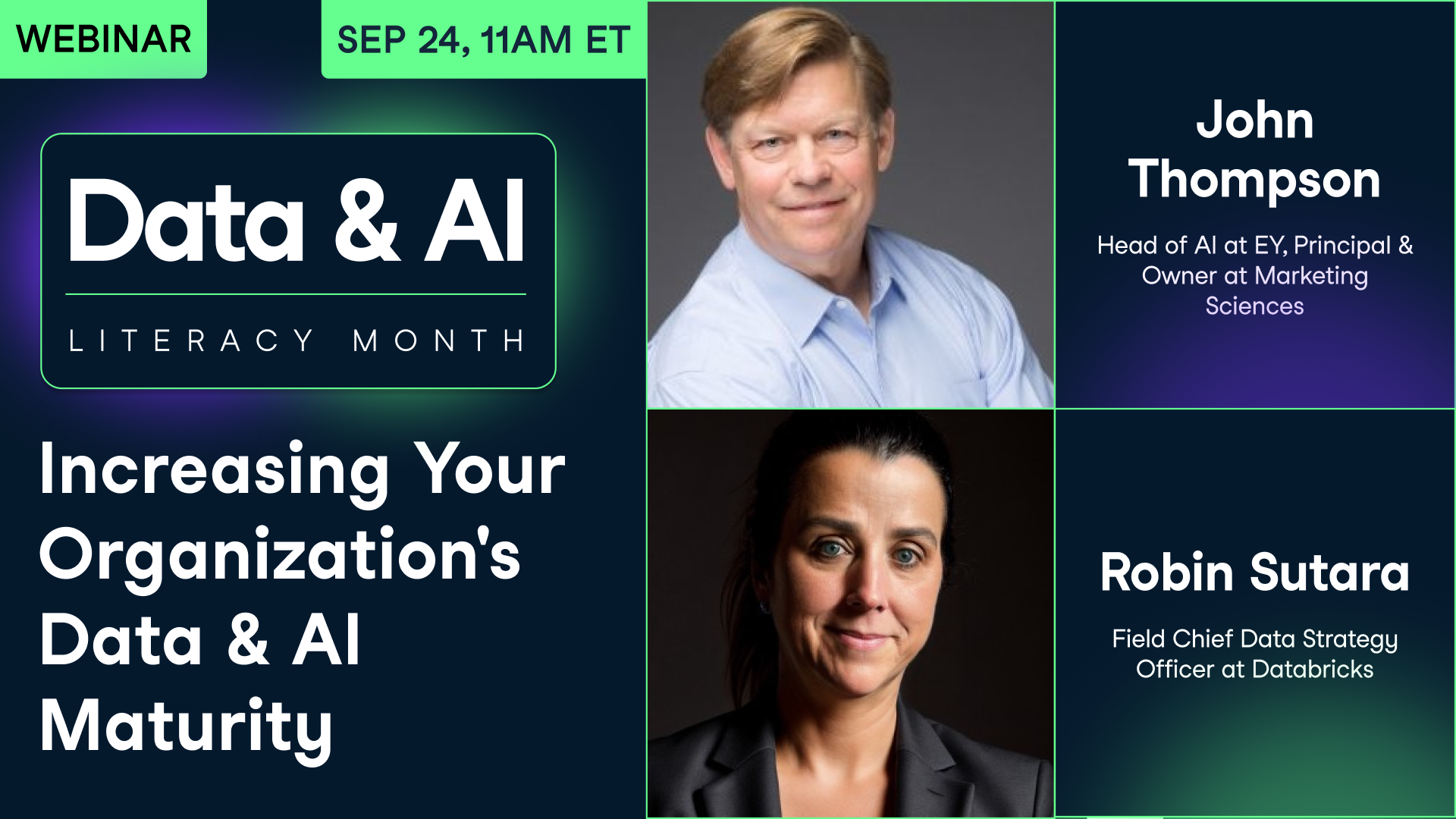
Increasing Your Organization's Data & AI Maturity

September 2024
Webinar Preview

Your Presenter(s)

Robin Sutara Headshot

Robin Sutara

Field CTO at Databricks

Robin is the Field CTO at Databricks. She has consulted with hundreds of organizations on data strategy, data culture, and building diverse data teams. Robin has had an eclectic career path in technical and business functions with more than two decades in tech companies, including Microsoft and Databricks. She also has achieved multiple academic accomplishments from her juris doctorate to a masters in law to engineering leadership. From her first technical role as an entry-level consumer support engineer to her current role in the C-Suite, Robin supports creating an inclusive workplace and is the current co-chair of Women in Data Safety Committee. She was also recognized in 2023 as a Top 20 Women in Data and Tech, as well as DataIQ 100 Most Influential People in Data.

John Thompson Headshot

John Thompson

Senior VP & Principal of GenAI Program & AI Products at The Hackett Group

John leads the design and development of an innovative AI and GenAI advisory service. Previously, he was a Global AI Leader at EY, where his team built the world's largest, secure, private LLM-based chat environment. John also runs the Marketing Sciences consultancy, advising clients on monetization strategies for data. He is the author of five books on data and AI, including "Data for All' and "Causal Artificial Intelligence". Earlier in his career, John was Global Head of AI at CSL Behring, and an Executive Partner at Gartner. John also teaches as an Adjunct Professor at University of Michigan and Lake Forest Graduate School of Management.

Summary

Data and AI maturity is an important factor for organizations aiming to utilize data effectively. Recognizing one's present data environment—including platforms, procedures, and talent—is the initial step in evaluating data maturity. It is vital to inspect variances between departments and teams for detailed insights. Data maturity not only relates to current assessment but also preparations for future enhancements. The session shared knowledge from experts like John Thompson, head of AI at EY, and Robin Sutara, field chief data strategy officer at Databricks. They accentuated the significance of organizational alignment with business goals and the requirement for top-level support in pushing data maturity initiatives. The session emphasized the need for clear objectives, such as improving operational efficiency or enhancing customer service, to direct data maturity efforts. Effective data usage also includes educating employees across varying levels and roles. Lastly, the speakers stressed the significance of gradual progress and constant communication in the path towards data maturity.

Key Takeaways:

  • Data maturity demands an exhaustive understanding of current data platforms, procedures, and talent.
  • Organizational variances should be considered for a more detailed understanding of data maturity.
  • Top-level support is important for pushing data maturity initiatives.
  • Clear business objectives are required to direct data maturity efforts.
  • Gradual progress and constant communication are essential in the data maturity path.

Deep Dives

Understanding Data Maturity

Data maturity involves evaluating an organization's present data capabilities and planning for future enhancements. As Richie pointed out, "If you want to get better at working with data, you need to know what your current data setup is like." This means understanding the data platforms in use, the procedures established, and the available talent. Robin Sutara emphasized the importance of considering variances between departments and teams to gain a detailed understanding of the organization's data maturity. She noted, "You have to do it as you would any change management across your organization." The process of evaluating data maturity should be aligned with the organization's strategic goals and adjusted to the specific needs of different business units.

The Role of Top-Level Support

Top-level support plays an important role in pushing data maturity initiatives. As John Thompson mentioned, "If you're really driving change, it needs to be in one of the senior executives in the organization." Without the backing of the C-suite, efforts to enhance data maturity may falter. It is also vital for executives to articulate clear business objectives, such as reducing operational costs or enhancing customer service. Robin Sutara added, "There has to be some level of accountability and responsibility at every part of the organization," highlighting the need for a collaborative approach.

Linking Data Maturity to Business Goals

Data maturity efforts must be aligned with the organization's business goals. Robin Sutara suggested focusing on key areas such as empowering employees, optimizing operational procedures, increasing revenue, and delivering better services. She stated, "If you're not thinking about the people in process, it'll never execute." This means that technology alone cannot drive data maturity; there must be a combined effort to align data initiatives with strategic business objectives. By doing so, organizations can ensure that data maturity efforts are not only effective but also sustainable.

The Importance of Training and Communication

Educating employees across varying levels and roles is a vital aspect of improving data maturity. John Thompson shared his experience at EY, where a structured training program was implemented to raise data literacy across the organization. He noted, "Organized by persona, bring it down to a point where it's manageable." Constant communication is also vital, as Robin Sutara pointed out, "Over-communicate, communicate, communicate." By ensuring that all employees are engaged and informed, organizations can promote a culture of data-driven decision-making and facilitate the path towards data maturity.


Gerelateerd

white paper

Your Organization's Guide to Data Maturity

Learn how evaluate and scale data maturity throughout your organization

white paper

Your Organization's Guide to Data Maturity

Learn how evaluate and scale data maturity throughout your organization

webinar

Building Your Organization’s Data & AI Maturity

Adel Nehme, VP of Media at DataCamp, details the path to become a data & AI mature organization.

webinar

Spreading Data & AI Literacy Across Your Organization

Learn how to devise a data and AI strategy that aligns with your business strategy, and how to combine technology and training to increase the data and AI literacy across your company for business success.

webinar

Spreading Data & AI Literacy Across Your Organization

Learn how to devise a data and AI strategy that aligns with your business strategy, and how to combine technology and training to increase the data and AI literacy across your company for business success.

webinar

How AI Can Improve Your Data Strategy

Find out how AI, ML, and data science can inform your data strategy.