Ga naar hoofdinhoud

Vul je gegevens in om de webinar te ontgrendelen

Door verder te gaan accepteer je onze Gebruiksvoorwaarden, ons Privacybeleid en dat je gegevens worden opgeslagen in de VS.

Share this webinar

Close your data and AI skills gap

We're the only platform uniquely engineered to advance data and AI skills across your entire organization. Let's explore a tailored program.

Book an Enterprise Demo
Upskilling a small team?Get started today
Artificial Intelligence

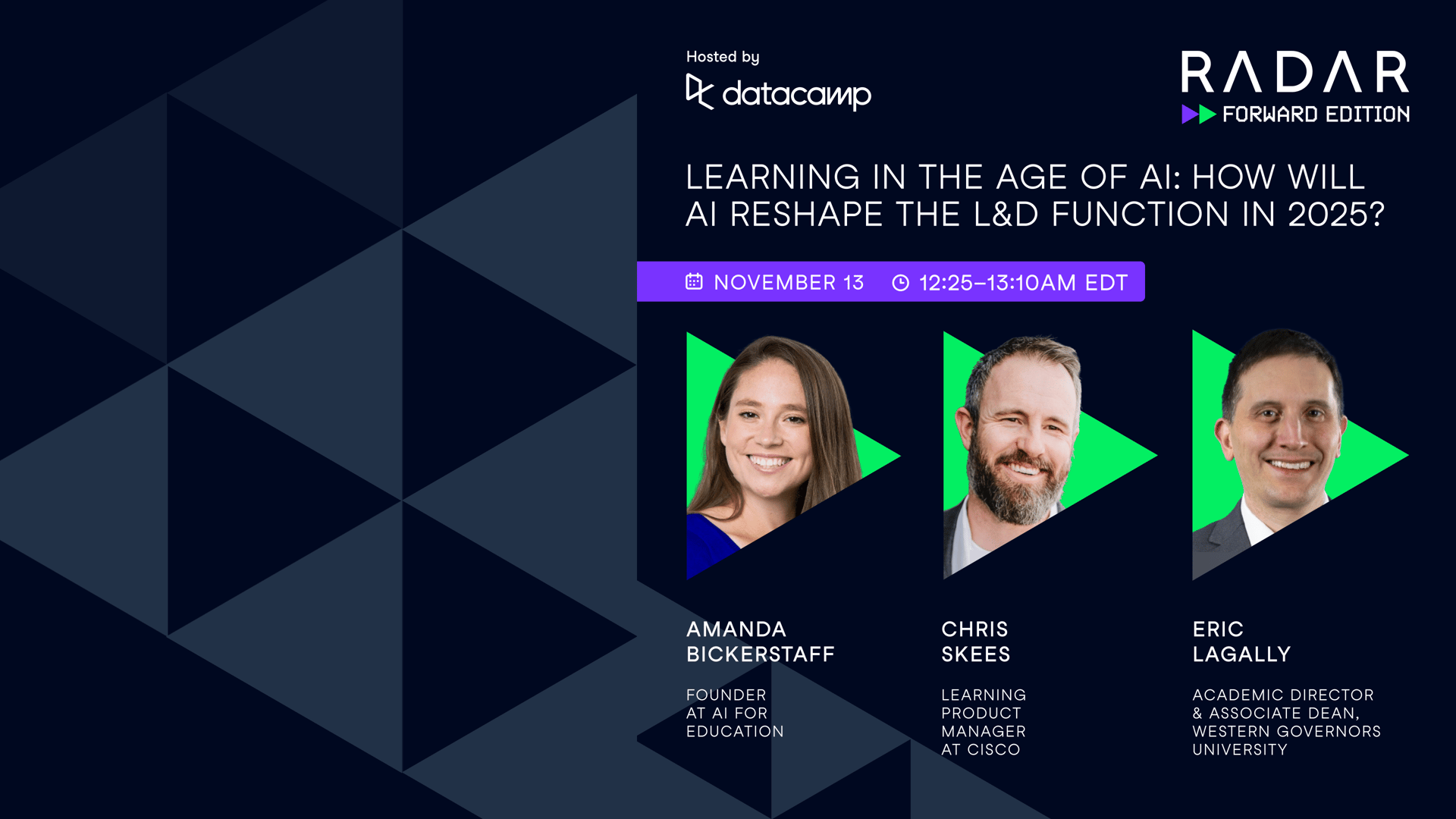
Learning in the Age of AI: How Will AI Reshape the L&D Function in 2025?

November 2024
Webinar Preview

Your Presenter(s)

Amanda Bickerstaff Headshot

Amanda Bickerstaff

Founder at AI for Education

Amanda is a high school biology teacher turned EdTech executive with over 20 years of experience in the education sector. She is a frequent consultant, speaker, and writer on the topic of AI in education, leading workshops and professional learning across both K12 and Higher Ed. Amanda is committed to helping schools and teachers maximize their potential through the ethical and equitable adoption of AI. Previously, Amanda was CEO at Pinot Professional Learning, and a Senior Advisor at Paragon One.

Chris Skees Headshot

Chris Skees

Learning Product Manager at Cisco

Chris has 20 years experience in L&D in tech. He manages the enablement content motion for Cisco Meraki, helping customers understand how Cisco is infusing AI throughout its products. Chris has led learning and enablement projects, teams and programs, and is an expert in assessment and certifications. Previously, he was a team lead for Learning Experience and Localization at GP Strategies.

Eric Lagally Headshot

Eric Lagally

Academic Director and Associate Dean at Western Governors University

Eric oversees the design and delivery of data analytics programs that prepare thousands of students for careers in the fast-growing fields of data science, machine learning, data mining, and database administration. He has transformed the bachelors and masters degree programs in data analytics while running a department of 120 faculty members. Previously he was Administrative Director for WGU's College of Information Technology, running the IT faculty, and an Assistant professor at University of British Columbia.

Summary

The dialogue focused on the integration of AI in Learning and Development (L&D), emphasizing the creation of personalized, scalable, and engaging educational experiences. Participants, including Richie, Amanda Bickerstaff, Eric Legalli, and Chris Skies, discussed the changing face of L&D, highlighting the importance of AI in customizing education and closing skill gaps. They also examined the difficulty of increasing learner engagement and expanding educational programs within organizations. The discussion emphasized the importance of AI literacy, stressing the necessity for training in ethical, safe, and effective use of AI. Furthermore, the panel investigated the potential of generative AI to democratize learning and access to technology, and how change management is essential in expanding learning initiatives.

Key Takeaways:

  • AI is vital in personalizing learning experiences to close skill gaps.
  • Engagement in L&D can be improved through personalized, real-time interventions.
  • Expanding learning programs requires strategic change management and stakeholder support.
  • AI literacy is becoming an essential skill across all organizational levels.
  • The integration of generative AI can democratize access to education and technology.

Deep Dives

Personalized Learning with AI

Personalization in learning is gaining traction, with AI leading this shift. Amanda Bickerstaff highlighted the potential of AI to customize educational content to individual learners' needs, improving both engagement and effectiveness. The modular approach to learning, as discussed by Chris Skies, allows for breaking down complex topics into manageable segments, making it easier to create personalized learning paths. Eric Legalli explained that AI can offer real-time feedback and interventions, which are essential for maintaining student engagement and preventing dropouts. This approach not only personalizes the learning experience but also ensures that learners are consistently supported throughout their education.

Engagement and Retention in Online Learning

Engagement remains a significant challenge in L&D, with learners often distracted by work and personal commitments. Chris Skies highlighted that meeting learners where they are is important, suggesting the integration of learning opportunities directly into the workflow. This method ensures that learning is relevant and timely, improving engagement. Eric Legalli added that predictive analytics and decision intelligence could be used to anticipate when learners might disengage, allowing for proactive interventions. Amanda Bickerstaff reinforced the idea that learning tied to real-world applications or immediate work tasks tends to increase learner commitment and focus.

Expanding educational programs requires strategic planning and effective change management. Eric Legalli noted that successful expansion often depends on executive sponsorship and a clear understanding of the organizational goals. Chris Skies suggested a product management approach, involving piloting programs on a small scale to test hypotheses before wider implementation. This iterative process allows for adjustments based on feedback and ensures that the program is effective and scalable. Change management models can offer frameworks for ensuring that all stakeholders are aligned and supportive of the expansion efforts.

AI Literacy in Education

AI literacy is emerging as an essential skill across various sectors. Amanda Bickerstaff stressed the importance of training individuals to use AI safely, ethically, and effectively. This training is not only necessary for productivity but also for ensuring that AI is used responsibly. The panelists agreed that organizations should prioritize AI literacy programs to prepare their workforce for the growing integration of AI in various roles. The development of AI competencies, including critical thinking and problem-solving, is essential for leveraging AI's full potential while mitigating risks associated with its misuse.


Gerelateerd

white paper

The Learning Leader's Guide to AI Literacy

Find out how learning leaders should be approaching AI literacy within their organization, focusing on the what, why, and how of fostering organization-wide AI literacy.

white paper

The Learning Leader's Guide to AI Literacy

Find out how learning leaders should be approaching AI literacy within their organization, focusing on the what, why, and how of fostering organization-wide AI literacy.

webinar

Data Science and Business Intelligence in 2025: How will AI Transform the Data Team?

Three guests explore the impact of LLMs and GenAI on analytics and data functions in 2025, how they will lower the barrier to entry for working with data, the skills data teams need to develop, and a lot more.

webinar

The State of Data & AI Literacy in 2024

Join this webinar to learn how and which data & AI skills are becoming increasingly pervasive in organizations across industries, how leaders are adapting their teams and workforce to the era of data & AI literacy and more.

webinar

Driving AI Literacy in Organizations

Gain insight into the growing importance of AI literacy and its role in driving success for modern organizations.

webinar

How L&D Leaders are Shaping Data Literate Workforces

Successful data literacy upskilling programs from a variety of industries